Thailand Flushing System Market Size, Share & Growth Rate
The Thailand Flushing System Market was estimated at USD 135 Million in 2025 and is projected to reach USD 155 Million by 2032, growing at a CAGR of 2.0% from 2026 to 2032. This growth trajectory is driven by a burgeoning demand for water-efficient flushing solutions, as consumers increasingly prioritize hygiene and environmental sustainability. Additionally, significant investments in infrastructure development, coupled with government-led initiatives aimed at promoting sanitation, are expected to further bolster market expansion.
Thailand Flushing System Market Year-wise Growth Rate and Key Drivers
This graph highlights how the Thailand Flushing System Market has steadily grown over the years, supported by major growth factors.
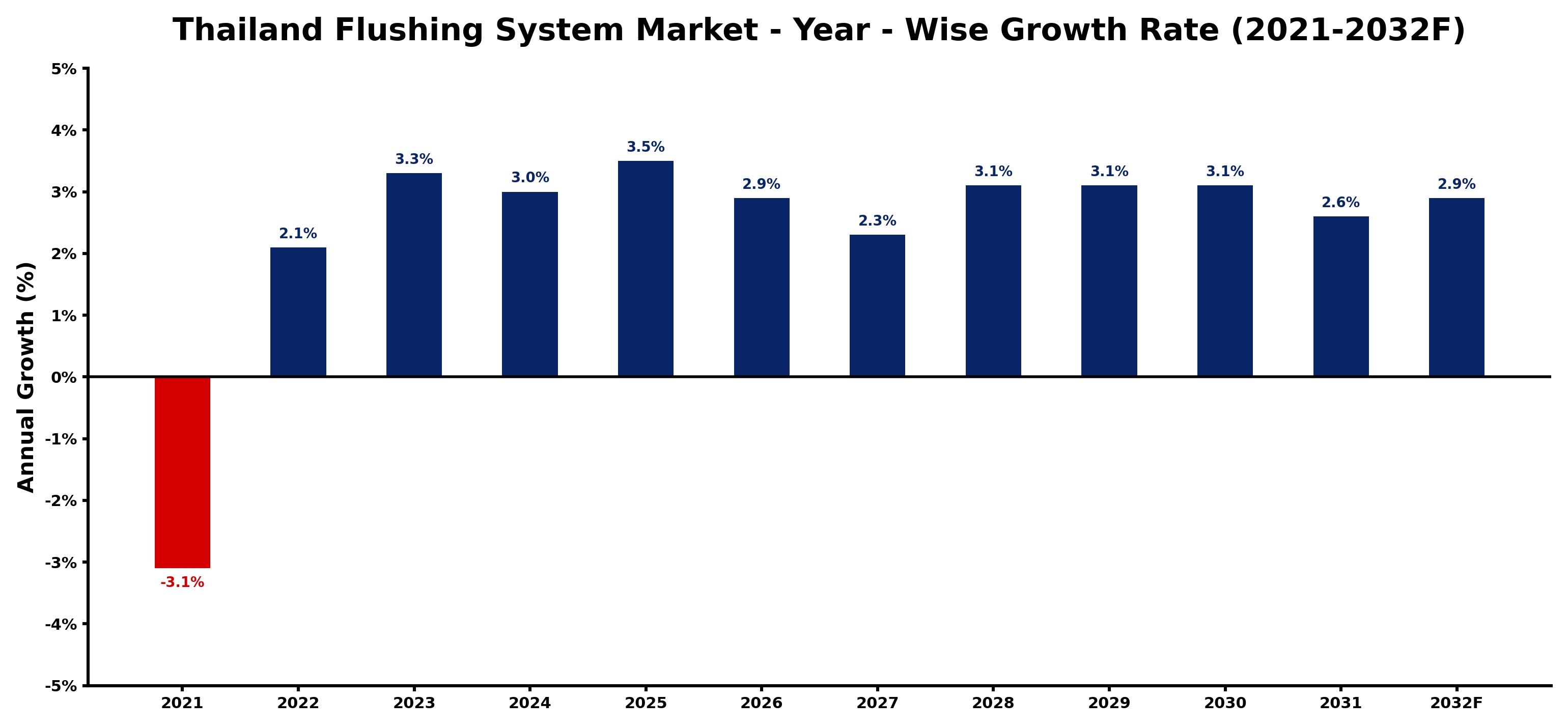
The table below presents the year‑wise growth rates along with the key drivers influencing the market
| Year | Growth Rate | Major Drivers |
| 2021 | -3.1% | Expansion of commercial construction activities |
| 2022 | 2.1% | Expansion of transportation and logistics networks |
| 2023 | 3.3% | Increasing adoption of advanced technologies |
| 2024 | 3.0% | Rapid growth in telecom and data center sectors |
| 2025 | 3.5% | Increasing industrial automation investments |
| 2026 | 2.9% | Increasing industrial automation investments |
| 2027 | 2.3% | Expansion of transportation and logistics networks |
| 2028 | 3.1% | Increasing adoption of advanced technologies |
| 2029 | 3.1% | Increasing industrial infrastructure investments |
| 2030 | 3.1% | Expansion of manufacturing activities |
| 2031 | 2.6% | Growing renewable energy integration projects |
| 2032 | 2.9% | Government infrastructure modernization initiatives |
Note - Market size estimations and growth projections presented in this report are based on 6Wresearch’s advanced forecasting approach, validated with industry datasets as of June 2026.
Thailand Flushing System Market Synopsis
In recent years, Thailand's flushing system market has gained considerable momentum, propelled by rising urbanization and heightened awareness of water conservation. Consumers are now leaning towards advanced flushing technologies that not only enhance sanitation but also prioritize water efficiency.
However, while this market exhibits positive growth, it is entering a phase where sustainability demands are intensifying. As a result, manufacturers are challenged to innovate continuously, ensuring that their products meet emerging environmental standards while delivering reliable performance.
Thailand Flushing System Market Key Takeaways
- The market is positioned for steady growth driven by urbanization and infrastructure investments.
- Water-saving technologies are increasingly favored by consumers, reflecting growing environmental concerns.
- Government initiatives aimed at enhancing public sanitation play a crucial role in market dynamics.
- Established brands are investing in R&D to innovate and enhance product efficiency.
- The recovery from pandemic-induced disruptions is gradual, impacting the supply chain dynamics.
Evaluation of Restraints in Thailand Flushing System Market
Despite promising growth, the Thailand flushing system market is not without its challenges. One significant restraint is the heightened focus on water conservation, which necessitates the development of flushing systems that consume less water while maintaining effectiveness. Manufacturers face a dual pressure to innovate while adhering to stringent environmental standards, balancing consumer expectations for high performance with sustainability goals. Additionally, fluctuations in raw material costs can impact pricing strategies, creating uncertainty in the competitive landscape.
Thailand Flushing System Market Trends
Several trends are currently shaping the Thailand flushing system market. Firstly, the integration of smart technologies in flushing systems is becoming more prevalent, enhancing user experience and promoting efficiency. Furthermore, the increasing adoption of eco-friendly materials in manufacturing reflects a broader commitment to sustainability. Lastly, public awareness campaigns regarding hygiene are influencing consumer preferences, making advanced flushing solutions not just a choice but a necessity for many households.
Thailand Flushing System Market Opportunities
The market presents numerous growth and investment opportunities, particularly in the realm of research and development for new flushing technologies. Innovations focusing on dual-flush systems and self-cleaning features are poised to attract environmentally conscious consumers. Additionally, expanding urban areas and the rise in public infrastructure projects create an ideal landscape for manufacturers to introduce more efficient and sustainable products, thereby capturing a larger market share.
Government Initiatives in the Thailand Flushing System Market
The Thai government has been proactive in promoting sanitation and cleanliness through various initiatives, such as campaigns encouraging the adoption of water-efficient technologies in both residential and commercial settings. Public spending on infrastructure is also being funneled towards improving sanitation facilities, which in turn propels the demand for modern flushing systems. Furthermore, incentives for eco-friendly products are likely to stimulate market growth while supporting broader sustainability goals.
Future Insights of the Thailand Flushing System Market
Looking ahead to 2026-2032, the Thailand flushing system market is set to undergo significant transformation as both technology and consumer expectations evolve. The increasing focus on sustainability will drive manufacturers to innovate continuously, leading to the emergence of even more efficient flushing systems. As urban development continues, the integration of smart, automated solutions will likely redefine standards in hygiene and sanitation, positioning the market for robust growth in the coming years.
Thailand Flushing System Market Latest Developments (May 2025 - June 2026)
In the recent months, the Thailand flushing system market has witnessed a surge in the introduction of water-efficient products designed to meet evolving consumer needs. Companies are increasingly focusing on enhancing user experience through smart technology integrations, ensuring ease of use while adhering to sustainability benchmarks. Moreover, construction activity has resumed post-COVID-19 disruptions, providing a favorable environment for new projects that require advanced flushing solutions.
Thailand Flushing System Market - Key Attractiveness of the Report
- 10 Years of Market Numbers
- Historical Data Starting from 2022 to 2025
- Base Year: 2025
- Forecast Data until 2032
- Key Performance Indicators Impacting the Market
- Major Upcoming Developments and Projects
Key Highlights of the Report:
- Thailand Flushing System Market Outlook
- Market Size of Thailand Flushing System Market, 2025
- Forecast of Thailand Flushing System Market, 2032
- Historical Data and Forecast of Thailand Flushing System Revenues & Volume for the Period 2022-2032F
- Thailand Flushing System Market Trend Evolution
- Thailand Flushing System Market Drivers and Challenges
- Thailand Flushing System Price Trends
- Thailand Flushing System Porter's Five Forces
- Thailand Flushing System Industry Life Cycle
- Historical Data and Forecast of Thailand Flushing System Market Revenues & Volume By Type for the Period 2022-2032F
- Historical Data and Forecast of Thailand Flushing System Market Revenues & Volume By Gravity Flush for the Period 2022-2032F
- Historical Data and Forecast of Thailand Flushing System Market Revenues & Volume By Dual Flush for the Period 2022-2032F
- Historical Data and Forecast of Thailand Flushing System Market Revenues & Volume By Pressure-assisted Flush for the Period 2022-2032F
- Historical Data and Forecast of Thailand Flushing System Market Revenues & Volume By Tornado Flush for the Period 2022-2032F
- Historical Data and Forecast of Thailand Flushing System Market Revenues & Volume By Others for the Period 2022-2032F
- Historical Data and Forecast of Thailand Flushing System Market Revenues & Volume By Technology for the Period 2022-2032F
- Historical Data and Forecast of Thailand Flushing System Market Revenues & Volume By Manual for the Period 2022-2032F
- Historical Data and Forecast of Thailand Flushing System Market Revenues & Volume By Sensors for the Period 2022-2032F
- Historical Data and Forecast of Thailand Flushing System Market Revenues & Volume By Remote Control for the Period 2022-2032F
- Historical Data and Forecast of Thailand Flushing System Market Revenues & Volume By Waterless Flushing for the Period 2022-2032F
- Historical Data and Forecast of Thailand Flushing System Market Revenues & Volume By Installation Type for the Period 2022-2032F
- Historical Data and Forecast of Thailand Flushing System Market Revenues & Volume By Surface Flush for the Period 2022-2032F
- Historical Data and Forecast of Thailand Flushing System Market Revenues & Volume By Rear Wall Mounting for the Period 2022-2032F
- Historical Data and Forecast of Thailand Flushing System Market Revenues & Volume By Others for the Period 2022-2032F
- Historical Data and Forecast of Thailand Flushing System Market Revenues & Volume By End User for the Period 2022-2032F
- Historical Data and Forecast of Thailand Flushing System Market Revenues & Volume By Residential for the Period 2022-2032F
- Historical Data and Forecast of Thailand Flushing System Market Revenues & Volume By Commercial for the Period 2022-2032F
- Thailand Flushing System Import Export Trade Statistics
- Market Opportunity Assessment By Type
- Market Opportunity Assessment By Technology
- Market Opportunity Assessment By Installation Type
- Market Opportunity Assessment By End User
- Thailand Flushing System Top Companies Market Share
- Thailand Flushing System Competitive Benchmarking By Technical and Operational Parameters
- Thailand Flushing System Company Profiles
- Thailand Flushing System Key Strategic Recommendations






































