Thailand Food & Beverages Processing Equipment Market Summary
The thailand food & beverages processing equipment market was estimated at USD 249 Million in 2025 and is projected to reach USD 325 Million by 2032, growing at a CAGR of 4.7% from 2026 to 2032.
Thailand Food & Beverages Processing Equipment Market Year-wise Growth Rate and Key Drivers
This graph highlights how the Thailand Food & Beverages Processing Equipment Market has steadily grown over the past five years, supported by major growth factors.
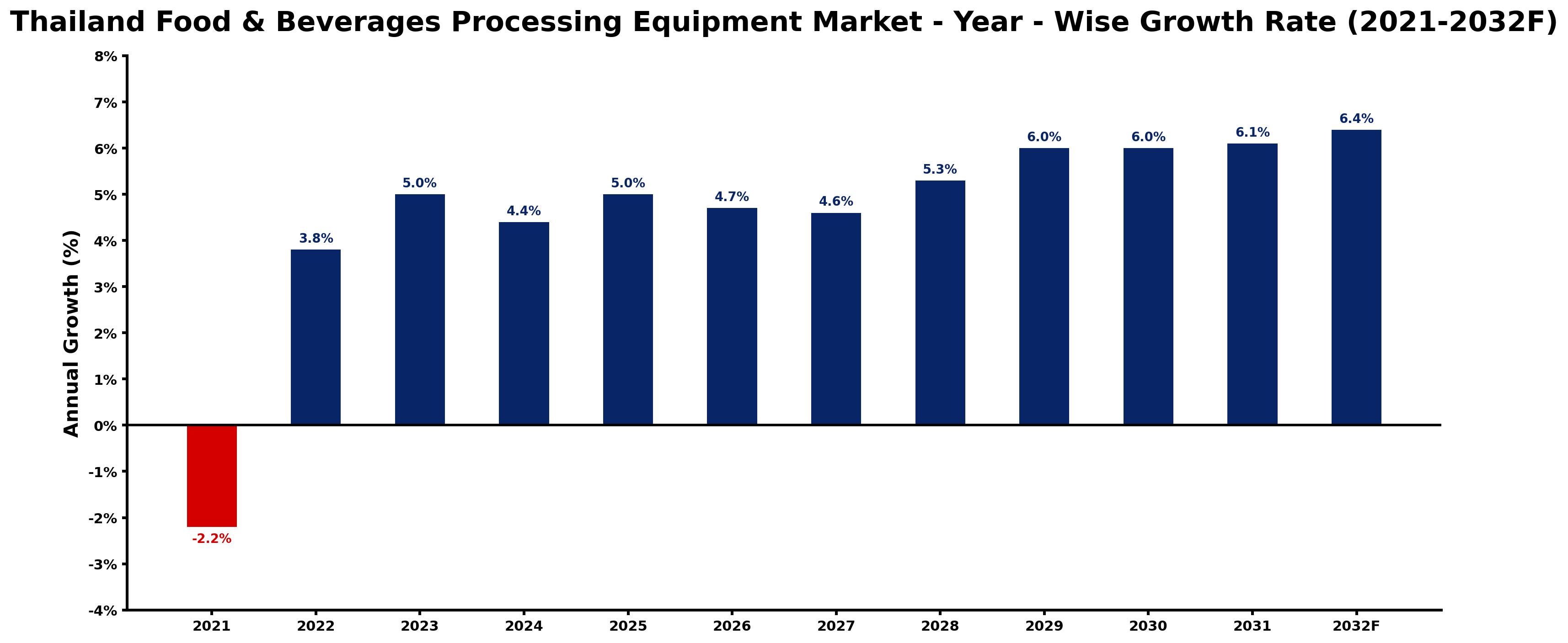
The table below presents the year wise growth rates along with the key drivers influencing the market
| Year | Growth Rate | Major Drivers |
| 2021 | -2.2% | Unprecedented supply chain disruptions due to pandemic restrictions hindered production capacity across processing equipment manufacturers. |
| 2022 | 3.8% | Emerging consumer preferences shifted towards health-oriented and organic food products. |
| 2023 | 5.0% | Technological innovations improved efficiency in food and beverage production lines. |
| 2024 | 4.4% | Sustainability trends pushed manufacturers to adopt eco-friendly processing technologies. |
| 2025 | 5.0% | Investment in cold chain logistics enhanced food preservation and distribution capabilities. |
| 2026 | 4.7% | Local food sourcing initiatives increased demand for small-scale processing machinery. |
| 2027 | 4.6% | Export opportunities for Thai food products expanded, driving equipment modernization. |
| 2028 | 5.3% | Rural electrification efforts led to improved processing facilities in agrarian regions. |
| 2029 | 6.0% | Digital transformation enabled real-time monitoring, optimizing production processes effectively. |
| 2030 | 6.0% | Collaboration between tech firms and food processors drove innovative equipment solutions. |
| 2031 | 6.1% | Consumer trends indicated a shift towards plant-based food options, altering processing demands. |
| 2032 | 6.4% | E-commerce growth necessitated advanced packaging solutions for the food sector. |
Note - Market size estimations and growth projections presented in this report are based on 6Wresearch's advanced forecasting approach, validated with industry datasets as of June 2026.
Thailand Food & Beverages Processing Equipment Market Synopsis
The Thailand Food Beverages Processing Equipment Market is projected to reach 4.7% and witness significant growth during the forecast period (2026-2032). Thailand stands as a prominent player in the Asia-Pacific region, distinguished for its robust production, consumption, and exportation of food and beverage processing technology. The modern infrastructure within the country promotes efficient production mechanisms, making it an appealing destination for global investors. As the food and beverage processing sector evolves, companies are aggressively competing for market share, driving innovative advancements and intensifying investments in research and development (R&D).
Thailand Food & Beverages Processing Equipment Market Drivers
Several factors contribute to the anticipated growth of the Thailand food & beverages processing equipment market. The increasing urbanization is a primary driver, as it leads to escalating demand for processed food products. With rising disposable incomes, consumers are shifting towards convenience-oriented and ready-to-eat food options, prompting producers to refine their production capabilities. Additionally, technological advancements in automation systems are streamlining processes, reducing costs, and enhancing productivity.
- Investment in R&D by government entities has emerged as a pivotal contributor, fostering the development of advanced machinery that meets modern processing requirements.
- The trend towards convenience foods has surged, leading to a rise in automated production lines capable of mass-producing while efficiently managing costs through economies of scale.
- Technological innovations, such as high-speed cutting and portioning machines, are essential for manufacturers looking to maintain competitive advantages in the marketplace.
- The robust infrastructure supporting logistics and supply chain management within Thailand bolsters the business environment for food and beverage processing enterprises.
- Growing consumer awareness regarding food safety and quality standards is increasing the demand for sophisticated equipment capable of ensuring compliance with stringent regulations.
Thailand Food & Beverages Processing Equipment Market Challenges and Restraints
While the outlook for the Thailand food & beverages processing equipment market is largely positive, several obstacles could hinder growth. Rising raw material costs, influenced by adverse weather conditions, have the potential to disrupt production processes and diminish profit margins. Labor shortages due to an aging population are also a significant barrier, complicating the recruitment of skilled labor necessary for advanced processing operations.
- Foreign competition is intensifying, particularly from China, where low-cost yet high-quality products challenge the pricing strategies of domestic manufacturers.
- Stringent regulations related to safety and environmental standards necessitate ongoing investments in compliance, potentially straining smaller businesses.
- The high capital intensity required for entry into this sector poses a challenge for new entrants, particularly startups with limited financial resources.
- Economic fluctuations and uncertainties can adversely affect consumer spending power, which may lead to volatility in demand for processed food products.
- The reconceptualization of business strategies may be required as rising raw material prices lead manufacturers to reassess their pricing mechanisms.
Thailand Food & Beverages Processing Equipment Market Government Investment and Initiatives
The government of Thailand plays a significant role in shaping the food & beverages processing equipment market through supportive investments and initiatives. Recognizing the industry's potential for economic growth and job creation, the government has made substantial efforts to bolster R&D activities. These initiatives often involve public-private partnerships aimed at enhancing technological capabilities within the sector.
- Various government programs are designed to promote innovations in processing technology, thereby elevating the overall competitiveness of domestic manufacturers on the global stage.
- Investments in infrastructure, such as transportation and logistics, contribute to supply chain efficiency, making the market more attractive for both local and international investors.
- Additionally, the government encourages foreign investment through favorable policies and incentives that aim to attract global players in food processing.
- Development programs focusing on sustainable practices are also being introduced to promote environmentally friendly manufacturing processes within the industry.
- Regulatory frameworks are continually evolving to support the integration of modern technology and enhance compliance with international safety standards.
Thailand Food & Beverages Processing Equipment Market Latest Developments (May 2025 - June 2026)
Between May 2025 and June 2026, the Thailand food & beverages processing equipment market has experienced a series of dynamic developments driving its evolution. Industry players have increasingly turned towards automation solutions to enhance production efficiency and meet the growing consumer demand for convenience foods. Companies are launching new machinery designed to optimize processing techniques while minimizing waste, reflecting a broader commitment to sustainability.
- Investment in robotic technology has surged, facilitating precision in production and reducing labor dependency, which is critical due to ongoing labor market challenges.
- Collaboration between enterprises and technology providers has intensified, fostering innovation in the design of processing equipment tailored to both traditional and modern food products.
- There has been a notable shift towards digitalization in operations, with digital solutions enhancing the monitoring and control of production processes.
- Ongoing market research and consumer feedback mechanisms are increasingly guiding product development, ensuring that innovations align with market needs.
- The focus on improving food safety protocols through advanced processing tools has become paramount, particularly in response to heightened consumer awareness regarding health and quality.
Thailand Food & Beverages Processing Equipment Market - Key Attractiveness of the Report
- 10 Years of Market Numbers
- Historical Data Starting from 2022 to 2025
- Base Year: 2025
- Forecast Data until 2032
- Key Performance Indicators Impacting the Market
- Major Upcoming Developments and Projects
Key Highlights of the Report:
- Thailand Food & Beverages Processing Equipment Market Outlook
- Market Size of Thailand Food & Beverages Processing Equipment Market, 2025
- Forecast of Thailand Food & Beverages Processing Equipment Market, 2032
- Historical Data and Forecast of Thailand Food & Beverages Processing Equipment Revenues & Volume for the Period 2022-2032F
- Thailand Food & Beverages Processing Equipment Market Trend Evolution
- Thailand Food & Beverages Processing Equipment Market Drivers and Challenges
- Thailand Food & Beverages Processing Equipment Price Trends
- Thailand Food & Beverages Processing Equipment Porter's Five Forces
- Thailand Food & Beverages Processing Equipment Industry Life Cycle
- Historical Data and Forecast of Thailand Food & Beverages Processing Equipment Market Revenues & Volume By Types for the Period 2022-2032F
- Historical Data and Forecast of Thailand Food & Beverages Processing Equipment Market Revenues & Volume By Pre-processing Equipment for the Period 2022-2032F
- Historical Data and Forecast of Thailand Food & Beverages Processing Equipment Market Revenues & Volume By Sorting & Grading for the Period 2022-2032F
- Historical Data and Forecast of Thailand Food & Beverages Processing Equipment Market Revenues & Volume By Processing Equipment for the Period 2022-2032F
- Historical Data and Forecast of Thailand Food & Beverages Processing Equipment Market Revenues & Volume By Mode of Operations for the Period 2022-2032F
- Historical Data and Forecast of Thailand Food & Beverages Processing Equipment Market Revenues & Volume By Automatic for the Period 2022-2032F
- Historical Data and Forecast of Thailand Food & Beverages Processing Equipment Market Revenues & Volume By Semi-Automatic for the Period 2022-2032F
- Historical Data and Forecast of Thailand Food & Beverages Processing Equipment Market Revenues & Volume By Forms for the Period 2022-2032F
- Historical Data and Forecast of Thailand Food & Beverages Processing Equipment Market Revenues & Volume By Liquid for the Period 2022-2032F
- Historical Data and Forecast of Thailand Food & Beverages Processing Equipment Market Revenues & Volume By Solid for the Period 2022-2032F
- Historical Data and Forecast of Thailand Food & Beverages Processing Equipment Market Revenues & Volume By Semi-Solid for the Period 2022-2032F
- Historical Data and Forecast of Thailand Food & Beverages Processing Equipment Market Revenues & Volume By Applications for the Period 2022-2032F
- Historical Data and Forecast of Thailand Food & Beverages Processing Equipment Market Revenues & Volume By Bakery & Confectionery Products for the Period 2022-2032F
- Historical Data and Forecast of Thailand Food & Beverages Processing Equipment Market Revenues & Volume By Meat & Poultry Products for the Period 2022-2032F
- Historical Data and Forecast of Thailand Food & Beverages Processing Equipment Market Revenues & Volume By Fish & Sea food for the Period 2022-2032F
- Historical Data and Forecast of Thailand Food & Beverages Processing Equipment Market Revenues & Volume By Dairy Products for the Period 2022-2032F
- Historical Data and Forecast of Thailand Food & Beverages Processing Equipment Market Revenues & Volume By Alcoholic Beverages for the Period 2022-2032F
- Historical Data and Forecast of Thailand Food & Beverages Processing Equipment Market Revenues & Volume By Non-Alcoholic Beverages for the Period 2022-2032F
- Historical Data and Forecast of Thailand Food & Beverages Processing Equipment Market Revenues & Volume By Others for the Period 2022-2032F
- Thailand Food & Beverages Processing Equipment Import Export Trade Statistics
- Market Opportunity Assessment By Types
- Market Opportunity Assessment By Mode of Operations
- Market Opportunity Assessment By Forms
- Market Opportunity Assessment By Applications
- Thailand Food & Beverages Processing Equipment Top Companies Market Share
- Thailand Food & Beverages Processing Equipment Competitive Benchmarking By Technical and Operational Parameters
- Thailand Food & Beverages Processing Equipment Company Profiles
- Thailand Food & Beverages Processing Equipment Key Strategic Recommendations






































