Thailand Food & Grocery Retail Market Size, Share & Growth Rate
The Thailand Food & Grocery Retail Market was estimated at USD 434 Million in 2025 and is projected to reach USD 577 Million by 2032, growing at a CAGR of 4.2% from 2026 to 2032. This growth is fueled by rising urbanization and changing lifestyles, leading to an increased demand for convenience foods and ready-to-eat meals. The shift towards online shopping, especially after the pandemic, further contributes to the market's upward trajectory as consumers embrace e-commerce platforms for their grocery needs.
Thailand Food & Grocery Retail Market Year-wise Growth Rate and Key Drivers
This graph highlights how the Thailand Food & Grocery Retail Market has steadily grown over the years, supported by major growth factors.
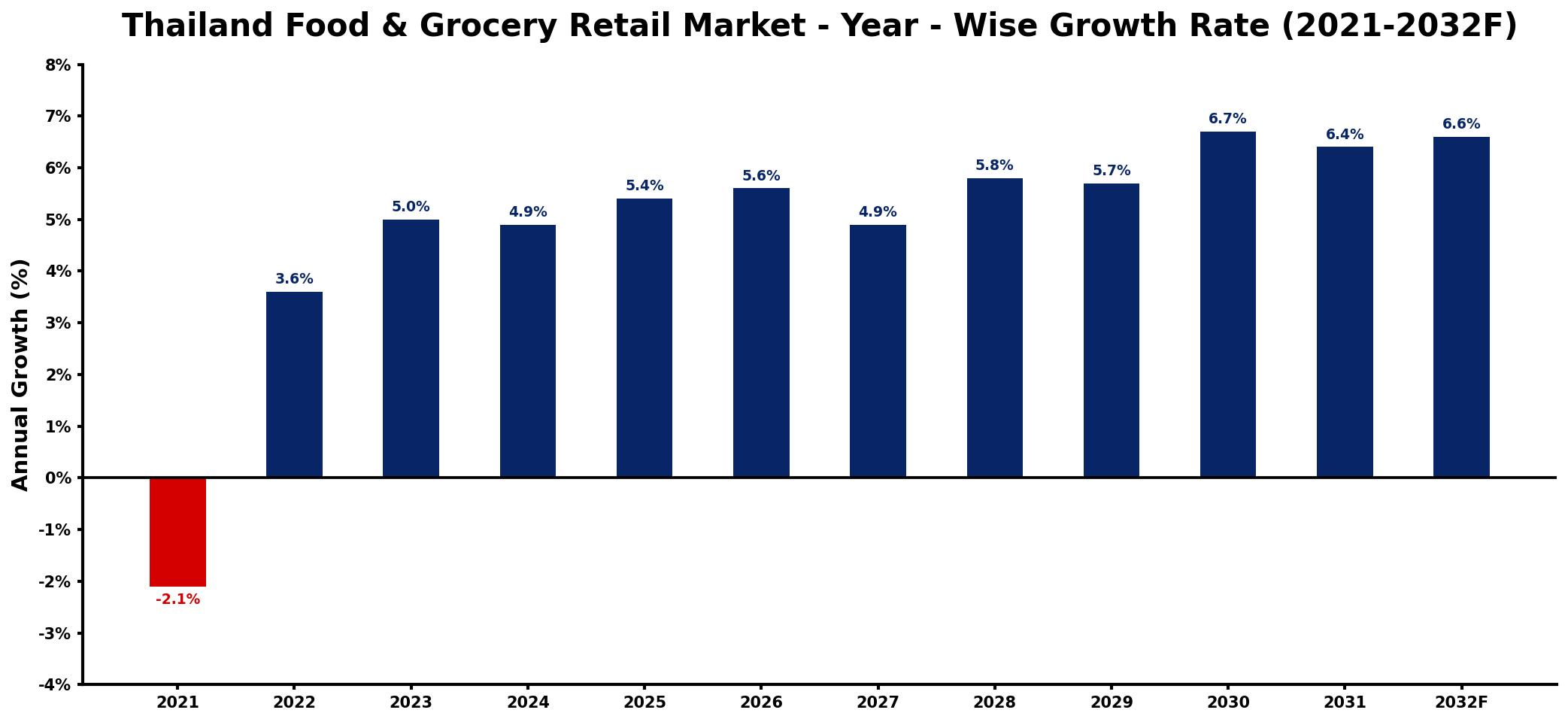
The table below presents the year‑wise growth rates along with the key drivers influencing the market
| Year | Growth Rate | Major Drivers |
| 2021 | -2.1% | shifts in consumer preferences |
| 2022 | 3.6% | expansion of online shopping |
| 2023 | 5.0% | increased disposable income levels |
| 2024 | 4.9% | growth in urban population density |
| 2025 | 5.4% | rising health consciousness trends |
| 2026 | 5.6% | enhanced supply chain efficiency |
| 2027 | 4.9% | increased international tourism influx |
| 2028 | 5.8% | development of local sourcing initiatives |
| 2029 | 5.7% | introduction of innovative technologies |
| 2030 | 6.7% | growing downstream application demand |
| 2031 | 6.4% | growing emerging market penetration |
| 2032 | 6.6% | increase in private label offerings |
Note: Market size estimations and growth projections presented in this report are based on 6Wresearch's proprietary forecasting methodology, utilizing the latest available industry data, government publications, and primary research inputs.
Thailand Food & Grocery Retail Market Synopsis
The Thailand food & grocery retail market is a vibrant sector that reflects the evolving preferences of Thai consumers. Retail formats are diversifying, with an increase in the number of supermarkets, convenience stores, and online grocery platforms to meet the demand for fresh produce and locally sourced products.
As urban centers expand, the retail landscape adapts, offering a mix of modern retail concepts alongside traditional options. This blend caters to the unique shopping habits of consumers who prioritize convenience, quality, and competitive pricing in their grocery purchases.
- The market is characterized by diverse retail formats and a growing preference for e-commerce solutions.
- Health-conscious consumers are driving demand for organic and healthy food products.
- Urbanization is reshaping consumer behavior, leading to a rise in demand for convenience foods.
- Government initiatives are supporting local food production and reducing waste, contributing positively to market growth.
- Post-pandemic, a hybrid shopping model has emerged, blending online and in-store grocery experiences.
Despite its promising outlook, the Thailand food & grocery retail market faces challenges that could impede growth. Traditional retail establishments are grappling with the pressure to innovate and compete against agile e-commerce platforms. Additionally, supply chain vulnerabilities, exacerbated by recent global disruptions, pose a risk to inventory management and product availability. Ensuring compliance with stringent food safety regulations remains critical for retailers to avoid potential legal issues and safeguard their reputations in the market.
A significant trend influencing the Thailand food & grocery retail market is the increasing integration of technology in shopping experiences. Retailers are leveraging digital solutions to enhance customer engagement and streamline operations. Furthermore, there is a noticeable shift towards sustainability, with consumers increasingly favoring brands that prioritize environmentally friendly practices. The demand for personalized shopping experiences, facilitated by data analytics, is also on the rise, allowing retailers to tailor offerings to meet specific consumer needs.
The evolving consumer landscape presents lucrative opportunities for investment in the Thailand food & grocery retail market. There is a growing demand for organic and health-focused products, offering a niche for retailers to explore. Additionally, the expansion of online grocery shopping platforms is a significant growth area, as more consumers seek convenience in their shopping habits. As urban areas continue to grow, the development of new retail formats that cater to the lifestyles of city dwellers will further enhance market potential.
The Thai government has introduced several initiatives to bolster the food & grocery retail sector. Policies aimed at promoting local agricultural production are designed to enhance food security and encourage sustainable practices within the industry. Furthermore, public spending on infrastructure improvements supports logistics and distribution networks, allowing retailers to efficiently reach consumers. These initiatives aim to create a more resilient market that not only meets domestic demand but also encourages exports.
Looking ahead to the period from 2026 to 2032, the Thailand food & grocery retail market is expected to experience continued growth driven by evolving consumer preferences and technological advancements. The increasing importance of health and wellness will likely propel the demand for organic products and ready-to-eat meals. As urbanization progresses, retailers who effectively adapt to hybrid shopping models and prioritize sustainability will be well-positioned to thrive in this dynamic market landscape.
Recent developments in the Thailand food & grocery retail market indicate a strong pivot towards digital transformation, with several retailers investing in advanced e-commerce solutions and logistics capabilities to enhance delivery efficiency. Furthermore, collaborations between local producers and retailers are becoming more prevalent, aiming to strengthen the supply chain and provide consumers with fresher, locally sourced products. These trends highlight the market's adaptability in response to changing consumer preferences and challenges in recent years.
- 10 Years of Market Numbers
- Historical Data Starting from 2022 to 2025
- Base Year: 2025
- Forecast Data until 2032
- Key Performance Indicators Impacting the Market
- Major Upcoming Developments and Projects
Key Highlights of the Report:
- Thailand Food & Grocery Retail Market Outlook
- Market Size of Thailand Food & Grocery Retail Market, 2025
- Forecast of Thailand Food & Grocery Retail Market, 2032
- Historical Data and Forecast of Thailand Food & Grocery Retail Revenues & Volume for the Period 2022-2032F
- Thailand Food & Grocery Retail Market Trend Evolution
- Thailand Food & Grocery Retail Market Drivers and Challenges
- Thailand Food & Grocery Retail Price Trends
- Thailand Food & Grocery Retail Porter's Five Forces
- Thailand Food & Grocery Retail Industry Life Cycle
- Historical Data and Forecast of Thailand Food & Grocery Retail Market Revenues & Volume By Product for the Period 2022-2032F
- Historical Data and Forecast of Thailand Food & Grocery Retail Market Revenues & Volume By Fresh Food for the Period 2022-2032F
- Historical Data and Forecast of Thailand Food & Grocery Retail Market Revenues & Volume By Frozen Food for the Period 2022-2032F
- Historical Data and Forecast of Thailand Food & Grocery Retail Market Revenues & Volume By Food Cupboard for the Period 2022-2032F
- Historical Data and Forecast of Thailand Food & Grocery Retail Market Revenues & Volume By Beverages for the Period 2022-2032F
- Historical Data and Forecast of Thailand Food & Grocery Retail Market Revenues & Volume By Cleaning & Household for the Period 2022-2032F
- Historical Data and Forecast of Thailand Food & Grocery Retail Market Revenues & Volume By Others for the Period 2022-2032F
- Historical Data and Forecast of Thailand Food & Grocery Retail Market Revenues & Volume By Distribution Channel for the Period 2022-2032F
- Historical Data and Forecast of Thailand Food & Grocery Retail Market Revenues & Volume By Supermarkets & Hypermarkets for the Period 2022-2032F
- Historical Data and Forecast of Thailand Food & Grocery Retail Market Revenues & Volume By Convenience Stores for the Period 2022-2032F
- Historical Data and Forecast of Thailand Food & Grocery Retail Market Revenues & Volume By Departmental Stores & Clubs for the Period 2022-2032F
- Historical Data and Forecast of Thailand Food & Grocery Retail Market Revenues & Volume By Online for the Period 2022-2032F
- Thailand Food & Grocery Retail Import Export Trade Statistics
- Market Opportunity Assessment By Product
- Market Opportunity Assessment By Distribution Channel
- Thailand Food & Grocery Retail Top Companies Market Share
- Thailand Food & Grocery Retail Competitive Benchmarking By Technical and Operational Parameters
- Thailand Food & Grocery Retail Company Profiles
- Thailand Food & Grocery Retail Key Strategic Recommendations






































