Thailand Food Retail Market Summary
The thailand food retail market was estimated at USD 468 Million in 2025 and is projected to reach USD 620 Million by 2032, growing at a CAGR of 5.6% from 2026 to 2032.
Thailand Food Retail Market Year-wise Growth Rate and Key Drivers
This graph highlights how the Thailand Food Retail Market has steadily grown over the past five years, supported by major growth factors.
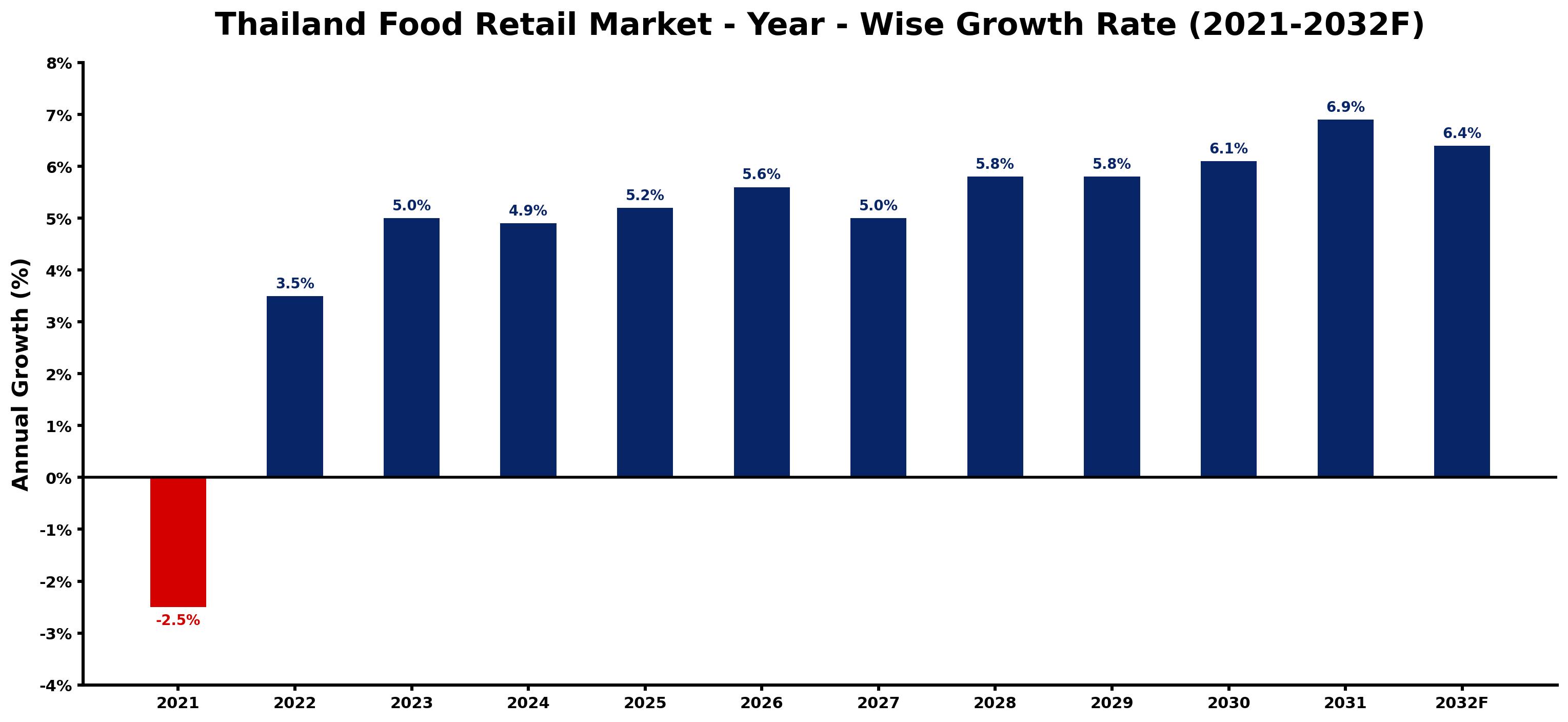
The table below presents the year wise growth rates along with the key drivers influencing the market
| Year | Growth Rate | Major Drivers |
| 2021 | -2.5% | Severe lockdown measures and reduced tourism drastically diminished foot traffic in retail food establishments. |
| 2022 | 3.5% | Local brands gained momentum, emphasizing fresh produce and sustainable sourcing practices. |
| 2023 | 5.0% | International retail chains expanded, offering diverse products catering to Thai tastes. |
| 2024 | 4.9% | Health-conscious trends influenced food choices, leading to increased organic product offerings. |
| 2025 | 5.2% | Technological integration enhanced shopping experiences with mobile apps and loyalty programs. |
| 2026 | 5.6% | Metropolitan areas saw a spike in convenience store openings, catering to urban lifestyles. |
| 2027 | 5.0% | Increased disposable income among middle-class families drove premium food selections. |
| 2028 | 5.8% | Local farmers' markets gained popularity, fostering community engagement and fresh offerings. |
| 2029 | 5.8% | Sustainability initiatives attracted environmentally aware consumers, boosting eco-friendly product lines. |
| 2030 | 6.1% | Digital payment methods revolutionized transactions, enhancing customer convenience and speed. |
| 2031 | 6.9% | Collaborations between retailers and local producers strengthened supply chains and product diversity. |
| 2032 | 6.4% | Cultural events and festivals integrated food retail, creating immersive consumer experiences. |
Note - Market size estimations and growth projections presented in this report are based on 6Wresearch's advanced forecasting approach, validated with industry datasets as of June 2026.
Thailand Food Retail Market Synopsis
The Thailand Food Retail Market is projected to reach 5.6% and witness significant growth during the forecast period (2026-2032). This growth is driven by several factors, including a rising demand for convenience foods, increasing disposable income levels, and shifts in lifestyle patterns among urban populations. Furthermore, the surge in online grocery shopping has captured consumer attention, providing an accessible platform for purchasing essential food items. The advent of advanced technologies such as artificial intelligence, big data analytics, and robotics automation is also fostering a transformative environment within the market, leading to enhanced efficiency and consumer engagement.
Thailand Food Retail Market Growth Drivers
Key drivers propelling the Thailand Food Retail Market include:
- The growing population, which expands the consumer base and consequently increases demand for food retail services.
- Heightened consumer spending on convenience foods, as busy lifestyles prompt a preference for quick and accessible meal solutions.
- The acceleration of digitalization, which facilitates seamless grocery shopping experiences through e-commerce platforms.
- Improved access to a diverse range of products that meet high-quality standards at competitive prices, attracting a broader customer demographic.
- Innovative packaging solutions introduced by manufacturers, which not only enhance product appeal but also ensure better preservation and convenience for consumers.
Thailand Food Retail Market Challenges and Restraints
Despite the promising growth prospects, the Thailand Food Retail Market faces several challenges:
- Stringent government regulations aimed at ensuring food safety and hygiene, which can create compliance burdens for retailers.
- Intense competition from local vendors offering fresh produce at lower prices compared to supermarkets and convenience stores, thus impacting the market share of larger retailers.
- A shortage of skilled labor, which may hinder operational efficiency and productivity within the food retail sector.
- Slow adoption rates of emerging technologies among smaller players, limiting their ability to compete effectively in an evolving market landscape.
- The potential for economic fluctuations or external shocks that might affect consumer spending patterns and overall market stability.
Thailand Food Retail Market COVID-19 Impact
The COVID-19 pandemic has precipitated significant disruptions within the Thailand Food Retail Market. Retailers experienced supply chain interruptions and a decline in foot traffic due to temporary store closures, leading to a noticeable drop in sales revenues during the height of the pandemic. Nevertheless, as global lockdown restrictions ease and consumer confidence begins to recover, a gradual resurgence in purchasing power is anticipated, signaling a potential return to normalcy for the sector following the challenges posed by the pandemic.
Thailand Food Retail Market Government Investment and Initiatives
The Thai government has been proactive in bolstering the food retail market through various investment strategies and initiatives. Key government policies focus on enhancing food safety and hygiene standards, which are vital for consumer trust and market integrity. Investments in infrastructure improvements, including transportation networks and cold chain logistics, further facilitate the efficient distribution of food products. Additionally, public spending in technology adoption within retail operations fosters an environment for innovation, which is crucial for competitiveness. Promoting local produce and collaborating with agricultural sectors also serve to strengthen the domestic food retail landscape, ensuring sustainability and resilience against external market shocks.
Thailand Food Retail Market Latest Developments (May 2025 - June 2026)
Recent developments in the Thailand Food Retail Market from May 2025 to June 2026 indicate a notable shift towards integrating advanced technologies into retail operations. Retailers are increasingly adopting AI-driven solutions for inventory management and customer insights. E-commerce platforms have also seen enhancements in user experience, with many retailers investing in mobile applications to streamline online shopping processes. Additionally, sustainability initiatives are gaining traction, as consumers show a growing preference for environmentally friendly products and packaging. This period has marked a significant pivot towards innovative retail strategies, setting the stage for long-term growth within the market.
Thailand Food Retail Market - Key Attractiveness of the Report
- 10 Years of Market Numbers
- Historical Data Starting from 2022 to 2025
- Base Year: 2025
- Forecast Data until 2032
- Key Performance Indicators Impacting the Market
- Major Upcoming Developments and Projects
Key Highlights of the Report:
- Thailand Food Retail Market Outlook
- Market Size of Thailand Food Retail Market, 2025
- Forecast of Thailand Food Retail Market, 2032
- Historical Data and Forecast of Thailand Food Retail Revenues & Volume for the Period 2022-2032F
- Thailand Food Retail Market Trend Evolution
- Thailand Food Retail Market Drivers and Challenges
- Thailand Food Retail Price Trends
- Thailand Food Retail Porter's Five Forces
- Thailand Food Retail Industry Life Cycle
- Historical Data and Forecast of Thailand Food Retail Market Revenues & Volume By Product Types for the Period 2022-2032F
- Historical Data and Forecast of Thailand Food Retail Market Revenues & Volume By Unpackaged Food for the Period 2022-2032F
- Historical Data and Forecast of Thailand Food Retail Market Revenues & Volume By Packaged Food for the Period 2022-2032F
- Historical Data and Forecast of Thailand Food Retail Market Revenues & Volume By Drinks for the Period 2022-2032F
- Historical Data and Forecast of Thailand Food Retail Market Revenues & Volume By Household Products for the Period 2022-2032F
- Historical Data and Forecast of Thailand Food Retail Market Revenues & Volume By Packaging Types for the Period 2022-2032F
- Historical Data and Forecast of Thailand Food Retail Market Revenues & Volume By Boxes for the Period 2022-2032F
- Historical Data and Forecast of Thailand Food Retail Market Revenues & Volume By Cans for the Period 2022-2032F
- Historical Data and Forecast of Thailand Food Retail Market Revenues & Volume By Cellophane Wrapping for the Period 2022-2032F
- Historical Data and Forecast of Thailand Food Retail Market Revenues & Volume By Cylindrical Cardboard for the Period 2022-2032F
- Thailand Food Retail Import Export Trade Statistics
- Market Opportunity Assessment By Product Types
- Market Opportunity Assessment By Packaging Types
- Thailand Food Retail Top Companies Market Share
- Thailand Food Retail Competitive Benchmarking By Technical and Operational Parameters
- Thailand Food Retail Company Profiles
- Thailand Food Retail Key Strategic Recommendations






































