Thailand Fruit Pulp Market Size, Share & Growth Rate
The Thailand Fruit Pulp Market was estimated at USD 167 Million in 2025 and is projected to reach USD 191 Million by 2032, growing at a CAGR of 1.9% from 2026 to 2032. This growth is fueled by increasing consumer awareness regarding the health benefits of fruit pulp, particularly its richness in vitamins and dietary fiber. Additionally, the robust production capacity stemming from Thailand's diverse tropical fruit cultivation enhances both domestic and export opportunities.
Thailand Fruit Pulp Market Year-wise Growth Rate and Key Drivers
This graph highlights how the Thailand Fruit Pulp Market has steadily grown over the years, supported by major growth factors.
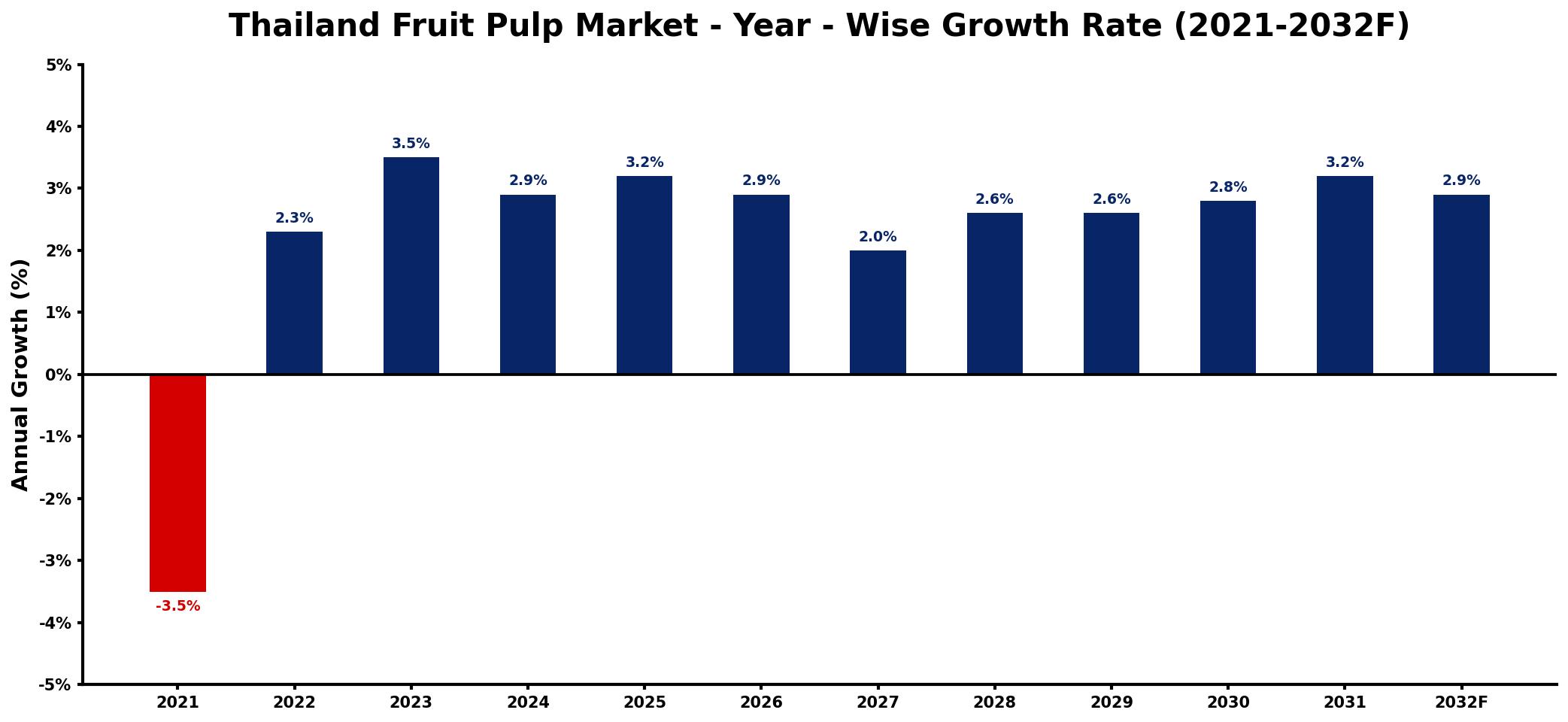
The table below presents the year‑wise growth rates along with the key drivers influencing the market
| Year | Growth Rate | Major Drivers |
| 2021 | -3.5% | decreased consumer purchasing power |
| 2022 | 2.3% | rising health consciousness among consumers |
| 2023 | 3.5% | expanding beverage industry applications |
| 2024 | 2.9% | increased investment in processing technology |
| 2025 | 3.2% | growing export opportunities in Asia |
| 2026 | 2.9% | emerging trends in plant-based diets |
| 2027 | 2.0% | enhanced supply chain efficiencies |
| 2028 | 2.6% | new product innovations in snacks |
| 2029 | 2.6% | strengthening distribution network capabilities |
| 2030 | 2.8% | increased consumer interest in sustainability |
| 2031 | 3.2% | rising demand for organic ingredients |
| 2032 | 2.9% | growing popularity of convenience foods |
Note: Market size estimations and growth projections presented in this report are based on 6Wresearch's proprietary forecasting methodology, utilizing the latest available industry data, government publications, and primary research inputs.
Thailand Fruit Pulp Market Synopsis
The Thailand Fruit Pulp Market has witnessed significant growth in recent years, driven by a combination of health trends and a growing affinity for natural food products. However, as the market matures, challenges such as seasonal fruit availability and processing quality have begun to emerge, necessitating innovation and adaptability.
Looking ahead, the trajectory appears positive, with continued investments in processing technologies and expanding distribution channels. The market's future hinges on its ability to respond to evolving consumer preferences while maintaining high-quality standards in fruit pulp production.
Thailand Fruit Pulp Market Key Takeaways
- The market is poised for steady growth with a projected CAGR of 1.9% from 2026 to 2032.
- Health-conscious consumer trends are significantly driving demand for fruit pulp.
- Thailand's favorable agricultural climate provides a robust supply of tropical fruits.
- Investments in processing technologies are enhancing product quality and shelf life.
- Changing dietary preferences and the trend towards natural products continue to shape market dynamics.
Evaluation of Restraints in Thailand Fruit Pulp Market
The Thailand Fruit Pulp Market faces notable restraints that could limit its growth potential. A primary concern is the dependence on seasonal fruit availability, which creates vulnerabilities in sourcing fresh and high-quality raw materials. This seasonal variability often impacts production consistency and market supply. Furthermore, the challenge of maintaining the natural flavor and texture of fruit pulp during processing is critical to meet consumer expectations. Lastly, increasing competition from alternative fruit-based products, such as jams and jellies, adds pressure to the market, compelling manufacturers to continuously innovate in order to retain market share.
Thailand Fruit Pulp Market Trends
Several current and emerging trends are shaping the Thailand Fruit Pulp Market. The rising inclination toward clean-label products is prompting manufacturers to focus on natural ingredients without artificial additives. Additionally, the popularity of plant-based diets is increasing the demand for fruit pulp in health-conscious circles. Furthermore, advancements in processing technology not only enhance the quality of fruit pulp but also extend shelf life, thus increasing its marketability in both local and international arenas. Online retailing is also on the rise, facilitating easier access for consumers and bolstering market growth.
Thailand Fruit Pulp Market Opportunities
The Thailand Fruit Pulp Market presents several lucrative growth and investment opportunities. With the global trend leaning towards natural and organic food products, there is a potential for Thai fruit pulp to penetrate new markets, particularly in health-focused sectors such as organic juices and smoothies. Additionally, developing innovative fruit pulp applications in the culinary arts and expanding usage in bakery products could further drive demand. Investing in sustainable agricultural practices and processing technologies will enhance product quality, providing a competitive edge in both local and export markets.
Government Initiatives in the Thailand Fruit Pulp Market
The Thai government has implemented various initiatives to support the agricultural sector, including subsidies for fruit farmers and investments in modern processing facilities. Policies promoting organic farming and sustainable agricultural practices aim to enhance the quality of fruit production. Additionally, trade agreements that facilitate exports of agricultural products are providing Thai fruit pulp manufacturers with access to broader international markets, thus fostering industry growth. Public spending on infrastructure development is also crucial for improving the supply chain efficiency necessary for the fruit pulp market.
Future Insights of the Thailand Fruit Pulp Market
From 2026 to 2032, the Thailand Fruit Pulp Market is expected to experience steady growth, driven by heightened health awareness among consumers and a growing preference for natural food ingredients. As the market adapts to changing consumer demands, innovation in processing technologies and product offerings will become increasingly critical. The emphasis on sustainability and quality will likely reshape industry dynamics, while the expanding global market for natural fruit products presents a favorable environment for Thai fruit pulp exports. The integration of modern marketing strategies will also play a significant role in promoting product awareness and accessibility.
Thailand Fruit Pulp Market Latest Developments (2025 - 2026)
Recent developments in the Thailand Fruit Pulp Market include a surge in partnerships aimed at enhancing supply chain efficiencies. Innovations in processing technologies have been unveiled, aimed at preserving the nutritional integrity and flavor profiles of fruit pulp. Moreover, several companies have ramped up efforts in e-commerce strategies, enabling easier distribution and access for consumers. This shift has been supported by an increased focus on consumer engagement through digital platforms, helping to drive demand further in an ever-evolving marketplace.
Thailand Fruit Pulp Market - Key Attractiveness of the Report
- 10 Years of Market Numbers
- Historical Data Starting from 2022 to 2025
- Base Year: 2025
- Forecast Data until 2032
- Key Performance Indicators Impacting the Market
- Major Upcoming Developments and Projects
Key Highlights of the Report:
- Thailand Fruit Pulp Market Outlook
- Market Size of Thailand Fruit Pulp Market, 2025
- Forecast of Thailand Fruit Pulp Market, 2032
- Historical Data and Forecast of Thailand Fruit Pulp Revenues & Volume for the Period 2022-2032F
- Thailand Fruit Pulp Market Trend Evolution
- Thailand Fruit Pulp Market Drivers and Challenges
- Thailand Fruit Pulp Price Trends
- Thailand Fruit Pulp Porter's Five Forces
- Thailand Fruit Pulp Industry Life Cycle
- Historical Data and Forecast of Thailand Fruit Pulp Market Revenues & Volume By Fruit Type for the Period 2022-2032F
- Historical Data and Forecast of Thailand Fruit Pulp Market Revenues & Volume By Mango for the Period 2022-2032F
- Historical Data and Forecast of Thailand Fruit Pulp Market Revenues & Volume By Strawberry for the Period 2022-2032F
- Historical Data and Forecast of Thailand Fruit Pulp Market Revenues & Volume By Apple for the Period 2022-2032F
- Historical Data and Forecast of Thailand Fruit Pulp Market Revenues & Volume By Guava for the Period 2022-2032F
- Historical Data and Forecast of Thailand Fruit Pulp Market Revenues & Volume By Berries for the Period 2022-2032F
- Historical Data and Forecast of Thailand Fruit Pulp Market Revenues & Volume By Citrus Fruits for the Period 2022-2032F
- Historical Data and Forecast of Thailand Fruit Pulp Market Revenues & Volume By Others for the Period 2022-2032F
- Historical Data and Forecast of Thailand Fruit Pulp Market Revenues & Volume By Form for the Period 2022-2032F
- Historical Data and Forecast of Thailand Fruit Pulp Market Revenues & Volume By Liquid for the Period 2022-2032F
- Historical Data and Forecast of Thailand Fruit Pulp Market Revenues & Volume By Powder for the Period 2022-2032F
- Historical Data and Forecast of Thailand Fruit Pulp Market Revenues & Volume By Application for the Period 2022-2032F
- Historical Data and Forecast of Thailand Fruit Pulp Market Revenues & Volume By Food and Beverages for the Period 2022-2032F
- Historical Data and Forecast of Thailand Fruit Pulp Market Revenues & Volume By Distribution for the Period 2022-2032F
- Historical Data and Forecast of Thailand Fruit Pulp Market Revenues & Volume By E-Commerce for the Period 2022-2032F
- Historical Data and Forecast of Thailand Fruit Pulp Market Revenues & Volume By Convenience Stores for the Period 2022-2032F
- Historical Data and Forecast of Thailand Fruit Pulp Market Revenues & Volume By Supermarkets/Hypermarkets for the Period 2022-2032F
- Historical Data and Forecast of Thailand Fruit Pulp Market Revenues & Volume By Specialty Stores for the Period 2022-2032F
- Historical Data and Forecast of Thailand Fruit Pulp Market Revenues & Volume By Others for the Period 2022-2032F
- Thailand Fruit Pulp Import Export Trade Statistics
- Market Opportunity Assessment By Fruit Type
- Market Opportunity Assessment By Form
- Market Opportunity Assessment By Application
- Market Opportunity Assessment By Distribution
- Thailand Fruit Pulp Top Companies Market Share
- Thailand Fruit Pulp Competitive Benchmarking By Technical and Operational Parameters
- Thailand Fruit Pulp Company Profiles
- Thailand Fruit Pulp Key Strategic Recommendations






































