Thailand Gamification in Education Market Size & Growth Rate (2026-2032)
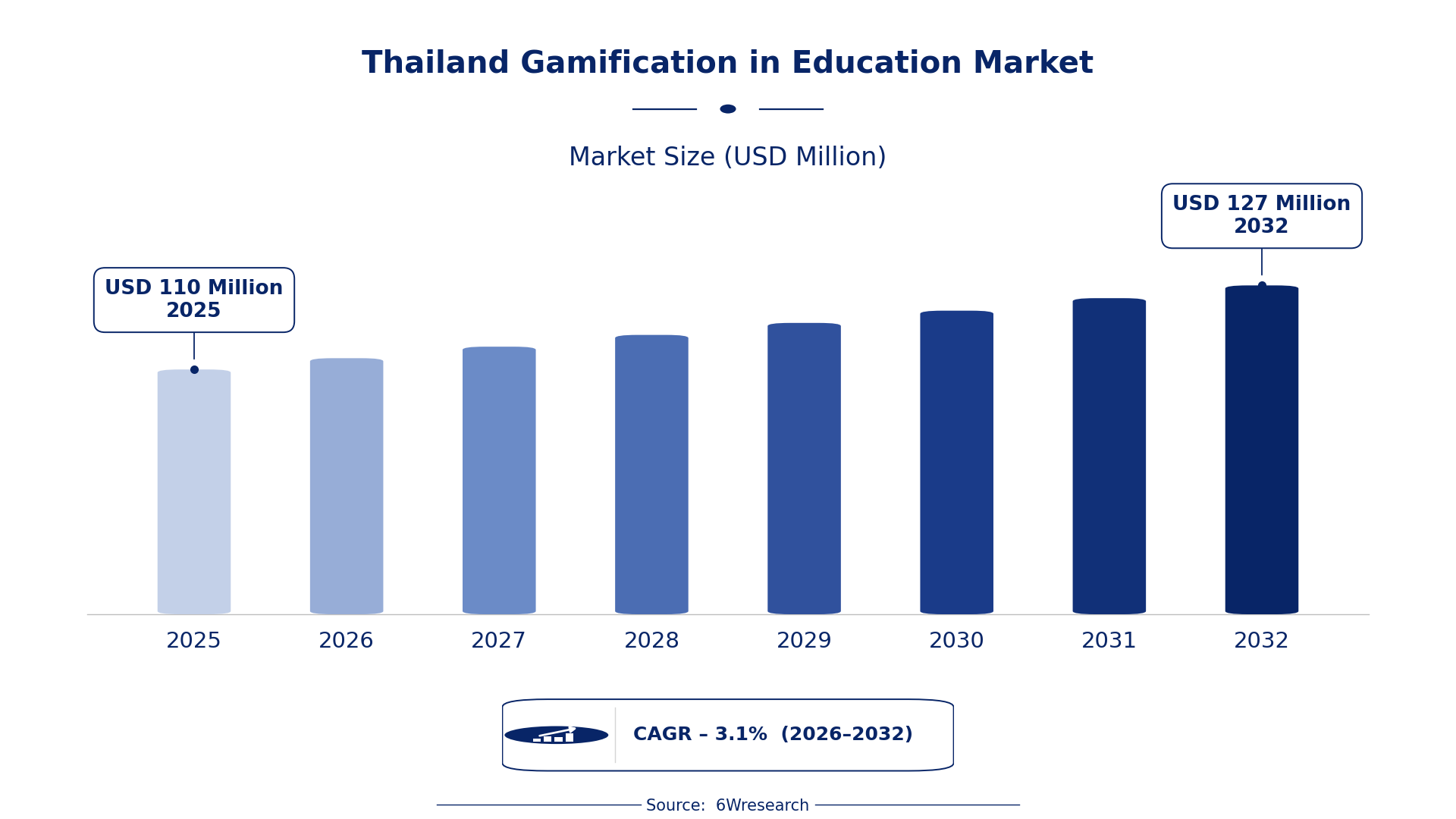
The Thailand Gamification in Education Market was estimated at USD 110 Million in 2025 and is projected to reach USD 127 Million by 2032, growing at a CAGR of 3.1% from 2026 to 2032.
Thailand Gamification in Education Market Synopsis
The Thailand Gamification in Education Market is currently witnessing a surge in interest, fueled by a growing recognition of the need for interactive and engaging educational methods. As traditional approaches falter in captivating students, institutions are increasingly turning to gamification to elevate learning experiences.
Looking ahead, the market is expected to evolve with technology advancements and changing educational paradigms. The integration of gamified solutions will likely reshape not just how students learn but also how educators teach, leading to transformative shifts in the educational framework across Thailand.
Thailand Gamification in Education Market Year-wise Growth Rate and Key Drivers
This graph illustrates the annual growth rates of the Thailand Gamification in Education Market from 2021 to 2032, highlighting a steady upward trajectory and projected expansion over the forecast period.
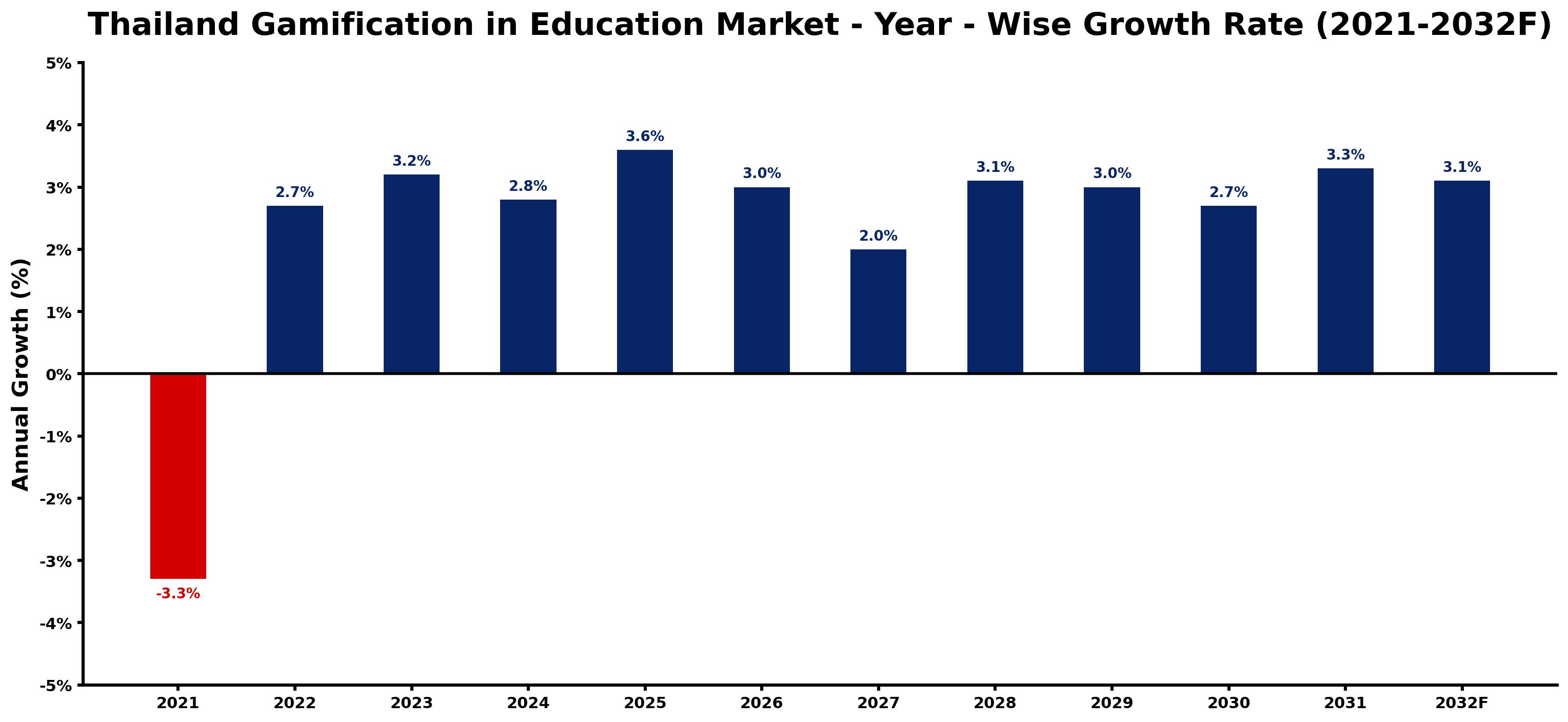
The table below presents the year‑wise growth rates along with the key drivers influencing the market
| Year | Growth Rate | Major Drivers |
| 2021 | -3.3% | Ministry of Education restricts gamified curriculum implementations. |
| 2022 | 2.7% | Integration of gamification in Thai national curriculum |
| 2023 | 3.2% | Surge in smartphone usage among students nationwide |
| 2024 | 2.8% | Collaborations with local game developers enhance engagement |
| 2025 | 3.6% | Increased emphasis on STEAM education by Ministry of Education |
| 2026 | 3.0% | Growing interest in online courses among Thai educators |
| 2027 | 2.0% | Launch of digital literacy campaigns by Thai government |
| 2028 | 3.1% | Rise in after-school gamified learning programs |
| 2029 | 3.0% | Adoption of VR technology in Thai classrooms |
| 2030 | 2.7% | Local startups driving innovation in educational gaming |
| 2031 | 3.3% | Government partnerships with tech firms for education |
| 2032 | 3.1% | Increased awareness of mental health in learning spaces |
Note: Market size estimations and growth projections presented in this report are based on 6Wresearch's proprietary forecasting methodology, utilizing the latest available industry data, government publications, and primary research inputs.
Thailand Gamification in Education Market Key Takeaways
Below are some of the specific key takeaways from the market, including:
- Growing demand for engaging learning experiences is driving gamification adoption in education.
- Educational institutions are increasingly leveraging technology to implement gamification strategies.
- Customization of gamified content is essential to meet diverse student needs and learning preferences.
- Collaboration between educational institutions and technology providers is crucial for effective implementation.
- Concerns about screen time and traditional resistance to gamification must be addressed for widespread acceptance.
Evaluation of Restraints in Thailand Gamification in Education Market
Several factors are hindering the growth of the Thailand Gamification in Education Market. The challenge of integrating gamified experiences into established educational frameworks remains significant, as traditional methods have deep roots. on top of that, there’s a need for customization to cater to the varying learning styles of Thai students, which complicates implementation. Resistance to embracing gaming elements within academic curricula, alongside concerns regarding excessive screen time, presents additional hurdles. Ensuring equitable access to gamified educational content across different socioeconomic groups is crucial for market expansion.
Thailand Gamification in Education Market Trends
Current trends reveal a strong push towards digital transformation within the education sector, with gamification at the forefront. Increasingly, educational institutions are adopting interactive simulations and rewards systems to motivate students. The rise of blended learning models, accelerated by the pandemic, has made gamification a key strategy to enhance student engagement in both physical and virtual classrooms. on top of that, the emphasis on personalized learning experiences is driving the development of adaptive gamified solutions tailored to individual student needs.
Thailand Gamification in Education Market Opportunities
Opportunities for growth in the Thailand Gamification in Education Market are plentiful. The increasing adoption of technology in classrooms opens doors for innovative gamified learning solutions. There is a significant opportunity for partnerships between educational institutions and technology companies to create customized gamified content. Additionally, as more schools embrace hybrid learning models, there is a growing demand for tools that enhance both in-person and online educational experiences. The potential for gamification to support skill development in areas like critical thinking and collaboration is another avenue for market expansion.
Government Initiatives in the Thailand Gamification in Education Market
The Thai government is increasingly recognizing the importance of gamification in improving educational outcomes. Public policy is shifting towards embracing innovative teaching methods, which includes supporting the integration of technology in education. These initiatives are designed to enhance learning experiences and ensure that students are equipped with the skills needed for the future.
- A recently completed initiative focused on upgrading digital infrastructure in schools to support gamified learning tools.
- Current efforts include a nationwide program to train educators on integrating gamification into their teaching methodologies.
- A planned public-private partnership aimed at developing gamified educational platforms is expected to launch in the next two years.
- The introduction of regulations promoting technology use in classrooms is set to encourage gamification adoption among educational institutions.
Future Insights of the Thailand Gamification in Education Market
From 2026 to 2032, the Thailand Gamification in Education Market is projected to experience steady growth. With educational institutions increasingly prioritizing student engagement and motivation, gamification will become an essential part of educational strategies. The ongoing development of technology and innovative pedagogical approaches will likely lead to more sophisticated gamification solutions, transforming how education is delivered across the country. As awareness of the benefits of gamification grows, more institutions will adopt these strategies, further propelling market growth.
Thailand Gamification in Education Market Latest Developments
In the past year, the Thailand Gamification in Education Market has seen considerable activity, with various initiatives aimed at enhancing educational engagement through gamified solutions. Educational institutions are increasingly collaborating with technology providers to develop tailored gamification strategies that resonate with students.
- A major technology vendor launched a new interactive gamified learning platform in early 2025, targeting K-12 education.
- An ongoing initiative started in mid-2025 focuses on creating gamified content for higher education institutions, enhancing student participation.
- A rollout of gamified assessment tools is planned for Q4 2026 to facilitate more engaging evaluations in classrooms.
- Schools are currently implementing a pilot program to integrate gamification into extracurricular activities, which began in early 2025.
Thailand Gamification in Education Market - Key Attractiveness of the Report
- 10 Years of Market Numbers
- Historical Data Starting from 2022 to 2025
- Base Year: 2025
- Forecast Data until 2032
- Key Performance Indicators Impacting the Market
- Major Upcoming Developments and Projects
Key Highlights of the Report:
- Thailand Gamification in Education Market Outlook
- Market Size of Thailand Gamification in Education Market, 2025
- Forecast of Thailand Gamification in Education Market, 2032
- Historical Data and Forecast of Thailand Gamification in Education Revenues & Volume for the Period 2022-2032F
- Thailand Gamification in Education Market Trend Evolution
- Thailand Gamification in Education Market Drivers and Challenges
- Thailand Gamification in Education Price Trends
- Thailand Gamification in Education Porter's Five Forces
- Thailand Gamification in Education Industry Life Cycle
- Historical Data and Forecast of Thailand Gamification in Education Market Revenues & Volume By Offering for the Period 2022-2032F
- Historical Data and Forecast of Thailand Gamification in Education Market Revenues & Volume By Software for the Period 2022-2032F
- Historical Data and Forecast of Thailand Gamification in Education Market Revenues & Volume By Services for the Period 2022-2032F
- Historical Data and Forecast of Thailand Gamification in Education Market Revenues & Volume By End User for the Period 2022-2032F
- Historical Data and Forecast of Thailand Gamification in Education Market Revenues & Volume By Academic for the Period 2022-2032F
- Historical Data and Forecast of Thailand Gamification in Education Market Revenues & Volume By Corporate Training for the Period 2022-2032F
- Historical Data and Forecast of Thailand Gamification in Education Market Revenues & Volume By Deployment Mode for the Period 2022-2032F
- Historical Data and Forecast of Thailand Gamification in Education Market Revenues & Volume By Cloud for the Period 2022-2032F
- Historical Data and Forecast of Thailand Gamification in Education Market Revenues & Volume By On-Premises for the Period 2022-2032F
- Thailand Gamification in Education Import Export Trade Statistics
- Market Opportunity Assessment By Offering
- Market Opportunity Assessment By End User
- Market Opportunity Assessment By Deployment Mode
- Thailand Gamification in Education Top Companies Market Share
- Thailand Gamification in Education Competitive Benchmarking By Technical and Operational Parameters
- Thailand Gamification in Education Company Profiles
- Thailand Gamification in Education Key Strategic Recommendations






































