Thailand Ghee Market: Import Trend Analysis
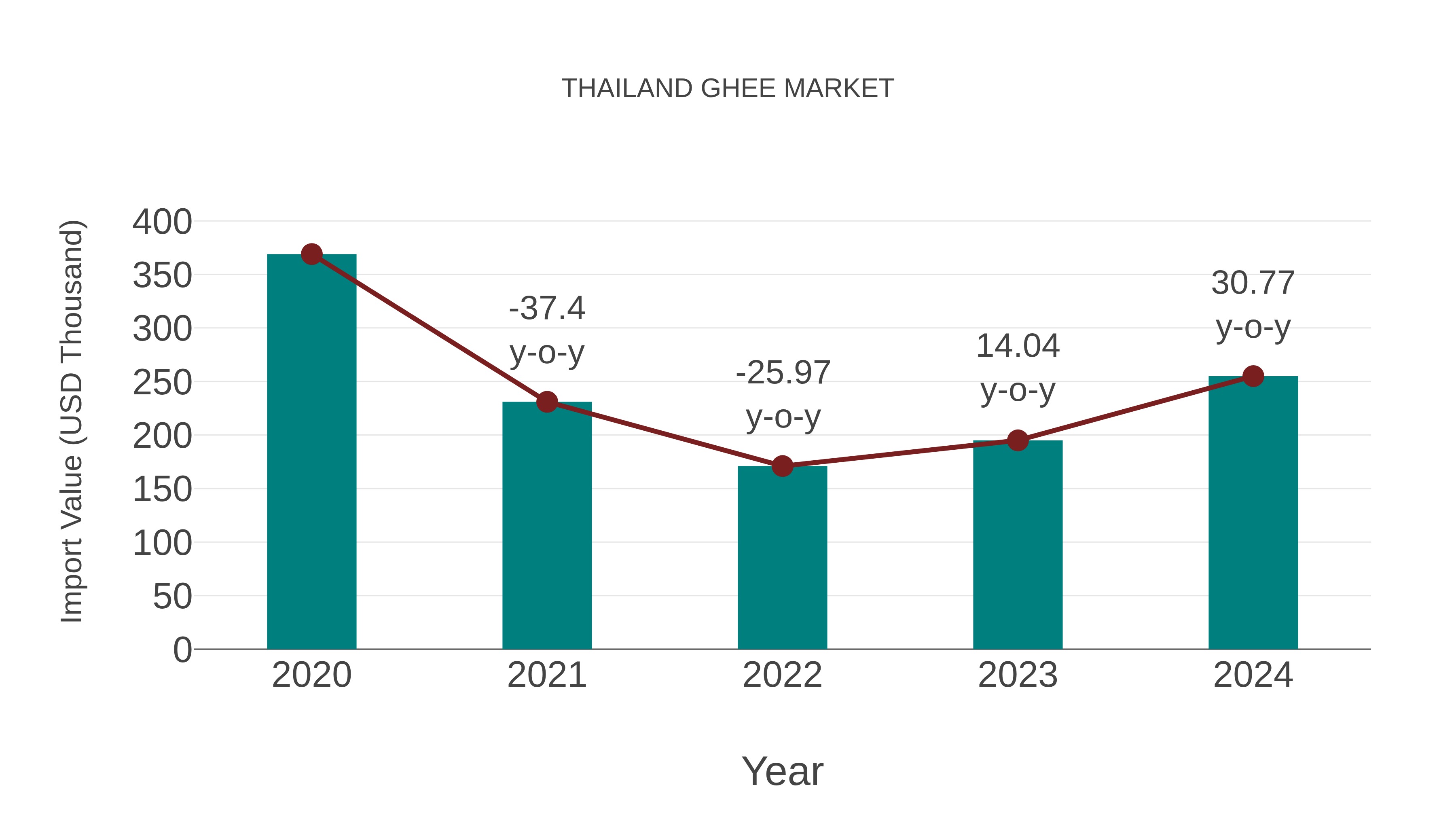
Thailand import trend for ghee in 2024 showed a notable growth rate of 30.77% compared to the previous year, with a compound annual growth rate (CAGR) of -8.82% from 2020 to 2024. This significant uptick in import momentum suggests a potential demand shift or market recovery, possibly influenced by evolving consumer preferences or trade policies during the period.
Ghee Market: Thailand vs Top 5 Major Economies in 2027 (Asia)
Thailand's Ghee market is anticipated to experience a growing growth rate of 6.43% by 2027, reflecting trends observed in the largest economy China, followed by India, Japan, Australia and South Korea.

Thailand Ghee Market Synopsis
The ghee market in Thailand generated revenue worth US$ 12 Million in 2025 and will witness steady growth owing to its use as cooking oil or fat source by households along with restaurants & hotels due to availability of various flavors such as garlic & onion flavored ghee which adds flavor while cooking various dishes like chapatti?s etc., thus adding taste value. Additionally, rise inculcating traditional Indian diet culture into Thai cuisine majorly through restaurants & hotels would drive growth significantly during forecasted timeframe.
Drivers of the Market
Ghee`s reputation as a traditional and nutrient-rich cooking medium has boosted its consumption. Ghee`s culinary and health benefits continue to drive demand in the market.
Challenges of the Market
The ghee market encounters challenges in terms of producing ghee with consistent flavor, texture, and aroma while addressing storage and shelf-life concerns due to its high fat content.
Trends & Oppourtunites of the Market
Ghee holds cultural significance and is esteemed for its culinary attributes. Entrepreneurs can explore this market by offering premium, locally-sourced ghee to both traditional and health-conscious consumers.
COVID-19 Impact on the Market
As consumers cooked more at home, traditional ingredients like ghee gained traction. The pandemic`s impact on sourcing and production led to occasional supply disruptions and price fluctuations.
Key Players in the Market
In the Thailand ghee market, entities like CP Group and Betagro Group contribute to the production and distribution of ghee, a clarified butter product used in cooking and traditional cuisine.
Key Highlights of the Report:
- Thailand Ghee Market Outlook
- Market Size of Thailand Ghee Market, 2025
- Forecast of Thailand Ghee Market, 2032
- Historical Data and Forecast of Thailand Ghee Revenues & Volume for the Period 2022-2032F
- Thailand Ghee Market Trend Evolution
- Thailand Ghee Market Drivers and Challenges
- Thailand Ghee Price Trends
- Thailand Ghee Porter's Five Forces
- Thailand Ghee Industry Life Cycle
- Historical Data and Forecast of Thailand Ghee Market Revenues & Volume By Source for the Period 2022-2032F
- Historical Data and Forecast of Thailand Ghee Market Revenues & Volume By Cow for the Period 2022-2032F
- Historical Data and Forecast of Thailand Ghee Market Revenues & Volume By Buffalo for the Period 2022-2032F
- Historical Data and Forecast of Thailand Ghee Market Revenues & Volume By Mixed for the Period 2022-2032F
- Historical Data and Forecast of Thailand Ghee Market Revenues & Volume By End-use for the Period 2022-2032F
- Historical Data and Forecast of Thailand Ghee Market Revenues & Volume By Retail for the Period 2022-2032F
- Historical Data and Forecast of Thailand Ghee Market Revenues & Volume By Institutional for the Period 2022-2032F
- Historical Data and Forecast of Thailand Ghee Market Revenues & Volume By Distribution Channel for the Period 2022-2032F
- Historical Data and Forecast of Thailand Ghee Market Revenues & Volume By Supermarkets/Hypermarkets for the Period 2022-2032F
- Historical Data and Forecast of Thailand Ghee Market Revenues & Volume By Convenience Stores for the Period 2022-2032F
- Historical Data and Forecast of Thailand Ghee Market Revenues & Volume By Specialty Stores for the Period 2022-2032F
- Historical Data and Forecast of Thailand Ghee Market Revenues & Volume By Online for the Period 2022-2032F
- Historical Data and Forecast of Thailand Ghee Market Revenues & Volume By Others for the Period 2022-2032F
- Thailand Ghee Import Export Trade Statistics
- Market Opportunity Assessment By Source
- Market Opportunity Assessment By End-use
- Market Opportunity Assessment By Distribution Channel
- Thailand Ghee Top Companies Market Share
- Thailand Ghee Competitive Benchmarking By Technical and Operational Parameters
- Thailand Ghee Company Profiles
- Thailand Ghee Key Strategic Recommendations






































