Thailand Gold Plating Chemicals Market Size, Share & Growth Rate
The Thailand Gold Plating Chemicals Market was estimated at USD 95 Million in 2025 and is projected to reach USD 109 Million by 2032, growing at a CAGR of 2.0% from 2026 to 2032. This growth trajectory is primarily driven by the escalating demand for gold plating in the electronics and automotive sectors, alongside the flourishing jewelry industry, which continually seeks to enhance product aesthetics and durability. As technological advancements occur and consumer preferences evolve, the market is poised to adapt and thrive, fueling further growth.
Thailand Gold Plating Chemicals Market Year-wise Growth Rate and Key Drivers
This graph highlights how the Thailand Gold Plating Chemicals Market has steadily grown over the years, supported by major growth factors.
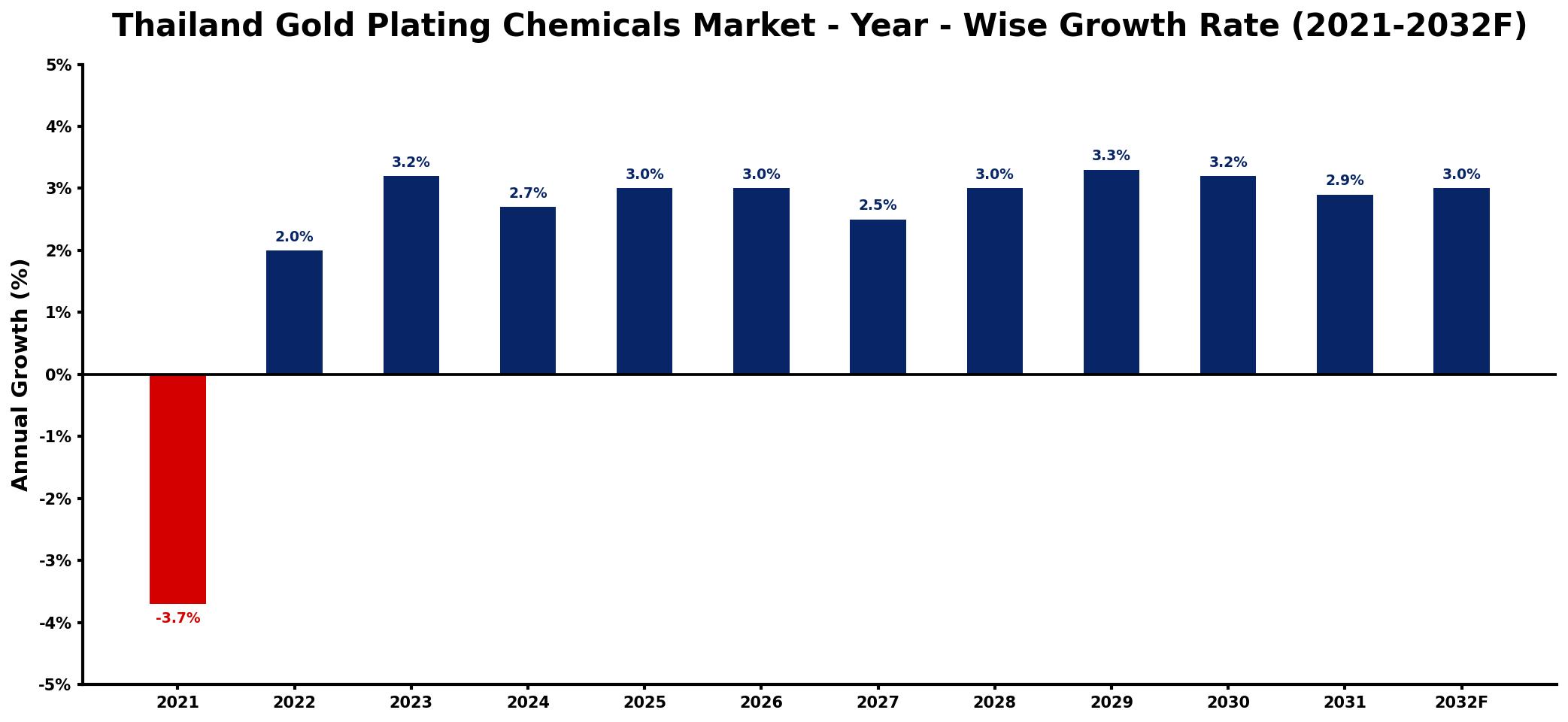
The table below presents the year‑wise growth rates along with the key drivers influencing the market
| Year | Growth Rate | Major Drivers |
| 2021 | -3.7% | decreased consumer electronics production |
| 2022 | 2.0% | increased automotive manufacturing needs |
| 2023 | 3.2% | growing demand for luxury goods |
| 2024 | 2.7% | expansion of jewelry market segment |
| 2025 | 3.0% | rising investment in fashion industry |
| 2026 | 3.0% | enhanced technological advancements integration |
| 2027 | 2.5% | increased exports to neighboring countries |
| 2028 | 3.0% | growing popularity of sustainable products |
| 2029 | 3.3% | rising demand from electronics |
| 2030 | 3.2% | increased focus on aesthetic designs |
| 2031 | 2.9% | growing automotive sector requirements |
| 2032 | 3.0% | growing interest in vintage styles |
Note: Market size estimations and growth projections presented in this report are based on 6Wresearch's proprietary forecasting methodology, utilizing the latest available industry data, government publications, and primary research inputs.
Thailand Gold Plating Chemicals Market Synopsis
Currently, the most significant influence on the Thailand Gold Plating Chemicals Market stems from the booming electronics sector. This sector utilizes gold plating extensively for connectors and contacts, crucial for the production of high-performance electronic devices. The growing demand from this industry, coupled with the traditional jewelry market's resurgence post-pandemic, is shaping the market landscape.
The ongoing evolution of consumer preferences towards higher-quality and aesthetically appealing products drives the need for gold plating chemicals. Additionally, sustainability initiatives are prompting manufacturers to explore environmentally friendly options in gold plating processes, further shaping market dynamics.
Thailand Gold Plating Chemicals Market Key Takeaways
- The market is driven by demand from the electronics, jewelry, and automotive sectors.
- Technological advancements are leading to more efficient and sustainable gold plating processes.
- Post-pandemic recovery in consumer confidence is contributing to market growth.
- Key players are actively seeking to address environmental concerns through innovative solutions.
- Investment opportunities are emerging as industries prioritize high-quality plating chemicals.
Evaluation of Restraints in Thailand Gold Plating Chemicals Market
Despite its growth potential, the Thailand Gold Plating Chemicals Market faces several restraints. The fluctuating prices of gold can hinder manufacturers ability to offer stable pricing to their customers. Ensuring uniformity in plating quality is another ongoing challenge, as variations can significantly impact the final product's aesthetic and functional properties. Moreover, the environmental implications related to gold extraction and the disposal of chemical waste necessitate compliance with stricter regulations, which can add to operational complexities.
Thailand Gold Plating Chemicals Market Trends
Emerging trends in the Thailand Gold Plating Chemicals Market include an increased focus on sustainable practices. Companies are exploring eco-friendly chemicals and processes to minimize environmental impact, reflecting a growing consumer preference for sustainability. Additionally, the rise of smart electronics is driving innovations in gold plating applications, as devices become more compact and require efficient materials for connectivity.
Thailand Gold Plating Chemicals Market Opportunities
There are promising growth opportunities within the Thailand Gold Plating Chemicals Market, particularly in sectors like renewable energy and electric vehicles. As these industries expand, the demand for high-quality, reliable plating solutions is likely to grow. Moreover, investments in research and development aimed at creating more efficient and environmentally friendly plating methods can also lead to significant market advancement.
Government Initiatives in the Thailand Gold Plating Chemicals Market
The Thai government has been increasingly supportive of industries focused on sustainability and innovation. Policies promoting eco-friendly manufacturing practices and investments in green technologies are expected to benefit the gold plating chemicals sector. Public funding and incentives aimed at enhancing technological capabilities can further spur advancements in this industry.
Future Insights of the Thailand Gold Plating Chemicals Market
Looking ahead to 2026-2032, the Thailand Gold Plating Chemicals Market is likely to experience steady growth, driven by advancements in technology and increasing demands from various sectors. The integration of digital solutions in manufacturing processes may lead to more efficient and cost-effective production methods. Additionally, as global trends shift towards sustainable practices, local manufacturers will need to adapt their offerings to remain competitive and meet regulatory standards.
Thailand Gold Plating Chemicals Market Latest Developments (2025 - 2026)
Recent developments in the Thailand Gold Plating Chemicals Market indicate a shift towards more environmentally conscious practices among manufacturers. Innovations in eco-friendly chemical compositions are being prioritized, aligning with global sustainability trends. Moreover, the industry has seen increased collaboration among players to enhance efficiency and reduce costs, setting the stage for more competitive offerings in the market.
Thailand Gold Plating Chemicals Market - Key Attractiveness of the Report
- 10 Years of Market Numbers
- Historical Data Starting from 2022 to 2025
- Base Year: 2025
- Forecast Data until 2032
- Key Performance Indicators Impacting the Market
- Major Upcoming Developments and Projects
Key Highlights of the Report:
- Thailand Gold Plating Chemicals Market Outlook
- Market Size of Thailand Gold Plating Chemicals Market, 2025
- Forecast of Thailand Gold Plating Chemicals Market, 2032
- Historical Data and Forecast of Thailand Gold Plating Chemicals Revenues & Volume for the Period 2022-2032F
- Thailand Gold Plating Chemicals Market Trend Evolution
- Thailand Gold Plating Chemicals Market Drivers and Challenges
- Thailand Gold Plating Chemicals Price Trends
- Thailand Gold Plating Chemicals Porter's Five Forces
- Thailand Gold Plating Chemicals Industry Life Cycle
- Historical Data and Forecast of Thailand Gold Plating Chemicals Market Revenues & Volume By Product Type for the Period 2022-2032F
- Historical Data and Forecast of Thailand Gold Plating Chemicals Market Revenues & Volume By Cleaning Chemicals for the Period 2022-2032F
- Historical Data and Forecast of Thailand Gold Plating Chemicals Market Revenues & Volume By Pre-treaters for the Period 2022-2032F
- Historical Data and Forecast of Thailand Gold Plating Chemicals Market Revenues & Volume By Electrolyte Solutions for the Period 2022-2032F
- Historical Data and Forecast of Thailand Gold Plating Chemicals Market Revenues & Volume By Acids for the Period 2022-2032F
- Historical Data and Forecast of Thailand Gold Plating Chemicals Market Revenues & Volume By Additives for the Period 2022-2032F
- Historical Data and Forecast of Thailand Gold Plating Chemicals Market Revenues & Volume By Others for the Period 2022-2032F
- Historical Data and Forecast of Thailand Gold Plating Chemicals Market Revenues & Volume By Chemical Type for the Period 2022-2032F
- Historical Data and Forecast of Thailand Gold Plating Chemicals Market Revenues & Volume By Potassium Gold Cyanide for the Period 2022-2032F
- Historical Data and Forecast of Thailand Gold Plating Chemicals Market Revenues & Volume By Palladium acetate for the Period 2022-2032F
- Historical Data and Forecast of Thailand Gold Plating Chemicals Market Revenues & Volume By Sodium succinate for the Period 2022-2032F
- Historical Data and Forecast of Thailand Gold Plating Chemicals Market Revenues & Volume By Succinic acid for the Period 2022-2032F
- Historical Data and Forecast of Thailand Gold Plating Chemicals Market Revenues & Volume By EDTA for the Period 2022-2032F
- Historical Data and Forecast of Thailand Gold Plating Chemicals Market Revenues & Volume By Others for the Period 2022-2032F
- Historical Data and Forecast of Thailand Gold Plating Chemicals Market Revenues & Volume By Application for the Period 2022-2032F
- Historical Data and Forecast of Thailand Gold Plating Chemicals Market Revenues & Volume By Jewellery for the Period 2022-2032F
- Historical Data and Forecast of Thailand Gold Plating Chemicals Market Revenues & Volume By Infrared Reflectors for the Period 2022-2032F
- Historical Data and Forecast of Thailand Gold Plating Chemicals Market Revenues & Volume By Grating for the Period 2022-2032F
- Thailand Gold Plating Chemicals Import Export Trade Statistics
- Market Opportunity Assessment By Product Type
- Market Opportunity Assessment By Chemical Type
- Market Opportunity Assessment By Application
- Thailand Gold Plating Chemicals Top Companies Market Share
- Thailand Gold Plating Chemicals Competitive Benchmarking By Technical and Operational Parameters
- Thailand Gold Plating Chemicals Company Profiles
- Thailand Gold Plating Chemicals Key Strategic Recommendations






































