Thailand Granite Market: Import Trend Analysis
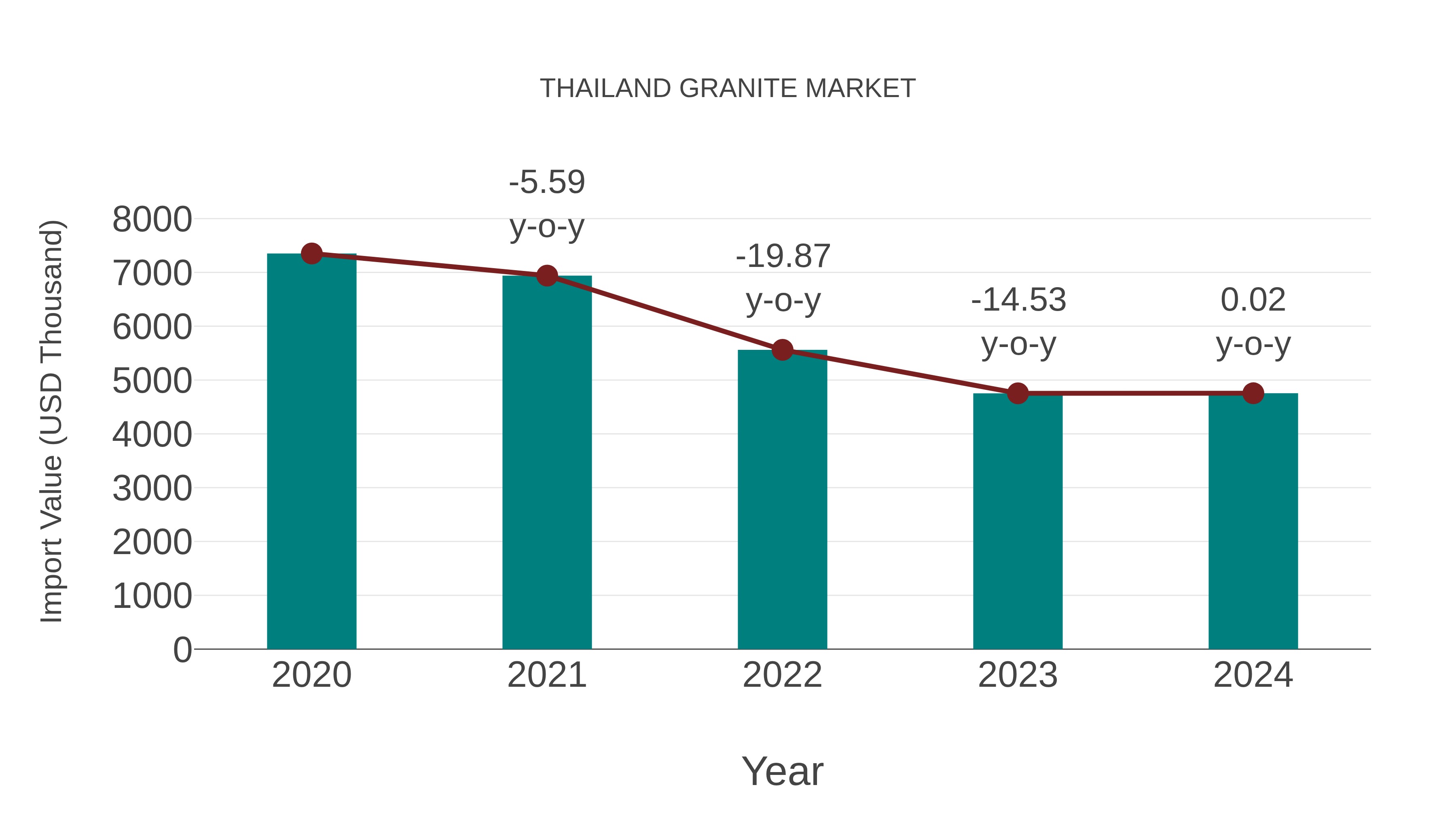
Thailand import trend for the granite market in 2024 saw a minimal growth rate of 0.02%, with a compound annual growth rate (CAGR) of -10.32% for the period 2020-2024. This decline in CAGR may be attributed to a sluggish demand shift or market instability affecting the granite import momentum in Thailand during this period.
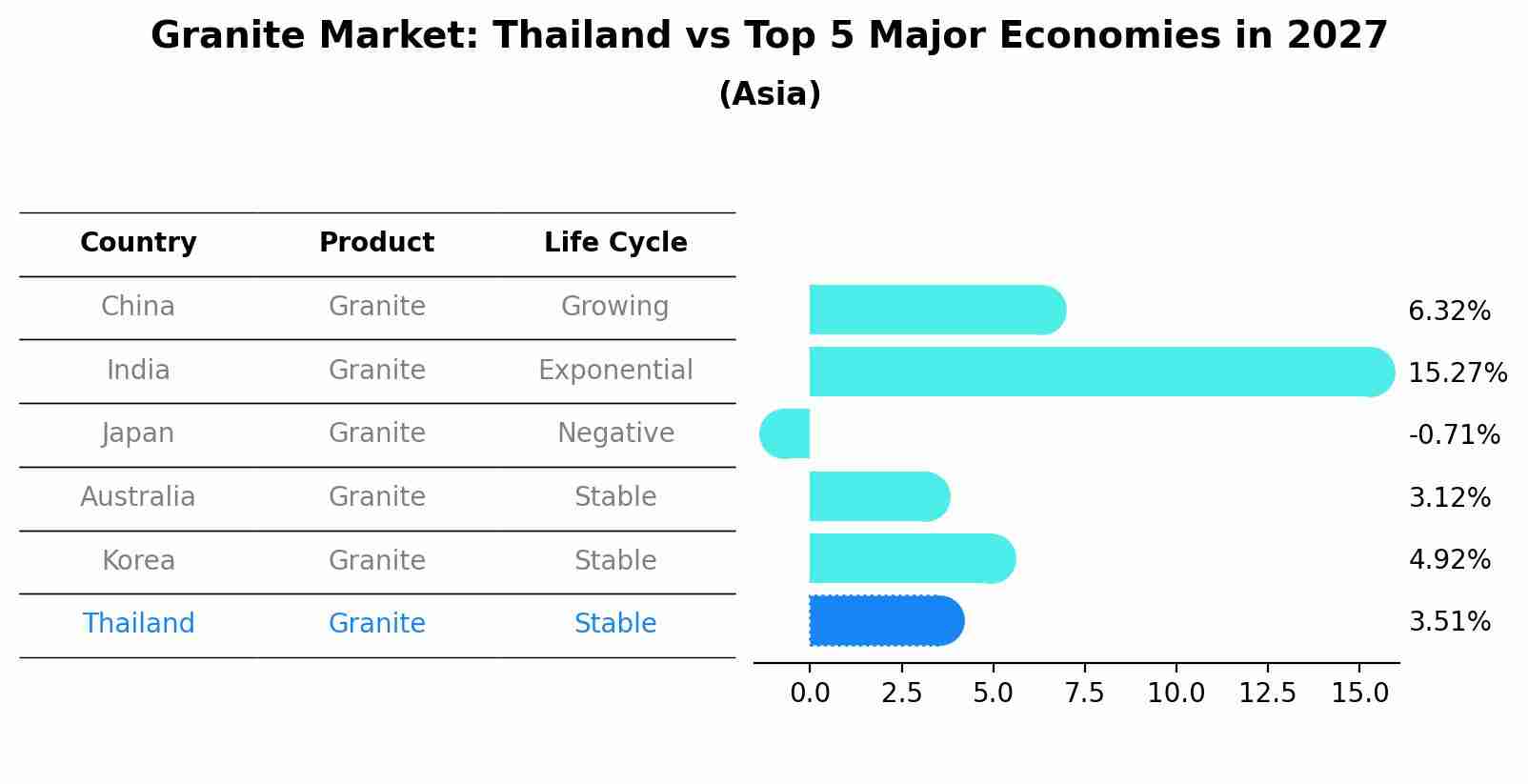
Granite Market: Thailand vs Top 5 Major Economies in 2027 (Asia)
Thailand's Granite market is anticipated to experience a stable growth rate of 3.51% by 2027, reflecting trends observed in the largest economy China, followed by India, Japan, Australia and South Korea.
Thailand Granite Market Synopsis
The granite market in Thailand has been a significant sector within the construction industry. Granite, a durable and attractive natural stone, is widely used for various applications, including countertops, flooring, cladding, monuments, and sculptures. The demand for granite in Thailand has been driven by the country`s construction and infrastructure development projects. Before the Covid-19 pandemic, the Thailand granite market was experiencing steady growth, fueled by construction activities and infrastructure projects. However, the pandemic`s impact temporarily affected market growth due to disruptions in construction activities and supply chains.
Market Drivers
Thailand ongoing infrastructure development projects, such as highways, airports, and commercial buildings, have been a major driver for the granite market. The growth in the real estate sector, including residential and commercial projects, has increased the demand for granite products. Granite`s natural beauty, durability, and resistance to wear and tear make it a preferred choice for various applications. Thailand tourism industry also indirectly impacts the granite market through the development of hotels, resorts, and other tourist facilities that utilize granite in their construction.
Challenges of the Market
The granite market may face challenges due to fluctuations in the Thailand economy, affecting construction activities and consumer spending on real estate. While granite is popular, it faces competition from other natural stones and engineered materials used in construction and interior design. The extraction and processing of granite raise environmental concerns, such as deforestation, land degradation, and water pollution. Ensuring compliance with environmental and safety regulations can be a challenge for industry players.
Covid-19 Impact on the Market
The Covid-19 pandemic had a significant impact on the Thailand granite market. Construction projects were temporarily halted or delayed due to lockdowns and restrictions, affecting the demand for granite products. Additionally, disruptions in supply chains, especially for imported raw materials, affected production capabilities. However, as construction activities gradually resumed, the market started showing signs of recovery.
Key Players of the Market
The Thailand granite market comprises various local and international players involved in the extraction, processing, and distribution of granite products. Some key players in the market include: SCG (Siam Cement Group), Italian Thailand Development Public Company Limited, Tachawit Marble & Granite Co., Ltd., Cemstone Public Company Limited, Bangkok Granite Co., Ltd.
Key Highlights of the Report:
- Thailand Granite Market Outlook
- Market Size of Thailand Granite Market, 2025
- Forecast of Thailand Granite Market, 2032
- Historical Data and Forecast of Thailand Granite Revenues & Volume for the Period 2022-2032F
- Thailand Granite Market Trend Evolution
- Thailand Granite Market Drivers and Challenges
- Thailand Granite Price Trends
- Thailand Granite Porter's Five Forces
- Thailand Granite Industry Life Cycle
- Historical Data and Forecast of Thailand Granite Market Revenues & Volume By Product for the Period 2022-2032F
- Historical Data and Forecast of Thailand Granite Market Revenues & Volume By Granite Slabs for the Period 2022-2032F
- Historical Data and Forecast of Thailand Granite Market Revenues & Volume By Granite Tiles for the Period 2022-2032F
- Historical Data and Forecast of Thailand Granite Market Revenues & Volume By Others for the Period 2022-2032F
- Historical Data and Forecast of Thailand Granite Market Revenues & Volume By Application for the Period 2022-2032F
- Historical Data and Forecast of Thailand Granite Market Revenues & Volume By Kitchen Countertops for the Period 2022-2032F
- Historical Data and Forecast of Thailand Granite Market Revenues & Volume By Flooring for the Period 2022-2032F
- Historical Data and Forecast of Thailand Granite Market Revenues & Volume By Stair Treads for the Period 2022-2032F
- Historical Data and Forecast of Thailand Granite Market Revenues & Volume By Monuments for the Period 2022-2032F
- Historical Data and Forecast of Thailand Granite Market Revenues & Volume By Others for the Period 2022-2032F
- Thailand Granite Import Export Trade Statistics
- Market Opportunity Assessment By Product
- Market Opportunity Assessment By Application
- Thailand Granite Top Companies Market Share
- Thailand Granite Competitive Benchmarking By Technical and Operational Parameters
- Thailand Granite Company Profiles
- Thailand Granite Key Strategic Recommendations






































