Thailand Gypsum Plaster Market: Import Trend Analysis
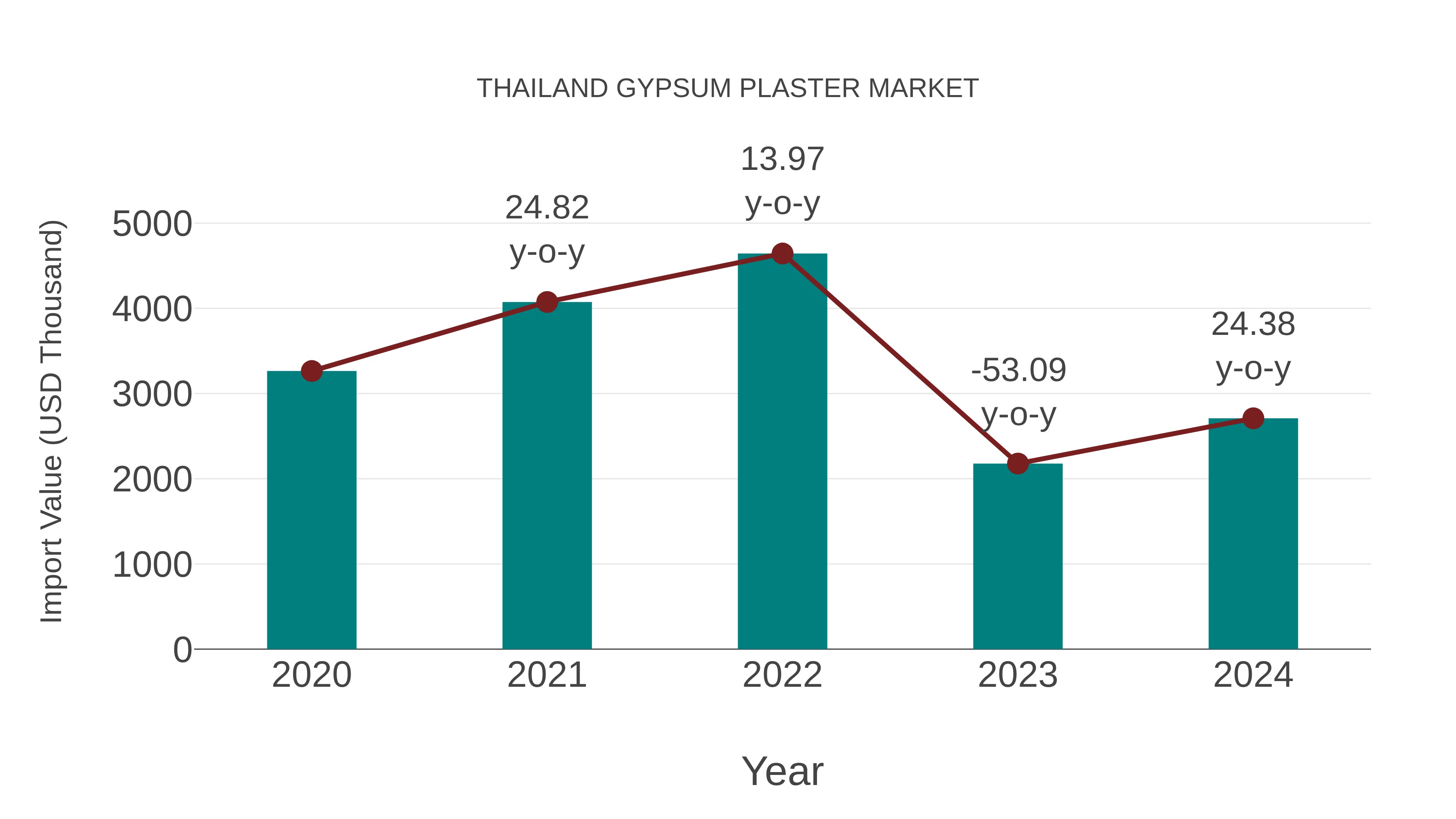
Thailand import trend for gypsum plaster in 2024 showed a significant growth rate of 24.38%, contrasting with a compound annual growth rate (CAGR) of -4.55% from 2020 to 2023. This shift could be attributed to evolving construction demands or changes in trade policies impacting market dynamics.
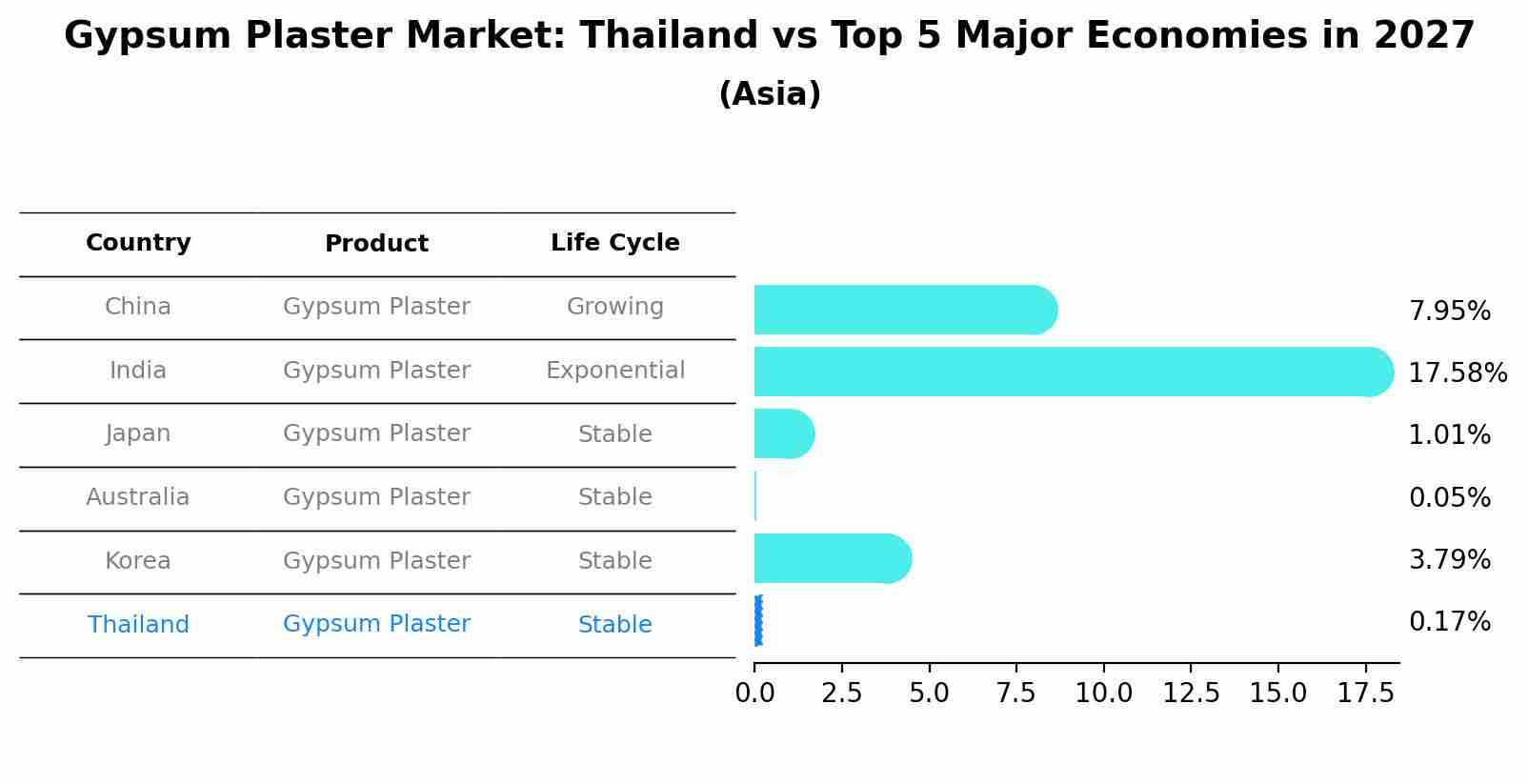
Gypsum Plaster Market: Thailand vs Top 5 Major Economies in 2027 (Asia)
The Gypsum Plaster market in Thailand is projected to grow at a stable growth rate of 0.17% by 2027, within the Asia region led by China, along with other countries like India, Japan, Australia and South Korea, collectively shaping a dynamic and evolving market environment driven by innovation and increasing adoption of emerging technologies.
Thailand Gypsum Plaster Market Synopsis
The gypsum plaster market in Thailand is projected to witness a CAGR of 5.6% during the forecast period. Growing awareness about green building materials coupled with rapid urbanization has been boosting construction activities across residential and non-residential sectors significantly throughout Asia Pacific region, thereby escalating usage rates of gypsum plaster considerably amongst end-users industries operating therein. Moreover stringent environmental regulations imposed on use raw material containing high levels volatile organic compounds (VOCs) also aid product`s consumption prospects as it does not contain any toxic elements nor release hazardous fumes upon drying up, thus making them safe enough even when used indoors. Additionally presence large scale infrastructure projects combined with continuously expanding manufacturing base across South East Asian countries should accelerate regional industry expansion further over coming few years.
Drivers of the Market
The Thailand gypsum plaster market is driven by the construction industry`s demand for versatile and sustainable building materials. Gypsum plaster is known for its ease of application, fire resistance, and sound insulation properties. As construction projects focus on efficiency, aesthetics, and environmental impact, the use of gypsum plaster as a reliable interior finishing material contributes to the market`s growth.
Challenges of the Market
In the Thailand gypsum plaster market, challenges arise from environmental concerns and application techniques. The sustainable sourcing of gypsum and minimizing the environmental impact of extraction and processing remain important considerations. Moreover, optimizing gypsum plaster formulations for various construction applications and ensuring proper installation techniques present ongoing challenges for manufacturers.
COVID-19 Impact on the Market
The Covid-19 pandemic had varying impacts on the Thailand gypsum plaster market. The construction industry, a significant consumer of gypsum plaster, faced disruptions due to lockdowns, reduced construction activity, and supply chain challenges. Delayed projects and reduced investment impacted demand for construction materials. However, as work-from-home dynamics increased demand for home improvement projects, the use of gypsum plaster for renovations and interior design gained traction. The market`s recovery was influenced by government infrastructure initiatives, construction rebound, and changes in housing preferences.
Key Players in the Market
Key participants in the Thailand gypsum plaster market consist of BuildingMaterialsTech Solutions, ThaiGypsum Plasters Ltd., and ConstructionInnovations. These companies specialize in producing gypsum plaster products used in construction and interior design. Their expertise in construction materials and architectural solutions positions them as key contributors to the building industry.
Key Highlights of the Report:
- Thailand Gypsum Plaster Market Outlook
- Market Size of Thailand Gypsum Plaster Market, 2025
- Forecast of Thailand Gypsum Plaster Market, 2032
- Historical Data and Forecast of Thailand Gypsum Plaster Revenues & Volume for the Period 2022-2032F
- Thailand Gypsum Plaster Market Trend Evolution
- Thailand Gypsum Plaster Market Drivers and Challenges
- Thailand Gypsum Plaster Price Trends
- Thailand Gypsum Plaster Porter's Five Forces
- Thailand Gypsum Plaster Industry Life Cycle
- Historical Data and Forecast of Thailand Gypsum Plaster Market Revenues & Volume By Plaster System for the Period 2022-2032F
- Historical Data and Forecast of Thailand Gypsum Plaster Market Revenues & Volume By Manually-applied Plaster for the Period 2022-2032F
- Historical Data and Forecast of Thailand Gypsum Plaster Market Revenues & Volume By Machine-applied Plaster for the Period 2022-2032F
- Historical Data and Forecast of Thailand Gypsum Plaster Market Revenues & Volume By Finishes for the Period 2022-2032F
- Historical Data and Forecast of Thailand Gypsum Plaster Market Revenues & Volume By Raw Material for the Period 2022-2032F
- Historical Data and Forecast of Thailand Gypsum Plaster Market Revenues & Volume By Natural Gypsum for the Period 2022-2032F
- Historical Data and Forecast of Thailand Gypsum Plaster Market Revenues & Volume By Synthetic Gypsum for the Period 2022-2032F
- Historical Data and Forecast of Thailand Gypsum Plaster Market Revenues & Volume By End-use for the Period 2022-2032F
- Historical Data and Forecast of Thailand Gypsum Plaster Market Revenues & Volume By Residential for the Period 2022-2032F
- Historical Data and Forecast of Thailand Gypsum Plaster Market Revenues & Volume By Non-residential for the Period 2022-2032F
- Thailand Gypsum Plaster Import Export Trade Statistics
- Market Opportunity Assessment By Plaster System
- Market Opportunity Assessment By Raw Material
- Market Opportunity Assessment By End-use
- Thailand Gypsum Plaster Top Companies Market Share
- Thailand Gypsum Plaster Competitive Benchmarking By Technical and Operational Parameters
- Thailand Gypsum Plaster Company Profiles
- Thailand Gypsum Plaster Key Strategic Recommendations






































