Thailand Hams, Shoulders and Cuts of Swine Market Size, Share & Growth Rate
The Thailand Hams, Shoulders and Cuts of Swine Market was estimated at USD 111 Million in 2025 and is projected to reach USD 127 Million by 2032, growing at a CAGR of 1.9% from 2026 to 2032. This steady growth is underpinned by a rising demand for processed pork products as Thai consumers increasingly favor convenience and a variety of flavors in their diets. The dual influence of local culinary traditions and international food trends further enhances market potential, creating opportunities for innovation within product offerings.
Thailand Hams, Shoulders and Cuts of Swine Market Year-wise Growth Rate and Key Drivers
This graph highlights how the Thailand Hams, Shoulders and Cuts of Swine Market has steadily grown over the years, supported by major growth factors.
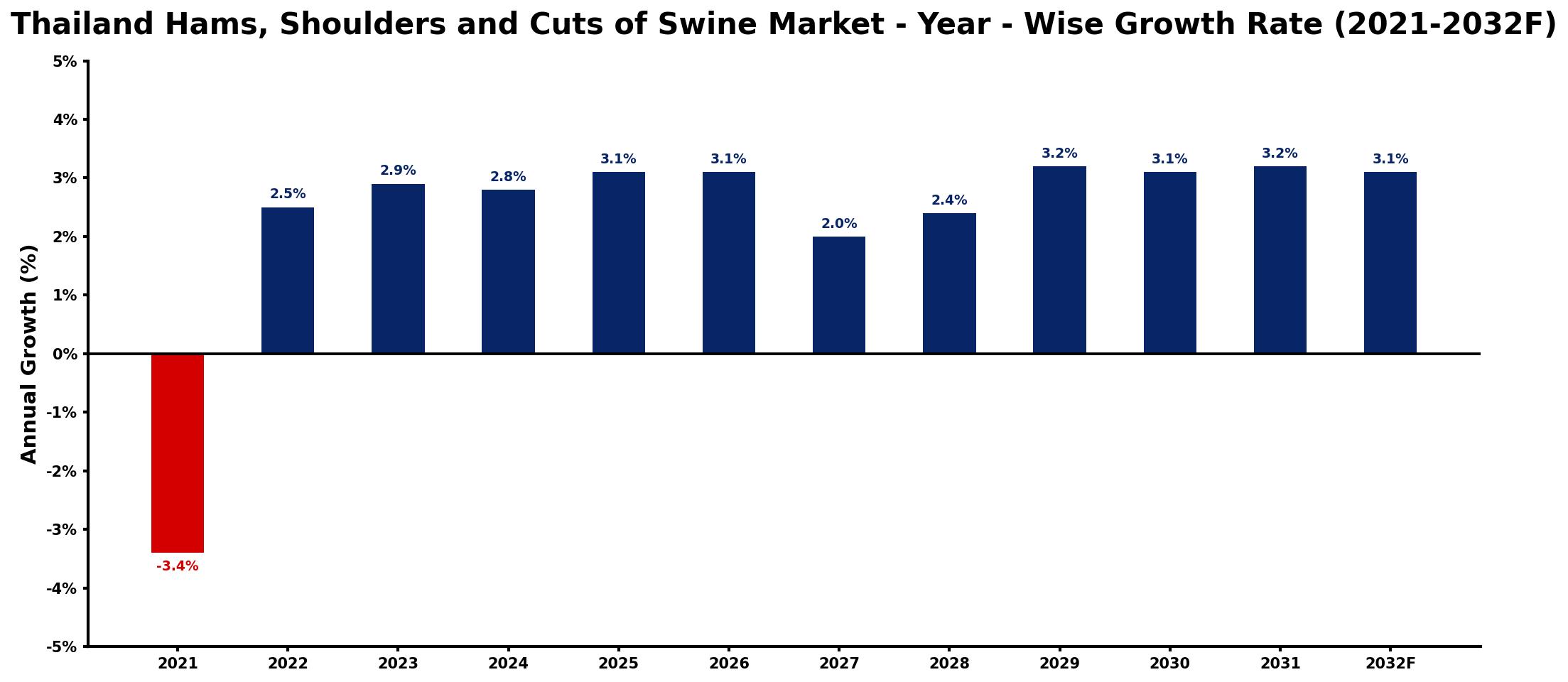
The table below presents the year‑wise growth rates along with the key drivers influencing the market
| Year | Growth Rate | Major Drivers |
| 2021 | -3.4% | decreased consumer spending on meat |
| 2022 | 2.5% | rise in domestic meat consumption |
| 2023 | 2.9% | increased investment in processing |
| 2024 | 2.8% | growing demand for premium products |
| 2025 | 3.1% | expansion of export markets |
| 2026 | 3.1% | enhanced supply chain efficiency |
| 2027 | 2.0% | increased popularity of local brands |
| 2028 | 2.4% | growth in health-conscious consumers |
| 2029 | 3.2% | rising urban population demand |
| 2030 | 3.1% | rising export shipment volumes |
| 2031 | 3.2% | increased focus on sustainability |
| 2032 | 3.1% | growing adoption of online retail |
Note: Market size estimations and growth projections presented in this report are based on 6Wresearch's proprietary forecasting methodology, utilizing the latest available industry data, government publications, and primary research inputs.
Thailand Hams, Shoulders and Cuts of Swine Market Synopsis
In Thailand, hams, shoulders, and cuts of swine are essential staples in both daily meals and festive occasions. The versatility of these products makes them integral to Thai cuisine, where they can be found in both street food and high-end dining establishments. Additionally, the processing industry is well-developed, facilitating efficient production and distribution to meet the varying needs of consumers.
The market is characterized by a rich variety of offerings, including smoked and cured options, which cater to a broad spectrum of taste preferences. Increased dining-out culture, coupled with the rising popularity of international dishes, has led to a greater incorporation of pork products in diverse culinary applications. This creates an ever-evolving landscape that challenges producers to keep pace with consumer demands.
Thailand Hams, Shoulders and Cuts of Swine Market Key Takeaways
- The market is poised for steady growth due to changing consumer preferences towards convenience foods.
- Diverse product offerings play a crucial role in appealing to a wide range of consumers.
- Thailand's established processing industry ensures a reliable supply of pork products.
- The increasing dining-out culture has heightened the demand for ready-to-eat and processed options.
- Health-conscious trends are influencing consumers towards choices perceived as more natural and locally sourced.
Evaluation of Restraints in Thailand Hams, Shoulders and Cuts of Swine Market
Despite its robust characteristics, the Thailand Hams, Shoulders and Cuts of Swine Market faces certain restraints that could limit its potential. Notably, competition from established pork producers complicates market dynamics, leading to price volatility and intensified marketing efforts. Additionally, stringent food safety regulations demand adherence, requiring continuous investment in quality assurance. The publics increasing health concerns surrounding processed meats pose another challenge, compelling producers to adapt their offerings while navigating shifting consumer preferences towards healthier alternatives.
Thailand Hams, Shoulders and Cuts of Swine Market Trends
Several trends are shaping the Thailand Hams, Shoulders and Cuts of Swine Market as consumer tastes evolve. A growing emphasis on sustainable and ethical farming practices is prompting producers to enhance transparency in sourcing, thereby appealing to health-conscious consumers. Additionally, innovative processing techniques are being adopted to improve product quality and extend shelf life, which aligns well with the increasing demand for convenience. The rise of social media platforms is also influencing dining choices, driving interest in diverse pork products and culinary experimentation.
Thailand Hams, Shoulders and Cuts of Swine Market Opportunities
Opportunities for growth within the Thailand Hams, Shoulders and Cuts of Swine Market are abundant. Producers can focus on developing premium product lines that cater to health-conscious consumers, such as low-sodium or organic options. There is also potential in expanding export capabilities, especially to regions with increasing interest in Thai cuisine. Capitalizing on food delivery and online shopping trends provides additional channels for reaching a broader audience, enabling producers to engage with consumers directly and cultivate brand loyalty.
Government Initiatives in the Thailand Hams, Shoulders and Cuts of Swine Market
The Thai government has implemented several initiatives aimed at supporting the pork industry, particularly regarding food safety regulations and quality standards. Programs promoting sustainable farming practices and financial incentives for modernizing processing facilities are designed to enhance the market's competitiveness. Furthermore, public awareness campaigns about the nutritional value of pork are expected to bolster demand, aligning with government goals of improving local agricultural production.
Future Insights of the Thailand Hams, Shoulders and Cuts of Swine Market
Looking ahead to 2026-2032, the Thailand Hams, Shoulders and Cuts of Swine Market is expected to see gradual evolution driven by an increasing focus on health, sustainability, and convenience. As consumers continue to seek more diverse and high-quality food options, businesses that innovate and adapt will likely thrive. Moreover, the growing trend of globalization will expose local producers to international markets, offering avenues for expansion beyond domestic sales. Investment in technology and sustainable practices will be critical to maintaining market relevance and competitiveness.
Thailand Hams, Shoulders and Cuts of Swine Market Latest Developments (2025 - 2026)
Recent developments in the Thailand Hams, Shoulders and Cuts of Swine Market have been marked by increased focus on health-conscious products. Some processors have started to introduce low-fat and organic options in response to consumer demands for healthier choices. Concurrently, efforts to modernize production facilities have intensified, driven by the need to meet stringent food safety standards. The ongoing trend towards e-commerce has led several businesses to enhance their online presence and explore partnerships with delivery services, aiming to capture a broader customer base.
Thailand Hams, Shoulders and Cuts of Swine Market - Key Attractiveness of the Report
- 10 Years of Market Numbers
- Historical Data Starting from 2022 to 2025
- Base Year: 2025
- Forecast Data until 2032
- Key Performance Indicators Impacting the Market
- Major Upcoming Developments and Projects
Key Highlights of the Report:
- Thailand Hams, Shoulders and Cuts of Swine Market Outlook
- Market Size of Thailand Hams, Shoulders and Cuts of Swine Market, 2025
- Forecast of Thailand Hams, Shoulders and Cuts of Swine Market, 2032
- Historical Data and Forecast of Thailand Hams, Shoulders and Cuts of Swine Revenues & Volume for the Period 2022-2032F
- Thailand Hams, Shoulders and Cuts of Swine Market Trend Evolution
- Thailand Hams, Shoulders and Cuts of Swine Market Drivers and Challenges
- Thailand Hams, Shoulders and Cuts of Swine Price Trends
- Thailand Hams, Shoulders and Cuts of Swine Porter's Five Forces
- Thailand Hams, Shoulders and Cuts of Swine Industry Life Cycle
- Historical Data and Forecast of Thailand Hams, Shoulders and Cuts of Swine Market Revenues & Volume By Product Type for the Period 2022-2032F
- Historical Data and Forecast of Thailand Hams, Shoulders and Cuts of Swine Market Revenues & Volume By Processed Meat for the Period 2022-2032F
- Historical Data and Forecast of Thailand Hams, Shoulders and Cuts of Swine Market Revenues & Volume By Frozen Meat for the Period 2022-2032F
- Historical Data and Forecast of Thailand Hams, Shoulders and Cuts of Swine Market Revenues & Volume By Chilled Meat for the Period 2022-2032F
- Historical Data and Forecast of Thailand Hams, Shoulders and Cuts of Swine Market Revenues & Volume By Canned Meat for the Period 2022-2032F
- Historical Data and Forecast of Thailand Hams, Shoulders and Cuts of Swine Market Revenues & Volume By Fresh Meat for the Period 2022-2032F
- Historical Data and Forecast of Thailand Hams, Shoulders and Cuts of Swine Market Revenues & Volume By Animal Type for the Period 2022-2032F
- Historical Data and Forecast of Thailand Hams, Shoulders and Cuts of Swine Market Revenues & Volume By Cattle and Buffalo for the Period 2022-2032F
- Historical Data and Forecast of Thailand Hams, Shoulders and Cuts of Swine Market Revenues & Volume By Pig for the Period 2022-2032F
- Historical Data and Forecast of Thailand Hams, Shoulders and Cuts of Swine Market Revenues & Volume By Poultry for the Period 2022-2032F
- Historical Data and Forecast of Thailand Hams, Shoulders and Cuts of Swine Market Revenues & Volume By Sheep and Goat for the Period 2022-2032F
- Historical Data and Forecast of Thailand Hams, Shoulders and Cuts of Swine Market Revenues & Volume By Other Animals for the Period 2022-2032F
- Historical Data and Forecast of Thailand Hams, Shoulders and Cuts of Swine Market Revenues & Volume By Distribution Channel for the Period 2022-2032F
- Historical Data and Forecast of Thailand Hams, Shoulders and Cuts of Swine Market Revenues & Volume By Business to Consumers (B2C) for the Period 2022-2032F
- Historical Data and Forecast of Thailand Hams, Shoulders and Cuts of Swine Market Revenues & Volume By Modern Groceries for the Period 2022-2032F
- Historical Data and Forecast of Thailand Hams, Shoulders and Cuts of Swine Market Revenues & Volume By Wet & Butcher Shops for the Period 2022-2032F
- Historical Data and Forecast of Thailand Hams, Shoulders and Cuts of Swine Market Revenues & Volume By Convenience Stores for the Period 2022-2032F
- Historical Data and Forecast of Thailand Hams, Shoulders and Cuts of Swine Market Revenues & Volume By Business to Business (B2B) for the Period 2022-2032F
- Historical Data and Forecast of Thailand Hams, Shoulders and Cuts of Swine Market Revenues & Volume By Other Channel for the Period 2022-2032F
- Thailand Hams, Shoulders and Cuts of Swine Import Export Trade Statistics
- Market Opportunity Assessment By Product Type
- Market Opportunity Assessment By Animal Type
- Market Opportunity Assessment By Distribution Channel
- Thailand Hams, Shoulders and Cuts of Swine Top Companies Market Share
- Thailand Hams, Shoulders and Cuts of Swine Competitive Benchmarking By Technical and Operational Parameters
- Thailand Hams, Shoulders and Cuts of Swine Company Profiles
- Thailand Hams, Shoulders and Cuts of Swine Key Strategic Recommendations






































