Thailand Hay Making Machinery Market Size, Share & Growth Rate
The Thailand Hay Making Machinery Market was estimated at USD 186 Million in 2025 and is projected to reach USD 214 Million by 2032, growing at a CAGR of 2.0% from 2026 to 2032. This steady growth trajectory reflects the increasing need for mechanization among Thai farmers, driven by advancements in agricultural practices and a growing livestock sector. As the demand for high-quality animal feed rises, the significance of efficient hay production methods becomes more pronounced, fostering opportunities for further technological innovations in this market.
Thailand Hay Making Machinery Market Year-wise Growth Rate and Key Drivers
This graph highlights how the Thailand Hay Making Machinery Market has steadily grown over the years, supported by major growth factors.
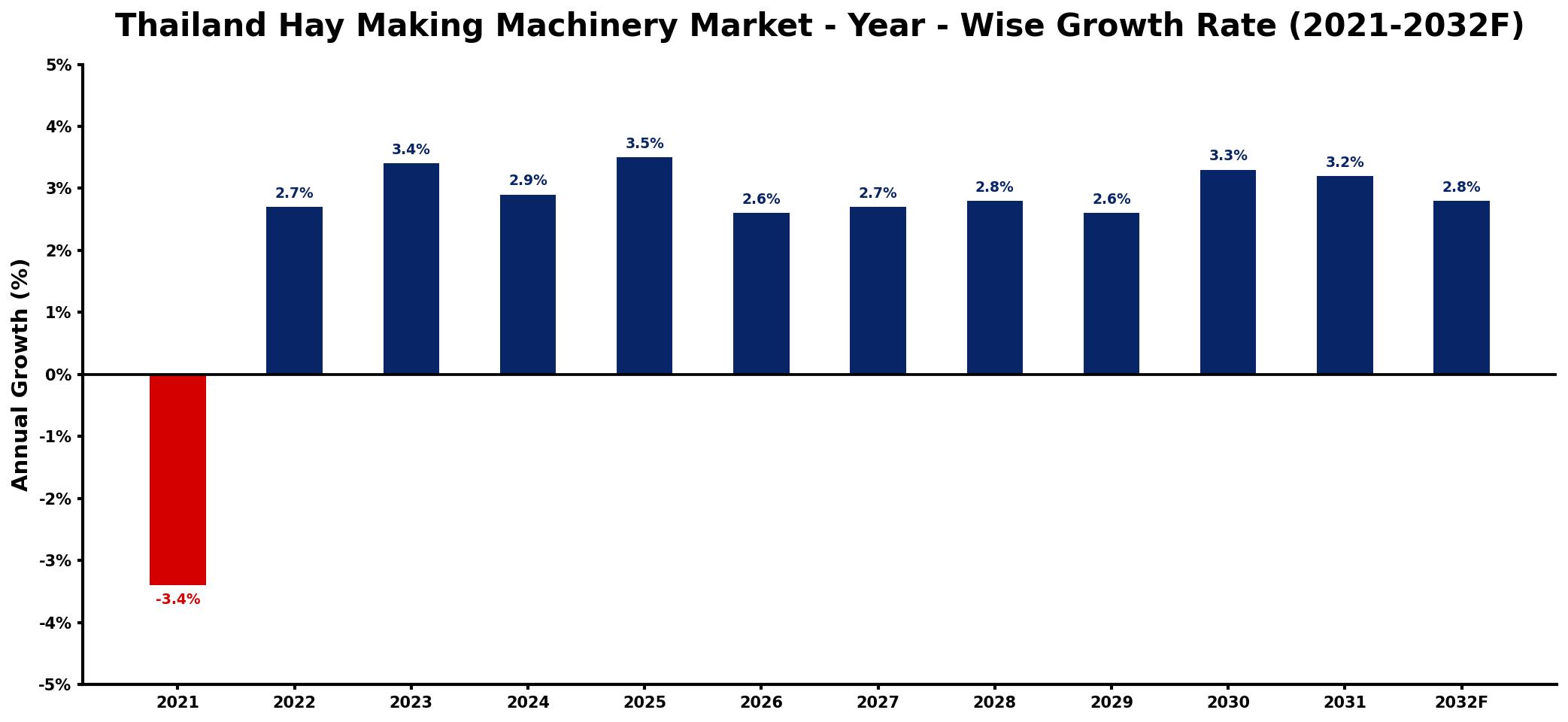
The table below presents the year‑wise growth rates along with the key drivers influencing the market
| Year | Growth Rate | Major Drivers |
| 2021 | -3.4% | decreased agricultural investment levels |
| 2022 | 2.7% | rising demand for efficient technology |
| 2023 | 3.4% | increased focus on sustainable practices |
| 2024 | 2.9% | growth in livestock farming sector |
| 2025 | 3.5% | expansion of rural financing options |
| 2026 | 2.6% | higher adoption of automation solutions |
| 2027 | 2.7% | increased exports of agricultural products |
| 2028 | 2.8% | growing interest in precision agriculture |
| 2029 | 2.6% | development of new farming techniques |
| 2030 | 3.3% | enhanced government support initiatives |
| 2031 | 3.2% | rising consumer demand for quality |
| 2032 | 2.8% | advancements in agricultural research |
Note: Market size estimations and growth projections presented in this report are based on 6Wresearch's proprietary forecasting methodology, utilizing the latest available industry data, government publications, and primary research inputs.
Thailand Hay Making Machinery Market Synopsis
In Thailand, the hay making machinery market is thriving, closely tied to the agriculture sector's evolution. Farmers are increasingly turning to modern machinery to enhance their hay production processes, driven by a need for efficiency and sustainability. Hay balers, mowers, and rakes are not just tools; they are vital components in meeting the rising demand for livestock feed, particularly as the country sees a surge in animal farming.
The Thai agricultural landscape is characterized by a unique blend of traditional practices and modern innovations. Government initiatives aimed at boosting productivity, coupled with a growing emphasis on exports, are steering farmers toward investing in advanced hay making machinery. This shift is pivotal for ensuring competitive advantage in both local and global markets.
Thailand Hay Making Machinery Market Key Takeaways
- The market is driven by increased livestock farming and the modernization of agricultural practices.
- Government initiatives to enhance agricultural productivity play a crucial role in market growth.
- Stable demand for hay making machinery was observed even during the COVID-19 pandemic.
- Export opportunities for hay products are on the rise, boosting production capacities.
- Challenges remain, including seasonal demand fluctuations and reliance on machinery performance in adverse weather.
Evaluation of Restraints in Thailand Hay Making Machinery Market
Despite the growth potential, several restraints hinder the Thailand Hay Making Machinery Market. Seasonality significantly affects demand, causing fluctuations that can complicate manufacturing and sales processes. Additionally, adverse weather conditions pose challenges for farmers, as they need equipment that can perform reliably across various environments. There is also a pressing need for machinery that can handle diverse forage types while preserving their nutritional value, which limits options for many producers. These factors combine to create an environment where market players must adapt continuously to meet evolving customer needs.
Thailand Hay Making Machinery Market Trends
Several trends are currently shaping the Thailand Hay Making Machinery Market. One significant trend is the increasing integration of smart technology into hay making equipment, allowing for enhanced precision and efficiency. Farmers are keen to adopt IoT solutions that enable real-time monitoring and data analytics, optimizing production processes. Additionally, sustainability has become a priority, with eco-friendly machinery gaining popularity as producers seek to reduce their carbon footprint and meet growing consumer demand for sustainably sourced products.
Thailand Hay Making Machinery Market Opportunities
The market presents genuine growth and investment opportunities, particularly in the realm of technological advancements. Companies that focus on developing smarter, more efficient machinery stand to gain a competitive edge. Furthermore, expanding agricultural export markets create avenues for increasing production capacities and diversifying offerings. Targeting niche segments, such as organic farming and sustainable practices, will also allow manufacturers to tap into a more environmentally conscious customer base.
Government Initiatives in the Thailand Hay Making Machinery Market
The Thai government plays an active role in supporting the agricultural sector through various initiatives aimed at improving productivity and reducing post-harvest losses. Funding and subsidy programs for advanced agricultural equipment have been established to encourage farmers to modernize their practices. Additionally, training programs aimed at educating farmers on best practices in machinery use and maintenance further empower them to maximize efficiency and yield.
Future Insights of the Thailand Hay Making Machinery Market
Looking ahead to the period from 2026 to 2032, the Thailand Hay Making Machinery Market is anticipated to evolve significantly. As farmers increasingly embrace technology, the trend towards automation and smart farming will likely continue to gain momentum. Moreover, ongoing government support and a rising focus on sustainability will further bolster market growth. By addressing the challenges of seasonality and machinery reliability, manufacturers that innovate will not only survive but thrive in this dynamic environment.
Thailand Hay Making Machinery Market Latest Developments (2025 - 2026)
Recent developments in the Thailand Hay Making Machinery Market indicate a shift towards more automated solutions, with several manufacturers focusing on integrating AI capabilities into their equipment. This focus aims to improve operational efficiency and reduce human error. Furthermore, increased collaborations between machinery producers and agricultural cooperatives are being seen, fostering the sharing of best practices and resources. Such collaborations are expected to enhance the overall productivity of the agriculture sector.
Thailand Hay Making Machinery Market - Key Attractiveness of the Report
- 10 Years of Market Numbers
- Historical Data Starting from 2022 to 2025
- Base Year: 2025
- Forecast Data until 2032
- Key Performance Indicators Impacting the Market
- Major Upcoming Developments and Projects
Key Highlights of the Report:
- Thailand Hay Making Machinery Market Outlook
- Market Size of Thailand Hay Making Machinery Market, 2025
- Forecast of Thailand Hay Making Machinery Market, 2032
- Historical Data and Forecast of Thailand Hay Making Machinery Revenues & Volume for the Period 2022-2032F
- Thailand Hay Making Machinery Market Trend Evolution
- Thailand Hay Making Machinery Market Drivers and Challenges
- Thailand Hay Making Machinery Price Trends
- Thailand Hay Making Machinery Porter's Five Forces
- Thailand Hay Making Machinery Industry Life Cycle
- Historical Data and Forecast of Thailand Hay Making Machinery Market Revenues & Volume By Type for the Period 2022-2032F
- Historical Data and Forecast of Thailand Hay Making Machinery Market Revenues & Volume By Mower for the Period 2022-2032F
- Historical Data and Forecast of Thailand Hay Making Machinery Market Revenues & Volume By Balers for the Period 2022-2032F
- Historical Data and Forecast of Thailand Hay Making Machinery Market Revenues & Volume By Tedder for the Period 2022-2032F
- Historical Data and Forecast of Thailand Hay Making Machinery Market Revenues & Volume By Rakes for the Period 2022-2032F
- Thailand Hay Making Machinery Import Export Trade Statistics
- Market Opportunity Assessment By Type
- Thailand Hay Making Machinery Top Companies Market Share
- Thailand Hay Making Machinery Competitive Benchmarking By Technical and Operational Parameters
- Thailand Hay Making Machinery Company Profiles
- Thailand Hay Making Machinery Key Strategic Recommendations






































