Thailand Household Cleaning Products Market: Import Trend Analysis
Thailand household cleaning products market witnessed a significant decline in imports from 2020 to 2024, with a CAGR of -89.77%. This steep negative growth indicates a substantial contraction in demand or a shift in consumer preferences, impacting market stability and import momentum adversely.
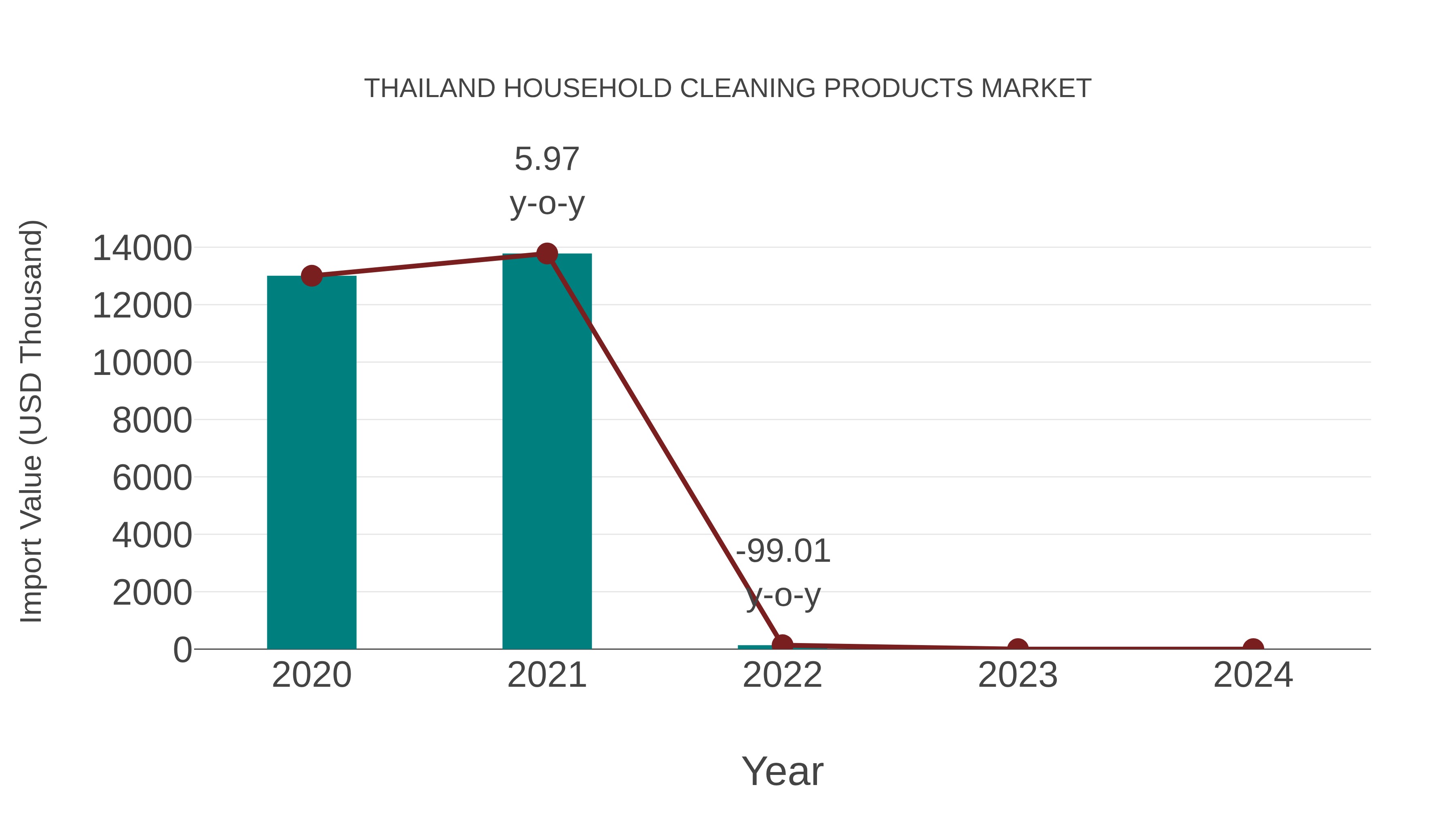
Thailand Household Cleaning Products Market Growth Rate
According to 6Wresearch internal database and industry insights, the Thailand Household Cleaning Products Market is projected to grow at a compound annual growth rate (CAGR) of 5.2% during the forecast period (2026-2032).
Topics Covered in the Thailand Household Cleaning Products Market Report
The Thailand Household Cleaning Products Market report thoroughly covers the market by product type. The report provides an unbiased and detailed analysis of ongoing market trends, opportunities/high-growth areas, and market drivers, helping stakeholders devise and align their market strategies according to the current and future market dynamics.
Thailand Household Cleaning Products Market Highlights
| Report Name | Thailand Household Cleaning Products Market |
| Forecast Period | 2026–2032 |
| CAGR | 5.2% |
| Growing Sector | Laundry Detergents |
Thailand Household Cleaning Products Market Synopsis
The Thailand Household Cleaning Products Market is witnessing major growth, which is spurred by the rising consumer awareness about hygiene and sanitation, particularly post-pandemic. Along with this, increasing health consciousness, coupled with the rising demand for green cleaning solutions, is propelling the expansion of the market. Additional factors that are supporting the growth of the market include the growing adoption of multi-functional cleaning products and the increasing purchasing power.
Evaluation of Growth Drivers in the Thailand Household Cleaning Products Market
Below mentioned are some prominent drivers and their influence on market dynamics:
| Drivers | Primary Segments Affected | Why it Matters (Evidence) |
| Increasing Health Consciousness | All Segments | The growing awareness of cleanliness and hygiene, particularly in the wake of the pandemic, is increasing demand. |
| Adoption of Eco-friendly Products | Laundry Detergents, Surface Cleaners, Others | Evolving consumer preference for green and nontoxic products is transforming the growth of the market. |
| Urbanization and Growing Disposable Income | All Segments | Rising purchasing power is propelling the demand for household cleaning solutions. |
| Growth of Online Retail | Distribution Channel, All Segments | The expanding e-commerce platforms make it easier for consumers to access cleaning products. |
| Technological Advancements in Products | Laundry Detergents, Toilet Cleaners | The advancement of technology like multi-purpose cleaners is fueling the expansion of the market. |
The Thailand Household Cleaning Products Market is expected to witness major growth at a CAGR of 5.2% during the forecast period (2026-2032). This growth is propelled by factors such as the rising demand for sanitation products, along with health consciousness and the evolving preference for natural cleaning solutions. Additionally, the rising middle-class population, combined with development and increasing purchasing power, is likely to accelerate the demand for cleaning products. Along with this, the increasing adoption of online and offline distribution channels is expected to propel the expansion of the market.
Evaluation of Restraints in the Thailand Household Cleaning Products Market
Below mentioned are some major restraints and their influence on market dynamics:
| Restraints | Primary Segments Affected | What This Means (Evidence) |
| High Price of Eco-friendly Products | Laundry Detergents, Surface Cleaners, Others | The premium cost of ecofriendly products is restricting their affordability in the market. |
| Availability of Counterfeit Products | All Segments | The presence of fake cleaning products can hurt consumer trust, which may slow down the expansion of the market. |
| Lack of Awareness of Product Efficacy | Surface Cleaners, Toilet Cleaners | Lack of awareness regarding the effectiveness of new cleaning products can slow down the market adoption. |
| Price Sensitivity in Emerging Markets | Laundry Detergents, Dishwashing Products | Price sensitivity of consumers in remote regions may affect the growth of high-priced cleaning solutions. |
| Supply Chain Disruptions | All Segments | Natural disasters and transportation disruptions could delay the production. |
Thailand Household Cleaning Products Market Challenges
Despite steady growth due to active demand from homes and businesses, the Thailand Household Cleaning Products Market faces several challenges. Issues such as fluctuating raw material prices affecting the product costs pose a major challenge in the production of the products. Additionally, manufacturers pose hurdles due to strict regulations on chemical ingredients and packaging. Another issue is the rising competition among many brands, which slows down the growth of the small companies.
Thailand Household Cleaning Products Market Trends
The following are key trends transforming the growth of the market:
- Technological Advancements in Cleaning Products: The advancements of technology in formulations and packaging, such as water-efficient cleaning products, are increasing the accessibility of the products.
- Shift Towards Eco-friendly Products: The increasing demand for green and non-toxic cleaning products is growing rapidly as many consumers adopt sustainable products.
- Growth of E-commerce: The expansion of the online shopping platforms for household products is improving consumer access to cleaning products across various industries.
- Convenience and Multi-functional Products: The increasing consumer demand for products that serve multiple purposes is transforming the product offerings.
Investment Opportunities in the Thailand Household Cleaning Products Market
The following are major investment opportunities that are anticipated to expand the revenue of the market:
- Expansion of Distribution Channels: Investment in both physical retail stores and digital platforms will increase the availability of cleaning products in rural areas.
- Product Innovation: The progress in eco-friendly and green products will create major growth opportunities, which are expected to propel the growth of the market.
- Technological Integration in Manufacturing: The advancements of technology in manufacturing techniques will increase product efficiency and meeting the rising need needs for more specialized cleaning solutions.
- Sustainability Initiatives: By investing in green sourcing practices, companies can attract ecofriendly consumers, coupled with the global push for sustainability.
Top 5 Leading Players in the Thailand Household Cleaning Products Market
Here is a list of prominent players leading the Thailand Household Cleaning Products Market:
1. Unilever
| Company Name | Unilever |
|---|---|
| Established Year | 1932 |
| Headquarters | Bangkok, Thailand |
| Official Website | Click Here |
Unilever Thailand is a major participant in the country’s household cleaning products market. The company offers a wide portfolio of consumer goods including detergents, surface cleaners, and home hygiene products. With strong distribution networks and well-known brands, Unilever continues to play a key role in Thailand’s consumer goods sector.
2. Procter & Gamble
| Company Name | Procter & Gamble (P&G) |
|---|---|
| Established Year | 1988 |
| Headquarters | Bangkok, Thailand |
| Official Website | Click Here |
Procter & Gamble Thailand is a significant competitor in the household cleaning market, offering well-known brands such as Mr. Clean, Ariel, and Downy. The company focuses on advanced cleaning technologies, strong marketing strategies, and product innovation to maintain its strong position in the Thai market.
3. Lion Corporation
| Company Name | Lion Corporation |
|---|---|
| Established Year | 1989 |
| Headquarters | Bangkok, Thailand |
| Official Website | Click Here |
Lion Corporation Thailand provides a wide range of household cleaning and personal care products. Popular products include Top laundry detergent and Toxicol disinfectant, which are widely used in Thai households for laundry care, sanitation, and everyday cleaning needs.
4. Kao Corporation Thailand
| Company Name | Kao Corporation |
|---|---|
| Established Year | 1992 |
| Headquarters | Bangkok, Thailand |
| Official Website | Click Here |
Kao Corporation Thailand offers various household cleaning products designed for effective hygiene and sanitation. Its flagship brands such as Magiclean and Attack are widely recognized for their strong cleaning performance and are commonly used in Thai homes for laundry and surface cleaning.
5. SC Johnson
| Company Name | SC Johnson |
|---|---|
| Established Year | 1985 |
| Headquarters | Bangkok, Thailand |
| Official Website | Click Here |
SC Johnson Thailand supplies a variety of household and professional cleaning solutions. The company is known for popular brands such as Windex, Pledge, and Drano, which are widely used for glass cleaning, furniture care, and drain maintenance in households and commercial environments.
Government Regulations in the Thailand Household Cleaning Products Market
According to the Thai government data, there are many guidelines in place to ensure the safety and quality of household cleaning products. For example, the Food and Drug Administration (FDA) in Thailand supervises the production and sale of cleaning products to confirm they meet safety standards, and it is estimated to drive the development of the market. These regulations are proposed to protect consumers and boost confidence in the products.
Future Insights of the Thailand Household Cleaning Products Market
The Thailand Household Cleaning Products Market is expected to grow steadily in the future as consumers are actively prioritising cleanliness and hygiene. The rising demand for easy-to-use and eco-friendly products will likely expand the growth of the market. In the coming years, the ongoing rise of online sales and retail will contribute to enhancing the accessibility of the products, also shaping the market dynamics. Additionally, the market's promising future is driven by several innovations in product formulas and sustainable packaging.
Market Segmentation Analysis
This report provides an inclusive study of the following market segments and their leading categories:
By Product Type - Laundry Detergents to Dominate
According to Shivanshi, Senior Research Analyst, 6Wresearch, laundry detergents hold the largest Thailand household cleaning products market share, which is propelled by the daily household usage, rising awareness of fabric care, convenience, consistent consumer demand and evolving hygiene-conscious lifestyles in the country.
Key Attractiveness of the Report
- 10 Years of Market Numbers
- Historical Data Starting from 2022 to 2025
- Base Year: 2025
- Forecast Data until 2032
- Key Performance Indicators Impacting the Market
- Major Upcoming Developments and Projects
Key Highlights of the Report:
- Thailand Household Cleaning Products Market Outlook
- Market Size of Thailand Household Cleaning Products Market, 2025
- Forecast of Thailand Household Cleaning Products Market, 2032
- Historical Data and Forecast of Thailand Household Cleaning Products Revenues & Volume for the Period 2019-2032F
- Thailand Household Cleaning Products Market Trend Evolution
- Thailand Household Cleaning Products Market Drivers and Challenges
- Thailand Household Cleaning Products Price Trends
- Thailand Household Cleaning Products Porter's Five Forces
- Thailand Household Cleaning Products Industry Life Cycle
- Historical Data and Forecast of Thailand Household Cleaning Products Market Revenues & Volume By Product Type for the Period 2019-2032F
- Historical Data and Forecast of Thailand Household Cleaning Products Market Revenues & Volume By Laundry Detergents for the Period 2019-2032F
- Historical Data and Forecast of Thailand Household Cleaning Products Market Revenues & Volume By Surface Cleaners for the Period 2019-2032F
- Historical Data and Forecast of Thailand Household Cleaning Products Market Revenues & Volume By Dishwashing Products for the Period 2019-2032F
- Historical Data and Forecast of Thailand Household Cleaning Products Market Revenues & Volume By Toilet Cleaners for the Period 2019-2032F
- Historical Data and Forecast of Thailand Household Cleaning Products Market Revenues & Volume By Others for the Period 2019-2032F
- Thailand Household Cleaning Products Import Export Trade Statistics
- Market Opportunity Assessment By Product Type
- Thailand Household Cleaning Products Top Companies Market Share
- Thailand Household Cleaning Products Competitive Benchmarking By Technical and Operational Parameters
- Thailand Household Cleaning Products Company Profiles
- Thailand Household Cleaning Products Key Strategic Recommendations
Markets Covered:
The Market report covers a detailed analysis of the following market segments:
By Product Type
- Laundry Detergents
- Surface Cleaners
- Dishwashing Products
- Toilet Cleaners






































