Thailand HVAC System Market Size Growth Rate
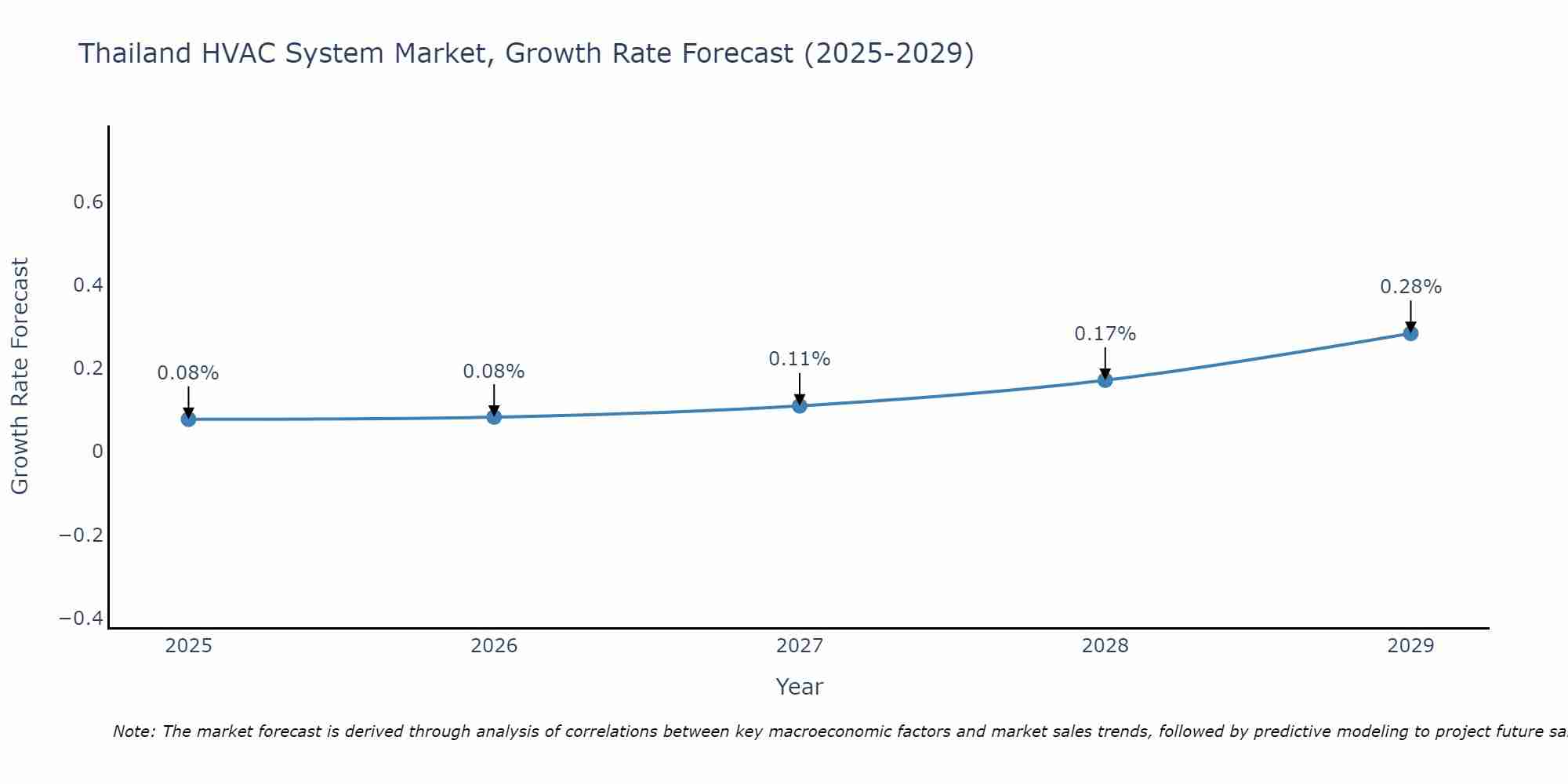
The Thailand HVAC System Market is poised for steady growth rate improvements from 2025 to 2029. Commencing at 0.08% in 2025, growth builds up to 0.28% by 2029.
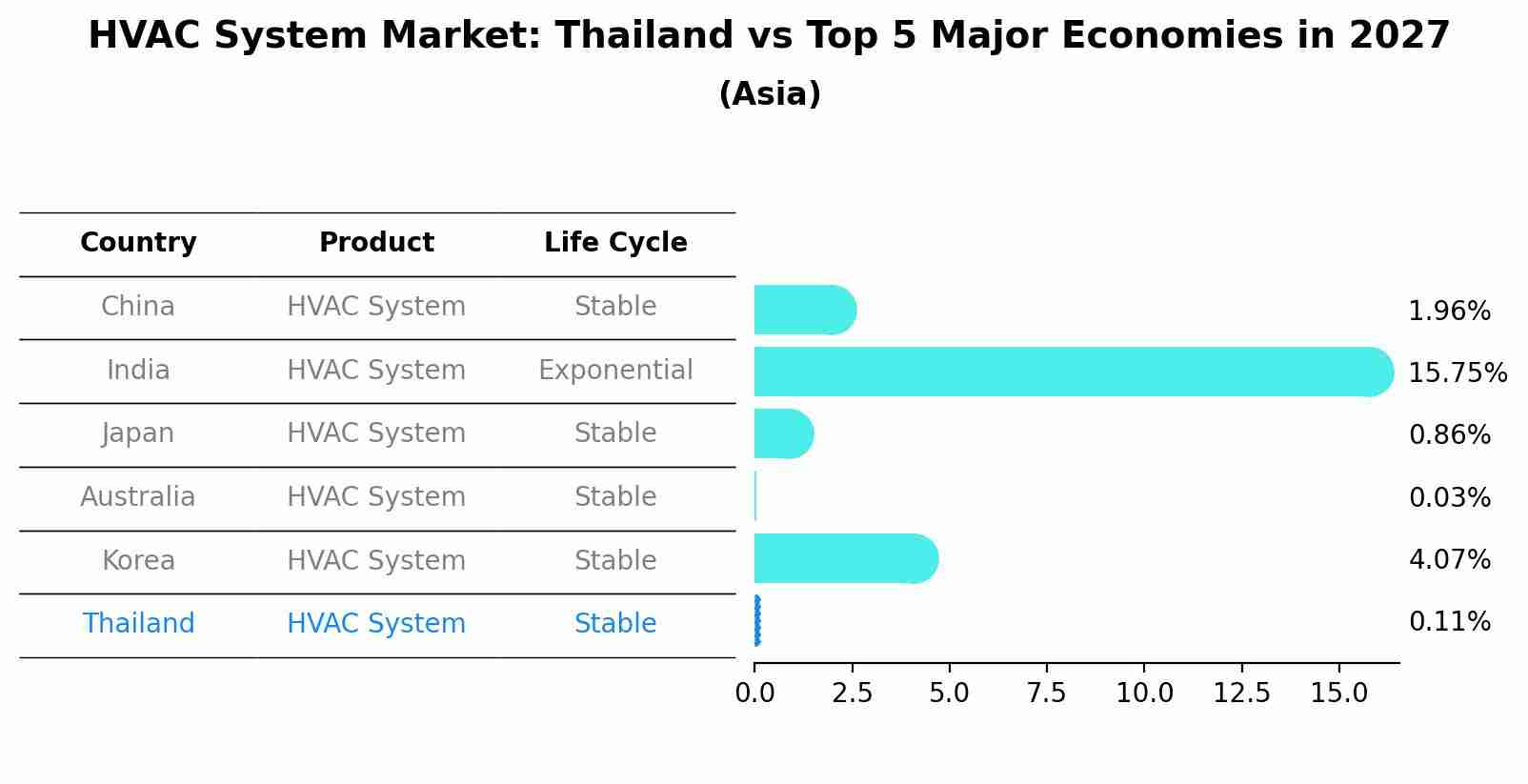
HVAC System Market: Thailand vs Top 5 Major Economies in 2027 (Asia)
Thailand's HVAC System market is anticipated to experience a stable growth rate of 0.11% by 2027, reflecting trends observed in the largest economy China, followed by India, Japan, Australia and South Korea.
Thailand Hvac System Market Synopsis
The Thailand HVAC system market is projected to reach USD 943.5 million by 2026, registering a CAGR of 6.2% during the forecast period (2020-2026). The increasing development in residential and commercial infrastructure has boosted the demand for advanced air conditioning systems with better energy efficiency. Moreover, rising disposable income levels have led to an increase in consumer spending on heating, ventilation, and air conditioning (HVAC) systems including chillers and furnaces across the country
Furthermore, government initiatives like Pracha Rat Bamphen Chonburi 2020 have also augmented the growth of this sector. Manufacturers are developing innovative products that require less power consumption while providing efficient cooling solutions which will help expand their customer base further. Additionally, rapid urbanization coupled with supportive regulations towards green energy solutions is expected to drive investments in renewable sources such as solar HVAC systems across Thailand over the coming years thereby propelling industry growth further
However, lack of awareness among consumers about efficient HVAC systems may hinder market performance adversely over certain periods of time due to low adoption rates for these products even though they provide better capabilities at lower costs than traditional options available in the market today
Key Highlights of the Report:
- Thailand HVAC System Market Outlook
- Market Size of Thailand HVAC System Market, 2019
- Forecast of Thailand HVAC System Market, 2026
- Historical Data and Forecast of Thailand HVAC System Revenues & Volume for the Period 2016 - 2026
- Thailand HVAC System Market Trend Evolution
- Thailand HVAC System Market Drivers and Challenges
- Thailand HVAC System Price Trends
- Thailand HVAC System Porter's Five Forces
- Thailand HVAC System Industry Life Cycle
- Historical Data and Forecast of Thailand HVAC System Market Revenues & Volume By Product Type for the Period 2016 - 2026
- Historical Data and Forecast of Thailand HVAC System Market Revenues & Volume By Heating for the Period 2016 - 2026
- Historical Data and Forecast of Thailand HVAC System Market Revenues & Volume By Cooling for the Period 2016 - 2026
- Historical Data and Forecast of Thailand HVAC System Market Revenues & Volume By Ventilation for the Period 2016 - 2026
- Historical Data and Forecast of Thailand HVAC System Market Revenues & Volume By End-User for the Period 2016 - 2026
- Historical Data and Forecast of Thailand HVAC System Market Revenues & Volume By Residential for the Period 2016 - 2026
- Historical Data and Forecast of Thailand HVAC System Market Revenues & Volume By Commercial for the Period 2016 - 2026
- Historical Data and Forecast of Thailand HVAC System Market Revenues & Volume By Industrial for the Period 2016 - 2026
- Thailand HVAC System Import Export Trade Statistics
- Market Opportunity Assessment By Product Type
- Market Opportunity Assessment By End-User
- Thailand HVAC System Top Companies Market Share
- Thailand HVAC System Competitive Benchmarking By Technical and Operational Parameters
- Thailand HVAC System Company Profiles
- Thailand HVAC System Key Strategic Recommendations






































