Thailand Hydrophobic and Superhydrophobic Materials Market Size, Share & Growth Rate
The Thailand Hydrophobic and Superhydrophobic Materials Market was estimated at USD 203 Million in 2025 and is projected to reach USD 234 Million by 2032, growing at a CAGR of 2.1% from 2026 to 2032. This anticipated growth reflects a growing recognition of the benefits these materials offer across diverse sectors, including construction and automotive. The increasing need for durable and high-performance products that can withstand environmental factors is propelling manufacturers to invest in advanced hydrophobic technologies.
Thailand Hydrophobic and Superhydrophobic Materials Market Year-wise Growth Rate and Key Drivers
This graph highlights how the Thailand Hydrophobic and Superhydrophobic Materials Market has steadily grown over the years, supported by major growth factors.
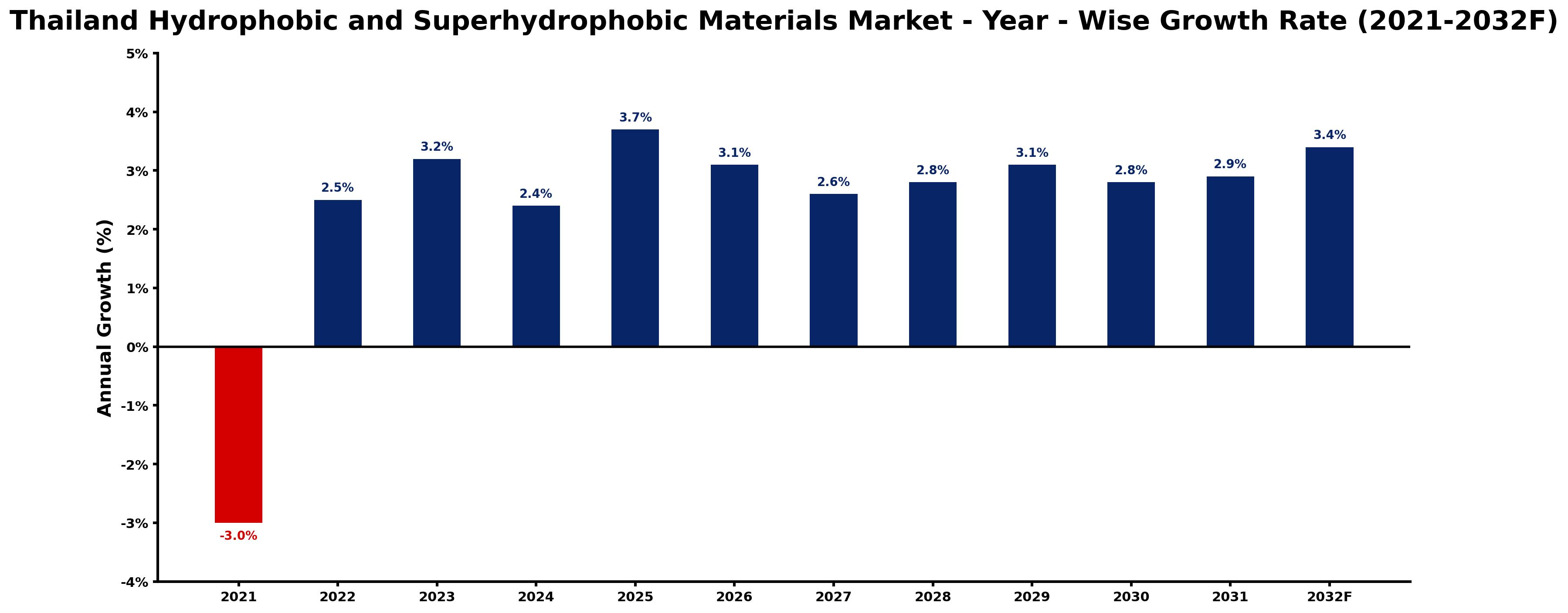
The table below presents the year‑wise growth rates along with the key drivers influencing the market
| Year | Growth Rate | Major Drivers |
| 2021 | -3.0% | Expansion of transportation and logistics networks |
| 2022 | 2.5% | Expansion of manufacturing activities |
| 2023 | 3.2% | Expansion of manufacturing activities |
| 2024 | 2.4% | Increasing industrial infrastructure investments |
| 2025 | 3.7% | Government infrastructure modernization initiatives |
| 2026 | 3.1% | Increasing smart city development projects |
| 2027 | 2.6% | Rapid growth in telecom and data center sectors |
| 2028 | 2.8% | Expansion of manufacturing activities |
| 2029 | 3.1% | Expansion of manufacturing activities |
| 2030 | 2.8% | Increasing industrial automation investments |
| 2031 | 2.9% | Expansion of commercial construction activities |
| 2032 | 3.4% | Growing urbanization and commercial development |
Note - Market size estimations and growth projections presented in this report are based on 6Wresearch’s advanced forecasting approach, validated with industry datasets as of June 2026.
Thailand Hydrophobic and Superhydrophobic Materials Market Synopsis
In Thailand, the hydrophobic and superhydrophobic materials market is gaining traction due to a surge in demand for innovative solutions that enhance product longevity. For instance, these materials are increasingly utilized in the construction industry to improve the weather resistance of buildings and infrastructure. The versatility of hydrophobic coatings also extends to textiles, where they provide stain resistance and ease of maintenance.
As environmental concerns rise, industries in Thailand are leaning towards sustainable materials that minimize the need for harsh chemicals. Hydrophobic coatings can significantly reduce the frequency of cleaning cycles, promoting eco-friendly practices. This aligns with global trends towards sustainability and places Thailand in a strong position to leverage these advancements.
Thailand Hydrophobic and Superhydrophobic Materials Market Key Takeaways
- The market is projected to grow steadily, driven by demand for water-repellent properties across multiple sectors.
- Eco-consciousness is pushing industries to adopt hydrophobic materials to reduce environmental impact.
- Challenges such as production costs and end-user awareness must be navigated for broader adoption.
- Emerging applications in electronics and textiles present substantial growth opportunities.
- The Covid-19 pandemic has catalyzed interest in antimicrobial properties associated with these materials.
Evaluation of Restraints in Thailand Hydrophobic and Superhydrophobic Materials Market
Despite the promising landscape, the Thailand hydrophobic and superhydrophobic materials market encounters certain restraints. One primary challenge is the high production costs, stemming from intricate manufacturing processes and the necessity for advanced technology. This financial burden restricts market entry for smaller enterprises, limiting innovation. Additionally, a gap in awareness regarding the advantages and applications of hydrophobic materials exists among potential end-users, which may slow down market penetration and growth.
Thailand Hydrophobic and Superhydrophobic Materials Market Trends
A noticeable trend within the Thailand hydrophobic and superhydrophobic materials market is the growing integration of smart technologies. Companies are beginning to explore the incorporation of IoT capabilities into hydrophobic solutions, enabling real-time monitoring of material performance. Furthermore, advances in nanotechnology are paving the way for more efficient production processes, enhancing the functionality of these materials. There is also increasing interest in the application of hydrophobic coatings for consumer electronics, promoting water resistance and durability.
Thailand Hydrophobic and Superhydrophobic Materials Market Opportunities
Opportunities abound in the Thailand hydrophobic and superhydrophobic materials market, particularly in the automotive and construction sectors. With the automotive industry focusing on lightweight and corrosion-resistant materials, hydrophobic solutions can play a critical role in achieving these goals. Additionally, the construction sector is actively seeking innovative materials to enhance structural longevity against water damage and mold. These sectors represent fertile ground for investment and innovation, as companies seek competitive advantages through advanced materials.
Government Initiatives in the Thailand Hydrophobic and Superhydrophobic Materials Market
The Thai government is increasingly supporting initiatives aimed at promoting the development of advanced materials. Policies are being formulated to foster innovation in sustainable technologies, including hydrophobic materials. Investment in research and development is being encouraged through grants and subsidies for companies focused on eco-friendly solutions. Furthermore, public awareness campaigns are being launched to educate industries on the benefits of adopting new material technologies, potentially expanding the market further.
Future Insights of the Thailand Hydrophobic and Superhydrophobic Materials Market
Looking ahead to 2026-2032, the Thailand hydrophobic and superhydrophobic materials market is poised for significant advancements. The increasing need for durable, high-performance materials across various applications will continue to drive innovation. As consumer preferences shift towards sustainability, businesses that capitalize on the eco-friendly aspects of hydrophobic coatings stand to gain a competitive edge. Moreover, the integration of smart technologies is expected to redefine the functional capabilities of these materials, offering even greater benefits in the future.
Thailand Hydrophobic and Superhydrophobic Materials Market Latest Developments (May 2025 - June 2026)
In recent months, the market has seen a surge in research activities focused on the development of cost-effective production methods for hydrophobic materials. Various organizations are collaborating with academic institutions to explore novel applications, particularly in healthcare and consumer products. Additionally, companies are investing in marketing strategies that emphasize the long-term cost savings and environmental benefits associated with these materials, thereby enhancing consumer awareness and interest.
Thailand Hydrophobic and Superhydrophobic Materials Market - Key Attractiveness of the Report
- 10 Years of Market Numbers
- Historical Data Starting from 2022 to 2025
- Base Year: 2025
- Forecast Data until 2032
- Key Performance Indicators Impacting the Market
- Major Upcoming Developments and Projects
Key Highlights of the Report:
- Thailand Hydrophobic and Superhydrophobic Materials Market Outlook
- Market Size of Thailand Hydrophobic and Superhydrophobic Materials Market, 2025
- Forecast of Thailand Hydrophobic and Superhydrophobic Materials Market, 2032
- Historical Data and Forecast of Thailand Hydrophobic and Superhydrophobic Materials Revenues & Volume for the Period 2022-2032F
- Thailand Hydrophobic and Superhydrophobic Materials Market Trend Evolution
- Thailand Hydrophobic and Superhydrophobic Materials Market Drivers and Challenges
- Thailand Hydrophobic and Superhydrophobic Materials Price Trends
- Thailand Hydrophobic and Superhydrophobic Materials Porter's Five Forces
- Thailand Hydrophobic and Superhydrophobic Materials Industry Life Cycle
- Historical Data and Forecast of Thailand Hydrophobic and Superhydrophobic Materials Market Revenues & Volume By Product for the Period 2022-2032F
- Historical Data and Forecast of Thailand Hydrophobic and Superhydrophobic Materials Market Revenues & Volume By Anti-corrosion for the Period 2022-2032F
- Historical Data and Forecast of Thailand Hydrophobic and Superhydrophobic Materials Market Revenues & Volume By Anti-wetting for the Period 2022-2032F
- Historical Data and Forecast of Thailand Hydrophobic and Superhydrophobic Materials Market Revenues & Volume By Anti-icing for the Period 2022-2032F
- Historical Data and Forecast of Thailand Hydrophobic and Superhydrophobic Materials Market Revenues & Volume By Self-cleaning for the Period 2022-2032F
- Historical Data and Forecast of Thailand Hydrophobic and Superhydrophobic Materials Market Revenues & Volume By End user for the Period 2022-2032F
- Historical Data and Forecast of Thailand Hydrophobic and Superhydrophobic Materials Market Revenues & Volume By Steel & Metal for the Period 2022-2032F
- Historical Data and Forecast of Thailand Hydrophobic and Superhydrophobic Materials Market Revenues & Volume By Building & Construction for the Period 2022-2032F
- Historical Data and Forecast of Thailand Hydrophobic and Superhydrophobic Materials Market Revenues & Volume By Automotive for the Period 2022-2032F
- Historical Data and Forecast of Thailand Hydrophobic and Superhydrophobic Materials Market Revenues & Volume By Textile & Fabric for the Period 2022-2032F
- Historical Data and Forecast of Thailand Hydrophobic and Superhydrophobic Materials Market Revenues & Volume By Others for the Period 2022-2032F
- Thailand Hydrophobic and Superhydrophobic Materials Import Export Trade Statistics
- Market Opportunity Assessment By Product
- Market Opportunity Assessment By End user
- Thailand Hydrophobic and Superhydrophobic Materials Top Companies Market Share
- Thailand Hydrophobic and Superhydrophobic Materials Competitive Benchmarking By Technical and Operational Parameters
- Thailand Hydrophobic and Superhydrophobic Materials Company Profiles
- Thailand Hydrophobic and Superhydrophobic Materials Key Strategic Recommendations






































