Thailand Industrial Gases Market: Import Trend Analysis
In the Thailand industrial gases market, the import trend showed a growth rate of 0.93% from 2023 to 2024. The compound annual growth rate (CAGR) for imports between 2020 and 2024 was 11.81%. This upward trajectory could be attributed to a steady demand shift towards industrial gases in various sectors, indicating market stability and sustained import momentum during the period analyzed.
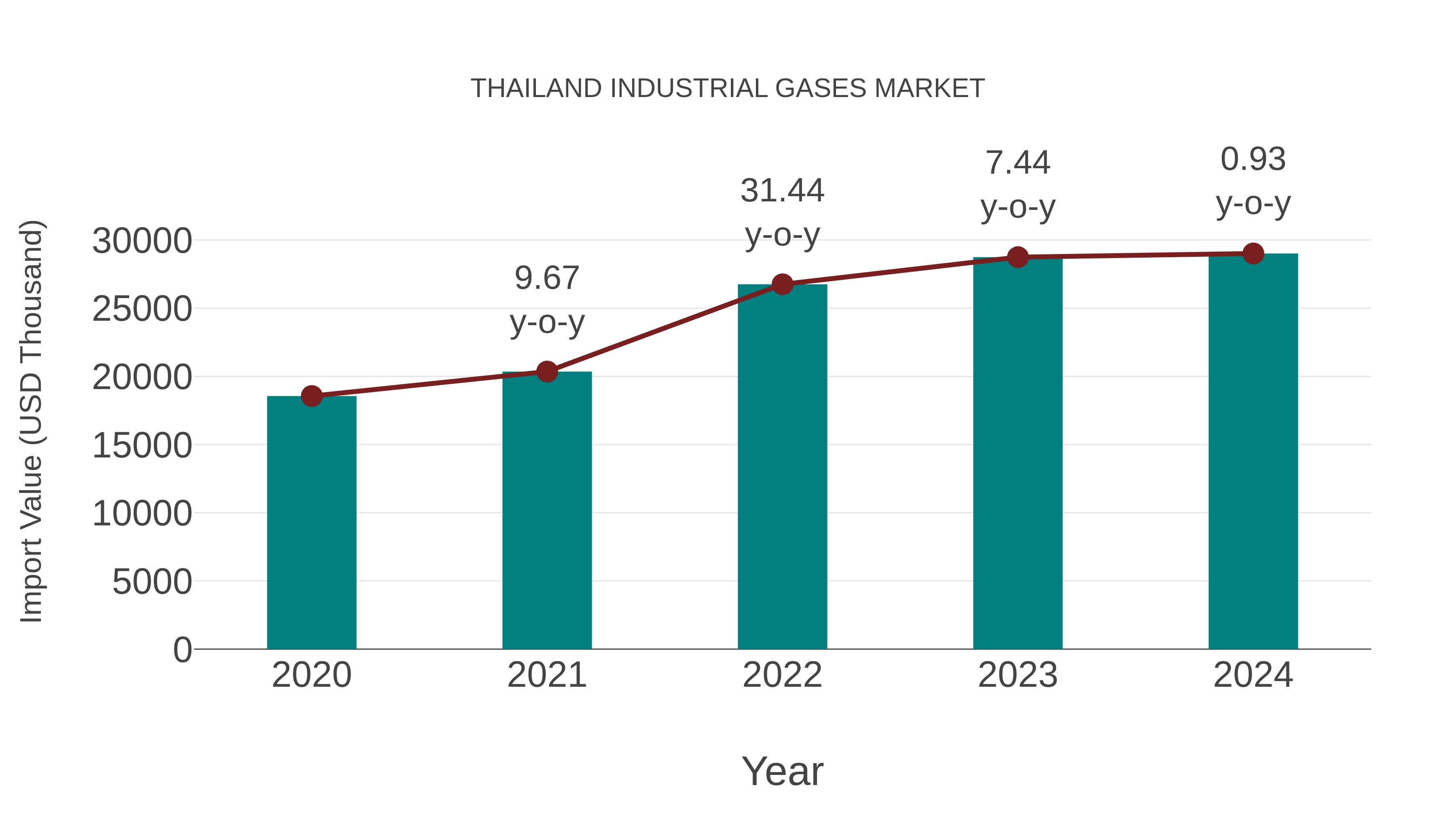
Thailand Industrial Gases Market Growth Rate
According to 6Wresearch internal database and industry insights, the Thailand Industrial Gases Market is projected to grow at a compound annual growth rate (CAGR) of 7.8% during the forecast period (2026-2032).
Topics Covered in the Thailand Industrial Gases Market Report
The Thailand Industrial Gases Market report thoroughly covers the market by Product Type, Application and Distribution. The market report provides an unbiased and detailed analysis of ongoing market trends, opportunities/high growth areas, and market drivers, which help stakeholders devise and align their market strategies according to the current and future market dynamics.
Thailand Industrial Gases Market Highlights
| Report Name | Thailand Industrial Gases Market |
| Forecast period | 2026-2032 |
| CAGR | 7.8% |
| Growing Sector | Manufacturing & Electronics Industries |
Thailand Industrial Gases Market Synopsis
The Thailand Industrial Gases Industry is experiencing consistent growth due to high industrialization rates, increased use of gases in hospitals, and growing consumption of gases in various industries, while the nation is also improving its industrial capacity via foreign investments and innovations. The growing adoption of oxygen, nitrogen, and argon gases in different sectors, including electronics, automobile, and food processing industries, is contributing to the growth of the market.
Evaluation of Growth Drivers in the Thailand Industrial Gases Market
Below mentioned are some prominent drivers and their influence on the market dynamics:
| Drivers | Primary Segments Affected | Why it Matters (Evidence) |
| Expansion of Manufacturing Sector | Oxygen, Nitrogen, Manufacturing | Increased industrial production boosts demand for process gases. |
| Growth in Healthcare Infrastructure | Oxygen, Healthcare | Hospitals require medical-grade oxygen and related gases for treatment. |
| Growing Electronics & Semiconductor Sector | Nitrogen, Argon, Production | Gases of high purity are needed for the fabrication of semiconductors. |
| Growing Food Processing Sector | Carbon Dioxide, Food & Beverages | Gases have applications in preservation, packing, and carbonation. |
| Policies for Industrial Growth | All Gases, All Uses | Industrial growth is encouraged by such policies. |
Thailand Industrial Gases Market is expected to grow at the CAGR of 7.8% during the forecast period of 2026-2032. Growth is supported by expanding manufacturing capabilities, increasing healthcare demand for medical gases, and rising investments in electronics production, while strong government backing for industrial development and foreign investments further enhances infrastructure, creating sustained demand for industrial gases across multiple sectors.
Evaluation of Restraints in the Thailand Industrial Gases Market
Below mentioned are some major restraints and their influence on the market dynamics:
| Restraints | Primary Segments Affected | What This Means (Evidence) |
| High Energy Costs | Manufacturing, On-site | Gas production is energy-intensive, increasing operational expenses. |
| Logistics and Storage Challenges | Bulk & Cylinder Distribution | Transportation of gases requires specialized infrastructure. |
| Environmental Regulations | Chemicals & Energy | Compliance increases operational costs for producers. |
| Dependency on Imported Equipment | All Types | Limits domestic production capabilities and innovation. |
| Price Volatility of Raw Materials | All Segments | Affects production costs and pricing stability. |
Thailand Industrial Gases Market Challenges
Even in view of robust Thailand Industrial Gases Market Growth, the sector still experiences certain issues like costly operations because of high energy consumption for manufacturing gas and difficulties in storing and transporting compressed/liquefied gases in different regions. In addition, reliance on imports, strict ecological laws, and volatile prices of raw materials become obstacles for business development in the sector, where smaller businesses fail to sustain their competitiveness.
Thailand Industrial Gases Market Trends
Important developing trends that will affect the Thailand Industrial Gases Market are:
- Increasing Demand for Ultra-Pure Gases: Sectors like electronics and health care are demanding ultra-pure gases, prompting innovations in gas purification technology and increased manufacturing capacity for these products.
- Automation in Gas Delivery Systems: Firms are employing automation in their gas delivery systems to increase efficiency and minimize waste while ensuring steady supply throughout industries.
- Trend towards Eco-Friendly Production of Gases: Manufacturers are moving towards sustainable gas production methods, involving low emissions and carbon capture techniques.
- Growth of On-site Gas Generation: Industries are adopting on-site gas generation systems to reduce dependency on external suppliers and enhance operational reliability.
Investment Opportunities in the Thailand Industrial Gases Market
Some major investment options in the Thailand Industrial Gases Market are:
- On-site Gas Plants Expansion – Building separate gas plants on an industrial site brings about economic feasibility and reliability of the supply chain.
- Healthcare Gas Network Setup – Investments in the healthcare gas pipeline and storage networks improve the medical services and their demand.
- Gas Distribution Networks for Electronics – The electronics industry uses high purity gas, thus creating significant opportunities for future expansion.
- Cold Chain and Food Processing Applications – Increasing use of gases in refrigeration and food preservation opens new investment opportunities in logistics and packaging technologies.
Top 5 Leading Players in the Thailand Industrial Gases Market
Key companies shaping the competitive landscape include:
1. Linde plc
| Company Name | Linde plc |
|---|---|
| Established Year | 1879 |
| Headquarters | Guildford, United Kingdom |
| Official Website | Click Here |
Linde plc is a global leader in industrial gases, offering oxygen, nitrogen, and specialty gases across manufacturing, healthcare, and energy sectors, while its advanced technologies and strong distribution network support efficient gas supply and industrial process optimization.
2. Air Liquide
| Company Name | Air Liquide |
|---|---|
| Established Year | 1902 |
| Headquarters | Paris, France |
| Official Website | Click Here |
Air Liquide provides industrial and medical gases along with innovative solutions for electronics, healthcare, and environmental sectors, leveraging advanced production systems and digital technologies to enhance efficiency and ensure high-quality gas supply.
3. Air Products and Chemicals, Inc.
| Company Name | Air Products and Chemicals, Inc. |
|---|---|
| Established Year | 1940 |
| Headquarters | Pennsylvania, USA |
| Official Website | Click Here |
Air Products specializes in supplying industrial gases and process technologies to industries such as refining, chemicals, and electronics, while focusing on sustainability initiatives and hydrogen-based energy solutions to support cleaner industrial operations.
4. Messer Group GmbH
| Company Name | Messer Group GmbH |
|---|---|
| Established Year | 1898 |
| Headquarters | Bad Soden, Germany |
| Official Website | Click Here |
Messer Group delivers industrial gases including oxygen, nitrogen, and argon, supporting sectors like metallurgy and healthcare, while emphasizing efficient production systems and tailored solutions for regional industrial requirements.
5. Taiyo Nippon Sanso Corporation
| Company Name | Taiyo Nippon Sanso Corporation |
|---|---|
| Established Year | 1910 |
| Headquarters | Tokyo, Japan |
| Official Website | Click Here |
Taiyo Nippon Sanso provides industrial and specialty gases for electronics, manufacturing, and healthcare industries, leveraging strong technological expertise and regional partnerships to expand its presence in Southeast Asian markets.
Government Regulations Introduced in the Thailand Industrial Gases Market
According to Thai Government Data, Both the IDP 2018 and EEC policy have made substantial contributions to fostering industrial gas demands through investments in industries like manufacturing, electronic, and petrochemicals. The regulations formulated by the Ministry of Industry have also enhanced the safety standards of gas production, storage, and transportation. Moreover, campaigns for promoting the use of clean energy and emission reductions have encouraged industries to opt for sustainable methods of producing gas.
Future Insights of the Thailand Industrial Gases Market
The Thailand Industrial Gases Market is forecasted to exhibit a steady growth trajectory over the upcoming years due to consistent growth in the manufacturing industry, growing demands from the health care industry, and growing investment in emerging technology like hydrogen energy and semiconductors, while improved infrastructure and logistics will increase accessibility and remove any logistical hurdles, leading to the development of new market opportunities.
Market Segmentation Analysis
The report offers a comprehensive study of the subsequent market segments and their leading categories:
Oxygen to dominate the Market- By Product Type
According to Deep, Senior Research Analyst, 6Wresearch, Oxygen is expected to dominate the Thailand Industrial Gases Market due to its extensive use in healthcare, metal fabrication, and chemical processing industries, where its critical role in combustion, oxidation, and life-support applications ensures consistent and high demand across both industrial and medical sectors.
Manufacturing to dominate the Market- By Application
Manufacturing leads the Thailand Industrial Gases Market Share as industries such as automotive, electronics, and metal processing rely heavily on gases like nitrogen and argon for welding, cooling, and inerting processes, making it the largest consumer segment.
Key Attractiveness of the Report
- 10 Years of Market Numbers.
- Historical Data Starting from 2022 to 2025.
- Base Year: 2025.
- Forecast Data until 2032.
- Key Performance Indicators Impacting the Market.
- Major Upcoming Developments and Projects.
Key Highlights of the Report:
- Thailand Industrial Gases Market Outlook
- Market Size of Thailand Industrial Gases Market, 2025
- Forecast of Thailand Industrial Gases Market, 2032
- Historical Data and Forecast of Thailand Industrial Gases Revenues & Volume for the Period 2022-2032F
- Thailand Industrial Gases Market Trend Evolution
- Thailand Industrial Gases Market Drivers and Challenges
- Thailand Industrial Gases Price Trends
- Thailand Industrial Gases Porter's Five Forces
- Thailand Industrial Gases Industry Life Cycle
- Historical Data and Forecast of Thailand Industrial Gases Market Revenues & Volume By Product Type for the Period 2022-2032F
- Historical Data and Forecast of Thailand Industrial Gases Market Revenues & Volume By Oxygen for the Period 2022-2032F
- Historical Data and Forecast of Thailand Industrial Gases Market Revenues & Volume By Nitrogen for the Period 2022-2032F
- Historical Data and Forecast of Thailand Industrial Gases Market Revenues & Volume By Hydrogen for the Period 2022-2032F
- Historical Data and Forecast of Thailand Industrial Gases Market Revenues & Volume By Carbon Dioxide for the Period 2022-2032F
- Historical Data and Forecast of Thailand Industrial Gases Market Revenues & Volume By Acetylene for the Period 2022-2032F
- Historical Data and Forecast of Thailand Industrial Gases Market Revenues & Volume By Argon for the Period 2022-2032F
- Historical Data and Forecast of Thailand Industrial Gases Market Revenues & Volume By Others for the Period 2022-2032F
- Historical Data and Forecast of Thailand Industrial Gases Market Revenues & Volume By Application for the Period 2022-2032F
- Historical Data and Forecast of Thailand Industrial Gases Market Revenues & Volume By Healthcare for the Period 2022-2032F
- Historical Data and Forecast of Thailand Industrial Gases Market Revenues & Volume By Manufacturing for the Period 2022-2032F
- Historical Data and Forecast of Thailand Industrial Gases Market Revenues & Volume By Metallurgy & Glasses for the Period 2022-2032F
- Historical Data and Forecast of Thailand Industrial Gases Market Revenues & Volume By Food & Beverage for the Period 2022-2032F
- Historical Data and Forecast of Thailand Industrial Gases Market Revenues & Volume By Retail for the Period 2022-2032F
- Historical Data and Forecast of Thailand Industrial Gases Market Revenues & Volume By Chemicals & Energy for the Period 2022-2032F
- Historical Data and Forecast of Thailand Industrial Gases Market Revenues & Volume By Others for the Period 2022-2032F
- Historical Data and Forecast of Thailand Industrial Gases Market Revenues & Volume By Distribution for the Period 2022-2032F
- Historical Data and Forecast of Thailand Industrial Gases Market Revenues & Volume By On-site for the Period 2022-2032F
- Historical Data and Forecast of Thailand Industrial Gases Market Revenues & Volume By Bulk (Liquid Gas Transport) for the Period 2022-2032F
- Historical Data and Forecast of Thailand Industrial Gases Market Revenues & Volume By Cylinder (Merchant) for the Period 2022-2032F
- Thailand Industrial Gases Import Export Trade Statistics
- Market Opportunity Assessment By Product Type
- Market Opportunity Assessment By Application
- Market Opportunity Assessment By Distribution
- Thailand Industrial Gases Top Companies Market Share
- Thailand Industrial Gases Competitive Benchmarking By Technical and Operational Parameters
- Thailand Industrial Gases Company Profiles
- Thailand Industrial Gases Key Strategic Recommendations
Market Covered
The report offers a comprehensive study of the subsequent market segments:
By Product Type
- Oxygen
- Nitrogen
- Hydrogen
- Carbon Dioxide
- Acetylene
- Argon
- Others
By Application
- Healthcare
- Manufacturing
- Metallurgy & Glasses
- Food & Beverage
- Retail
- Chemicals & Energy
- Others
By Distribution
- On-site
- Bulk (Liquid Gas Transport)
- Cylinder (Merchant)






































