Thailand Industrial Vacuum Cleaner Market Size, Share & Growth Rate
The Thailand Industrial Vacuum Cleaner Market was estimated at USD 88 Million in 2025 and is projected to reach USD 101 Million by 2032, growing at a CAGR of 2.0% from 2026 to 2032. This upward trajectory is primarily driven by an increasing awareness of hygiene and cleanliness in various industrial sectors. With the pharmaceutical and food processing industries facing stringent cleanliness standards, the demand for high-performance industrial vacuum cleaners is expected to rise significantly.
Thailand Industrial Vacuum Cleaner Market Year-wise Growth Rate and Key Drivers
This graph highlights how the Thailand Industrial Vacuum Cleaner Market has steadily grown over the years, supported by major growth factors.
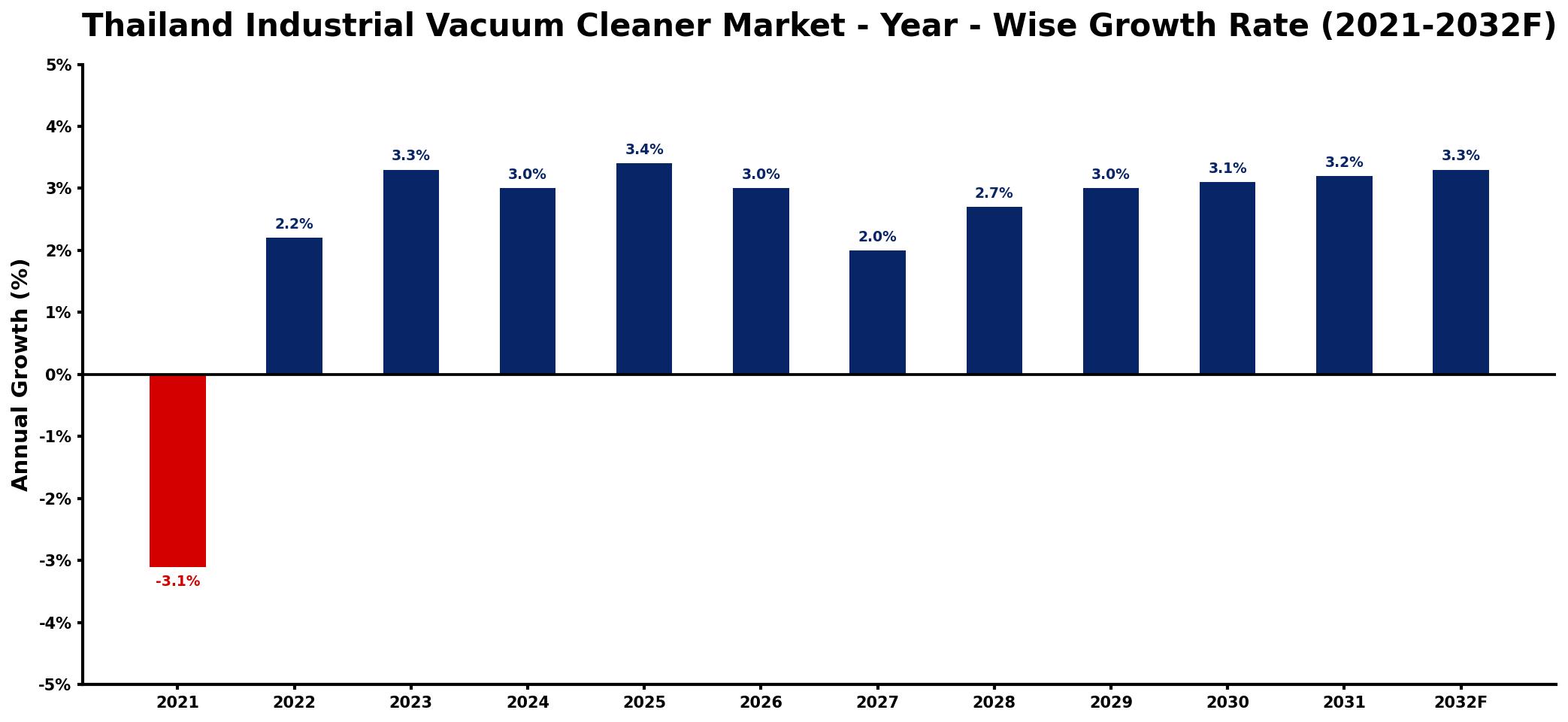
The table below presents the year‑wise growth rates along with the key drivers influencing the market
| Year | Growth Rate | Major Drivers |
| 2021 | -3.1% | decrease in manufacturing output |
| 2022 | 2.2% | increased focus on hygiene standards |
| 2023 | 3.3% | growing demand in logistics sector |
| 2024 | 3.0% | expansion of food processing industry |
| 2025 | 3.4% | rise in e-commerce activities |
| 2026 | 3.0% | investment in smart technologies |
| 2027 | 2.0% | enhanced environmental regulations compliance |
| 2028 | 2.7% | growth in healthcare sector applications |
| 2029 | 3.0% | increased automation in factories |
| 2030 | 3.1% | development of green technologies |
| 2031 | 3.2% | emphasis on energy efficiency solutions |
| 2032 | 3.3% | broader adoption of robotics technology |
Note: Market size estimations and growth projections presented in this report are based on 6Wresearch's proprietary forecasting methodology, utilizing the latest available industry data, government publications, and primary research inputs.
Thailand Industrial Vacuum Cleaner Market Synopsis
The most influential factor currently shaping the Thailand Industrial Vacuum Cleaner Market is the heightened focus on workplace cleanliness and hygiene. Industries, particularly those with strict regulatory compliance like pharmaceuticals and food processing, are pushing for advanced vacuum systems that can maintain their operational standards.
Additionally, as workplace safety regulations become more rigorous, businesses are increasingly investing in modern vacuum cleaning solutions that enhance safety by effectively controlling dust and contaminants. This trend is fostering an environment ripe for growth in the industrial vacuum cleaner sector.
Thailand Industrial Vacuum Cleaner Market Key Takeaways
- The market is poised for steady growth driven by heightened hygiene standards across industries.
- Emerging technologies in filtration and energy efficiency are enhancing product offerings.
- Manufacturers are focusing on developing models tailored to specific industry needs.
- Government regulations surrounding workplace safety are increasing demand for compliant cleaning systems.
- The ongoing emphasis on environmental sustainability is shaping product innovation.
Evaluation of Restraints in Thailand Industrial Vacuum Cleaner Market
Despite the positive growth outlook, the Thailand Industrial Vacuum Cleaner Market faces certain limitations. One significant restraint is the evolution of cleaning standards and the pressure to meet increasingly stringent environmental regulations. Companies are challenged to provide vacuum cleaners that not only deliver efficient cleaning but also incorporate advanced filtration systems capable of trapping fine particles and allergens. Moreover, the compliance with noise and emission standards complicates product development, requiring manufacturers to balance performance with environmental considerations.
Thailand Industrial Vacuum Cleaner Market Trends
Current trends indicate a shift toward automation and smart technology within the industrial vacuum cleaner space. As industries embrace the Internet of Things (IoT), integrated cleaning solutions equipped with connectivity features are becoming more prevalent. These advancements allow for real-time monitoring and efficient maintenance scheduling, thereby enhancing operational efficiency.
Furthermore, there's a growing demand for compact, portable vacuum units that can adapt to various cleaning environments. This flexibility is particularly appealing to sectors such as construction and warehousing, where space and mobility are critical considerations.
Thailand Industrial Vacuum Cleaner Market Opportunities
Significant growth opportunities lie within the expanding sectors such as e-commerce and logistics. With the rise of these industries comes a greater need for efficient cleaning solutions to manage the cleanliness of distribution centers and warehouses. Additionally, the push towards sustainable manufacturing practices offers avenues for innovation in eco-friendly vacuum systems that meet both performance and environmental standards.
Government Initiatives in the Thailand Industrial Vacuum Cleaner Market
The Thai government is actively promoting industrial hygiene standards through various policies and initiatives aimed at enhancing workplace safety and cleanliness. Public funding for industrial upgrades often includes incentives for businesses to adopt advanced cleaning technologies. Such policies are designed to ensure compliance with health regulations, encouraging firms to invest in modern cleaning equipment.
Future Insights of the Thailand Industrial Vacuum Cleaner Market
Looking ahead to the period of 2026-2032, the Thailand Industrial Vacuum Cleaner Market is expected to evolve significantly. With a sustained focus on hygiene and safety, coupled with technological advancements, businesses will increasingly prioritize investments in state-of-the-art vacuum systems. Additionally, the integration of smart technologies and IoT solutions is anticipated to enhance the efficiency and effectiveness of cleaning operations, driving market growth in the years to come.
Thailand Industrial Vacuum Cleaner Market Latest Developments (2025 - 2026)
In recent months, the Thailand Industrial Vacuum Cleaner Market has witnessed several noteworthy developments. Manufacturers are launching advanced vacuum models with enhanced filtration capabilities to better address the growing concerns regarding allergens and fine particulate matter. Additionally, there's been a marked increase in collaborations among industry stakeholders aimed at developing innovative cleaning solutions that meet evolving regulatory standards.
Thailand Industrial Vacuum Cleaner Market - Key Attractiveness of the Report
- 10 Years of Market Numbers
- Historical Data Starting from 2022 to 2025
- Base Year: 2025
- Forecast Data until 2032
- Key Performance Indicators Impacting the Market
- Major Upcoming Developments and Projects
Key Highlights of the Report:
- Thailand Industrial Vacuum Cleaner Market Outlook
- Market Size of Thailand Industrial Vacuum Cleaner Market, 2025
- Forecast of Thailand Industrial Vacuum Cleaner Market, 2032
- Historical Data and Forecast of Thailand Industrial Vacuum Cleaner Revenues & Volume for the Period 2022-2032F
- Thailand Industrial Vacuum Cleaner Market Trend Evolution
- Thailand Industrial Vacuum Cleaner Market Drivers and Challenges
- Thailand Industrial Vacuum Cleaner Price Trends
- Thailand Industrial Vacuum Cleaner Porter's Five Forces
- Thailand Industrial Vacuum Cleaner Industry Life Cycle
- Historical Data and Forecast of Thailand Industrial Vacuum Cleaner Market Revenues & Volume By Type for the Period 2022-2032F
- Historical Data and Forecast of Thailand Industrial Vacuum Cleaner Market Revenues & Volume By Dry for the Period 2022-2032F
- Historical Data and Forecast of Thailand Industrial Vacuum Cleaner Market Revenues & Volume By Wet & Dry for the Period 2022-2032F
- Historical Data and Forecast of Thailand Industrial Vacuum Cleaner Market Revenues & Volume By Power Source for the Period 2022-2032F
- Historical Data and Forecast of Thailand Industrial Vacuum Cleaner Market Revenues & Volume By Electric for the Period 2022-2032F
- Historical Data and Forecast of Thailand Industrial Vacuum Cleaner Market Revenues & Volume By Pneumatic for the Period 2022-2032F
- Historical Data and Forecast of Thailand Industrial Vacuum Cleaner Market Revenues & Volume By Industry for the Period 2022-2032F
- Historical Data and Forecast of Thailand Industrial Vacuum Cleaner Market Revenues & Volume By Food & Beverages for the Period 2022-2032F
- Historical Data and Forecast of Thailand Industrial Vacuum Cleaner Market Revenues & Volume By Metalworking for the Period 2022-2032F
- Historical Data and Forecast of Thailand Industrial Vacuum Cleaner Market Revenues & Volume By Pharmaceuticals for the Period 2022-2032F
- Historical Data and Forecast of Thailand Industrial Vacuum Cleaner Market Revenues & Volume By Manufacturing for the Period 2022-2032F
- Historical Data and Forecast of Thailand Industrial Vacuum Cleaner Market Revenues & Volume By Building & Construction for the Period 2022-2032F
- Historical Data and Forecast of Thailand Industrial Vacuum Cleaner Market Revenues & Volume By Others for the Period 2022-2032F
- Thailand Industrial Vacuum Cleaner Import Export Trade Statistics
- Market Opportunity Assessment By Type
- Market Opportunity Assessment By Power Source
- Market Opportunity Assessment By Industry
- Thailand Industrial Vacuum Cleaner Top Companies Market Share
- Thailand Industrial Vacuum Cleaner Competitive Benchmarking By Technical and Operational Parameters
- Thailand Industrial Vacuum Cleaner Company Profiles
- Thailand Industrial Vacuum Cleaner Key Strategic Recommendations






































