Thailand Inorganic Acids Market Size, Share & Growth Rate
The Thailand Inorganic Acids Market was estimated at USD 125 Million in 2025 and is projected to reach USD 143 Million by 2032, growing at a CAGR of 1.9% from 2026 to 2032. This growth trajectory is largely influenced by the burgeoning industrial sectors, including chemicals and manufacturing, which are increasingly utilizing inorganic acids in their processes. Additionally, the agricultural segments reliance on these acids for fertilizer production is expected to further bolster demand as Thailand emphasizes enhancing agricultural productivity.
Thailand Inorganic Acids Market Year-wise Growth Rate and Key Drivers
This graph highlights how the Thailand Inorganic Acids Market has steadily grown over the years, supported by major growth factors.
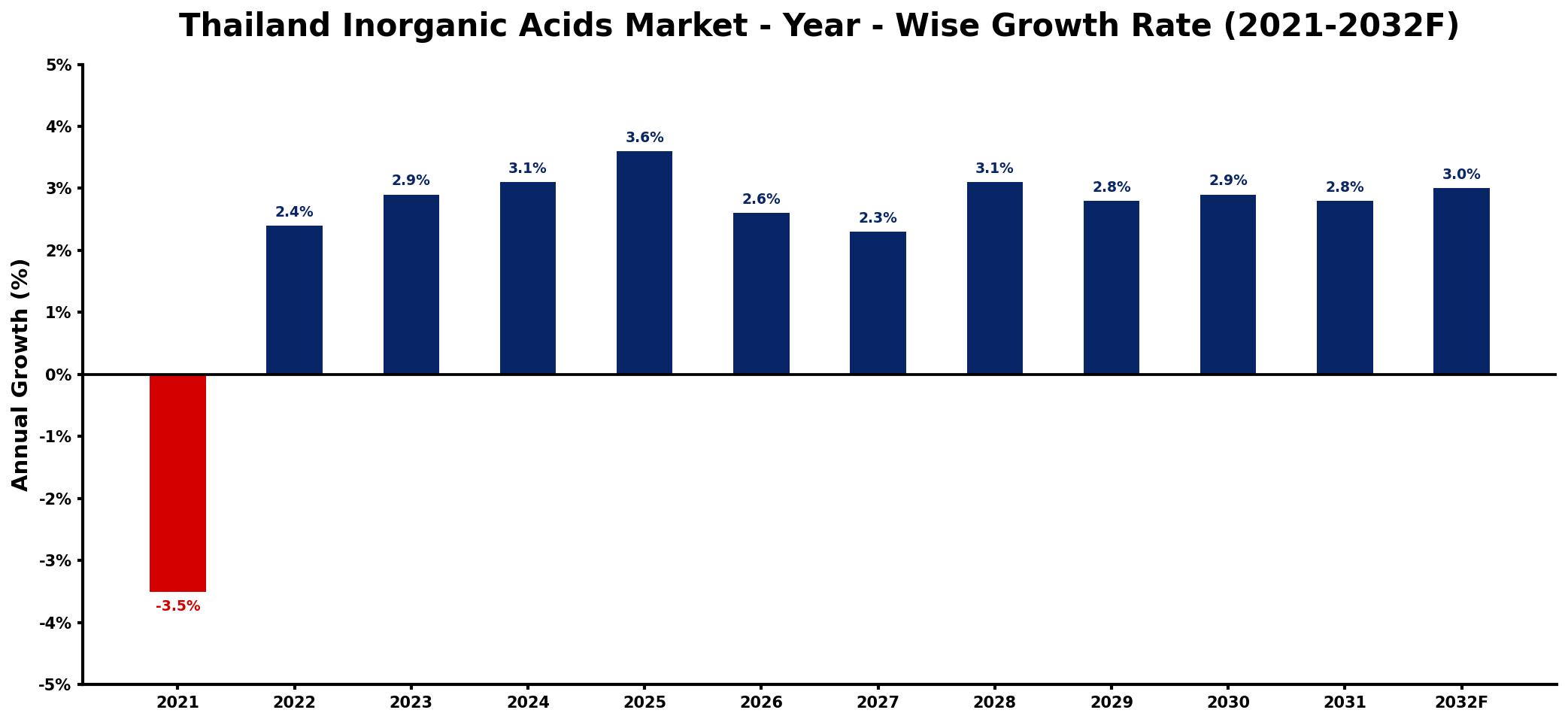
The table below presents the year‑wise growth rates along with the key drivers influencing the market
| Year | Growth Rate | Major Drivers |
| 2021 | -3.5% | decreased industrial manufacturing activity |
| 2022 | 2.4% | increased demand from agriculture sector |
| 2023 | 2.9% | expansion of chemical production facilities |
| 2024 | 3.1% | growth in water treatment investments |
| 2025 | 3.6% | rising applications in pharmaceuticals |
| 2026 | 2.6% | enhanced infrastructure development projects |
| 2027 | 2.3% | growing focus on environmental regulations |
| 2028 | 3.1% | increase in construction sector activities |
| 2029 | 2.8% | higher investments in energy sector |
| 2030 | 2.9% | improved processing technologies adoption |
| 2031 | 2.8% | rising demand from electronics manufacturing |
| 2032 | 3.0% | strengthening underlying market demand |
Note: Market size estimations and growth projections presented in this report are based on 6Wresearch's proprietary forecasting methodology, utilizing the latest available industry data, government publications, and primary research inputs.
Thailand Inorganic Acids Market Synopsis
The market for inorganic acids in Thailand plays a pivotal role in sustaining various industries, particularly agriculture and manufacturing. With significant applications in water treatment and metal processing, the demand for acids like sulfuric and hydrochloric is rising rapidly as industries seek efficient chemical solutions.
Inorganic acids serve as fundamental raw materials across a spectrum of processes, including textile manufacturing and the production of cleaning agents. This versatility not only contributes to the steady growth of the market but also indicates a continuous adaptation to technological advancements, ensuring product quality and operational cost-effectiveness.
Thailand Inorganic Acids Market Key Takeaways
- The Thailand Inorganic Acids Market is driven by robust demand from the manufacturing and agricultural sectors.
- Technological advancements are enhancing production efficiency and product quality.
- Environmental regulations necessitate sustainable practices in acid production and disposal.
- The healthcare and pharmaceutical industries have emerged as vital consumers amid changing market dynamics.
- Fluctuations in raw material prices remain a critical factor impacting market stability.
Evaluation of Restraints in Thailand Inorganic Acids Market
Despite its growth potential, the Thailand Inorganic Acids Market faces several restraints. The fluctuations in raw material prices can significantly impact production costs, creating challenges for manufacturers trying to maintain profitability while adhering to competitive pricing. Additionally, supply chain disruptions, particularly those caused by environmental regulations regarding waste disposal, can complicate operations. Manufacturers must innovate and invest in sustainable practices while ensuring compliance with these regulations to mitigate such risks.
Thailand Inorganic Acids Market Trends
Current trends in the Thailand Inorganic Acids Market reflect a growing focus on sustainability and eco-friendly practices. There is a marked shift toward the development of greener chemical processes to reduce environmental impact. Furthermore, the rising investment in wastewater treatment technologies is spurring demand for inorganic acids, as industries aim to comply with stringent environmental standards. Innovations in production methods, such as improved recycling techniques, are also becoming more prevalent.
Thailand Inorganic Acids Market Opportunities
Opportunities in the Thailand Inorganic Acids Market primarily lie in the expansion of the agricultural and pharmaceutical sectors. With an increasing emphasis on food security and sustainable agricultural practices, investments in fertilizer production are expected to create significant demand for inorganic acids. Moreover, the growing healthcare sector, driven by a need for disinfectants and pharmaceuticals, presents a fertile ground for expansion and innovation in acid applications.
Government Initiatives in the Thailand Inorganic Acids Market
The Thai government has implemented various initiatives aimed at bolstering the chemical industry, including inorganic acids. Policies promoting sustainable practices and environmental stewardship are gaining traction. Government spending on infrastructure improvements and research and development for chemical processes is also enhancing the competitive landscape. Such initiatives not only support market growth but also align with global trends towards sustainability.
Future Insights of the Thailand Inorganic Acids Market
Looking ahead to 2026-2032, the Thailand Inorganic Acids Market is poised for growth, driven by industrial recovery and increased applications across various sectors. As manufacturers adapt to technological innovations and regulatory changes, the market will likely see a diversification of product offerings and enhanced production capabilities. Emphasis on sustainable practices will also shape the future direction of the market, ensuring it meets both local and global demand efficiently.
Thailand Inorganic Acids Market Latest Developments (2025 - 2026)
Recent developments within the Thailand Inorganic Acids Market have highlighted an emphasis on technological advancements in production processes. Manufacturers are increasingly focusing on sustainable practices, with new methods being developed to recycle acids and reduce waste. Additionally, partnerships between industry players and research institutions are fostering innovation, particularly in environmentally-friendly applications of inorganic acids in agriculture and pharmaceuticals.
Thailand Inorganic Acids Market - Key Attractiveness of the Report
- 10 Years of Market Numbers
- Historical Data Starting from 2022 to 2025
- Base Year: 2025
- Forecast Data until 2032
- Key Performance Indicators Impacting the Market
- Major Upcoming Developments and Projects
Key Highlights of the Report:
- Thailand Inorganic Acids Market Outlook
- Market Size of Thailand Inorganic Acids Market, 2025
- Forecast of Thailand Inorganic Acids Market, 2032
- Historical Data and Forecast of Thailand Inorganic Acids Revenues & Volume for the Period 2022-2032F
- Thailand Inorganic Acids Market Trend Evolution
- Thailand Inorganic Acids Market Drivers and Challenges
- Thailand Inorganic Acids Price Trends
- Thailand Inorganic Acids Porter's Five Forces
- Thailand Inorganic Acids Industry Life Cycle
- Historical Data and Forecast of Thailand Inorganic Acids Market Revenues & Volume By Type for the Period 2022-2032F
- Historical Data and Forecast of Thailand Inorganic Acids Market Revenues & Volume By Hydrochloric Acid for the Period 2022-2032F
- Historical Data and Forecast of Thailand Inorganic Acids Market Revenues & Volume By Sulfuric Acid for the Period 2022-2032F
- Historical Data and Forecast of Thailand Inorganic Acids Market Revenues & Volume By Nitric Acid for the Period 2022-2032F
- Historical Data and Forecast of Thailand Inorganic Acids Market Revenues & Volume By Phosphoric Acid for the Period 2022-2032F
- Historical Data and Forecast of Thailand Inorganic Acids Market Revenues & Volume By Boric Acid for the Period 2022-2032F
- Historical Data and Forecast of Thailand Inorganic Acids Market Revenues & Volume By Hydrofluoric Acid for the Period 2022-2032F
- Historical Data and Forecast of Thailand Inorganic Acids Market Revenues & Volume By Others for the Period 2022-2032F
- Historical Data and Forecast of Thailand Inorganic Acids Market Revenues & Volume By Application for the Period 2022-2032F
- Historical Data and Forecast of Thailand Inorganic Acids Market Revenues & Volume By Agrochemicals & Fertilizers for the Period 2022-2032F
- Historical Data and Forecast of Thailand Inorganic Acids Market Revenues & Volume By Pigments & Dyes for the Period 2022-2032F
- Historical Data and Forecast of Thailand Inorganic Acids Market Revenues & Volume By Pharmaceutical for the Period 2022-2032F
- Historical Data and Forecast of Thailand Inorganic Acids Market Revenues & Volume By Explosives for the Period 2022-2032F
- Historical Data and Forecast of Thailand Inorganic Acids Market Revenues & Volume By Others for the Period 2022-2032F
- Thailand Inorganic Acids Import Export Trade Statistics
- Market Opportunity Assessment By Type
- Market Opportunity Assessment By Application
- Thailand Inorganic Acids Top Companies Market Share
- Thailand Inorganic Acids Competitive Benchmarking By Technical and Operational Parameters
- Thailand Inorganic Acids Company Profiles
- Thailand Inorganic Acids Key Strategic Recommendations






































