Thailand IoT Connectivity Market Size & Growth Rate (2026-2032)
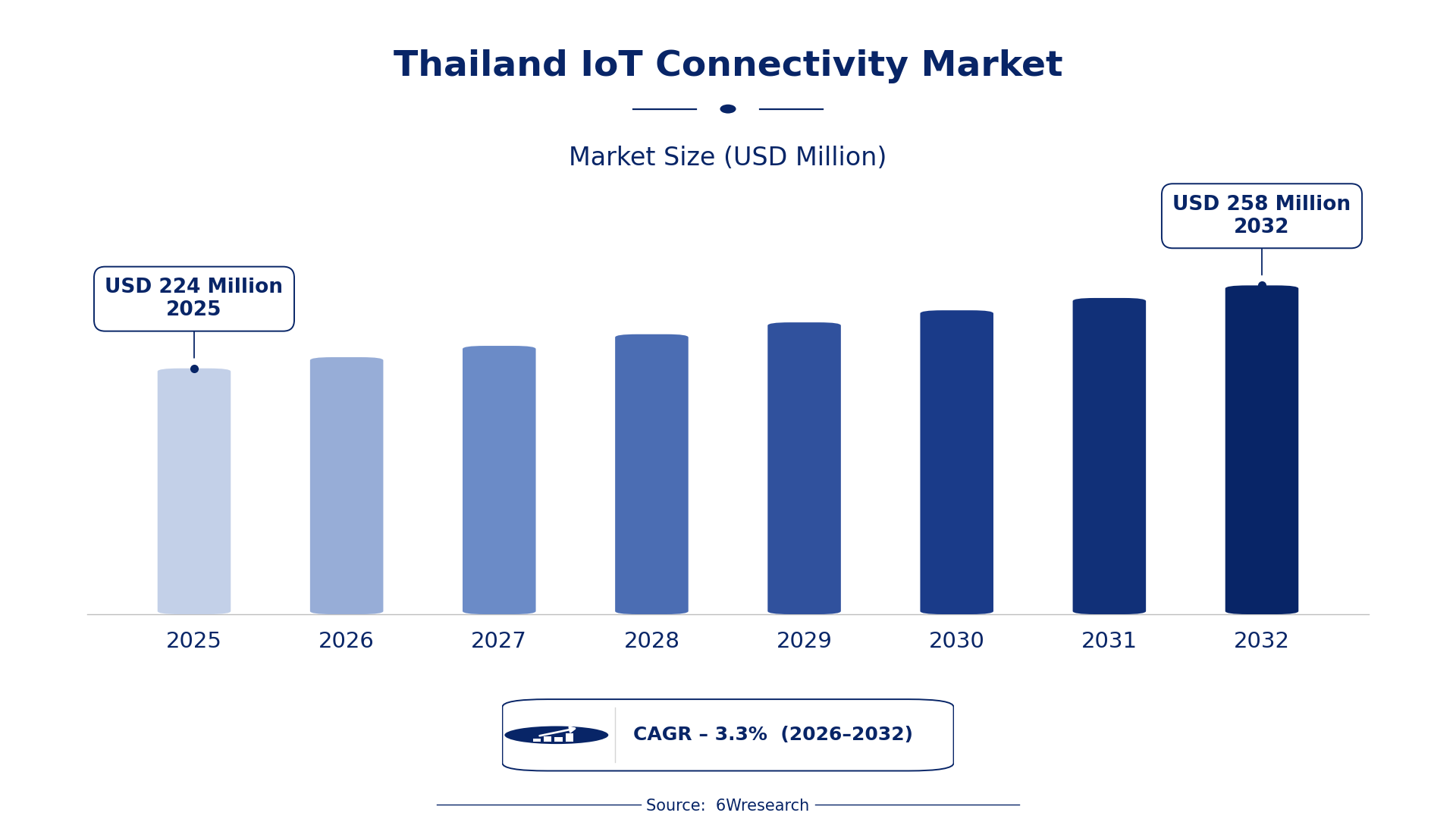
The Thailand IoT Connectivity Market was estimated at USD 224 Million in 2025 and is projected to reach USD 258 Million by 2032, growing at a CAGR of 3.3% from 2026 to 2032.
Thailand IoT Connectivity Market Synopsis
The relentless demand for reliable connectivity is the driving force behind the Thailand IoT Connectivity Market. As industries increasingly adopt IoT solutions, the need for efficient and robust network infrastructure becomes imperative, facilitating seamless communication among devices.
Connectivity options such as cellular networks, LPWAN, and satellite communications are essential for supporting the growing ecosystem of IoT devices. Organizations in Thailand face the challenge of selecting the right connectivity solutions tailored to their specific requirements, further shaping market dynamics.
Thailand IoT Connectivity Market Year-wise Growth Rate and Key Drivers
This graph illustrates the annual growth rates of the Thailand IoT Connectivity Market from 2021 to 2032, highlighting a steady upward trajectory and projected expansion over the forecast period.
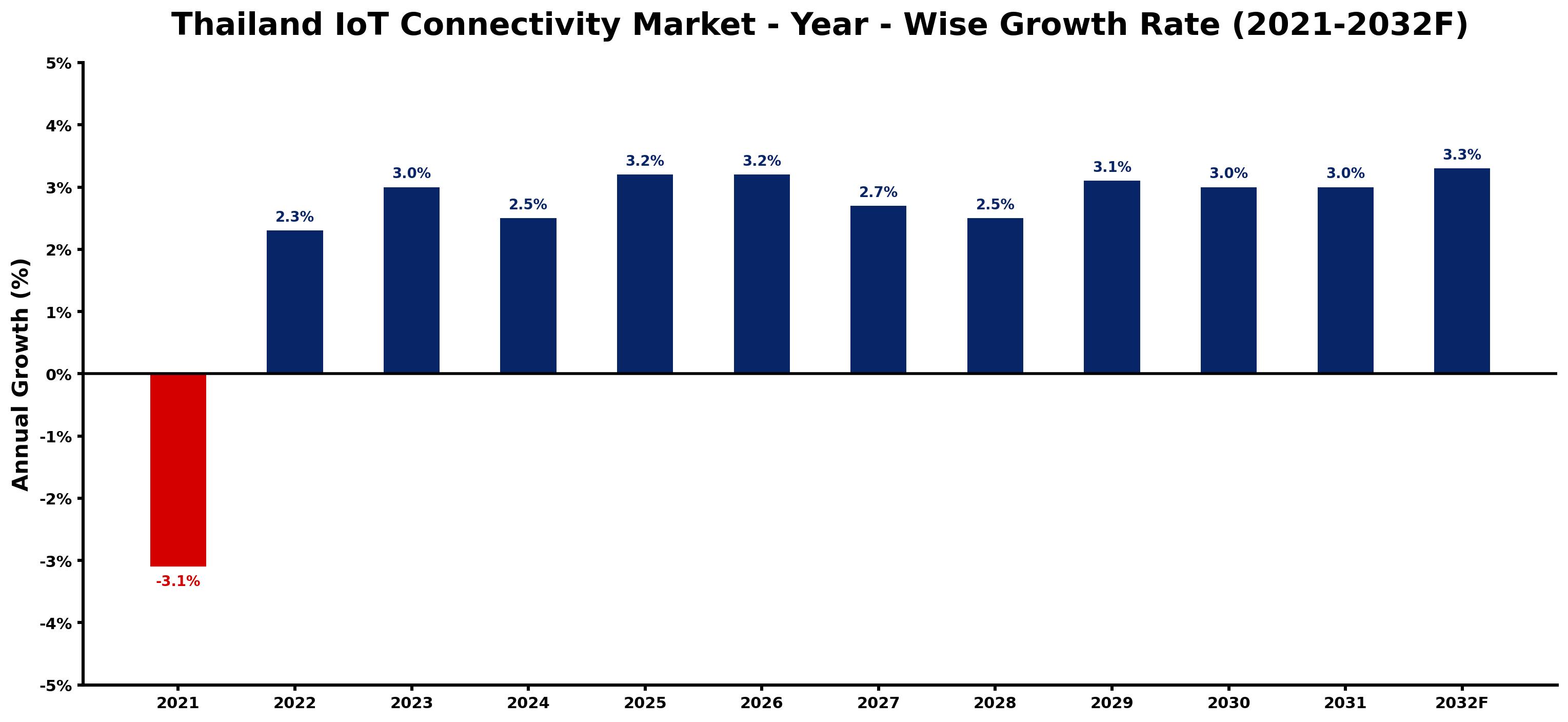
The table below presents the year‑wise growth rates along with the key drivers influencing the market
| Year | Growth Rate | Major Drivers |
| 2021 | -3.1% | Delayed 5G rollout impacting IoT network investments |
| 2022 | 2.3% | Thailand 4G expansion drives IoT connectivity growth. |
| 2023 | 3.0% | Smart City initiatives enhance demand for IoT solutions. |
| 2024 | 2.5% | Government's Thailand 4.0 policy boosts digital infrastructure. |
| 2025 | 3.2% | Rising mobile penetration increases IoT adoption rates. |
| 2026 | 3.2% | Local tech startups innovate IoT applications in agriculture. |
| 2027 | 2.7% | Increased investment in manufacturing automation spurs connectivity. |
| 2028 | 2.5% | Healthcare sector's digital transformation fuels IoT services demand. |
| 2029 | 3.1% | Rural broadband projects facilitate rural IoT connectivity expansion. |
| 2030 | 3.0% | Collaborations between telecoms and tech firms enhance IoT networks. |
| 2031 | 3.0% | E-commerce growth necessitates advanced IoT logistics solutions. |
| 2032 | 3.3% | Regulatory support accelerates smart home technology adoption. |
Note: Market size estimations and growth projections presented in this report are based on 6Wresearch's proprietary forecasting methodology, utilizing the latest available industry data, government publications, and primary research inputs.
Thailand IoT Connectivity Market Key Takeaways
Below are some of the specific key takeaways from the market, including:
- The increasing number of connected devices is driving the demand for IoT connectivity solutions.
- Cellular networks, LPWAN, and satellite communications are key technologies shaping the market.
- Organizations face challenges related to network coverage and interoperability.
- The impact of COVID-19 has accelerated the adoption of technology-driven platforms.
- Collaboration between telecommunication providers and regulatory bodies is vital for market growth.
Evaluation of Restraints in Thailand IoT Connectivity Market
Despite the promising growth trajectory, the Thailand IoT Connectivity Market grapples with significant restraints. One of the primary challenges is ensuring widespread network coverage across diverse geographical areas. Many regions still face connectivity gaps, which can hamper the deployment of IoT solutions. Additionally, the lack of interoperability among various communication protocols can lead to complications in integrating different devices. Addressing these issues will be crucial for fully realizing the potential of IoT applications across various sectors.
Thailand IoT Connectivity Market Trends
Several trends are influencing the Thailand IoT Connectivity Market. The shift towards smart cities is driving investment in connectivity infrastructure, enabling better data management and resource allocation. on top of that, the rise of Industry 4.0 is pushing manufacturers to adopt IoT solutions to enhance efficiency and productivity. The demand for low-latency communication is also growing, particularly in sectors like healthcare and transportation, where timely data exchange is critical.
Thailand IoT Connectivity Market Opportunities
With the growing interest in digital transformation, numerous opportunities lie ahead for investors and stakeholders in the Thailand IoT Connectivity Market. The agricultural sector, for instance, presents significant potential for IoT applications that enhance crop monitoring and resource management. on top of that, the increasing focus on sustainability and energy efficiency opens doors for IoT solutions that optimize energy consumption. As organizations continue to adapt to technology-driven frameworks, the demand for specialized connectivity solutions will expand.
Government Initiatives in the Thailand IoT Connectivity Market
Government policy is playing a crucial role in shaping the Thailand IoT Connectivity Market. With a strong emphasis on enhancing digital infrastructure, the Thai government is prioritizing initiatives that support the expansion of connectivity solutions. This regulatory posture aims to create an environment conducive to IoT development, ensuring that the necessary frameworks are in place to facilitate growth.
- A national digital infrastructure upgrade programme was recently completed to enhance network capabilities.
- Ongoing initiatives focus on expanding broadband access in rural areas, fostering greater inclusivity in IoT adoption.
- A regulatory framework to improve billing transparency for IoT services was introduced in early 2025.
- A planned public-private partnership is expected to develop smart city projects by 2027, integrating IoT solutions for urban management.
- The government has initiated discussions with industry stakeholders to streamline IoT device certification processes.
Future Insights of the Thailand IoT Connectivity Market
Looking ahead to 2026-2032, the Thailand IoT Connectivity Market is set for sustained growth. The increasing reliance on connected devices across various sectors will drive the demand for innovative connectivity solutions. As organizations strive for greater efficiency and automation, investment in advanced IoT infrastructure will become essential. on top of that, emerging technologies such as 5G will play a transformative role, enhancing connectivity and enabling new applications that were previously unattainable.
Thailand IoT Connectivity Market Latest Developments
In the past year, the Thailand IoT Connectivity Market has seen notable developments as stakeholders adapt to changing demands. The focus has shifted towards creating resilient and scalable connectivity solutions that can meet the needs of various industries. This period of activity is characterized by partnerships and technological advancements aimed at enhancing IoT infrastructure.
- A leading regional operator launched a new LPWAN service in early 2025, enabling low-power IoT device connectivity.
- In mid-2025, a major technology vendor expanded its satellite communication offerings to improve connectivity in remote areas.
- A rollout of a new cellular network infrastructure began in Q3 2025, aimed at increasing coverage in urban centers.
- By late 2026, a partnership between telecom companies is expected to enhance interoperability among different IoT devices.
- A research initiative focused on developing standards for IoT security is currently underway, expected to conclude by early 2026.
Thailand IoT Connectivity Market - Key Attractiveness of the Report
- 10 Years of Market Numbers
- Historical Data Starting from 2022 to 2025
- Base Year: 2025
- Forecast Data until 2032
- Key Performance Indicators Impacting the Market
- Major Upcoming Developments and Projects
Key Highlights of the Report:
- Thailand IoT Connectivity Market Outlook
- Market Size of Thailand IoT Connectivity Market, 2025
- Forecast of Thailand IoT Connectivity Market, 2032
- Historical Data and Forecast of Thailand IoT Connectivity Revenues & Volume for the Period 2022-2032F
- Thailand IoT Connectivity Market Trend Evolution
- Thailand IoT Connectivity Market Drivers and Challenges
- Thailand IoT Connectivity Price Trends
- Thailand IoT Connectivity Porter's Five Forces
- Thailand IoT Connectivity Industry Life Cycle
- Historical Data and Forecast of Thailand IoT Connectivity Market Revenues & Volume By Component for the Period 2022-2032F
- Historical Data and Forecast of Thailand IoT Connectivity Market Revenues & Volume By Platform for the Period 2022-2032F
- Historical Data and Forecast of Thailand IoT Connectivity Market Revenues & Volume By Services for the Period 2022-2032F
- Historical Data and Forecast of Thailand IoT Connectivity Market Revenues & Volume By Application Areas for the Period 2022-2032F
- Historical Data and Forecast of Thailand IoT Connectivity Market Revenues & Volume By Building & Home Automation for the Period 2022-2032F
- Historical Data and Forecast of Thailand IoT Connectivity Market Revenues & Volume By Smart Energy & Utility for the Period 2022-2032F
- Historical Data and Forecast of Thailand IoT Connectivity Market Revenues & Volume By Smart Manufacturing for the Period 2022-2032F
- Historical Data and Forecast of Thailand IoT Connectivity Market Revenues & Volume By Connected Health for the Period 2022-2032F
- Historical Data and Forecast of Thailand IoT Connectivity Market Revenues & Volume By Smart Retail for the Period 2022-2032F
- Historical Data and Forecast of Thailand IoT Connectivity Market Revenues & Volume By Smart Transportation for the Period 2022-2032F
- Historical Data and Forecast of Thailand IoT Connectivity Market Revenues & Volume By Others (Education and Agriculture) for the Period 2022-2032F
- Historical Data and Forecast of Thailand IoT Connectivity Market Revenues & Volume By Organization Size for the Period 2022-2032F
- Historical Data and Forecast of Thailand IoT Connectivity Market Revenues & Volume By Large Enterprises for the Period 2022-2032F
- Historical Data and Forecast of Thailand IoT Connectivity Market Revenues & Volume By SMEs for the Period 2022-2032F
- Thailand IoT Connectivity Import Export Trade Statistics
- Market Opportunity Assessment By Component
- Market Opportunity Assessment By Application Areas
- Market Opportunity Assessment By Organization Size
- Thailand IoT Connectivity Top Companies Market Share
- Thailand IoT Connectivity Competitive Benchmarking By Technical and Operational Parameters
- Thailand IoT Connectivity Company Profiles
- Thailand IoT Connectivity Key Strategic Recommendations






































