Thailand Iron Castings Market Summary
The thailand iron castings market was estimated at USD 198 Million in 2025 and is projected to reach USD 227 Million by 2032, growing at a CAGR of 3.0% from 2026 to 2032.
Thailand Iron Castings Market Year-wise Growth Rate and Key Drivers
This graph highlights how the Thailand Iron Castings Market has steadily grown over the past five years, supported by major growth factors.
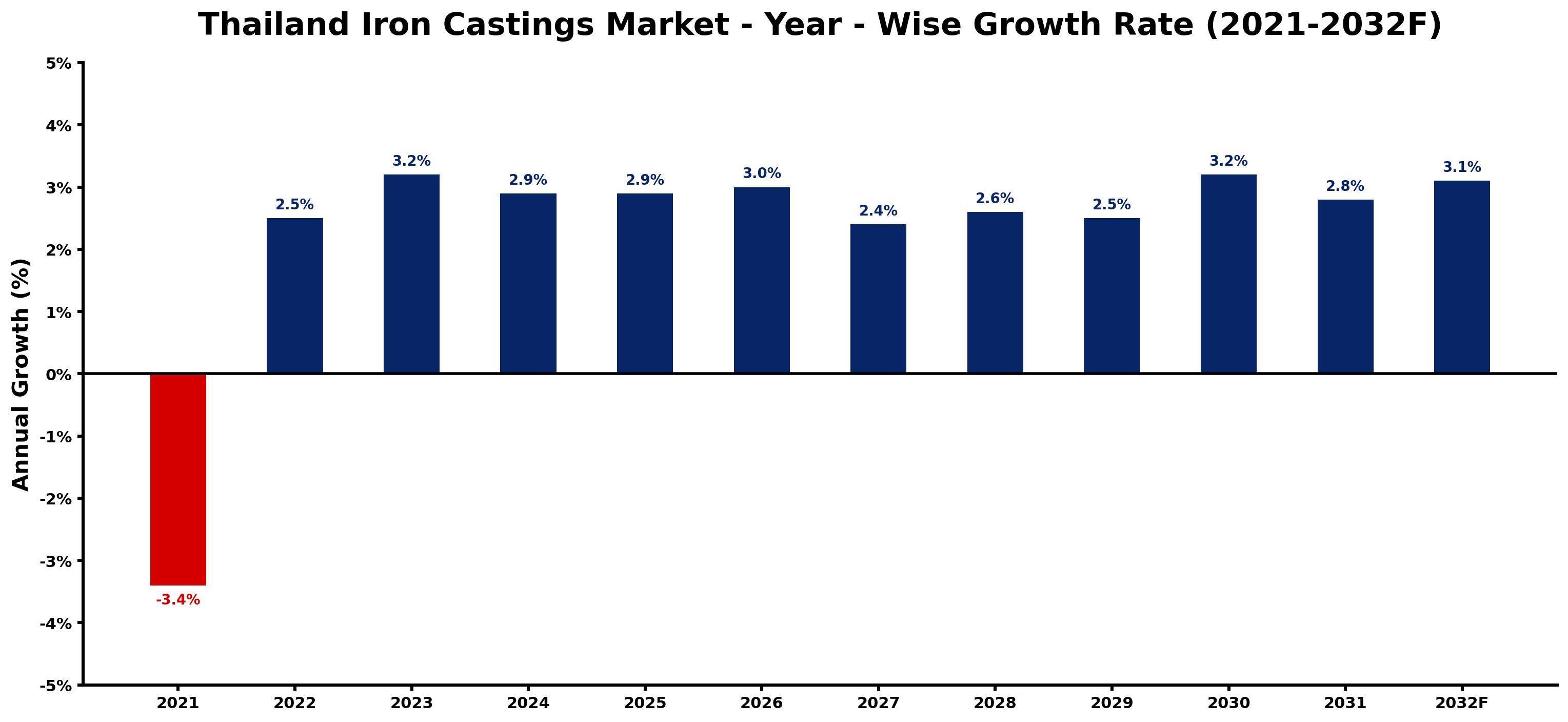
The table below presents the year wise growth rates along with the key drivers influencing the market
| Year | Growth Rate | Major Drivers |
| 2021 | -3.4% | Supply chain disruptions severely impacted production capabilities, leading to a decline in product availability. |
| 2022 | 2.5% | Increased construction activities prompted a surge in iron casting requirements. |
| 2023 | 3.2% | Industry leaders initiated partnerships to enhance product quality and market reach. |
| 2024 | 2.9% | Emerging automotive production trends drove demand for specialized casting solutions. |
| 2025 | 2.9% | Sustainability practices gained traction, influencing material sourcing strategies in casting. |
| 2026 | 3.0% | Technological integration led to efficiencies in iron casting production processes. |
| 2027 | 2.4% | Market players focused on innovative designs to cater to diverse industries. |
| 2028 | 2.6% | Export opportunities grew, with Thailand becoming a regional manufacturing hub. |
| 2029 | 2.5% | Infrastructure projects received funding, boosting the overall demand for cast iron components. |
| 2030 | 3.2% | Shift towards lightweight materials challenged traditional iron casting methods. |
| 2031 | 2.8% | Consumer preferences evolved, increasing the need for customized casting solutions. |
| 2032 | 3.1% | Long-term partnerships formed within the supply chain enhanced stability and growth. |
Note - Market size estimations and growth projections presented in this report are based on 6Wresearch's advanced forecasting approach, validated with industry datasets as of June 2026.
Thailand Iron Castings Market Synopsis
The Thailand Iron Castings Market is projected to reach 3.0% and witness significant growth during the forecast period (2026-2032). This growth trajectory is primarily driven by the expanding automotive sector paired with ongoing industrialization and urbanization initiatives across the country. Additionally, Thailand's robust economic performance has attracted increased foreign investments aimed at enhancing production capabilities and fostering technological advancements. However, rising raw material costs, primarily due to high import expenses, pose a potential challenge to market expansion in the coming years.
Thailand Iron Castings Market Growth Drivers
The Thailand Iron Castings Market is experiencing a robust demand surge, primarily influenced by several key factors:
- The automotive sector's evolution in Thailand has positioned the country as a prominent destination for international automotive manufacturers, who are drawn by tax exemptions provided under the Board of Investment (BOI) policies.
- Iron castings are essential components in automotive production, contributing to weight reduction and fuel efficiency, thus increasing their demand in vehicle manufacturing.
- Ongoing construction projects across both residential and commercial segments have led to an increase in the demand for iron castings owing to their durability and ability to endure extreme operational conditions.
- Technological advancements in casting processes are boosting productivity and enhancing the overall quality of iron castings, making them an attractive choice among manufacturers.
- The rise of green initiatives in manufacturing is motivating companies to adopt iron castings, as they are often more cost-effective and environmentally sustainable compared to alternatives like aluminum or steel alloys.
Thailand Iron Castings Market Challenges and Restraints
While the outlook for the Thailand Iron Castings Market is promising, numerous challenges could hinder its growth:
- Import regulations and tariffs have led to increased costs for raw materials, impacting profit margins, especially for smaller industry entrants reliant on these imports.
- The ongoing volatility in global supply chains, exacerbated by geopolitical tensions, can cause significant delays and increased costs in acquiring necessary materials.
- The labor market is tightening, creating difficulties for foundries in sourcing skilled labor, which may impair production efficiency and output.
- Environmental regulations are becoming more stringent, necessitating additional investments in cleaner technologies and processes to comply with sustainability goals.
- Economic fluctuations, particularly those provoked by global crises such as pandemics, may reduce consumer demand and impact the overall growth trajectory of the market.
Thailand Iron Castings Market Government Investment and Initiatives
The Thai government has undertaken several initiatives to bolster the Iron Castings Market as part of its broader economic strategy:
- Investment incentives, including tax exemptions and grants, are offered for companies investing in high-efficiency manufacturing technologies, which are crucial for improving production capacity.
- Infrastructure development projects, such as transportation systems and urban redevelopment, are anticipated to increase demand for iron castings significantly.
- The government has set sustainability targets that promote the use of eco-friendly materials and processes in the manufacturing sector, encouraging foundries to align with these objectives.
- Public-private partnerships are becoming increasingly common, aiming to enhance technological advancements in the foundry sector through collaborative research and development projects.
- Regulatory frameworks are being restructured to facilitate ease of doing business in the iron castings segment, which is crucial for attracting and retaining foreign investments.
Thailand Iron Castings Market Latest Developments (May 2025 - June 2026)
Recent developments in the Thailand Iron Castings Market reflect a gradual recovery following the disruptions caused by the Covid-19 pandemic:
- The resumption of factory operations has been marked by a focus on implementing health and safety protocols, ensuring the continuity of production while safeguarding workforce health.
- Investment in technology upgrades has continued, with companies looking to enhance automation and reduce reliance on manual labor, addressing labor shortages in the industry.
- Supply chain diversifications are being explored by manufacturers, aiming to mitigate risks associated with dependency on a single supplier or region.
- Market players are increasingly engaging in strategic partnerships to unlock new market opportunities and leverage shared resources for enhanced operational efficiency.
- In response to rising raw material costs, companies are revisiting pricing strategies and exploring alternative sourcing options to maintain competitiveness.
Thailand Iron Castings Market - Key Attractiveness of the Report
- 10 Years of Market Numbers
- Historical Data Starting from 2022 to 2025
- Base Year: 2025
- Forecast Data until 2032
- Key Performance Indicators Impacting the Market
- Major Upcoming Developments and Projects
Key Highlights of the Report:
- Thailand Iron Castings Market Outlook
- Market Size of Thailand Iron Castings Market, 2025
- Forecast of Thailand Iron Castings Market, 2032
- Historical Data and Forecast of Thailand Iron Castings Revenues & Volume for the Period 2022-2032F
- Thailand Iron Castings Market Trend Evolution
- Thailand Iron Castings Market Drivers and Challenges
- Thailand Iron Castings Price Trends
- Thailand Iron Castings Porter's Five Forces
- Thailand Iron Castings Industry Life Cycle
- Historical Data and Forecast of Thailand Iron Castings Market Revenues & Volume By Product for the Period 2022-2032F
- Historical Data and Forecast of Thailand Iron Castings Market Revenues & Volume By Gray Iron for the Period 2022-2032F
- Historical Data and Forecast of Thailand Iron Castings Market Revenues & Volume By Ductile Iron for the Period 2022-2032F
- Historical Data and Forecast of Thailand Iron Castings Market Revenues & Volume By Malleable Iron for the Period 2022-2032F
- Historical Data and Forecast of Thailand Iron Castings Market Revenues & Volume By End-User for the Period 2022-2032F
- Historical Data and Forecast of Thailand Iron Castings Market Revenues & Volume By Automobile for the Period 2022-2032F
- Historical Data and Forecast of Thailand Iron Castings Market Revenues & Volume By Industrial Machinery for the Period 2022-2032F
- Historical Data and Forecast of Thailand Iron Castings Market Revenues & Volume By Infrastructure and Construction Machines for the Period 2022-2032F
- Historical Data and Forecast of Thailand Iron Castings Market Revenues & Volume By Power for the Period 2022-2032F
- Historical Data and Forecast of Thailand Iron Castings Market Revenues & Volume By Others for the Period 2022-2032F
- Thailand Iron Castings Import Export Trade Statistics
- Market Opportunity Assessment By Product
- Market Opportunity Assessment By End-User
- Thailand Iron Castings Top Companies Market Share
- Thailand Iron Castings Competitive Benchmarking By Technical and Operational Parameters
- Thailand Iron Castings Company Profiles
- Thailand Iron Castings Key Strategic Recommendations






































