Thailand Iron chloride Market Size, Share & Growth Rate
The Thailand Iron chloride Market was estimated at USD 103 Million in 2025 and is projected to reach USD 118 Million by 2032, growing at a CAGR of 2.0% from 2026 to 2032. This anticipated growth reflects a steady demand driven by the product's versatile applications across multiple sectors, particularly in water treatment, where it plays a crucial role. Additionally, the expanding paint and coatings market, alongside emerging technologies in electronics, will further bolster iron chloride consumption in Thailand.
Thailand Iron chloride Market Year-wise Growth Rate and Key Drivers
This graph highlights how the Thailand Iron chloride Market has steadily grown over the years, supported by major growth factors.
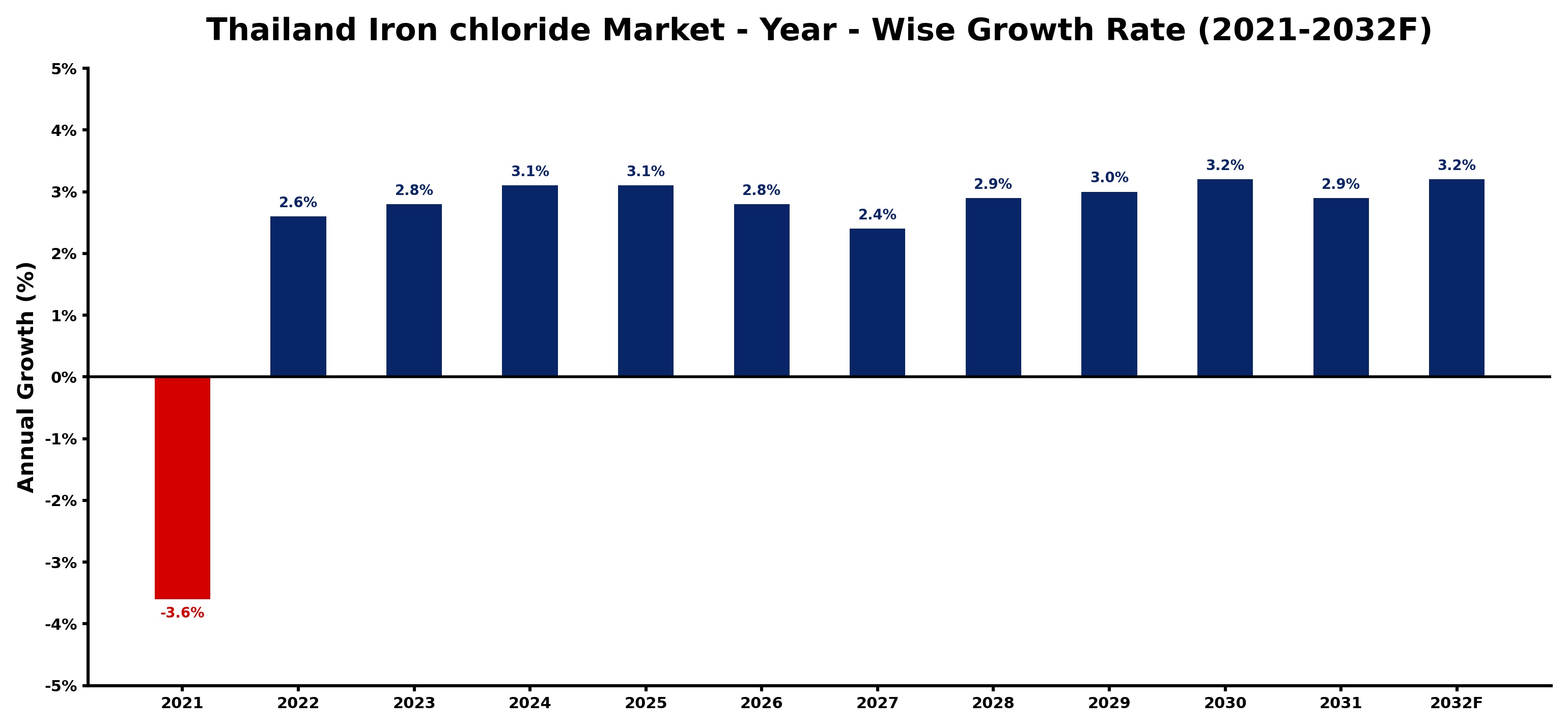
The table below presents the year‑wise growth rates along with the key drivers influencing the market
| Year | Growth Rate | Major Drivers |
| 2021 | -3.6% | Manufacturing slowdowns curtailed iron chloride procurement across industries |
| 2022 | 2.6% | Surge in water treatment projects boosts iron chloride consumption |
| 2023 | 2.8% | Strengthened chemical production efficiency boosted iron chloride output |
| 2024 | 3.1% | Domestic chemical plants scale up iron chloride production capacity |
| 2025 | 3.1% | Export driven construction projects boosted iron chloride production capabilities |
| 2026 | 2.8% | New production techniques boost iron chloride quality for exports |
| 2027 | 2.4% | Domestic construction projects boosted iron chloride demand for water treatment |
| 2028 | 2.9% | Higher domestic construction projects boosted iron chloride demand in Thailand |
| 2029 | 3.0% | Modernized wastewater treatment plants drive iron chloride demand increase |
| 2030 | 3.2% | Domestic demand for iron chloride boosts regional manufacturing capabilities |
| 2031 | 2.9% | Infrastructure projects fueled demand for iron chloride in construction |
| 2032 | 3.2% | Automation adoption in wastewater treatment boosts iron chloride usage |
Note - Market size estimations and growth projections presented in this report are based on 6Wresearch's advanced forecasting approach, validated with industry datasets as of June 2026.
Thailand Iron chloride Market Synopsis
Thailand's iron chloride market is experiencing a pivotal moment, highlighted by its essential role in various industrial processes. Notably, its application in water treatment is paramount as industries and municipalities increasingly focus on sustainable solutions for managing wastewater and ensuring potable water safety.
In addition to water treatment, iron chloride's utilization in electronics, specifically for etching printed circuit boards, underscores its significance in the rapidly evolving technology landscape. This dual reliance on iron chloride across critical sectors positions the market for sustained growth amid rising environmental regulations and technological advancements.
Thailand Iron chloride Market Key Takeaways
- The market is projected to grow steadily, fueled by the demand for efficient water treatment solutions.
- Iron chloride serves as a critical intermediate in the manufacturing of paints, coatings, and printing inks.
- Technological advancements in electronics are driving increased consumption of iron chloride for PCB etching.
- Environmental regulations will enhance the focus on sustainable practices, boosting market growth opportunities.
- Challenges related to waste management necessitate innovative disposal solutions within the industry.
Evaluation of Restraints in Thailand Iron chloride Market
Despite the positive growth trajectory, the Thailand iron chloride market faces notable restraints, particularly regarding waste management and disposal issues associated with its production and application. The byproducts generated from using iron chloride in various processes can create environmental challenges, leading to regulatory scrutiny. Ensuring compliance with environmental standards while managing waste effectively is critical for industry players. Consequently, there is a pressing need for the development of advanced recycling techniques and sustainable practices to mitigate these concerns and maintain market momentum.
Thailand Iron chloride Market Trends
Current trends in the Thailand iron chloride market indicate a growing emphasis on sustainability and technological innovation. As industries strive for greener solutions, the demand for eco-friendly processes, particularly in water treatment, is on the rise. Furthermore, the integration of advanced manufacturing techniques in electronics is enhancing the efficiency of iron chloride applications, promoting its adoption across sectors. Companies are increasingly investing in R&D to develop higher-quality iron chloride products that align with stringent environmental regulations and market needs.
Thailand Iron chloride Market Opportunities
Significant growth opportunities are emerging within the Thailand iron chloride market, particularly driven by increasing infrastructural investments in water treatment facilities. As municipalities upgrade their systems to meet stricter regulations, the demand for iron chloride for water purification is set to rise. Additionally, the push towards expanding electronic manufacturing within the region creates a fertile ground for increased iron chloride utilization in PCB production. Companies that innovate and adapt to these trends are well-positioned to capitalize on the expanding market landscape.
Government Initiatives in the Thailand Iron chloride Market
The Thai government is actively pursuing policies that favor sustainable industrial practices, which directly impact the iron chloride market. Initiatives aimed at improving water management and pollution control are becoming increasingly prominent, with public spending directed towards modernizing water treatment facilities. Moreover, programs that encourage technological innovation in manufacturing and waste management are creating a supportive environment for iron chloride producers, enhancing their operational efficiencies and compliance with environmental standards.
Future Insights of the Thailand Iron chloride Market
Looking ahead to the period from 2026 to 2032, the Thailand iron chloride market is poised for continued growth, driven by evolving consumer demands and environmental considerations. As industrial sectors adapt to more stringent regulations and focus on sustainable practices, iron chloride's role as a crucial ingredient in water treatment and electronics will likely expand. Furthermore, the ongoing push for infrastructural upgrades, alongside technological advancements in manufacturing processes, will support a steady rise in market demand.
Thailand Iron chloride Market Latest Developments (May 2025 - June 2026)
Recent developments within the Thailand iron chloride market reflect an ongoing adaptation to changing consumer needs and regulatory demands. Companies are increasingly focusing on enhancing product quality and sustainable production methods to align with environmental regulations. Moreover, partnerships and collaborations aimed at advancing research into more efficient water treatment technologies are becoming commonplace, indicating a collective industry shift towards innovation. The recovery of industrial activities post-COVID-19 is also reinforcing the market's resilience and potential for growth.
Thailand Iron chloride Market - Key Attractiveness of the Report
- 10 Years of Market Numbers
- Historical Data Starting from 2022 to 2025
- Base Year: 2025
- Forecast Data until 2032
- Key Performance Indicators Impacting the Market
- Major Upcoming Developments and Projects
Key Highlights of the Report:
- Thailand Iron chloride Market Outlook
- Market Size of Thailand Iron chloride Market, 2025
- Forecast of Thailand Iron chloride Market, 2032
- Historical Data and Forecast of Thailand Iron chloride Revenues & Volume for the Period 2022-2032F
- Thailand Iron chloride Market Trend Evolution
- Thailand Iron chloride Market Drivers and Challenges
- Thailand Iron chloride Price Trends
- Thailand Iron chloride Porter's Five Forces
- Thailand Iron chloride Industry Life Cycle
- Historical Data and Forecast of Thailand Iron chloride Market Revenues & Volume By Type for the Period 2022-2032F
- Historical Data and Forecast of Thailand Iron chloride Market Revenues & Volume By Ferric Chloride for the Period 2022-2032F
- Historical Data and Forecast of Thailand Iron chloride Market Revenues & Volume By Ferrous Chloride for the Period 2022-2032F
- Historical Data and Forecast of Thailand Iron chloride Market Revenues & Volume By Application for the Period 2022-2032F
- Historical Data and Forecast of Thailand Iron chloride Market Revenues & Volume By Water and Sewage Treatment Industry for the Period 2022-2032F
- Historical Data and Forecast of Thailand Iron chloride Market Revenues & Volume By Metal Surface Treatment Industry for the Period 2022-2032F
- Historical Data and Forecast of Thailand Iron chloride Market Revenues & Volume By PCB Industry for the Period 2022-2032F
- Historical Data and Forecast of Thailand Iron chloride Market Revenues & Volume By Pigment Industry for the Period 2022-2032F
- Thailand Iron chloride Import Export Trade Statistics
- Market Opportunity Assessment By Type
- Market Opportunity Assessment By Application
- Thailand Iron chloride Top Companies Market Share
- Thailand Iron chloride Competitive Benchmarking By Technical and Operational Parameters
- Thailand Iron chloride Company Profiles
- Thailand Iron chloride Key Strategic Recommendations






































