Thailand Kitchen Appliances Market: Import Trend Analysis
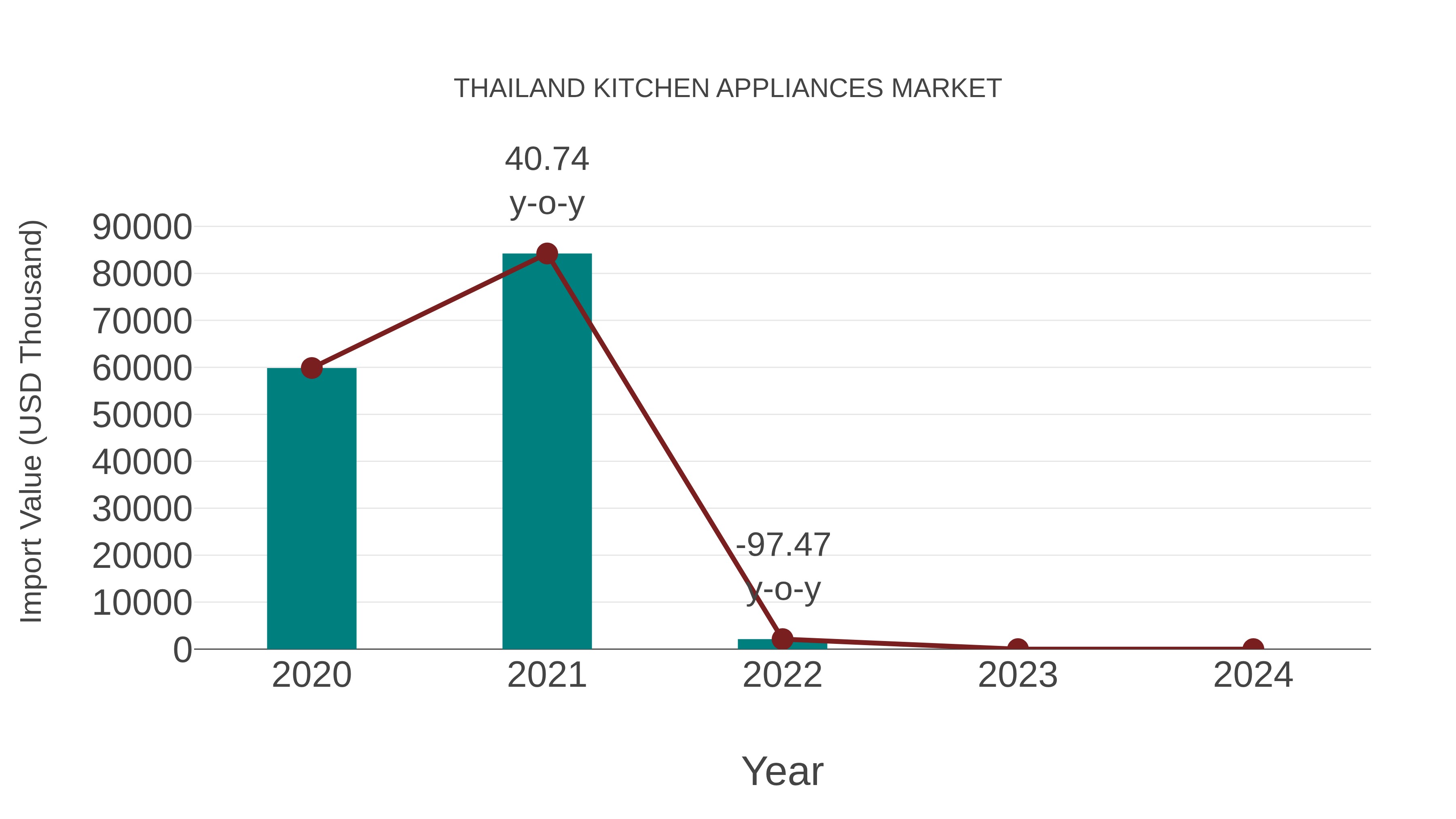
Thailand kitchen appliances market experienced a significant decline in imports from 2020 to 2024, with a compound annual growth rate (CAGR) of -81.14%. This sharp negative import momentum suggests a notable shift in demand or market stability impacting trade performance during this period.
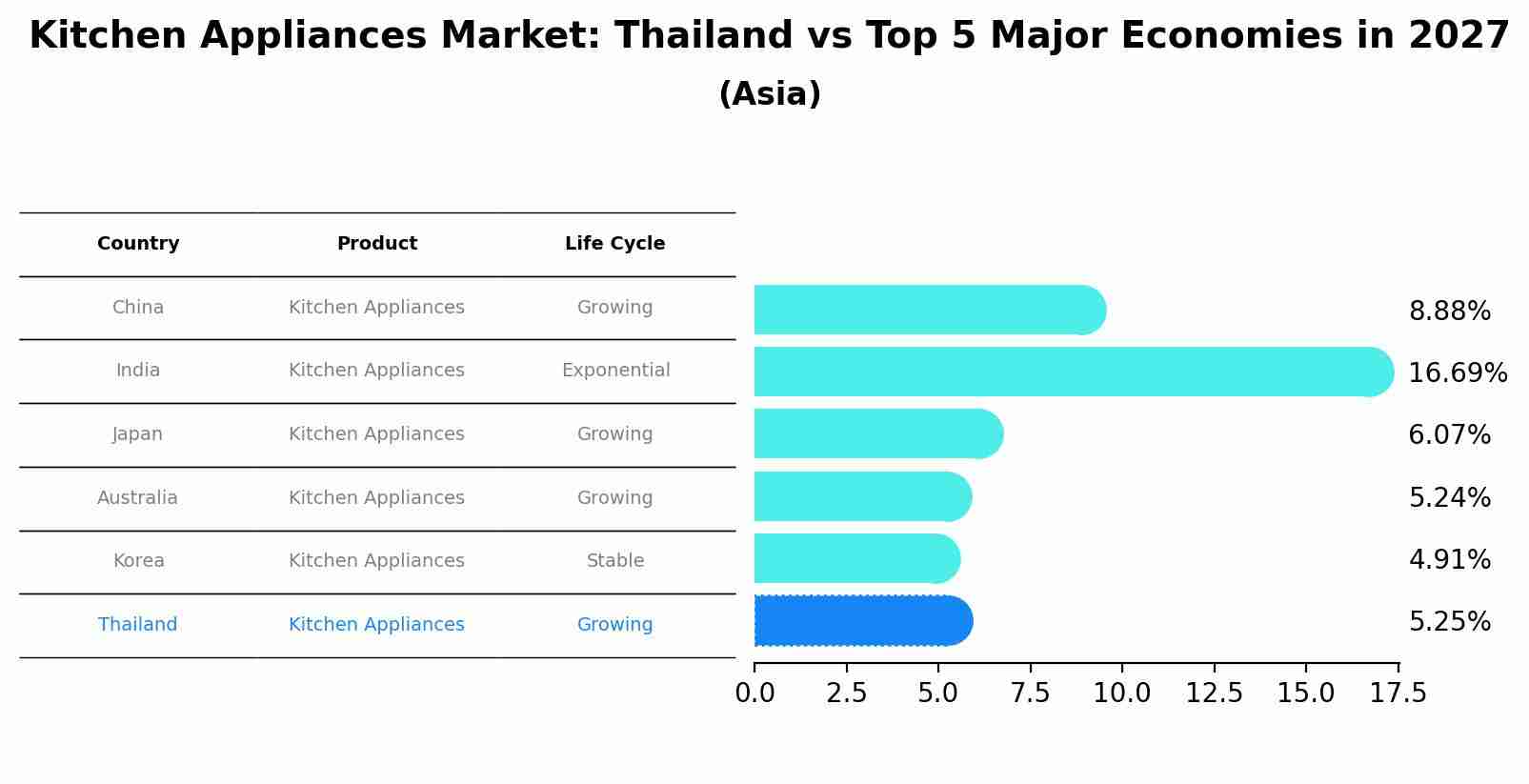
Kitchen Appliances Market: Thailand vs Top 5 Major Economies in 2027 (Asia)
In the Asia region, the Kitchen Appliances market in Thailand is projected to expand at a growing growth rate of 5.25% by 2027. The largest economy is China, followed by India, Japan, Australia and South Korea.
Thailand Kitchen Appliances Market Highlights
| Report Name | Thailand Kitchen Appliances Market |
| Forecast period | 2026-2032 |
| CAGR | 4.8% |
| Growing Sector | Household |
Thailand Kitchen Appliances Market Synopsis
The Thailand kitchen appliances market is evolving rapidly as changing lifestyles and rising urban living standards drive demand for modern kitchen solutions. Growing disposable incomes, greater awareness of energy‑efficient and smart appliances, and expanding retail and e‑commerce channels are making kitchens more functional and stylish. Consumers increasingly seek convenience, aesthetics, and technologically advanced appliances to suit contemporary living.
According to 6Wresearch internal database and industry insights, the Thailand Kitchen Appliances Market is projected to grow at a compound annual growth rate (CAGR) of 4.8% during the forecast period (2026–2032). Over the forecast horizon, rising disposable income, shifting lifestyle preferences, and greater focus on household convenience are expected to drive expanded adoption of advanced kitchen solutions. Multiple distribution channels will support broader availability.
Key Attractiveness of the Report
- 10 Years of Market Numbers.
- Historical Data Starting from 2022 to 2025.
- Base Year: 2025
- Forecast Data until 2032.
- Key Performance Indicators Impacting the market.
- Major Upcoming Developments and Projects.
Key Highlights of the Report:
- Thailand Kitchen Appliances Market Outlook
- Market Size of Thailand Kitchen Appliances Market, 2025
- Forecast of Thailand Kitchen Appliances Market, 2032
- Historical Data and Forecast of Thailand Kitchen Appliances Revenues & Volume for the Period 2022-2032
- Thailand Kitchen Appliances Market Trend Evolution
- Thailand Kitchen Appliances Market Drivers and Challenges
- Thailand Kitchen Appliances Price Trends
- Thailand Kitchen Appliances Porter's Five Forces
- Thailand Kitchen Appliances Industry Life Cycle
- Historical Data and Forecast of Thailand Kitchen Appliances Market Revenues & Volume By Product Type for the Period 2022-2032
- Historical Data and Forecast of Thailand Kitchen Appliances Market Revenues & Volume By Refrigerator for the Period 2022-2032
- Historical Data and Forecast of Thailand Kitchen Appliances Market Revenues & Volume By Cooking Appliances for the Period 2022-2032
- Historical Data and Forecast of Thailand Kitchen Appliances Market Revenues & Volume By Dishwasher for the Period 2022-2032
- Historical Data and Forecast of Thailand Kitchen Appliances Market Revenues & Volume By Others for the Period 2022-2032
- Historical Data and Forecast of Thailand Kitchen Appliances Market Revenues & Volume By Product Structure for the Period 2022-2032
- Historical Data and Forecast of Thailand Kitchen Appliances Market Revenues & Volume By Built-in for the Period 2022-2032
- Historical Data and Forecast of Thailand Kitchen Appliances Market Revenues & Volume By Free Stand for the Period 2022-2032
- Historical Data and Forecast of Thailand Kitchen Appliances Market Revenues & Volume By Fuel Type for the Period 2022-2032
- Historical Data and Forecast of Thailand Kitchen Appliances Market Revenues & Volume By Electric for the Period 2022-2032
- Historical Data and Forecast of Thailand Kitchen Appliances Market Revenues & Volume By Cooking Gas for the Period 2022-2032
- Historical Data and Forecast of Thailand Kitchen Appliances Market Revenues & Volume By Others for the Period 2022-2032
- Historical Data and Forecast of Thailand Kitchen Appliances Market Revenues & Volume By Distribution Channel for the Period 2022-2032
- Historical Data and Forecast of Thailand Kitchen Appliances Market Revenues & Volume By Online for the Period 2022-2032
- Historical Data and Forecast of Thailand Kitchen Appliances Market Revenues & Volume By Offline for the Period 2022-2032
- Historical Data and Forecast of Thailand Kitchen Appliances Market Revenues & Volume By User Applications for the Period 2022-2032
- Historical Data and Forecast of Thailand Kitchen Appliances Market Revenues & Volume By Commercial for the Period 2022-2032
- Historical Data and Forecast of Thailand Kitchen Appliances Market Revenues & Volume By Household for the Period 2022-2032
- Thailand Kitchen Appliances Import Export Trade Statistics
- Market Opportunity Assessment By Product Type
- Market Opportunity Assessment By Product Structure
- Market Opportunity Assessment By Fuel Type
- Market Opportunity Assessment By Distribution Channel
- Market Opportunity Assessment By User Applications
- Thailand Kitchen Appliances Top Companies Market Share
- Thailand Kitchen Appliances Competitive Benchmarking By Technical and Operational Parameters
- Thailand Kitchen Appliances Company Profiles
- Thailand Kitchen Appliances Key Strategic Recommendations
By Product Type
- Refrigerator
- Cooking Appliances
- Dishwasher
- Others
By Product Structure
- Built-in
- Free Stand
By Fuel Type
- Electric
- Cooking Gas
- Others
By Distribution Channel
- Online
- Offline
By User Applications
- Commercial
- Household






































