Thailand Kosher Food Market Size, Share & Growth Rate
The Thailand Kosher Food Market was estimated at USD 125 Million in 2025 and is projected to reach USD 142 Million by 2032, growing at a CAGR of 1.8% from 2026 to 2032. This growth trajectory reflects an increasing awareness of dietary choices influenced by modernization and a rising interest in health-conscious products among Thai consumers. The market is further buoyed by expanding hospitality sectors that cater to diverse dietary needs, including the growing availability of kosher offerings in hotels and restaurants.
Thailand Kosher Food Market Year-wise Growth Rate and Key Drivers
This graph highlights how the Thailand Kosher Food Market has steadily grown over the years, supported by major growth factors.
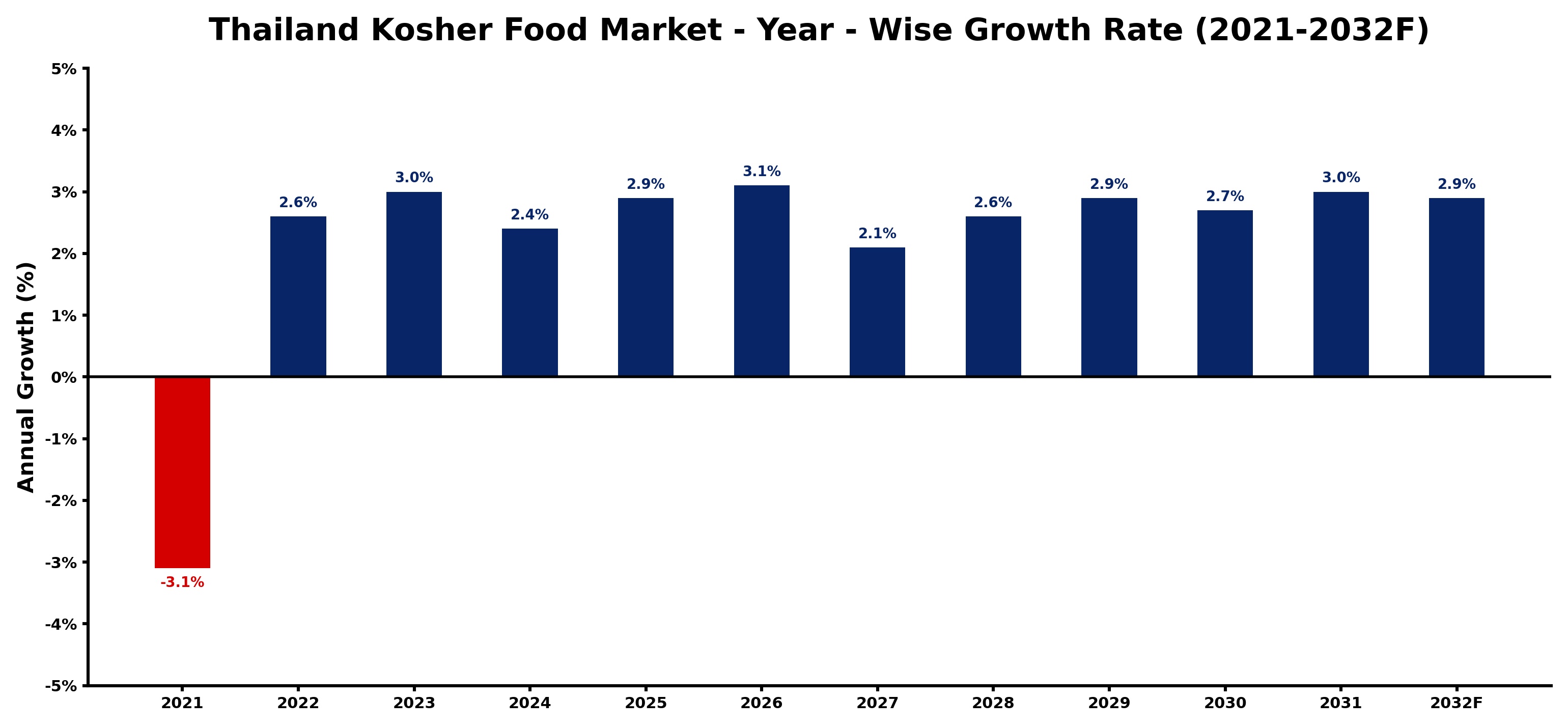
The table below presents the year‑wise growth rates along with the key drivers influencing the market
| Year | Growth Rate | Major Drivers |
| 2021 | -3.1% | Manufacturing slowdowns led to decreased demand for kosher ingredients |
| 2022 | 2.6% | Domestic processing capacity upgrades boosted kosher food product output |
| 2023 | 3.0% | Export driven manufacturing investments boost Thailand's kosher food processing capacity |
| 2024 | 2.4% | Local food manufacturers expanded kosher product lines to meet demand |
| 2025 | 2.9% | Smart processing technology adoption boosts kosher food manufacturing efficiency |
| 2026 | 3.1% | Regional meat processing upgrades boosted kosher certification throughput |
| 2027 | 2.1% | New facilities established to boost kosher food processing capacity |
| 2028 | 2.6% | Local kosher certification demand boosts food processing efficiency improvements |
| 2029 | 2.9% | Local manufacturers upgraded facilities to meet rising kosher certification standards |
| 2030 | 2.7% | New kosher certification factories boost Thailand's food manufacturing capabilities |
| 2031 | 3.0% | Kosher certification process optimization boosts local food production efficiency |
| 2032 | 2.9% | Export driven food safety technologies boost kosher food manufacturing efficiency |
Note - Market size estimations and growth projections presented in this report are based on 6Wresearch’s advanced forecasting approach, validated with industry datasets as of June 2026.
Thailand Kosher Food Market Synopsis
In Thailand, the demand for kosher food products is gaining momentum, particularly within urban centers. The introduction of kosher dining options in hotels not only satisfies Jewish travelers but also appeals to health-conscious locals who perceive kosher certification as synonymous with high quality and safety.
This burgeoning market is characterized by a diverse array of offerings, from processed foods to fresh produce, all adhering to kosher dietary laws. As collaborations between local producers and international brands increase, the accessibility and variety of kosher foods are expected to improve, further stimulating market growth.
Thailand Kosher Food Market Key Takeaways
- The kosher food sector is thriving due to heightened consumer awareness and demand for certified products.
- Strategic partnerships are enhancing distribution channels and market penetration for kosher offerings.
- The hospitality industry plays a crucial role in expanding kosher food availability in urban regions.
- Market growth is influenced by the increasing appeal of kosher dietary standards among non-Jewish consumers.
- Ongoing collaborations across borders are set to facilitate both imports and exports of kosher-certified foods.
Evaluation of Restraints in Thailand Kosher Food Market
While the Thailand Kosher Food Market is on an upward trajectory, several constraints exist. One significant challenge is the stringent requirements for kosher certification. The certification process demands meticulous oversight of production methods and ingredient sourcing, which can be both time-consuming and costly for local manufacturers. This creates a barrier to entry for new players and limits the rapid expansion of kosher offerings in the market.
Moreover, the fluctuating demand brought on by external factors, such as economic conditions and health crises like COVID-19, has introduced uncertainty. While interest in kosher foods remains, businesses must navigate these challenges to sustain growth and ensure product availability.
Thailand Kosher Food Market Trends
Several trends are currently shaping the Thailand kosher food market. Firstly, the rise of health awareness has prompted consumers to seek out kosher products, which are often perceived as healthier options. Additionally, there is a notable increase in online sales channels catering specifically to kosher food, enabling easier access for consumers. Social media also plays a pivotal role in educating the public about kosher foods and their benefits, further driving interest.
Moreover, the tourism sector is witnessing a surge in kosher-friendly venues, enhancing the dining experience for Jewish travelers and local patrons alike. This trend, combined with globalization, is gradually integrating kosher standards into mainstream culinary practices.
Thailand Kosher Food Market Opportunities
The Thailand kosher food market presents several promising opportunities for growth and investment. Companies can explore partnerships with local producers to expand their product lines, leveraging Thailand's rich agricultural resources. Additionally, innovative marketing strategies targeting health-conscious consumers can help capture a larger share of the market.
Investors can also look into establishing online platforms dedicated to kosher foods, tapping into the growing e-commerce trend. Furthermore, as more hotels and restaurants embrace kosher offerings, there is an opportunity for suppliers to enhance their distribution networks to cater to this expanding clientele.
Government Initiatives in the Thailand Kosher Food Market
The Thai government has shown a supportive stance towards the expansion of specialized food markets, including kosher products. Initiatives promoting culinary tourism and foreign investment have been implemented, aiming to position Thailand as a hub for diverse food experiences. This public spending on hospitality and food safety initiatives could facilitate greater access to kosher foods, promoting their acceptance and integration into mainstream dining culture.
Future Insights of the Thailand Kosher Food Market
Looking ahead to 2026-2032, the Thailand kosher food market is poised for steady growth. As urban populations continue to evolve, the demand for diverse culinary offerings will likely intensify. With ongoing globalization, it's anticipated that more international kosher brands will enter the Thai market, enriching local options.
In addition, the development of clear guidelines and support for local businesses seeking kosher certification could streamline access to this niche market, ultimately fostering a more robust ecosystem that meets the needs of both Jewish consumers and health-oriented individuals.
Thailand Kosher Food Market Latest Developments (May 2025 - June 2026)
In recent months, there have been significant strides within the Thailand kosher food market as various stakeholders collaborate to enhance product offerings. Trends indicate a growing number of partnerships between local suppliers and international brands aiming to diversify available kosher products. Furthermore, a rise in consumer education initiatives focused on the benefits of kosher certification has emerged, leading to increased interest among health-conscious individuals beyond the Jewish community.
Thailand Kosher Food Market - Key Attractiveness of the Report
- 10 Years of Market Numbers
- Historical Data Starting from 2022 to 2025
- Base Year: 2025
- Forecast Data until 2032
- Key Performance Indicators Impacting the Market
- Major Upcoming Developments and Projects
Key Highlights of the Report:
- Thailand Kosher Food Market Outlook
- Market Size of Thailand Kosher Food Market, 2025
- Forecast of Thailand Kosher Food Market, 2032
- Historical Data and Forecast of Thailand Kosher Food Revenues & Volume for the Period 2022-2032F
- Thailand Kosher Food Market Trend Evolution
- Thailand Kosher Food Market Drivers and Challenges
- Thailand Kosher Food Price Trends
- Thailand Kosher Food Porter's Five Forces
- Thailand Kosher Food Industry Life Cycle
- Historical Data and Forecast of Thailand Kosher Food Market Revenues & Volume By Type for the Period 2022-2032F
- Historical Data and Forecast of Thailand Kosher Food Market Revenues & Volume By Meat for the Period 2022-2032F
- Historical Data and Forecast of Thailand Kosher Food Market Revenues & Volume By Dairy for the Period 2022-2032F
- Historical Data and Forecast of Thailand Kosher Food Market Revenues & Volume By Pareve for the Period 2022-2032F
- Historical Data and Forecast of Thailand Kosher Food Market Revenues & Volume By Application for the Period 2022-2032F
- Historical Data and Forecast of Thailand Kosher Food Market Revenues & Volume By Seafood for the Period 2022-2032F
- Historical Data and Forecast of Thailand Kosher Food Market Revenues & Volume By Processed Meat and Poultry for the Period 2022-2032F
- Historical Data and Forecast of Thailand Kosher Food Market Revenues & Volume By Beverages for the Period 2022-2032F
- Historical Data and Forecast of Thailand Kosher Food Market Revenues & Volume By Staples for the Period 2022-2032F
- Historical Data and Forecast of Thailand Kosher Food Market Revenues & Volume By Snacks & Savoury for the Period 2022-2032F
- Historical Data and Forecast of Thailand Kosher Food Market Revenues & Volume By Bakery and Confectionery for the Period 2022-2032F
- Historical Data and Forecast of Thailand Kosher Food Market Revenues & Volume By Others for the Period 2022-2032F
- Historical Data and Forecast of Thailand Kosher Food Market Revenues & Volume By Distribution Channel for the Period 2022-2032F
- Historical Data and Forecast of Thailand Kosher Food Market Revenues & Volume By Supermarkets and Hypermarkets for the Period 2022-2032F
- Historical Data and Forecast of Thailand Kosher Food Market Revenues & Volume By Grocery Stores for the Period 2022-2032F
- Historical Data and Forecast of Thailand Kosher Food Market Revenues & Volume By Online Stores for the Period 2022-2032F
- Thailand Kosher Food Import Export Trade Statistics
- Market Opportunity Assessment By Type
- Market Opportunity Assessment By Application
- Market Opportunity Assessment By Distribution Channel
- Thailand Kosher Food Top Companies Market Share
- Thailand Kosher Food Competitive Benchmarking By Technical and Operational Parameters
- Thailand Kosher Food Company Profiles
- Thailand Kosher Food Key Strategic Recommendations






































