Thailand Letterpress Printing Machinery Market Size, Share & Growth Rate
The Thailand Letterpress Printing Machinery Market was estimated at USD 117 Million in 2025 and is projected to reach USD 135 Million by 2032, growing at a CAGR of 2.1% from 2026 to 2032. This growth trajectory is fueled by a robust demand for high-quality printing in the packaging and specialty product sectors, where customization and tactile experiences are paramount. The integration of digital capabilities into traditional letterpress machinery is also reshaping the landscape, enhancing operational efficiency and appealing to the modern consumer's desire for unique printed products.
Thailand Letterpress Printing Machinery Market Year-wise Growth Rate and Key Drivers
This graph highlights how the Thailand Letterpress Printing Machinery Market has steadily grown over the years, supported by major growth factors.
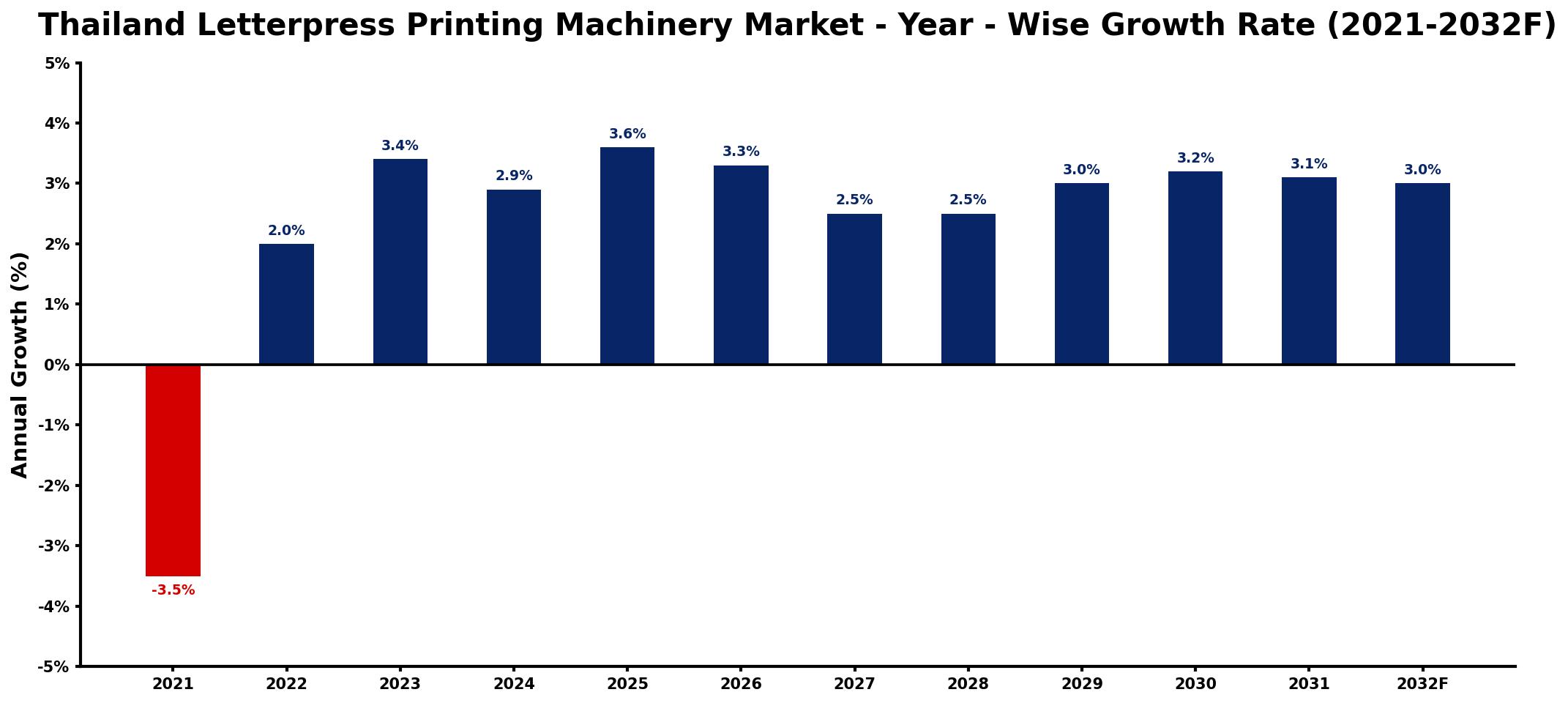
The table below presents the year‑wise growth rates along with the key drivers influencing the market
| Year | Growth Rate | Major Drivers |
| 2021 | -3.5% | decreased demand from small businesses |
| 2022 | 2.0% | increased investment in technology |
| 2023 | 3.4% | growing interest in customization |
| 2024 | 2.9% | rising adoption in packaging |
| 2025 | 3.6% | expansion of eco-friendly products |
| 2026 | 3.3% | growing popularity of artisanal goods |
| 2027 | 2.5% | increased focus on local production |
| 2028 | 2.5% | emerging trends in sustainable practices |
| 2029 | 3.0% | higher demand from creative industries |
| 2030 | 3.2% | expanding market for specialty applications |
| 2031 | 3.1% | growth in e-commerce packaging needs |
| 2032 | 3.0% | increased collaboration with designers |
Note: Market size estimations and growth projections presented in this report are based on 6Wresearch's proprietary forecasting methodology, utilizing the latest available industry data, government publications, and primary research inputs.
Thailand Letterpress Printing Machinery Market Synopsis
Innovation stands as the strongest force shaping the Thailand Letterpress Printing Machinery Market today. The blend of traditional craftsmanship with modern technological advancements allows manufacturers to cater to a diverse range of printing needs, from packaging to specialty items. This synergy not only appeals to established businesses but also attracts new entrants looking to differentiate their offerings through bespoke printing solutions.
Additionally, the market is characterized by a growing focus on sustainability. Eco-friendly inks and sustainable materials are increasingly popular, aligning with the global push towards environmental responsibility. This trend is particularly relevant in Thailand, where businesses aim to resonate with eco-conscious consumers, further solidifying letterpress printings relevance in the modern marketplace.
Thailand Letterpress Printing Machinery Market Key Takeaways
- The market is projected to witness steady growth driven by customization and high-quality print demand.
- Technological advancements are integrating digital capabilities into traditional letterpress processes.
- Sustainability is emerging as a key focus, with eco-friendly materials gaining traction in production.
- Letterpress remains vital for businesses seeking unique, tactile, and visually appealing printed products.
- The market's resilience post-COVID-19 reflects the adaptability of industry players to shifting consumer behaviors.
Evaluation of Restraints in Thailand Letterpress Printing Machinery Market
Despite the potential for growth, the Thailand Letterpress Printing Machinery Market faces notable restraints. The increasing prevalence of digital printing technologies poses a significant challenge, as businesses may lean towards faster and more cost-effective solutions. Additionally, the need for significant capital investment in new machinery can deter smaller enterprises from entering the market or upgrading existing equipment. As competition intensifies, companies must also navigate fluctuating demand and ensure they remain agile enough to adapt to evolving customer preferences.
Thailand Letterpress Printing Machinery Market Trends
A key trend influencing the Thailand Letterpress Printing Machinery Market is the rise of hybrid printing solutions that combine traditional letterpress with digital technologies. This hybrid approach allows for efficient short-run printing while maintaining the unique aesthetic qualities of letterpress. Additionally, personalization in printing, driven by consumer demand for unique products, is pushing manufacturers to innovate and offer customizable print options. Moreover, advancements in automation are enhancing production efficiency, enabling businesses to cater to more complex printing needs.
Thailand Letterpress Printing Machinery Market Opportunities
Genuine growth opportunities lie in the expanding packaging sector, particularly as brands seek to enhance consumer engagement through unique packaging designs. There's also potential for development in the educational and artisanal markets, where letterpress printing can be utilized for creative projects and educational purposes. Furthermore, as sustainability becomes a key selling point, investing in eco-friendly materials and inks can serve to attract environmentally conscious consumers, opening doors to niche markets.
Government Initiatives in the Thailand Letterpress Printing Machinery Market
The Thai government has been proactive in supporting the printing industry through various initiatives aimed at promoting innovation and sustainability. Investments in technology upgrades and training programs for skilled labor in the printing sector have been emphasized. Additionally, policies encouraging the use of eco-friendly materials align with global sustainability goals, fostering an environment where letterpress printing can thrive while adhering to responsible practices.
Future Insights of the Thailand Letterpress Printing Machinery Market
Looking ahead to 2026-2032, the Thailand Letterpress Printing Machinery Market is expected to evolve with a stronger emphasis on technological integration and sustainability. As consumer preferences shift towards personalized and eco-conscious products, the demand for innovative letterpress solutions is likely to grow. Manufacturers who invest in modernizing their equipment and exploring new eco-friendly materials will find themselves well-positioned to capture emerging market opportunities. This evolution promises not only to preserve the traditional appeal of letterpress printing but to enhance its relevance in a digital world.
Thailand Letterpress Printing Machinery Market Latest Developments (2025 - 2026)
Recent developments in the Thailand Letterpress Printing Machinery Market indicate a growing trend towards the implementation of automation within traditional printing processes. Efforts to diversify product offerings have also been noted, with companies exploring new market segments such as artisanal products and high-end packaging. Additionally, ongoing investments in eco-friendly production methods continue to shape the industry's direction, reflecting a broader commitment to sustainability across the printing sector.
Thailand Letterpress Printing Machinery Market - Key Attractiveness of the Report
- 10 Years of Market Numbers
- Historical Data Starting from 2022 to 2025
- Base Year: 2025
- Forecast Data until 2032
- Key Performance Indicators Impacting the Market
- Major Upcoming Developments and Projects
Key Highlights of the Report:
- Thailand Letterpress Printing Machinery Market Outlook
- Market Size of Thailand Letterpress Printing Machinery Market, 2025
- Forecast of Thailand Letterpress Printing Machinery Market, 2032
- Historical Data and Forecast of Thailand Letterpress Printing Machinery Revenues & Volume for the Period 2022-2032F
- Thailand Letterpress Printing Machinery Market Trend Evolution
- Thailand Letterpress Printing Machinery Market Drivers and Challenges
- Thailand Letterpress Printing Machinery Price Trends
- Thailand Letterpress Printing Machinery Porter's Five Forces
- Thailand Letterpress Printing Machinery Industry Life Cycle
- Historical Data and Forecast of Thailand Letterpress Printing Machinery Market Revenues & Volume By Type for the Period 2022-2032F
- Historical Data and Forecast of Thailand Letterpress Printing Machinery Market Revenues & Volume By Rotary Letterpress Machine for the Period 2022-2032F
- Historical Data and Forecast of Thailand Letterpress Printing Machinery Market Revenues & Volume By Other for the Period 2022-2032F
- Historical Data and Forecast of Thailand Letterpress Printing Machinery Market Revenues & Volume By Application for the Period 2022-2032F
- Historical Data and Forecast of Thailand Letterpress Printing Machinery Market Revenues & Volume By Securities for the Period 2022-2032F
- Historical Data and Forecast of Thailand Letterpress Printing Machinery Market Revenues & Volume By Invitation Card for the Period 2022-2032F
- Historical Data and Forecast of Thailand Letterpress Printing Machinery Market Revenues & Volume By Other for the Period 2022-2032F
- Thailand Letterpress Printing Machinery Import Export Trade Statistics
- Market Opportunity Assessment By Type
- Market Opportunity Assessment By Application
- Thailand Letterpress Printing Machinery Top Companies Market Share
- Thailand Letterpress Printing Machinery Competitive Benchmarking By Technical and Operational Parameters
- Thailand Letterpress Printing Machinery Company Profiles
- Thailand Letterpress Printing Machinery Key Strategic Recommendations






































