Thailand Lithographic Printing for Packaging Market Summary
The thailand lithographic printing for packaging market was estimated at USD 236 Million in 2025 and is projected to reach USD 272 Million by 2032, growing at a CAGR of 3.1% from 2026 to 2032.
Thailand Lithographic Printing for Packaging Market Year-wise Growth Rate and Key Drivers
This graph highlights how the Thailand Lithographic Printing for Packaging Market has steadily grown over the past five years, supported by major growth factors.
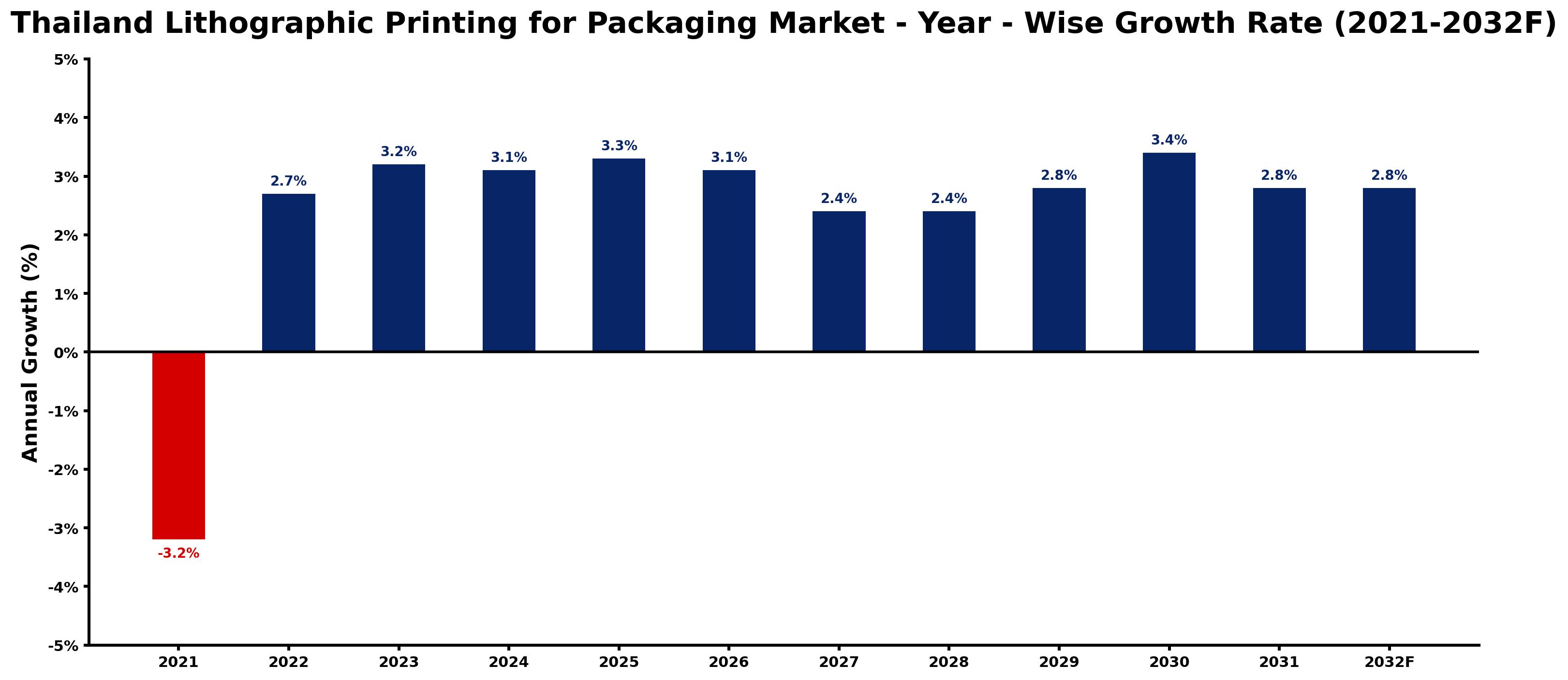
The table below presents the year wise growth rates along with the key drivers influencing the market
| Year | Growth Rate | Major Drivers |
| 2021 | -3.2% | Supply chain disruptions from the pandemic hindered timely packaging production, leading to decreased market activity. |
| 2022 | 2.7% | Sustainability trends motivate brands to shift towards eco-friendly lithographic printing options. |
| 2023 | 3.2% | E-commerce expansion necessitates diverse packaging solutions for various product categories. |
| 2024 | 3.1% | Innovations in printing technology enhance speed and reduce costs for manufacturers. |
| 2025 | 3.3% | Consumer preference for personalized packaging influences design strategies and production. |
| 2026 | 3.1% | Local manufacturers increase investments in lithographic printing infrastructure and capacity. |
| 2027 | 2.4% | Rising competition among brands intensifies the focus on visually appealing packaging. |
| 2028 | 2.4% | International brands enter Thailand, pushing for local partnerships in packaging processes. |
| 2029 | 2.8% | Technological integration in supply chains streamlines operations and boosts efficiency significantly. |
| 2030 | 3.4% | Regulatory shifts push for greater environmental compliance in packaging materials used. |
| 2031 | 2.8% | Market diversification creates opportunities for specialty packaging solutions across industries. |
| 2032 | 2.8% | Consumer awareness on sustainability strengthens demand for recyclable lithographic products. |
Note - Market size estimations and growth projections presented in this report are based on 6Wresearch's advanced forecasting approach, validated with industry datasets as of June 2026.
Thailand Lithographic Printing for Packaging Market Synopsis
The Thailand Lithographic Printing for Packaging Market is projected to reach 3.1% and witness significant growth during the forecast period (2026-2032). The market is being driven by a surge in consumer demand for convenience products, which has prompted manufacturers to invest in high-quality, visually appealing packaging solutions. This trend is expected to intensify as urbanization progresses and disposable incomes rise, allowing consumers greater access to packaged goods. Additionally, advancements in printing technology, including digital and 3D printing capabilities, are further enhancing the potential of lithographic printing for packaging applications.
Thailand Lithographic Printing for Packaging Market Growth Drivers
The growth trajectory of the Thailand Lithographic Printing for Packaging Market is mainly attributed to several key drivers:
- Consumer preference for convenience products significantly impacts the market, as consumers increasingly favor packaging that enhances product visibility and appeal. Lithographic printing provides the required aesthetic quality that attracts consumers.
- Rapid urbanization is a critical factor, as it leads to changes in consumer behavior and lifestyle, pushing demand for packaged goods that are easy to consume on-the-go.
- Rising disposable incomes in Thailand have made consumers more willing to pay for premium packaging that offers better functionality and design.
- Technological innovations in printing processes, including the adoption of digital and 3D printing, are opening new avenues for lithographic printing applications, enhancing production efficiency.
- The burgeoning e-commerce sector also contributes to the demand for lithographic printing in packaging, necessitating attractive packaging that can withstand shipping requirements while maintaining visual appeal.
Thailand Lithographic Printing for Packaging Market Challenges and Restraints
Despite the promising growth prospects, the Thailand Lithographic Printing for Packaging Market faces several challenges:
- High initial investment costs for lithographic printing setups hinder many small to medium-sized enterprises from adopting this technology, limiting their ability to compete effectively.
- Ongoing maintenance expenses associated with printing machinery can be a significant burden, especially for companies with limited operational budgets.
- The market is also challenged by the environmental concerns associated with traditional printing processes, pushing companies toward more sustainable practices.
- Availability of alternative printing technologies that may be cheaper or more efficient could weigh on the growth of the lithographic printing segment.
- The global economic fluctuations can impact demand for packaging materials, subsequently affecting the lithographic printing market.
Thailand Lithographic Printing for Packaging Market COVID-19 Impact
The COVID-19 pandemic had a profound impact on the Thailand Lithographic Printing for Packaging Market, particularly through lockdowns and restrictions that curtailed production capacities. In 2025, many industries, including packaging, experienced significant revenue declines. However, as the economy gradually recovered, the lithographic printing sector began to rebound. Although growth rates improved post-2025, they have yet to return to pre-pandemic levels. The recovery process underscores a trend toward agility and sustainable practices in the industry, responding to shifting consumer behaviors.
Thailand Lithographic Printing for Packaging Market Government Investment and Initiatives
The Thai government has been proactive in supporting the lithographic printing for packaging sector through various investment initiatives and policies. Public spending on infrastructure improvements has facilitated better logistics for packaging materials, thereby enhancing market efficiency. Additionally, there are efforts to promote sustainable practices within the industry, which include incentives for companies that adopt eco-friendly printing techniques. Development plans focus on fostering innovation in the printing technology space, encouraging collaborations between private sector companies and research institutions.
Thailand Lithographic Printing for Packaging Market Latest Developments (May 2025 - June 2026)
During the period from May 2025 to June 2026, the Thailand Lithographic Printing for Packaging Market witnessed several notable developments. Businesses began to adopt more advanced printing technologies to enhance production capabilities and reduce operational costs. Companies also focused increasingly on sustainable practices, with many shifting towards eco-friendly inks and materials. Simultaneously, the competitive landscape became more dynamic, as firms sought to leverage innovative packaging solutions to meet growing consumer expectations for both aesthetics and functionality.
Thailand Lithographic Printing for Packaging Market - Key Attractiveness of the Report
- 10 Years of Market Numbers
- Historical Data Starting from 2022 to 2025
- Base Year: 2025
- Forecast Data until 2032
- Key Performance Indicators Impacting the Market
- Major Upcoming Developments and Projects
Key Highlights of the Report:
- Thailand Lithographic Printing for Packaging Market Outlook
- Market Size of Thailand Lithographic Printing for Packaging Market, 2025
- Forecast of Thailand Lithographic Printing for Packaging Market, 2032
- Historical Data and Forecast of Thailand Lithographic Printing for Packaging Revenues & Volume for the Period 2022-2032F
- Thailand Lithographic Printing for Packaging Market Trend Evolution
- Thailand Lithographic Printing for Packaging Market Drivers and Challenges
- Thailand Lithographic Printing for Packaging Price Trends
- Thailand Lithographic Printing for Packaging Porter's Five Forces
- Thailand Lithographic Printing for Packaging Industry Life Cycle
- Historical Data and Forecast of Thailand Lithographic Printing for Packaging Market Revenues & Volume By Printing Ink Types for the Period 2022-2032F
- Historical Data and Forecast of Thailand Lithographic Printing for Packaging Market Revenues & Volume By U.V based for the Period 2022-2032F
- Historical Data and Forecast of Thailand Lithographic Printing for Packaging Market Revenues & Volume By Aqueous for the Period 2022-2032F
- Historical Data and Forecast of Thailand Lithographic Printing for Packaging Market Revenues & Volume By Strikethrough for the Period 2022-2032F
- Historical Data and Forecast of Thailand Lithographic Printing for Packaging Market Revenues & Volume By Material for the Period 2022-2032F
- Historical Data and Forecast of Thailand Lithographic Printing for Packaging Market Revenues & Volume By Paper & Paperboard for the Period 2022-2032F
- Historical Data and Forecast of Thailand Lithographic Printing for Packaging Market Revenues & Volume By Plastic for the Period 2022-2032F
- Historical Data and Forecast of Thailand Lithographic Printing for Packaging Market Revenues & Volume By Application for the Period 2022-2032F
- Historical Data and Forecast of Thailand Lithographic Printing for Packaging Market Revenues & Volume By Food & Beverages for the Period 2022-2032F
- Historical Data and Forecast of Thailand Lithographic Printing for Packaging Market Revenues & Volume By Cosmetics & Toiletries for the Period 2022-2032F
- Historical Data and Forecast of Thailand Lithographic Printing for Packaging Market Revenues & Volume By Healthcare for the Period 2022-2032F
- Historical Data and Forecast of Thailand Lithographic Printing for Packaging Market Revenues & Volume By Other? for the Period 2022-2032F
- Thailand Lithographic Printing for Packaging Import Export Trade Statistics
- Market Opportunity Assessment By Printing Ink Types
- Market Opportunity Assessment By Material
- Market Opportunity Assessment By Application
- Thailand Lithographic Printing for Packaging Top Companies Market Share
- Thailand Lithographic Printing for Packaging Competitive Benchmarking By Technical and Operational Parameters
- Thailand Lithographic Printing for Packaging Company Profiles
- Thailand Lithographic Printing for Packaging Key Strategic Recommendations






































