Thailand LTE IoT Market Size & Growth Rate (2026-2032)
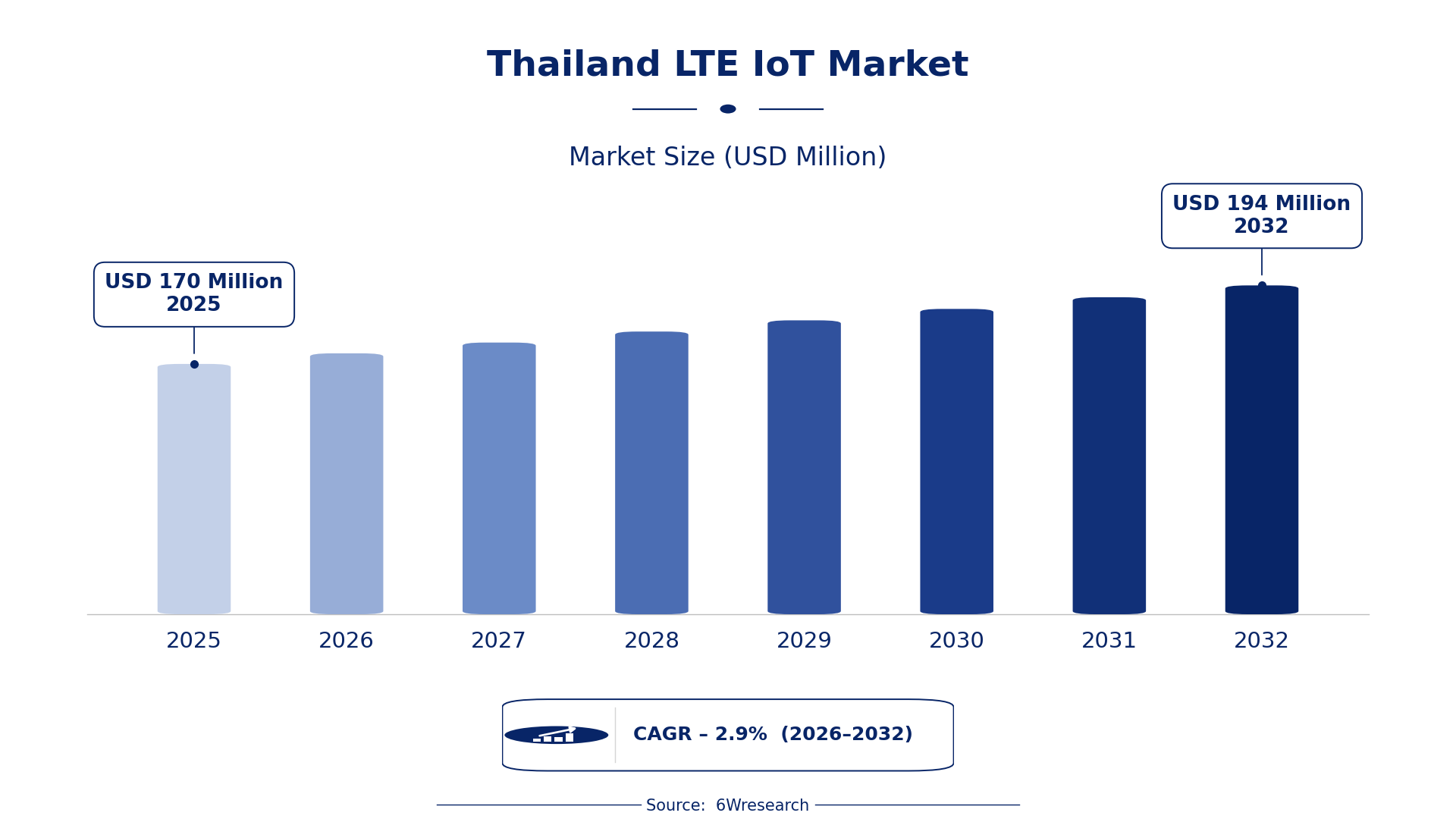
The Thailand LTE IoT Market was estimated at USD 170 Million in 2025 and is projected to reach USD 194 Million by 2032, growing at a CAGR of 2.9% from 2026 to 2032.
Thailand LTE IoT Market Synopsis
The Thailand LTE IoT market has experienced noteworthy growth, fueled by the rapid deployment of LTE networks tailored to accommodate a myriad of IoT applications. This surge reflects a broader trend toward digital transformation, yet the market faces critical challenges as it forges ahead into the next phase of development, where reliability and efficiency are paramount.
As industries increasingly adopt IoT solutions, the demand for dependable low-latency connectivity becomes undeniable. LTE technology stands out by offering the ideal blend of speed and power efficiency, which is essential as Thailand's economy increasingly leans on smart infrastructure and connected devices.
Thailand LTE IoT Market Year-wise Growth Rate and Key Drivers
This graph illustrates the annual growth rates of the Thailand LTE IoT Market from 2021 to 2032, highlighting a steady upward trajectory and projected expansion over the forecast period.
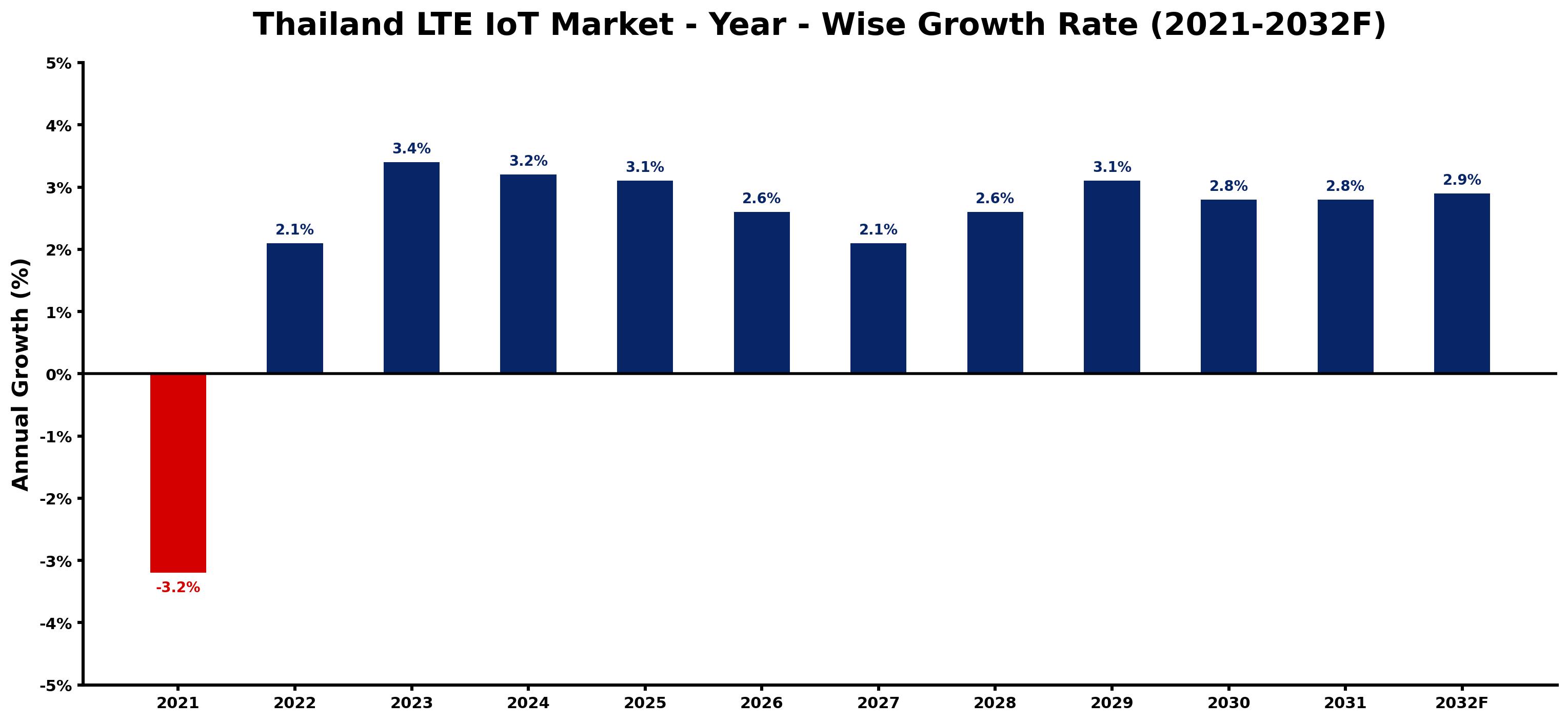
The table below presents the year‑wise growth rates along with the key drivers influencing the market
| Year | Growth Rate | Major Drivers |
| 2021 | -3.2% | Delayed 5G rollout hindered LTE IoT investments. |
| 2022 | 2.1% | Thailand's Digital Economy Promotion Agency initiatives |
| 2023 | 3.4% | Government incentives for smart agriculture technology adoption |
| 2024 | 3.2% | Increased deployment of smart meters in utilities sector |
| 2025 | 3.1% | Growing popularity of connected devices in retail outlets |
| 2026 | 2.6% | Support for Industry 4.0 initiatives by Thai government |
| 2027 | 2.1% | Launch of 5G services enabling advanced IoT applications |
| 2028 | 2.6% | Rising integration of IoT in transportation infrastructure |
| 2029 | 3.1% | Augmented government support for smart city projects |
| 2030 | 2.8% | Increased focus on sustainable smart city development |
| 2031 | 2.8% | Growing number of urban startups developing IoT solutions |
| 2032 | 2.9% | Enhanced data security regulations boosting IoT investments |
Note: Market size estimations and growth projections presented in this report are based on 6Wresearch's proprietary forecasting methodology, utilizing the latest available industry data, government publications, and primary research inputs.
Thailand LTE IoT Market Key Takeaways
Below are some of the specific key takeaways from the market, including:
- The market's expansion is driven by increasing LTE network deployments across various sectors.
- Growth is supported by applications in smart cities, industrial automation, and healthcare monitoring.
- Energy efficiency and data transfer speed are critical considerations for the adoption of LTE IoT solutions.
- Challenges include network optimization and managing diverse IoT device requirements.
- The COVID-19 pandemic has accelerated the demand for robust IoT connectivity across industries.
Evaluation of Restraints in Thailand LTE IoT Market
Despite the promising prospects, several restraints hinder the growth of the Thailand LTE IoT market. A primary concern is the optimization of network coverage, which remains inconsistent in various regions. The diverse requirements of IoT devices pose another challenge, complicating the efforts to create a cohesive and interoperable environment. Additionally, issues surrounding data privacy and security continue to create apprehension among potential adopters. Organizations require substantial education about the benefits of LTE IoT and guidance to transition effectively to these solutions.
Thailand LTE IoT Market Trends
Key trends are shaping the Thailand LTE IoT market. A marked increase in investment in smart city initiatives is pushing the demand for connected solutions. Furthermore, industries are becoming more focused on operational efficiency and cost reductions, pushing organizations to explore new technologies. The integration of LTE-M and NB-IoT services is enhancing capabilities, especially in sectors like agriculture and logistics. As the technology matures, businesses are increasingly recognizing the critical need for high-quality, low-latency connectivity.
Thailand LTE IoT Market Opportunities
Opportunities within the Thailand LTE IoT market are on the rise. The national push towards digital transformation is a significant driver for investment. Companies can capitalize on the demand for smart city solutions, as municipalities are eager to enhance operational efficiencies through interconnected systems. Healthcare monitoring applications also present lucrative opportunities, especially as the sector leans into technology for improved patient outcomes. As industries grow accustomed to digital solutions, the possibilities for innovative IoT applications will expand significantly.
Government Initiatives in the Thailand LTE IoT Market
Government initiatives are crucial in shaping the trajectory of the Thailand LTE IoT market. With a strong focus on enhancing digital infrastructure, the government is actively working to create a regulatory environment that supports IoT integration across various sectors. Policies aimed at bolstering connectivity not only facilitate business growth but also encourage innovation in emerging technologies.
- A national digital infrastructure upgrade programme currently in its rollout phase aims to enhance LTE coverage across urban and rural areas.
- A regulatory framework introduced in 2025 mandates transparency in billing practices, aiming to boost consumer confidence in IoT services.
- A public-private initiative to expand access to telecom infrastructure is expected to be launched by 2026, promoting wider adoption of IoT solutions.
- Recent policy adjustments support incentives for companies implementing sustainable IoT solutions, fostering a green technology approach.
Future Insights of the Thailand LTE IoT Market
Looking ahead to 2026-2032, the Thailand LTE IoT market is on a growth trajectory driven by technological advancements and increased adoption across sectors. A focus on smart infrastructure and urbanization will propel demand for LTE connectivity. As businesses seek to optimize operations through IoT, the need for reliable, energy-efficient solutions will only intensify. The combination of government support, technological evolution, and changing consumer behaviors will create an environment ripe for innovation and growth.
Thailand LTE IoT Market Latest Developments
In recent months, the Thailand LTE IoT market has witnessed a flurry of activity, underscoring its growing importance in the regional economy. Various initiatives and technological advancements are paving the way for enhanced connectivity solutions that cater to diverse applications across industries.
- A leading regional operator launched a new LTE-M service in early 2025, aimed at smart agriculture applications, improving connectivity in rural areas.
- A major technology vendor announced a partnership in Q1 2025, developing IoT solutions tailored for urban environments to enhance smart city functionalities.
- An initiative that began in mid-2025 is focused on rolling out NB-IoT solutions for logistics, aimed at improving supply chain efficiencies.
- A service upgrade to existing LTE networks is expected to enhance capabilities by mid-2026, bolstering data transfer rates for IoT applications.
Thailand LTE IoT Market - Key Attractiveness of the Report
- 10 Years of Market Numbers
- Historical Data Starting from 2022 to 2025
- Base Year: 2025
- Forecast Data until 2032
- Key Performance Indicators Impacting the Market
- Major Upcoming Developments and Projects
Key Highlights of the Report:
- Thailand LTE IoT Market Outlook
- Market Size of Thailand LTE IoT Market, 2025
- Forecast of Thailand LTE IoT Market, 2032
- Historical Data and Forecast of Thailand LTE IoT Revenues & Volume for the Period 2022-2032F
- Thailand LTE IoT Market Trend Evolution
- Thailand LTE IoT Market Drivers and Challenges
- Thailand LTE IoT Price Trends
- Thailand LTE IoT Porter's Five Forces
- Thailand LTE IoT Industry Life Cycle
- Historical Data and Forecast of Thailand LTE IoT Market Revenues & Volume By Technology for the Period 2022-2032F
- Historical Data and Forecast of Thailand LTE IoT Market Revenues & Volume By NB-IoT for the Period 2022-2032F
- Historical Data and Forecast of Thailand LTE IoT Market Revenues & Volume By LTE-M for the Period 2022-2032F
- Historical Data and Forecast of Thailand LTE IoT Market Revenues & Volume By Service for the Period 2022-2032F
- Historical Data and Forecast of Thailand LTE IoT Market Revenues & Volume By Professional Services for the Period 2022-2032F
- Historical Data and Forecast of Thailand LTE IoT Market Revenues & Volume By Managed Services for the Period 2022-2032F
- Historical Data and Forecast of Thailand LTE IoT Market Revenues & Volume By Industry for the Period 2022-2032F
- Historical Data and Forecast of Thailand LTE IoT Market Revenues & Volume By Manufacturing for the Period 2022-2032F
- Historical Data and Forecast of Thailand LTE IoT Market Revenues & Volume By Energy and utilities for the Period 2022-2032F
- Historical Data and Forecast of Thailand LTE IoT Market Revenues & Volume By Transportation and logistics for the Period 2022-2032F
- Historical Data and Forecast of Thailand LTE IoT Market Revenues & Volume By Healthcare for the Period 2022-2032F
- Historical Data and Forecast of Thailand LTE IoT Market Revenues & Volume By Agriculture for the Period 2022-2032F
- Thailand LTE IoT Import Export Trade Statistics
- Market Opportunity Assessment By Technology
- Market Opportunity Assessment By Service
- Market Opportunity Assessment By Industry
- Thailand LTE IoT Top Companies Market Share
- Thailand LTE IoT Competitive Benchmarking By Technical and Operational Parameters
- Thailand LTE IoT Company Profiles
- Thailand LTE IoT Key Strategic Recommendations






































