Thailand Manufacturing Analytics Market Size & Growth Rate (2026-2032)
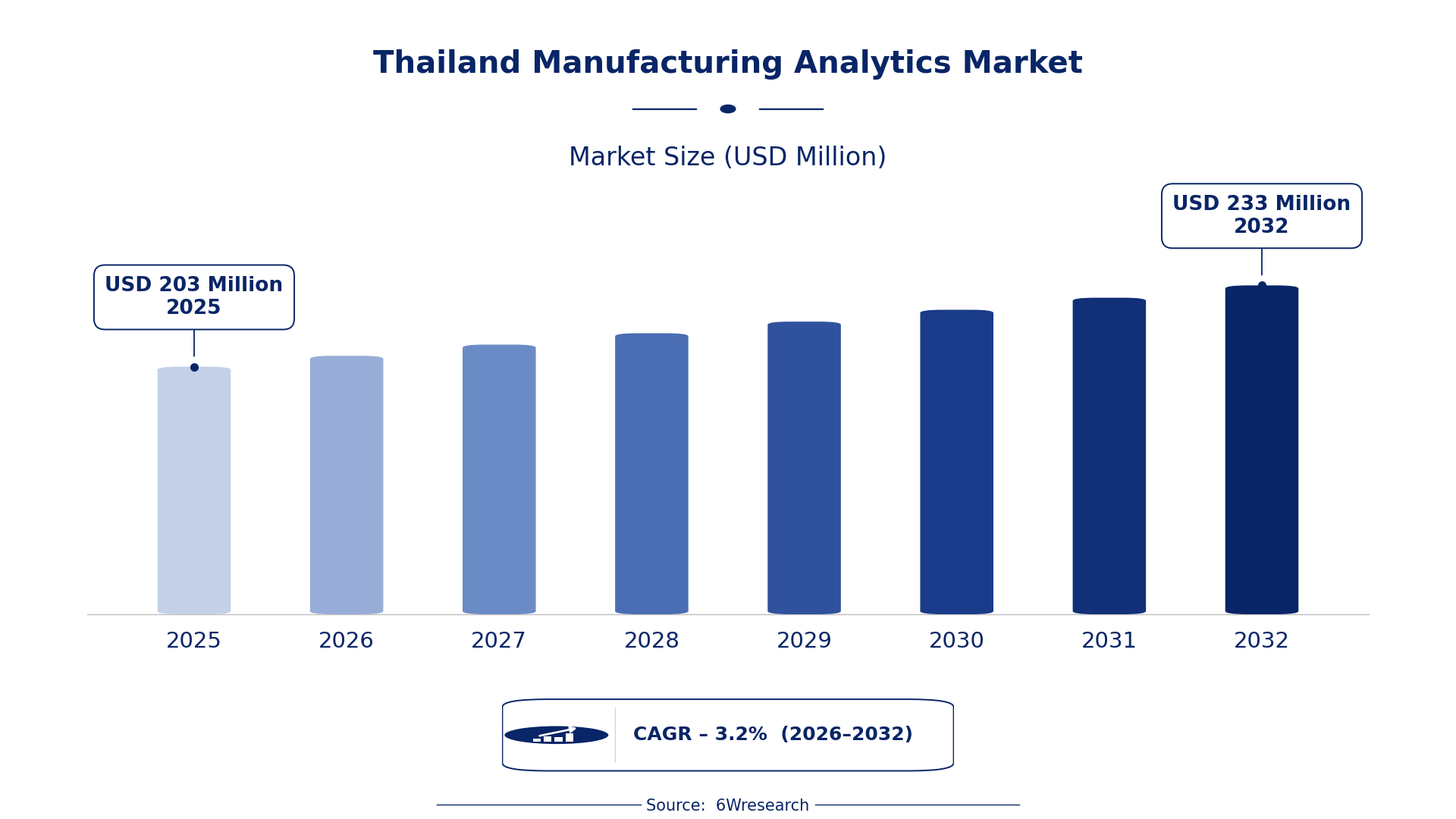
The Thailand Manufacturing Analytics Market was estimated at USD 203 Million in 2025 and is projected to reach USD 233 Million by 2032, growing at a CAGR of 3.2% from 2026 to 2032.
Thailand Manufacturing Analytics Market Synopsis
Manufacturing analytics is becoming an essential tool for Thai manufacturers aiming to enhance operational efficiency and product quality. As the industry adopts data-driven approaches, analytics solutions are being integrated into various processes to improve productivity and cost management.
With Thailand's manufacturing sector increasingly focused on smart technologies, the demand for advanced analytics is on the rise. This shift not only helps manufacturers make informed decisions but also drives innovation across various production lines, positioning them favorably in the competitive landscape.
Thailand Manufacturing Analytics Market Year-wise Growth Rate and Key Drivers
This graph illustrates the annual growth rates of the Thailand Manufacturing Analytics Market from 2021 to 2032, highlighting a steady upward trajectory and projected expansion over the forecast period.
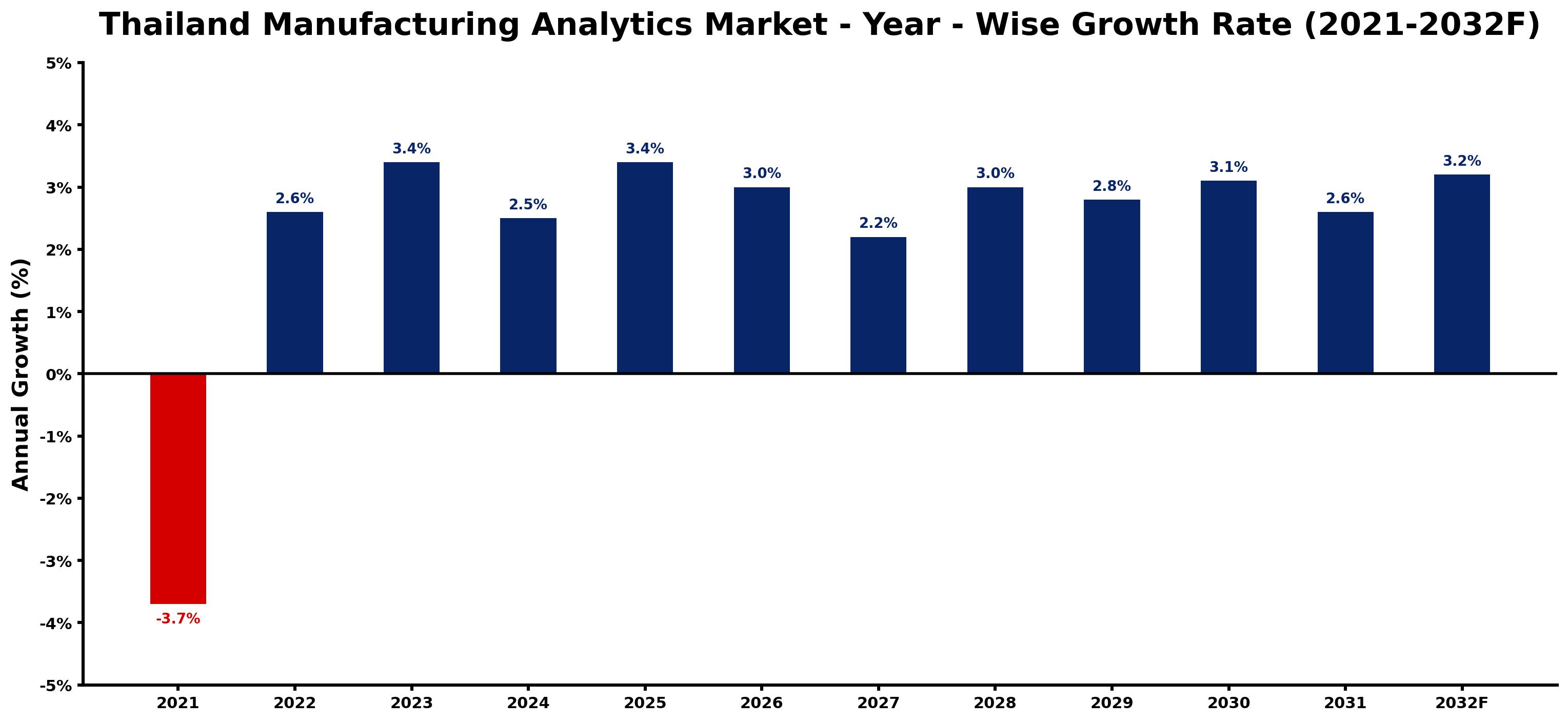
The table below presents the year‑wise growth rates along with the key drivers influencing the market
| Year | Growth Rate | Major Drivers |
| 2021 | -3.7% | COVID-19 restrictions disrupted manufacturing analytics implementation |
| 2022 | 2.6% | Thailand 4.0 roadmap boosting advanced manufacturing analytics adoption |
| 2023 | 3.4% | Increased demand for data-driven decision-making in factories |
| 2024 | 2.5% | Growing investments in Industry 4.0 technologies by manufacturers |
| 2025 | 3.4% | Government incentives for smart production systems implementation |
| 2026 | 3.0% | Rising workforce skills in data analytics and AI |
| 2027 | 2.2% | Focus on sustainability drives efficient manufacturing processes |
| 2028 | 3.0% | Increasing foreign investment in Thailand's manufacturing sector |
| 2029 | 2.8% | Advancements in IoT technology enhancing production monitoring |
| 2030 | 3.1% | Manufacturers adopting cloud-based analytics for efficiency |
| 2031 | 2.6% | Emerging local startups providing innovative analytics solutions |
| 2032 | 3.2% | Growing regulatory pressures on operational efficiency improvements |
Note: Market size estimations and growth projections presented in this report are based on 6Wresearch's proprietary forecasting methodology, utilizing the latest available industry data, government publications, and primary research inputs.
Thailand Manufacturing Analytics Market Key Takeaways
Below are some of the specific key takeaways from the market, including:
- Analytics solutions are being leveraged to optimize production processes and improve quality control.
- The market growth is driven by the increasing focus on smart manufacturing initiatives.
- Predictive maintenance is becoming a key focus for manufacturers aiming to reduce downtime.
- Integration of analytics with legacy systems poses a challenge for many businesses.
- The COVID-19 pandemic has accelerated the adoption of analytics tools in manufacturing operations.
Evaluation of Restraints in Thailand Manufacturing Analytics Market
Despite the promising growth trajectory, several restraints continue to hinder the Thailand Manufacturing Analytics market. A significant barrier is the resistance from traditional manufacturers who are hesitant to adopt Industry 4.0 technologies. Legacy systems often complicate integration efforts, leading to delays and increased costs. on top of that, the necessity for substantial capital investments in analytics solutions can deter smaller firms from embracing these technologies. Addressing these issues is critical for realizing the full potential of manufacturing analytics in Thailand.
Thailand Manufacturing Analytics Market Trends
Current trends indicate a strong movement towards data-centric decision-making within the manufacturing sector. Companies are increasingly investing in Internet of Things (IoT) devices to gather real-time data, which feeds into analytics platforms. This facilitates faster, more informed decision-making and enhances operational agility.
on top of that, as manufacturers strive for sustainability, analytics solutions are being deployed to monitor resource usage and minimize waste. This trend aligns with global sustainability goals, making manufacturers more competitive on an international scale.
Thailand Manufacturing Analytics Market Opportunities
The Thailand Manufacturing Analytics market presents numerous growth and investment opportunities, particularly in sectors like automotive and electronics. As these industries continue to innovate, the demand for sophisticated analytics solutions will likely surge. on top of that, companies providing tailored analytics solutions that address specific manufacturing challenges can capitalize on this growing market.
There is also room for partnerships between analytics providers and manufacturers, enabling the development of customized solutions that enhance operational efficiency. This collaborative approach can lead to breakthrough advancements, particularly in predictive maintenance and process optimization.
Government Initiatives in the Thailand Manufacturing Analytics Market
The Thai government is actively fostering a favorable environment for the Manufacturing Analytics market through various initiatives. Policymakers recognize the importance of digital transformation in boosting competitiveness within the manufacturing sector. As a result, there is a concerted effort to promote technology adoption and support manufacturers in their transition toward data-driven operations.
- A national digital infrastructure upgrade program was completed in 2024, enhancing connectivity for manufacturers across the country.
- A regulatory framework introduced in 2025 aims to encourage transparency in manufacturing processes, promoting data sharing.
- Currently, an initiative is underway to provide financial incentives for small and medium-sized enterprises (SMEs) investing in analytics technologies.
- A planned public-private partnership expected to launch in late 2026 will focus on workforce training in advanced manufacturing analytics.
- The government is set to roll out a comprehensive data security policy in 2027 to protect intellectual property in analytics applications.
Future Insights of the Thailand Manufacturing Analytics Market
Looking ahead to 2026-2032, the Thailand Manufacturing Analytics market is on track for steady growth. As manufacturers increasingly recognize the value of data analytics, investment in these technologies will likely escalate. The focus on predictive maintenance and resource optimization will continue to shape the market, with manufacturers striving for greater efficiency and sustainability.
The integration of artificial intelligence and machine learning into analytics solutions is anticipated to further enhance capabilities, enabling manufacturers to extract deeper insights from data. This progression promises to solidify Thailand’s position as a competitive player in the global manufacturing arena.
Thailand Manufacturing Analytics Market Latest Developments
In the past year, the Thailand Manufacturing Analytics market has seen significant activity as firms adopt advanced technologies to improve operations. The drive for digital transformation has led to increased investments in analytics solutions, with companies eager to capitalize on data-driven insights.
- A leading technology vendor launched a new analytics platform in Q2 2025 designed to streamline production processes and enhance quality control.
- In early 2025, a collaborative project between manufacturers and analytics firms aimed at developing customized solutions was initiated and remains ongoing.
- By late 2025, several manufacturers began pilot projects to implement predictive maintenance analytics, showcasing early successes.
- A major industry conference held in Q1 2026 focused on showcasing advancements in manufacturing analytics and fostering partnerships.
- Upcoming in mid-2026, a nationwide awareness campaign is set to promote the benefits of manufacturing analytics among SMEs.
Thailand Manufacturing Analytics Market - Key Attractiveness of the Report
- 10 Years of Market Numbers
- Historical Data Starting from 2022 to 2025
- Base Year: 2025
- Forecast Data until 2032
- Key Performance Indicators Impacting the Market
- Major Upcoming Developments and Projects
Key Highlights of the Report:
- Thailand Manufacturing Analytics Market Outlook
- Market Size of Thailand Manufacturing Analytics Market, 2025
- Forecast of Thailand Manufacturing Analytics Market, 2032
- Historical Data and Forecast of Thailand Manufacturing Analytics Revenues & Volume for the Period 2022-2032F
- Thailand Manufacturing Analytics Market Trend Evolution
- Thailand Manufacturing Analytics Market Drivers and Challenges
- Thailand Manufacturing Analytics Price Trends
- Thailand Manufacturing Analytics Porter's Five Forces
- Thailand Manufacturing Analytics Industry Life Cycle
- Historical Data and Forecast of Thailand Manufacturing Analytics Market Revenues & Volume By Type for the Period 2022-2032F
- Historical Data and Forecast of Thailand Manufacturing Analytics Market Revenues & Volume By Software for the Period 2022-2032F
- Historical Data and Forecast of Thailand Manufacturing Analytics Market Revenues & Volume By Service for the Period 2022-2032F
- Historical Data and Forecast of Thailand Manufacturing Analytics Market Revenues & Volume By Deployment Models for the Period 2022-2032F
- Historical Data and Forecast of Thailand Manufacturing Analytics Market Revenues & Volume By On-premises for the Period 2022-2032F
- Historical Data and Forecast of Thailand Manufacturing Analytics Market Revenues & Volume By On-demand for the Period 2022-2032F
- Historical Data and Forecast of Thailand Manufacturing Analytics Market Revenues & Volume By Applications for the Period 2022-2032F
- Historical Data and Forecast of Thailand Manufacturing Analytics Market Revenues & Volume By Predictive maintenance & asset management for the Period 2022-2032F
- Historical Data and Forecast of Thailand Manufacturing Analytics Market Revenues & Volume By Inventory management for the Period 2022-2032F
- Historical Data and Forecast of Thailand Manufacturing Analytics Market Revenues & Volume By Supply chain planning & procurement for the Period 2022-2032F
- Historical Data and Forecast of Thailand Manufacturing Analytics Market Revenues & Volume By Energy management for the Period 2022-2032F
- Historical Data and Forecast of Thailand Manufacturing Analytics Market Revenues & Volume By Emergency management for the Period 2022-2032F
- Historical Data and Forecast of Thailand Manufacturing Analytics Market Revenues & Volume By Sales & customer management for the Period 2022-2032F
- Historical Data and Forecast of Thailand Manufacturing Analytics Market Revenues & Volume By Other applications for the Period 2022-2032F
- Historical Data and Forecast of Thailand Manufacturing Analytics Market Revenues & Volume By Industry Vertical for the Period 2022-2032F
- Historical Data and Forecast of Thailand Manufacturing Analytics Market Revenues & Volume By Automotive & aerospace manufacturing for the Period 2022-2032F
- Historical Data and Forecast of Thailand Manufacturing Analytics Market Revenues & Volume By Electronics equipment manufacturing for the Period 2022-2032F
- Historical Data and Forecast of Thailand Manufacturing Analytics Market Revenues & Volume By Food & beverages manufacturing for the Period 2022-2032F
- Historical Data and Forecast of Thailand Manufacturing Analytics Market Revenues & Volume By Chemicals & materials manufacturing for the Period 2022-2032F
- Historical Data and Forecast of Thailand Manufacturing Analytics Market Revenues & Volume By Machinery & industrial equipment manufacturing for the Period 2022-2032F
- Historical Data and Forecast of Thailand Manufacturing Analytics Market Revenues & Volume By Pharma and life sciences for the Period 2022-2032F
- Historical Data and Forecast of Thailand Manufacturing Analytics Market Revenues & Volume By Paper, pulp, plastic and rubber manufacturing for the Period 2022-2032F
- Historical Data and Forecast of Thailand Manufacturing Analytics Market Revenues & Volume By Others for the Period 2022-2032F
- Thailand Manufacturing Analytics Import Export Trade Statistics
- Market Opportunity Assessment By Type
- Market Opportunity Assessment By Deployment Models
- Market Opportunity Assessment By Applications
- Market Opportunity Assessment By Industry Vertical
- Thailand Manufacturing Analytics Top Companies Market Share
- Thailand Manufacturing Analytics Competitive Benchmarking By Technical and Operational Parameters
- Thailand Manufacturing Analytics Company Profiles
- Thailand Manufacturing Analytics Key Strategic Recommendations






































