Thailand Mega Data Center Market Size & Growth Rate (2026-2032)
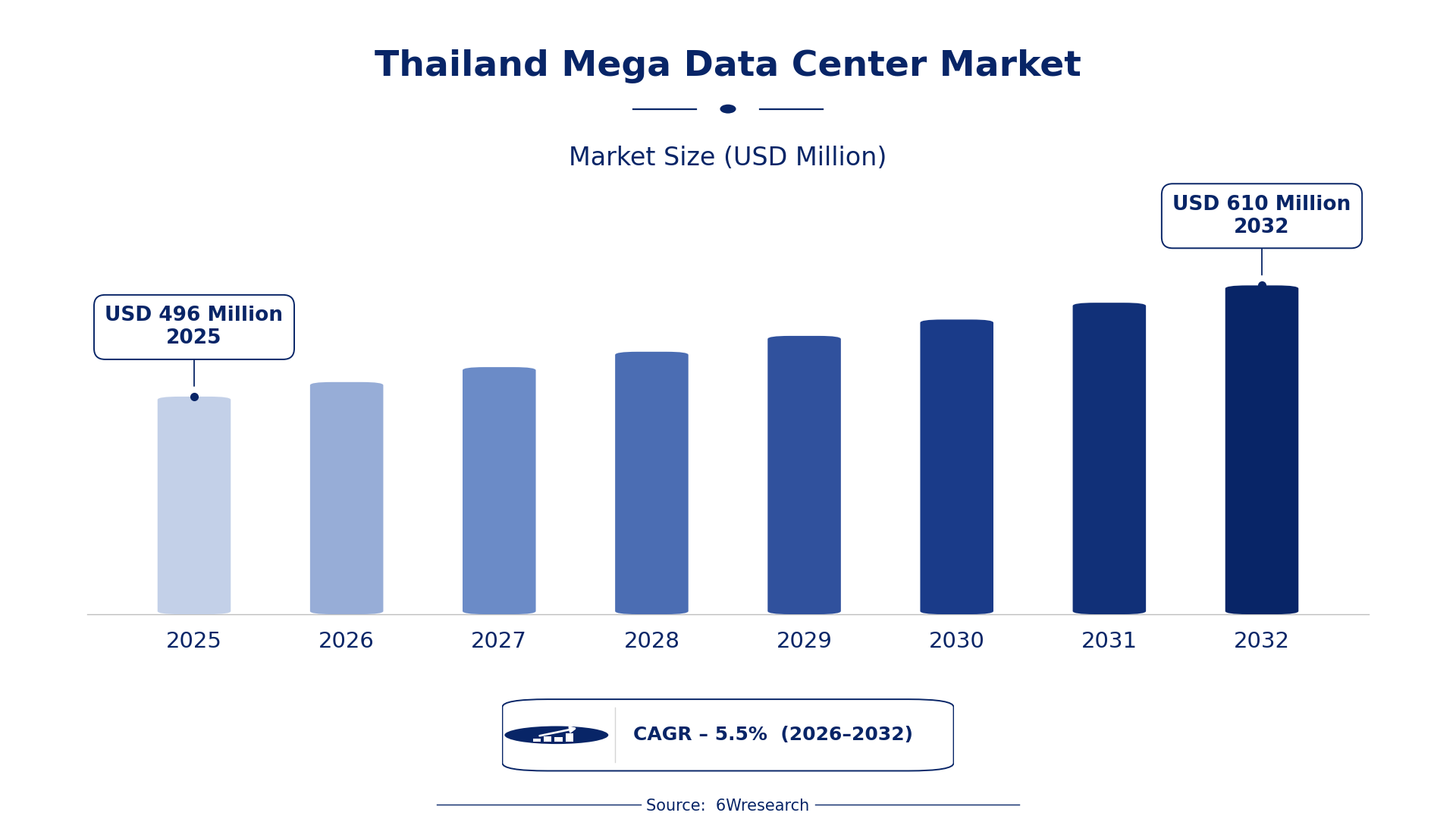
The Thailand Mega Data Center Market was estimated at USD 496 Million in 2025 and is projected to reach USD 610 Million by 2032, growing at a CAGR of 5.5% from 2026 to 2032.
Thailand Mega Data Center Market Synopsis
The Thailand Mega Data Center Market is rapidly evolving, driven by the growing demand for data storage and processing capabilities. As digital services expand, the importance of large-scale data center facilities becomes increasingly evident in supporting enterprises and cloud providers.
This market is not just about infrastructure; it's about resilience and scalability in an age where data is king. Organizations are investing heavily in mega data centers to cater to the escalating requirements of big data analytics and cloud services, making this sector a critical part of Thailand's IT ecosystem.
Thailand Mega Data Center Market Year-wise Growth Rate and Key Drivers
This graph illustrates the annual growth rates of the Thailand Mega Data Center Market from 2021 to 2032, highlighting a steady upward trajectory and projected expansion over the forecast period.
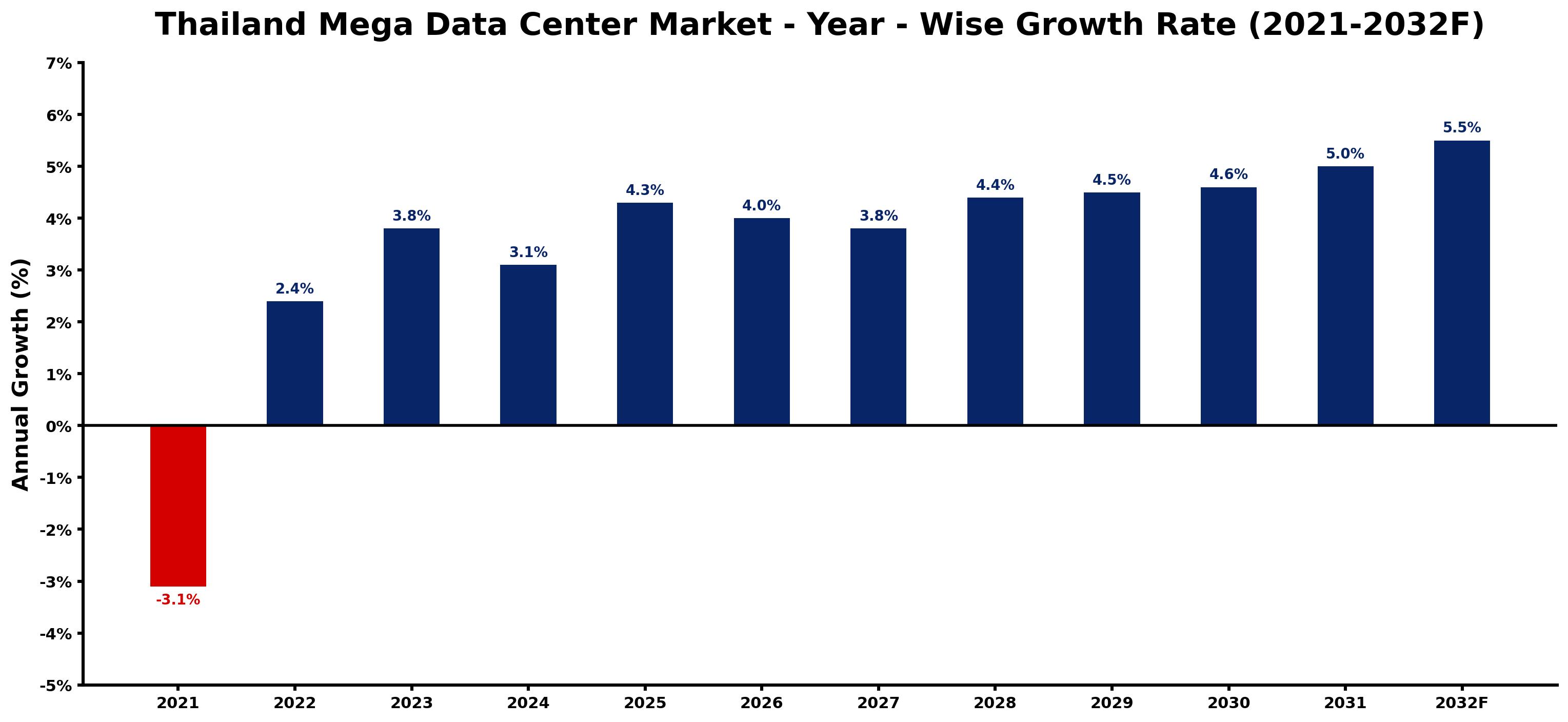
The table below presents the year‑wise growth rates along with the key drivers influencing the market
| Year | Growth Rate | Major Drivers |
| 2021 | -3.1% | Regulatory delays in new data center approvals. |
| 2022 | 2.4% | Digital Economy Promotion Act boosts data center investments. |
| 2023 | 3.8% | Increased demand from e-commerce sector drives capacity needs. |
| 2024 | 3.1% | Cloud adoption accelerates among local businesses and startups. |
| 2025 | 4.3% | Thailand 4.0 initiative enhances technology sector growth. |
| 2026 | 4.0% | Rising fintech companies spur demand for secure data storage. |
| 2027 | 3.8% | Sustainability goals encourage energy-efficient data center designs. |
| 2028 | 4.4% | Telecommunication upgrades support larger data center infrastructures. |
| 2029 | 4.5% | Growing global outsourcing trends attract multinational data operations. |
| 2030 | 4.6% | Urban expansion increases data connectivity and infrastructure necessity. |
| 2031 | 5.0% | Government partnerships promote smart city data management systems. |
| 2032 | 5.5% | Local content requirements boost domestic data processing capabilities. |
Note: Market size estimations and growth projections presented in this report are based on 6Wresearch's proprietary forecasting methodology, utilizing the latest available industry data, government publications, and primary research inputs.
Thailand Mega Data Center Market Key Takeaways
Below are some of the specific key takeaways from the market, including:
- The market is expected to grow steadily, driven by increased cloud service demand.
- Large-scale data centers are essential for accommodating big data analytics and digital transformation initiatives.
- Investment in infrastructure, energy, and cooling systems remains a top priority for market players.
- Regulatory compliance and environmental concerns continue to shape operational strategies.
- Key players are focusing on innovation to enhance service offerings and scalability.
Evaluation of Restraints in Thailand Mega Data Center Market
The Thailand Mega Data Center Market faces a range of challenges that could impede growth. High capital expenditures required for building and maintaining these large facilities are significant barriers for many businesses. The need for advanced cooling systems and energy efficiency further complicates operational logistics. Additionally, maintaining uptime and meeting regulatory standards adds layers of complexity to the market. These factors create a demanding environment for operators striving to balance cost and performance.
Thailand Mega Data Center Market Trends
A noticeable trend is the rise of hyperscale infrastructure, as companies aim to centralize their computing resources. This shift towards larger data centers is not merely a response to current demand but also a proactive strategy to accommodate future needs. on top of that, the push for energy-efficient designs is becoming crucial, with stakeholders increasingly prioritizing sustainability in their operations.
Thailand Mega Data Center Market Opportunities
With the growing focus on digital transformation, opportunities are abundant in this sector. Companies are increasingly looking to invest in next-generation technologies, such as AI and machine learning, which can be effectively supported by robust data center infrastructure. Additionally, the need for data sovereignty in compliance with local regulations presents a chance for localized data center solutions, opening doors for strategic partnerships and collaborations.
Government Initiatives in the Thailand Mega Data Center Market
The Thai government is actively shaping the Mega Data Center Market through various initiatives aimed at enhancing digital infrastructure. Policies are being implemented to promote investments in data centers, focusing on sustainability and compliance. As the country aims to position itself as a digital hub in Southeast Asia, these initiatives are crucial for attracting both local and foreign investments.
- A national digital infrastructure upgrade programme launched in early 2025 to enhance connectivity across the region.
- Current efforts include regulatory frameworks being revised to facilitate the establishment of energy-efficient data centers.
- Planned public-private partnerships expected to commence in late 2026, aimed at expanding cloud service accessibility.
- An initiative focused on improving cybersecurity measures within data centers currently underway, enhancing data protection standards.
- Ongoing discussions around tax incentives for companies investing in green data center technologies.
Future Insights of the Thailand Mega Data Center Market
Looking ahead to 2026-2032, the Thailand Mega Data Center Market is set for continued evolution. As businesses increasingly adopt cloud and digital services, the demand for efficient data processing will rise. Companies that can deliver scalable and resilient solutions will find themselves at the forefront of this growth. Strategic investments in technology and infrastructure will be essential for staying competitive in this dynamic environment.
Thailand Mega Data Center Market Latest Developments
In the past year, the Thailand Mega Data Center Market has witnessed several key developments that indicate a shift towards modernization and sustainability. The focus has been on enhancing service delivery while ensuring compliance with evolving regulations. Key players are also investing in advanced technologies to improve operational efficiencies.
- A major technology vendor initiated a project in early 2025 to upgrade existing data centers with AI-driven management systems.
- A rollout of energy-efficient cooling solutions is currently underway, aiming for completion by mid-2026.
- Partnerships between local firms and international cloud providers are being formed to enhance service capabilities, with several agreements signed in Q1 2025.
- Plans for a new data center facility designed for hyperscale operations are expected to begin construction in late 2025.
- An initiative focused on developing a standardized compliance framework for data centers is currently being reviewed for implementation in early 2026.
Thailand Mega Data Center Market - Key Attractiveness of the Report
- 10 Years of Market Numbers
- Historical Data Starting from 2022 to 2025
- Base Year: 2025
- Forecast Data until 2032
- Key Performance Indicators Impacting the Market
- Major Upcoming Developments and Projects
Key Highlights of the Report:
- Thailand Mega Data Center Market Outlook
- Market Size of Thailand Mega Data Center Market, 2025
- Forecast of Thailand Mega Data Center Market, 2032
- Historical Data and Forecast of Thailand Mega Data Center Revenues & Volume for the Period 2022-2032F
- Thailand Mega Data Center Market Trend Evolution
- Thailand Mega Data Center Market Drivers and Challenges
- Thailand Mega Data Center Price Trends
- Thailand Mega Data Center Porter's Five Forces
- Thailand Mega Data Center Industry Life Cycle
- Historical Data and Forecast of Thailand Mega Data Center Market Revenues & Volume By Solutions Infrastructure for the Period 2022-2032F
- Historical Data and Forecast of Thailand Mega Data Center Market Revenues & Volume By IT infrastructure solutions for the Period 2022-2032F
- Historical Data and Forecast of Thailand Mega Data Center Market Revenues & Volume By Support infrastructure solutions for the Period 2022-2032F
- Historical Data and Forecast of Thailand Mega Data Center Market Revenues & Volume By Power solutions for the Period 2022-2032F
- Historical Data and Forecast of Thailand Mega Data Center Market Revenues & Volume By Cooling solutions for the Period 2022-2032F
- Historical Data and Forecast of Thailand Mega Data Center Market Revenues & Volume By Security solutions for the Period 2022-2032F
- Historical Data and Forecast of Thailand Mega Data Center Market Revenues & Volume By Management software for the Period 2022-2032F
- Historical Data and Forecast of Thailand Mega Data Center Market Revenues & Volume By Services for the Period 2022-2032F
- Historical Data and Forecast of Thailand Mega Data Center Market Revenues & Volume By System integration for the Period 2022-2032F
- Historical Data and Forecast of Thailand Mega Data Center Market Revenues & Volume By Monitoring services for the Period 2022-2032F
- Historical Data and Forecast of Thailand Mega Data Center Market Revenues & Volume By Professional services for the Period 2022-2032F
- Historical Data and Forecast of Thailand Mega Data Center Market Revenues & Volume By Support for the Period 2022-2032F
- Historical Data and Forecast of Thailand Mega Data Center Market Revenues & Volume By Power for the Period 2022-2032F
- Historical Data and Forecast of Thailand Mega Data Center Market Revenues & Volume By Cooling for the Period 2022-2032F
- Historical Data and Forecast of Thailand Mega Data Center Market Revenues & Volume By Security for the Period 2022-2032F
- Historical Data and Forecast of Thailand Mega Data Center Market Revenues & Volume By Verticals for the Period 2022-2032F
- Historical Data and Forecast of Thailand Mega Data Center Market Revenues & Volume By Banking, Financial Services and Insurance (BFSI) for the Period 2022-2032F
- Historical Data and Forecast of Thailand Mega Data Center Market Revenues & Volume By Telecom and IT for the Period 2022-2032F
- Historical Data and Forecast of Thailand Mega Data Center Market Revenues & Volume By Media and entertainment for the Period 2022-2032F
- Historical Data and Forecast of Thailand Mega Data Center Market Revenues & Volume By Government and public for the Period 2022-2032F
- Historical Data and Forecast of Thailand Mega Data Center Market Revenues & Volume By Others for the Period 2022-2032F
- Thailand Mega Data Center Import Export Trade Statistics
- Market Opportunity Assessment By Solutions Infrastructure
- Market Opportunity Assessment By Services
- Market Opportunity Assessment By Support
- Market Opportunity Assessment By Verticals
- Thailand Mega Data Center Top Companies Market Share
- Thailand Mega Data Center Competitive Benchmarking By Technical and Operational Parameters
- Thailand Mega Data Center Company Profiles
- Thailand Mega Data Center Key Strategic Recommendations






































