Thailand Molded Pulp Packaging Market Size, Share & Growth Rate
The Thailand Molded Pulp Packaging Market was estimated at USD 149 Million in 2025 and is projected to reach USD 170 Million by 2032, growing at a CAGR of 1.9% from 2026 to 2032. This anticipated growth is being driven by a surging demand for sustainable packaging solutions, largely influenced by heightened environmental consciousness among consumers and businesses alike. As the Thai economy continues to expand and disposable incomes rise, the preference for eco-friendly products is steadily reshaping market dynamics.
Thailand Molded Pulp Packaging Market Year-wise Growth Rate and Key Drivers
This graph highlights how the Thailand Molded Pulp Packaging Market has steadily grown over the years, supported by major growth factors.
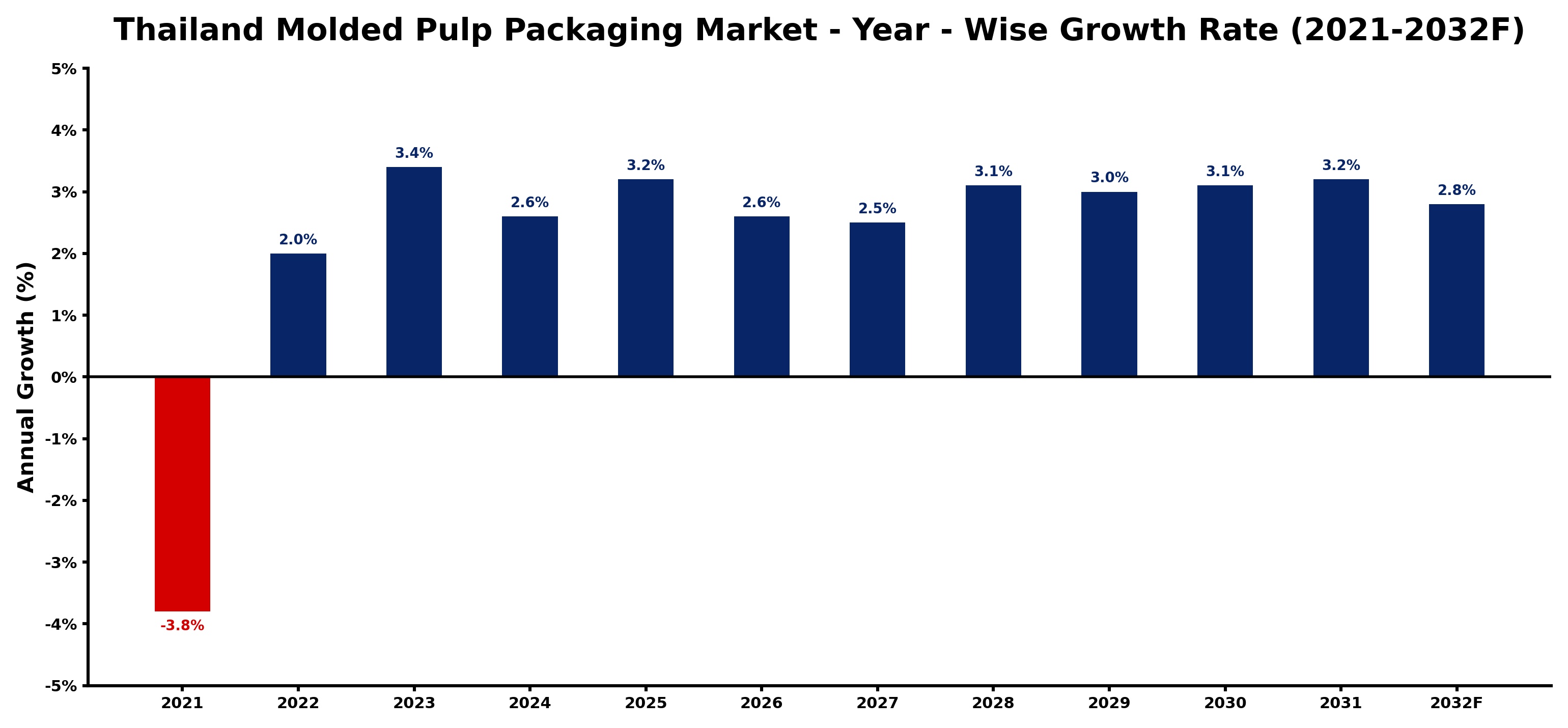
The table below presents the year‑wise growth rates along with the key drivers influencing the market
| Year | Growth Rate | Major Drivers |
| 2021 | -3.8% | Increasing industrial infrastructure investments |
| 2022 | 2.0% | Expansion of commercial construction activities |
| 2023 | 3.4% | Government infrastructure modernization initiatives |
| 2024 | 2.6% | Increasing industrial automation investments |
| 2025 | 3.2% | Growing urbanization and commercial development |
| 2026 | 2.6% | Growing renewable energy integration projects |
| 2027 | 2.5% | Expansion of commercial construction activities |
| 2028 | 3.1% | Increasing industrial automation investments |
| 2029 | 3.0% | Increasing adoption of advanced technologies |
| 2030 | 3.1% | Expansion of commercial construction activities |
| 2031 | 3.2% | Expansion of manufacturing activities |
| 2032 | 2.8% | Growing renewable energy integration projects |
Note - Market size estimations and growth projections presented in this report are based on 6Wresearch’s advanced forecasting approach, validated with industry datasets as of June 2026.
Thailand Molded Pulp Packaging Market Synopsis
In Thailand, the molded pulp packaging sector is gaining momentum due to its versatility and biodegradability. This material, primarily crafted from recycled paper, has found numerous applications, ranging from food packaging to electronics, thereby appealing to various industries that prioritize sustainability. As environmental regulations become more stringent, molded pulp is quickly emerging as a preferred alternative to plastic.
A significant factor fuelling this market is the Thai government's push towards sustainable practices. Public initiatives promoting green alternatives are encouraging both manufacturers and consumers to shift towards more environmentally friendly packaging solutions. This growing awareness reflects a broader global trend towards sustainability that resonates strongly in Thailand's evolving marketplace.
Thailand Molded Pulp Packaging Market Key Takeaways
- The market is driven by rising environmental awareness and government initiatives promoting sustainability.
- Versatility across various applications from food to electronics enhances market growth potential.
- Customization and scalability are significant challenges in meeting diverse packaging needs.
- The pandemic has shifted consumer preferences towards eco-friendly and reliable packaging solutions.
- Investments in innovative production techniques are crucial for future growth and development.
Evaluation of Restraints in Thailand Molded Pulp Packaging Market
Despite the promising growth trajectory, the Thailand molded pulp packaging market contends with certain restraints. The complexity of achieving scalable production while maintaining consistent quality poses a significant challenge for manufacturers. Furthermore, customization efforts to create packaging that meets the varying shapes and sizes of products often require advanced technology and expertise, which may not be uniformly accessible across the industry. Addressing these issues is essential for unlocking the full potential of the market.
Thailand Molded Pulp Packaging Market Trends
Several trends are currently shaping the molded pulp packaging landscape in Thailand. A notable trend is the increasing demand for compostable packaging options, as consumers increasingly favor products that reduce landfill waste. Additionally, technological advancements in molding techniques are enabling manufacturers to produce more complex designs and functional packaging that enhances product safety and presentation. These trends are driving innovation and positioning molded pulp as a key player in the sustainable packaging arena.
Thailand Molded Pulp Packaging Market Opportunities
Significant growth and investment opportunities are emerging within the Thailand molded pulp packaging market, particularly in the food and beverage sector. As more businesses seek sustainable alternatives to traditional plastic packaging, molded pulp presents a viable solution. Furthermore, the rise of e-commerce and home delivery services is fueling demand for protective packaging solutions, creating openings for innovative products that cater to this expanding market segment.
Government Initiatives in the Thailand Molded Pulp Packaging Market
The Thai government is actively promoting initiatives aimed at enhancing sustainability across various sectors, including packaging. Policies encouraging the reduction of single-use plastics and incentives for companies adopting eco-friendly practices are playing a pivotal role in supporting the molded pulp packaging market. These programs not only foster awareness but also assist manufacturers in transitioning to greener alternatives.
Future Insights of the Thailand Molded Pulp Packaging Market
Looking forward to 2026-2032, the Thailand molded pulp packaging market is poised for continued growth. As consumer preference for sustainability solidifies, companies will increasingly invest in R&D to enhance product functionality and performance. The integration of advanced technologies and materials will likely drive innovation, ensuring that molded pulp remains competitive against traditional packaging solutions, while also meeting stringent environmental regulations.
Thailand Molded Pulp Packaging Market Latest Developments (May 2025 - June 2026)
Recent developments within the Thailand molded pulp packaging market indicate a strong move towards greater customization and production efficiency. Firms are exploring partnerships to leverage technological advancements in molding processes and material sourcing. Additionally, there is a growing emphasis on consumer education regarding the benefits of molded pulp, as companies aim to raise awareness and enhance market penetration.
Thailand Molded Pulp Packaging Market - Key Attractiveness of the Report
- 10 Years of Market Numbers
- Historical Data Starting from 2022 to 2025
- Base Year: 2025
- Forecast Data until 2032
- Key Performance Indicators Impacting the Market
- Major Upcoming Developments and Projects
Key Highlights of the Report:
- Thailand Molded Pulp Packaging Market Outlook
- Market Size of Thailand Molded Pulp Packaging Market, 2025
- Forecast of Thailand Molded Pulp Packaging Market, 2032
- Historical Data and Forecast of Thailand Molded Pulp Packaging Revenues & Volume for the Period 2022-2032F
- Thailand Molded Pulp Packaging Market Trend Evolution
- Thailand Molded Pulp Packaging Market Drivers and Challenges
- Thailand Molded Pulp Packaging Price Trends
- Thailand Molded Pulp Packaging Porter's Five Forces
- Thailand Molded Pulp Packaging Industry Life Cycle
- Historical Data and Forecast of Thailand Molded Pulp Packaging Market Revenues & Volume By Source for the Period 2022-2032F
- Historical Data and Forecast of Thailand Molded Pulp Packaging Market Revenues & Volume By Wood Pulp for the Period 2022-2032F
- Historical Data and Forecast of Thailand Molded Pulp Packaging Market Revenues & Volume By Non-wood Pulp for the Period 2022-2032F
- Historical Data and Forecast of Thailand Molded Pulp Packaging Market Revenues & Volume By Molded Type for the Period 2022-2032F
- Historical Data and Forecast of Thailand Molded Pulp Packaging Market Revenues & Volume By Thick Wall for the Period 2022-2032F
- Historical Data and Forecast of Thailand Molded Pulp Packaging Market Revenues & Volume By Transfer for the Period 2022-2032F
- Historical Data and Forecast of Thailand Molded Pulp Packaging Market Revenues & Volume By Thermoformed for the Period 2022-2032F
- Historical Data and Forecast of Thailand Molded Pulp Packaging Market Revenues & Volume By Processed for the Period 2022-2032F
- Historical Data and Forecast of Thailand Molded Pulp Packaging Market Revenues & Volume By Product for the Period 2022-2032F
- Historical Data and Forecast of Thailand Molded Pulp Packaging Market Revenues & Volume By Trays for the Period 2022-2032F
- Historical Data and Forecast of Thailand Molded Pulp Packaging Market Revenues & Volume By End Caps for the Period 2022-2032F
- Historical Data and Forecast of Thailand Molded Pulp Packaging Market Revenues & Volume By Bowls & Cups for the Period 2022-2032F
- Historical Data and Forecast of Thailand Molded Pulp Packaging Market Revenues & Volume By Clamshells for the Period 2022-2032F
- Historical Data and Forecast of Thailand Molded Pulp Packaging Market Revenues & Volume By Plates for the Period 2022-2032F
- Historical Data and Forecast of Thailand Molded Pulp Packaging Market Revenues & Volume By Others for the Period 2022-2032F
- Thailand Molded Pulp Packaging Import Export Trade Statistics
- Market Opportunity Assessment By Source
- Market Opportunity Assessment By Molded Type
- Market Opportunity Assessment By Product
- Thailand Molded Pulp Packaging Top Companies Market Share
- Thailand Molded Pulp Packaging Competitive Benchmarking By Technical and Operational Parameters
- Thailand Molded Pulp Packaging Company Profiles
- Thailand Molded Pulp Packaging Key Strategic Recommendations






































