Thailand Mortar Market Summary
The thailand mortar market was estimated at USD 115 Million in 2025 and is projected to reach USD 131 Million by 2032, growing at a CAGR of 2.8% from 2026 to 2032.
Thailand Mortar Market Year-wise Growth Rate and Key Drivers
This graph highlights how the Thailand Mortar Market has steadily grown over the past five years, supported by major growth factors.
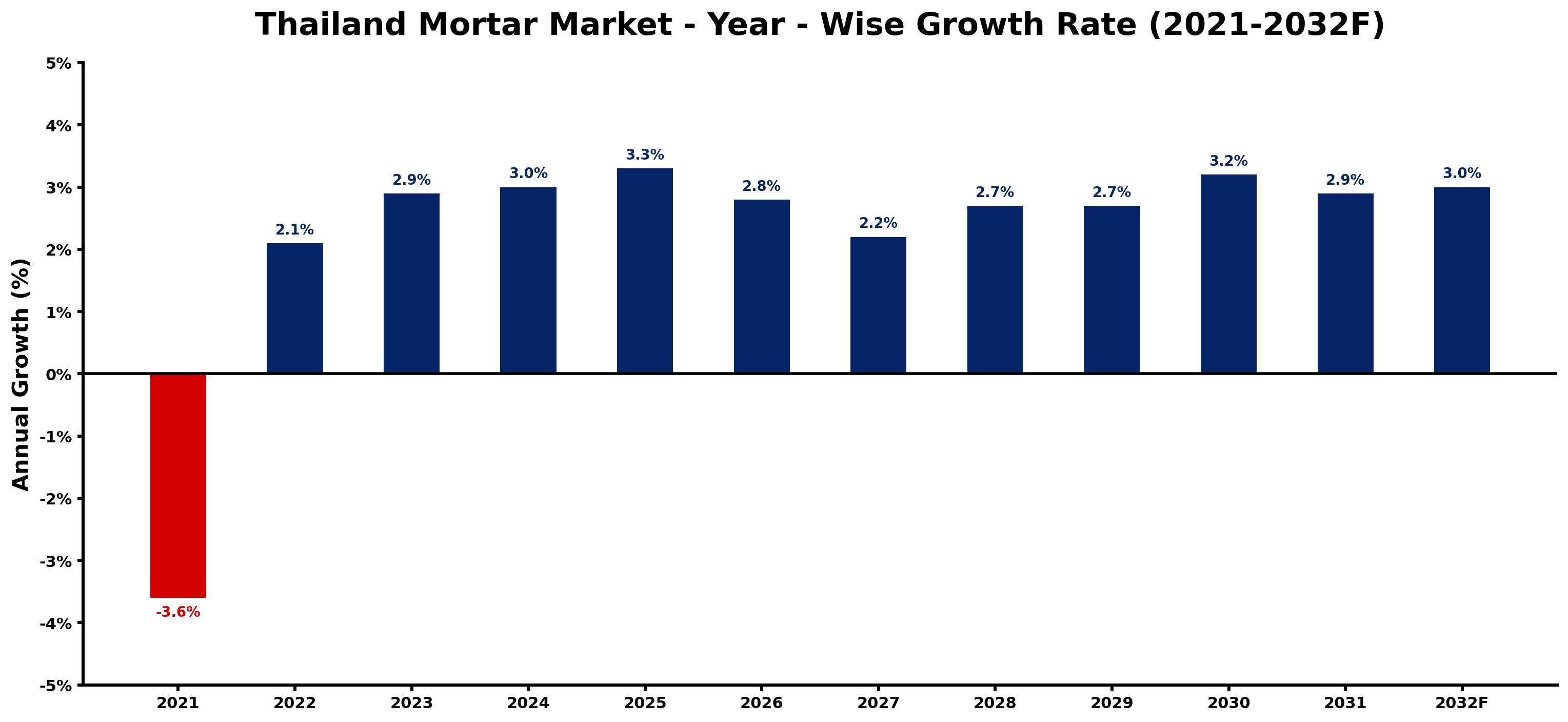
The table below presents the year wise growth rates along with the key drivers influencing the market
| Year | Growth Rate | Major Drivers |
| 2021 | -3.6% | Increased competition from alternative building materials limited market share and stifled demand for traditional mortar products. |
| 2022 | 2.1% | Increasing urbanization in Thailand spurred infrastructure development, driving up mortar consumption rates. |
| 2023 | 2.9% | Rural housing initiatives led to heightened demand for affordable and durable mortar products. |
| 2024 | 3.0% | Technological innovations in mortar production enhanced quality, attracting more customers and builders. |
| 2025 | 3.3% | Sustainability trends prompted shifts towards eco-friendly mortar alternatives, appealing to environmentally conscious consumers. |
| 2026 | 2.8% | Market players expanded distribution networks, making mortar products more accessible to diverse regions. |
| 2027 | 2.2% | Global construction material manufacturers entered Thailand, intensifying competition and improving product offerings. |
| 2028 | 2.7% | Local artisans adopted modern techniques, increasing the demand for specialized mortar varieties. |
| 2029 | 2.7% | Government housing policies encouraged private investments in residential projects, boosting mortar supply needs. |
| 2030 | 3.2% | Demand for resilient materials rose amid climate change concerns, influencing mortar formulation innovations. |
| 2031 | 2.9% | Emerging smart city projects in Bangkok require advanced mortar solutions, expanding market potentials. |
| 2032 | 3.0% | Collaborations between construction firms and mortar manufacturers fostered tailored product development, enhancing market efficiency. |
Note - Market size estimations and growth projections presented in this report are based on 6Wresearch's advanced forecasting approach, validated with industry datasets as of June 2026.
Thailand Mortar Market Synopsis
The Thailand Mortar Market is projected to reach 2.8% and witness significant growth during the forecast period (2026-2032). This growth is fueled by an upsurge in construction activities, bolstered by various government initiatives and increased foreign investments. Additionally, trends such as urbanization and industrialization are further augmenting the demand for mortars in Thailand, while the rapid development of infrastructure creates substantial opportunities for stakeholders in the cement production and supply sectors.
Thailand Mortar Market Growth Drivers
Several key factors are contributing to the expansion of the Thailand mortar market. These include:
- A thriving construction industry, particularly in residential and non-residential sectors, is propelling the demand for various mortar types, facilitating both new builds and renovations.
- The increasing tourism industry is driving the construction of hotels, resorts, and infrastructure projects, thereby amplifying the need for high-quality mortar solutions.
- Technological advancements are leading to a preference for lightweight mortars that offer superior strength and durability, thus replacing traditional options in certain applications.
- Government initiatives aimed at promoting sustainable construction practices are encouraging the use of eco-friendly mortars composed of recycled materials, which resonate well with the growing green building movement.
- The availability of low-cost labor, combined with various tax incentives from the government, is enhancing the attractiveness of investment in the Thai mortar sector, further contributing to market growth.
Thailand Mortar Market Challenges and Restraints
Despite robust growth prospects, the Thailand mortar market faces significant challenges that could hinder its potential:
- A shortage of skilled labor has been identified as a critical issue, particularly in the context of evolving technological requirements in mortar production.
- Regulatory hurdles relating to the use of locally sourced materials have created complications, especially with import tariffs on foreign products, which can affect price competitiveness.
- The proliferation of counterfeit products in the market poses risks to established brands, leading to potential brand dilution and loss of consumer trust.
- Economic fluctuations, particularly associated with global market trends, can also influence investment decisions in the construction sector, thereby indirectly affecting mortar demand.
- Market players must continually adapt to the stringent quality control measures that come with advancements in production technology, which can strain operational capacities.
Thailand Mortar Market Government Investment and Initiatives
The Thai government plays a pivotal role in shaping the mortar market through various investment initiatives aimed at bolstering the construction sector:
- Substantial public spending on infrastructure, including transportation, utilities, and public facilities, is a critical driver for demand in the mortar market.
- Programs designed to promote sustainable construction practices encourage the use of environmentally friendly mortars, aligning with national goals of reducing carbon footprints.
- Incentives such as tax reductions for projects that utilize local materials have been implemented to stimulate domestic production and reduce reliance on imports.
- The government has also introduced regulatory frameworks to enhance quality assurance in construction materials, which supports the growth of reliable mortar products.
- Public-private partnerships are being leveraged to address infrastructure deficits, with specific mandates for using advanced construction materials, including innovative mortar solutions.
Thailand Mortar Market Latest Developments (May 2025 - June 2026)
Recent developments in the Thailand mortar market highlight a dynamic shift towards modernization and sustainability. Key industry trends have emerged during this period:
- A noticeable recovery in construction activities following the disruptions caused by the COVID-19 pandemic is indicated by increased government and private sector investments.
- Innovations in mortar formulations have gained traction, focusing on lightweight and high-performance products that meet the stringent demands of modern construction techniques.
- Sustainability initiatives have been amplified, reflecting a growing commitment within the industry to embrace eco-friendly materials and practices.
- Collaborative ventures between technology providers and construction firms have been spotlighted, aiming to enhance production efficiency and product quality.
- Awareness campaigns aimed at educating stakeholders about the benefits of advanced mortar types are also on the rise, fostering greater market acceptance of innovative solutions.
Thailand Mortar Market - Key Attractiveness of the Report
- 10 Years of Market Numbers
- Historical Data Starting from 2022 to 2025
- Base Year: 2025
- Forecast Data until 2032
- Key Performance Indicators Impacting the Market
- Major Upcoming Developments and Projects
Key Highlights of the Report:
- Thailand Mortar Market Outlook
- Market Size of Thailand Mortar Market, 2025
- Forecast of Thailand Mortar Market, 2032
- Historical Data and Forecast of Thailand Mortar Revenues & Volume for the Period 2022-2032F
- Thailand Mortar Market Trend Evolution
- Thailand Mortar Market Drivers and Challenges
- Thailand Mortar Price Trends
- Thailand Mortar Porter's Five Forces
- Thailand Mortar Industry Life Cycle
- Historical Data and Forecast of Thailand Mortar Market Revenues & Volume By Type for the Period 2022-2032F
- Historical Data and Forecast of Thailand Mortar Market Revenues & Volume By Wet Mixed Mortar for the Period 2022-2032F
- Historical Data and Forecast of Thailand Mortar Market Revenues & Volume By Dry Mortar for the Period 2022-2032F
- Historical Data and Forecast of Thailand Mortar Market Revenues & Volume By Application for the Period 2022-2032F
- Historical Data and Forecast of Thailand Mortar Market Revenues & Volume By Construction Industry for the Period 2022-2032F
- Historical Data and Forecast of Thailand Mortar Market Revenues & Volume By Home Decoration Industry for the Period 2022-2032F
- Historical Data and Forecast of Thailand Mortar Market Revenues & Volume By Others for the Period 2022-2032F
- Thailand Mortar Import Export Trade Statistics
- Market Opportunity Assessment By Type
- Market Opportunity Assessment By Application
- Thailand Mortar Top Companies Market Share
- Thailand Mortar Competitive Benchmarking By Technical and Operational Parameters
- Thailand Mortar Company Profiles
- Thailand Mortar Key Strategic Recommendations






































