Thailand Multifunctional Composite Materials Market Summary
The thailand multifunctional composite materials market was estimated at USD 174 Million in 2025 and is projected to reach USD 199 Million by 2032, growing at a CAGR of 2.9% from 2026 to 2032.
Thailand Multifunctional Composite Materials Market Year-wise Growth Rate and Key Drivers
This graph highlights how the Thailand Multifunctional Composite Materials Market has steadily grown over the past five years, supported by major growth factors.
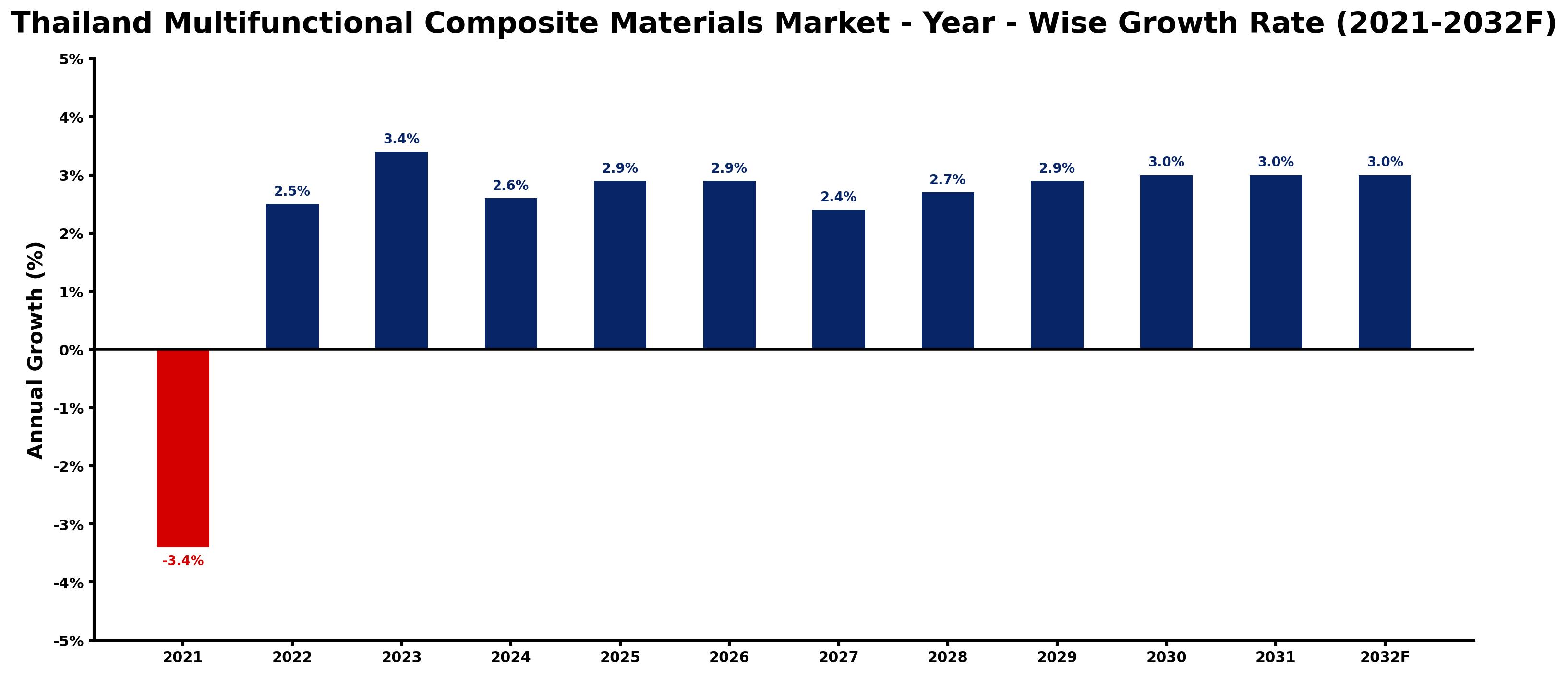
The table below presents the year wise growth rates along with the key drivers influencing the market
| Year | Growth Rate | Major Drivers |
| 2021 | -3.4% | Decreased construction activity amid economic uncertainties led to reduced demand for multifunctional composite materials. |
| 2022 | 2.5% | Local manufacturers increasingly prioritized lightweight composites for automotive and aerospace applications. |
| 2023 | 3.4% | Emerging tech startups introduced advanced composite materials for enhanced product performance. |
| 2024 | 2.6% | Key infrastructure developments in Thailand necessitated durable yet flexible material options. |
| 2025 | 2.9% | Investment in renewable energy sources spurred interest in composite materials for efficiency. |
| 2026 | 2.9% | Collaborations between global firms and local enterprises enhanced research in composite technologies. |
| 2027 | 2.4% | Market players focused on sustainability, driving the need for eco-friendly composite alternatives. |
| 2028 | 2.7% | International partnerships expanded knowledge transfer in advanced composite manufacturing techniques. |
| 2029 | 2.9% | Shifting consumer preferences towards lightweight products impacted material selection in various industries. |
| 2030 | 3.0% | Significant expansion in the electronics sector created new demands for multifunctional materials. |
| 2031 | 3.0% | Technological innovations in production processes improved the scalability of composite materials. |
| 2032 | 3.0% | Market consolidation among key players led to increased competition and enhanced product offerings. |
Note - Market size estimations and growth projections presented in this report are based on 6Wresearch's advanced forecasting approach, validated with industry datasets as of June 2026.
Thailand Multifunctional Composite Materials Market Synopsis
The Thailand Multifunctional Composite Materials Market is projected to reach 2.9% and witness significant growth during the forecast period (2026-2032). The increasing demand from various end-use sectors, including automotive, aerospace defense, wind energy, and construction, is a primary growth driver in this region. Additionally, rising research and development activities focused on advanced multifunctional composites with enhanced structural properties will further propel the market's expansion. As industries seek to leverage lightweight composite materials, the versatility and application scope of these components are facilitated across multiple sectors, particularly in automotive and aerospace & defense.
Thailand Multifunctional Composite Materials Market Growth Drivers
The growth of the Thailand Multifunctional Composite Materials Market is influenced by several key factors:
- The automotive industry's transition towards lightweight materials is crucial for improving vehicle performance and fuel efficiency, boosting the demand for multifunctional composites.
- Technological advancements in manufacturing processes, such as automated fiber placement and 3D printing, enhance the production capabilities and application of multifunctional composites.
- The aerospace & defense sectors are increasingly incorporating these materials to reduce weight and increase strength, thereby improving overall performance and reducing operational costs.
- Government and private sector investments in renewable energy, particularly in wind energy projects, are accelerating the need for durable and lightweight composite materials.
- Heightened consumer awareness regarding sustainability and eco-friendly products is leading to a shift toward composite materials that offer better performance with reduced environmental impact.
Thailand Multifunctional Composite Materials Market Trends and Opportunities
As the Thailand Multifunctional Composite Materials Market evolves, several trends are emerging that underline future opportunities:
- The integration of smart materials that can respond to environmental changes is becoming increasingly significant, opening new applications in various industries.
- Research initiatives focused on recycling and repurposing composite materials are gaining traction, which aligns with global sustainability goals and circular economy practices.
- Collaboration between academia and industry is fostering innovation in composite material development, ensuring that the latest technologies are rapidly adopted and commercialized.
- Growing investments in infrastructure development, particularly in construction, are increasing the demand for composites used in building materials.
- The demand for high-performance materials in industries like sports equipment and consumer goods is fostering niche market opportunities for specialized multifunctional composites.
Thailand Multifunctional Composite Materials Market Challenges and Restraints
Despite the promising growth outlook, the Thailand Multifunctional Composite Materials Market faces several challenges:
- The high cost of raw materials for manufacturing advanced composites can inhibit market expansion, particularly for smaller manufacturers.
- There is a lack of standardized regulations governing the use of composite materials in various applications, which can lead to inconsistencies in quality and performance.
- The complexity of composite manufacturing processes requires skilled labor and significant investment in advanced machinery, which may limit accessibility for some companies.
- Concerns regarding the long-term durability and recyclability of composite materials may deter potential users, particularly in traditional industries.
- Market saturation in certain segments can hinder innovation, as companies struggle to differentiate their products in a growing crowd of options.
Thailand Multifunctional Composite Materials Market Government Investment and Initiatives
The Thai government has recognized the strategic importance of the multifunctional composite materials sector and is channeling investments and initiatives to support its growth:
- Government funding programs aim to facilitate research and development in advanced materials, providing financial backing to projects that align with national industrial goals.
- Public-private partnerships are being encouraged to foster innovation in the composite materials sector, enabling collaboration between research institutions and industry leaders.
- Policies promoting sustainability and green technology are incentivizing companies to adopt environmentally friendly composite solutions, contributing to a more sustainable manufacturing landscape.
- Training and skill development programs are being implemented to build a talented workforce adept at working with advanced composite materials.
- Long-term infrastructure plans include investments in renewable energy projects, creating a sustained demand for multifunctional composites in wind energy applications.
Thailand Multifunctional Composite Materials Market Latest Developments (May 2025 - June 2026)
Recent developments in the Thailand Multifunctional Composite Materials Market highlight ongoing shifts and advancements:
- Research institutions have been actively publishing studies on the benefits of incorporating multifunctional composites in various applications, emphasizing their performance advantages.
- Collaborative projects between universities and industry players have been initiated, focusing on the development of next-generation composite materials with enhanced properties.
- There is a notable increase in trade exhibitions and conferences focused on composites, reflecting the sector's growing importance and interest within the region.
- Innovative manufacturing techniques have begun to gain industry acceptance, resulting in better production efficiencies and reduction in costs for composite components.
- New partnerships are forming across the supply chain to streamline the production and distribution of composite materials, enhancing market accessibility.
Thailand Multifunctional Composite Materials Market - Key Attractiveness of the Report
- 10 Years of Market Numbers
- Historical Data Starting from 2022 to 2025
- Base Year: 2025
- Forecast Data until 2032
- Key Performance Indicators Impacting the Market
- Major Upcoming Developments and Projects
The growth is primarily driven by the increasing demand from sectors such as automotive, aerospace & defense, and construction, along with advancements in manufacturing technology and a focus on lightweight materials.
Key Highlights of the Report:
- Thailand Multifunctional Composite Materials Market Outlook
- Market Size of Thailand Multifunctional Composite Materials Market, 2025
- Forecast of Thailand Multifunctional Composite Materials Market, 2032F
- Historical Data and Forecast of Thailand Multifunctional Composite Materials Revenues & Volume for the Period 2022-2032F
- Thailand Multifunctional Composite Materials Market Trend Evolution
- Thailand Multifunctional Composite Materials Market Drivers and Challenges
- Thailand Multifunctional Composite Materials Price Trends
- Thailand Multifunctional Composite Materials Porter's Five Forces
- Thailand Multifunctional Composite Materials Industry Life Cycle
- Historical Data and Forecast of Thailand Multifunctional Composite Materials Market Revenues & Volume By Product Type for the Period 2022-2032F
- Historical Data and Forecast of Thailand Multifunctional Composite Materials Market Revenues & Volume By Carbon Fiber for the Period 2022-2032F
- Historical Data and Forecast of Thailand Multifunctional Composite Materials Market Revenues & Volume By Fabrics/Reinforcements for the Period 2022-2032F
- Historical Data and Forecast of Thailand Multifunctional Composite Materials Market Revenues & Volume By Prepregs/Resins for the Period 2022-2032F
- Historical Data and Forecast of Thailand Multifunctional Composite Materials Market Revenues & Volume By Adhesives for the Period 2022-2032F
- Historical Data and Forecast of Thailand Multifunctional Composite Materials Market Revenues & Volume By Honeycomb for the Period 2022-2032F
- Historical Data and Forecast of Thailand Multifunctional Composite Materials Market Revenues & Volume By Other for the Period 2022-2032F
- Historical Data and Forecast of Thailand Multifunctional Composite Materials Market Revenues & Volume By Applications for the Period 2022-2032F
- Historical Data and Forecast of Thailand Multifunctional Composite Materials Market Revenues & Volume By Aerospace Industry for the Period 2022-2032F
- Historical Data and Forecast of Thailand Multifunctional Composite Materials Market Revenues & Volume By Medical Industry for the Period 2022-2032F
- Historical Data and Forecast of Thailand Multifunctional Composite Materials Market Revenues & Volume By Machinery Industry for the Period 2022-2032F
- Historical Data and Forecast of Thailand Multifunctional Composite Materials Market Revenues & Volume By Achitechture Industry for the Period 2022-2032F
- Historical Data and Forecast of Thailand Multifunctional Composite Materials Market Revenues & Volume By Other for the Period 2022-2032F
- Thailand Multifunctional Composite Materials Import Export Trade Statistics
- Market Opportunity Assessment By Product Type
- Market Opportunity Assessment By Applications
- Thailand Multifunctional Composite Materials Top Companies Market Share
- Thailand Multifunctional Composite Materials Competitive Benchmarking By Technical and Operational Parameters
- Thailand Multifunctional Composite Materials Company Profiles
- Thailand Multifunctional Composite Materials Key Strategic Recommendations






































