Thailand Music Toys Market Size, Share & Growth Rate
The Thailand Music Toys Market was estimated at USD 142 Million in 2025 and is projected to reach USD 162 Million by 2032, growing at a CAGR of 1.9% from 2026 to 2032. This growth trajectory is significantly driven by Thailand's rich musical culture, which encourages children to engage with music from an early age. Furthermore, increased awareness among parents about the cognitive and social benefits of music toys is fostering demand, alongside advancements in technology that create more interactive and appealing products.
Thailand Music Toys Market Year-wise Growth Rate and Key Drivers
This graph highlights how the Thailand Music Toys Market has steadily grown over the years, supported by major growth factors.
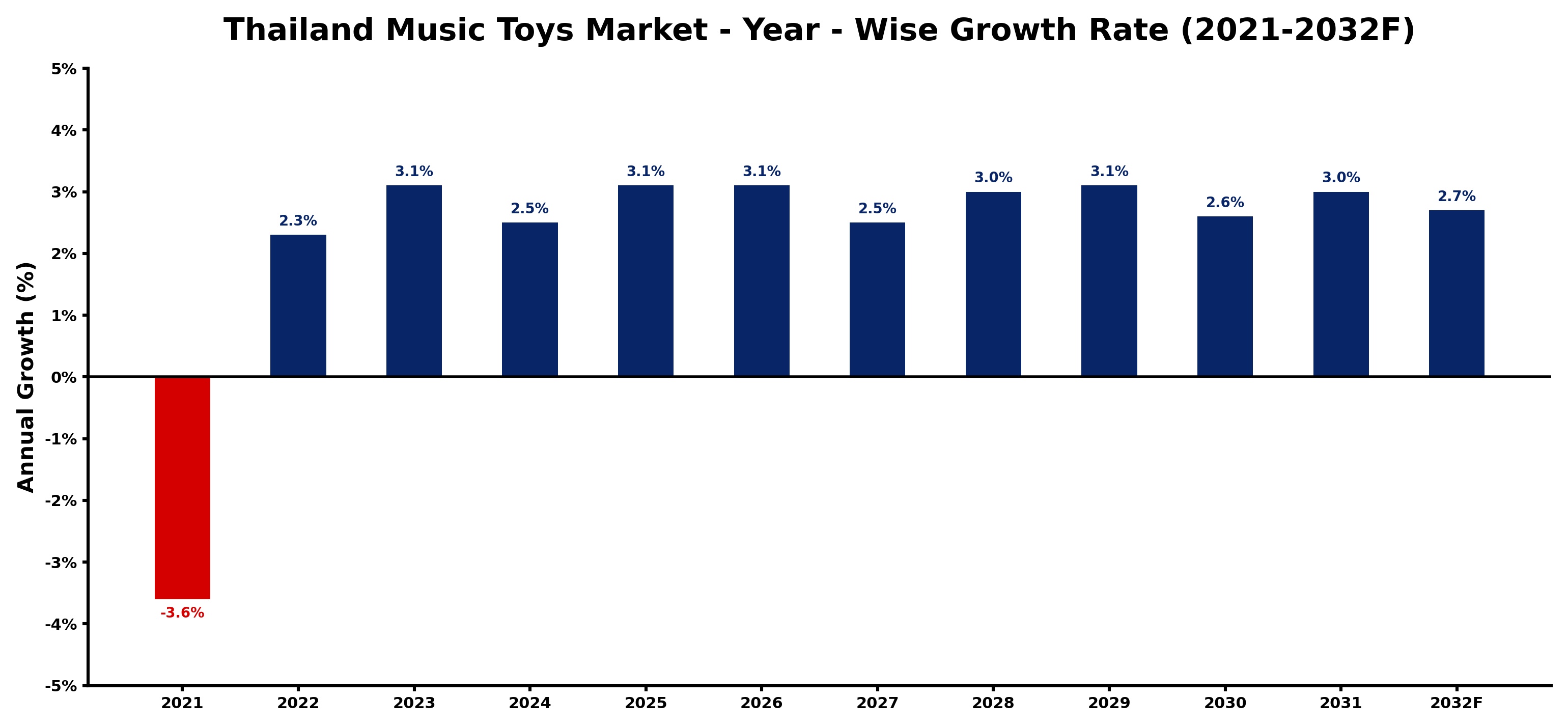
The table below presents the year‑wise growth rates along with the key drivers influencing the market
| Year | Growth Rate | Major Drivers |
| 2021 | -3.6% | Growing renewable energy integration projects |
| 2022 | 2.3% | Government infrastructure modernization initiatives |
| 2023 | 3.1% | Growing urbanization and commercial development |
| 2024 | 2.5% | Expansion of commercial construction activities |
| 2025 | 3.1% | Expansion of commercial construction activities |
| 2026 | 3.1% | Increasing industrial automation investments |
| 2027 | 2.5% | Increasing industrial automation investments |
| 2028 | 3.0% | Rising electricity demand across industries |
| 2029 | 3.1% | Increasing industrial automation investments |
| 2030 | 2.6% | Increasing adoption of advanced technologies |
| 2031 | 3.0% | Expansion of transportation and logistics networks |
| 2032 | 2.7% | Expansion of commercial construction activities |
Note - Market size estimations and growth projections presented in this report are based on 6Wresearch's advanced forecasting approach, validated with industry datasets as of June 2026.
Thailand Music Toys Market Synopsis
The primary force shaping the Thailand Music Toys Market is the cultural significance of music in Thai society. Parents and educators alike recognize the role of music in fostering creativity and enhancing developmental skills among children, which in turn bolsters the demand for music-related toys. As such, toys that produce sound and music are not merely playthings; they are seen as essential tools for learning and development.
Additionally, the rising trend of innovative and interactive music toys further accelerates market growth. Products that combine traditional sounds with modern technology not only capture children's attention but also meet the expectations of tech-savvy parents. As a result, the market is witnessing a diverse range of offerings, from classic instruments to sophisticated electronic toys.
Thailand Music Toys Market Key Takeaways
- The Thai music toys sector is fueled by a strong cultural inclination towards music and the arts.
- Parents are increasingly aware of the developmental advantages that music toys offer to children.
- Technological advancements are creating opportunities for innovative and engaging music toys.
- Educational institutions are incorporating music toys into their curriculums, further supporting market growth.
- The market is evolving with the entry of new brands and products that cater to modern consumer needs.
Evaluation of Restraints in Thailand Music Toys Market
Despite its robust growth, the Thailand Music Toys Market faces challenges primarily due to competition from digital devices. The allure of smartphones, tablets, and other electronic gadgets often overshadows traditional music toys, diverting children's attention. This shift in focus underscores the necessity for parents and educators to be educated about the unique benefits of physical play and the indispensable role of music toys in nurturing creativity and social interaction among children. Moreover, adherence to stringent safety regulations is paramount in maintaining consumer confidence and ensuring market sustainability.
Thailand Music Toys Market Trends
Current trends indicate a significant shift towards interactive and digitally enhanced music toys, which incorporate gamification and smart technology. Products that allow children to learn through play are gaining traction, appealing to parents who seek educational value in toys. Moreover, sustainable materials are becoming increasingly important, as consumers favor eco-friendly products that align with their values. This focus on sustainability is further driving innovation in toy design, prompting manufacturers to rethink traditional materials and methods.
Thailand Music Toys Market Opportunities
The genuine growth potential within the Thailand Music Toys Market lies in expanding product offerings tailored to various age groups and learning stages. Opportunities also exist in developing partnerships with educational institutions that incorporate music into their teaching methodologies. Moreover, as more parents prioritize developmental benefits, creating marketing campaigns that emphasize the educational aspects of music toys could significantly enhance market penetration. Online platforms for sales and marketing provide another avenue for growth, especially as e-commerce continues to flourish in Thailand.
Government Initiatives in the Thailand Music Toys Market
Government initiatives focusing on early childhood education and cultural heritage promote the use of music as a vital educational tool. Various public programs aim to integrate music into learning curriculums, facilitating children's exposure to musical play. Such initiatives not only underscore the importance of arts in education but also reflect a commitment to enhancing the developmental landscape for the youth in Thailand, thereby positively impacting the music toys market.
Future Insights of the Thailand Music Toys Market
Looking ahead to 2026-2032, the Thailand Music Toys Market is poised for continued growth. The ongoing recognition of music's role in cognitive and emotional development will sustain consumer interest. Moreover, innovations in product design and technology will likely lead to the introduction of more engaging and educational toys. As parents increasingly seek quality products that facilitate learning through play, the market is expected to evolve to meet these demands, fostering a vibrant ecosystem for music toys.
Thailand Music Toys Market Latest Developments (May 2025 - June 2026)
Recent developments in the music toys industry indicate a pivot towards interactive and educational products, with companies launching new lines that incorporate augmented reality and app integration. This trend reflects a broader shift in consumer expectations, as families look for toys that not only entertain but also educate. Furthermore, collaborations between manufacturers and educational content creators are becoming more common, aiming to enrich the learning experiences of children through music.
Thailand Music Toys Market - Key Attractiveness of the Report
- 10 Years of Market Numbers
- Historical Data Starting from 2022 to 2025
- Base Year: 2025
- Forecast Data until 2032
- Key Performance Indicators Impacting the Market
- Major Upcoming Developments and Projects
Key Highlights of the Report:
- Thailand Music Toys Market Outlook
- Market Size of Thailand Music Toys Market, 2025
- Forecast of Thailand Music Toys Market, 2032
- Historical Data and Forecast of Thailand Music Toys Revenues & Volume for the Period 2022-2032F
- Thailand Music Toys Market Trend Evolution
- Thailand Music Toys Market Drivers and Challenges
- Thailand Music Toys Price Trends
- Thailand Music Toys Porter's Five Forces
- Thailand Music Toys Industry Life Cycle
- Historical Data and Forecast of Thailand Music Toys Market Revenues & Volume By Type for the Period 2022-2032F
- Historical Data and Forecast of Thailand Music Toys Market Revenues & Volume By Drums & Percussion for the Period 2022-2032F
- Historical Data and Forecast of Thailand Music Toys Market Revenues & Volume By Guitars & Strings for the Period 2022-2032F
- Historical Data and Forecast of Thailand Music Toys Market Revenues & Volume By Pianos & Keyboards for the Period 2022-2032F
- Historical Data and Forecast of Thailand Music Toys Market Revenues & Volume By Wind & Brass for the Period 2022-2032F
- Historical Data and Forecast of Thailand Music Toys Market Revenues & Volume By Others for the Period 2022-2032F
- Historical Data and Forecast of Thailand Music Toys Market Revenues & Volume By Age for the Period 2022-2032F
- Historical Data and Forecast of Thailand Music Toys Market Revenues & Volume By Below 1 Year for the Period 2022-2032F
- Historical Data and Forecast of Thailand Music Toys Market Revenues & Volume By 1??3 Years for the Period 2022-2032F
- Historical Data and Forecast of Thailand Music Toys Market Revenues & Volume By 3??5 Year for the Period 2022-2032F
- Historical Data and Forecast of Thailand Music Toys Market Revenues & Volume By 5??7 Years for the Period 2022-2032F
- Historical Data and Forecast of Thailand Music Toys Market Revenues & Volume By 7??9 Years for the Period 2022-2032F
- Historical Data and Forecast of Thailand Music Toys Market Revenues & Volume By Above 9 Years for the Period 2022-2032F
- Historical Data and Forecast of Thailand Music Toys Market Revenues & Volume By Distribution Channel for the Period 2022-2032F
- Historical Data and Forecast of Thailand Music Toys Market Revenues & Volume By Online Channel for the Period 2022-2032F
- Historical Data and Forecast of Thailand Music Toys Market Revenues & Volume By Offline Channel for the Period 2022-2032F
- Thailand Music Toys Import Export Trade Statistics
- Market Opportunity Assessment By Type
- Market Opportunity Assessment By Age
- Market Opportunity Assessment By Distribution Channel
- Thailand Music Toys Top Companies Market Share
- Thailand Music Toys Competitive Benchmarking By Technical and Operational Parameters
- Thailand Music Toys Company Profiles
- Thailand Music Toys Key Strategic Recommendations






































