Thailand MVNO Market Size & Growth Rate (2026-2032)
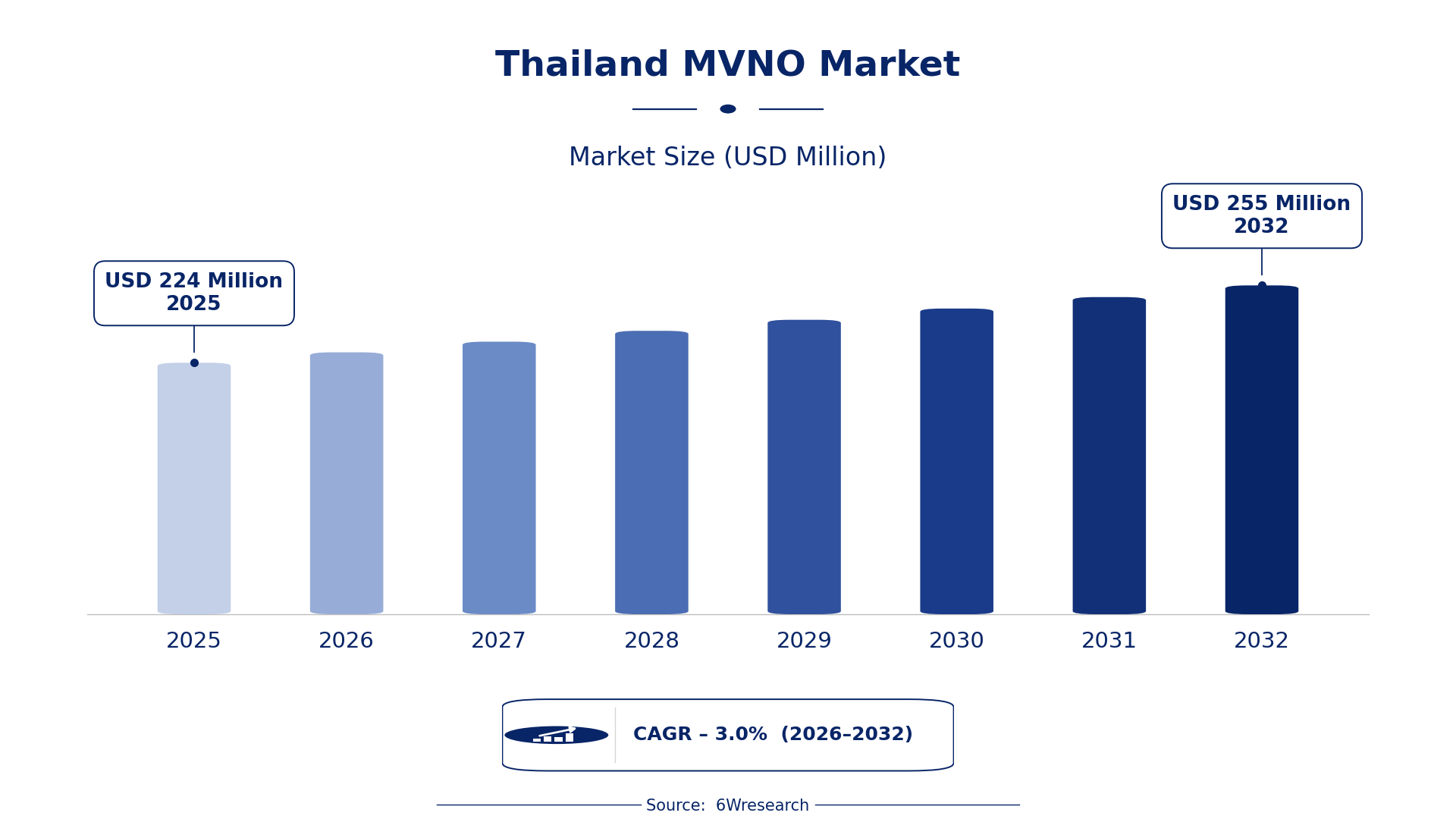
The Thailand MVNO Market was estimated at USD 224 Million in 2025 and is projected to reach USD 255 Million by 2032, growing at a CAGR of 3.0% from 2026 to 2032.
Thailand MVNO Market Synopsis
The Thailand MVNO market is carving a niche in the mobile telecommunications sector by providing tailored services that cater to specific consumer needs. With a growing base of tech-savvy users, MVNOs are stepping in to fill gaps left by traditional operators, offering flexible pricing and specialized packages that resonate with diverse demographics.
As established carriers continue to dominate, MVNOs are not just competing on price; they’re also focusing on customer service and innovation. This shift is crucial as consumer expectations evolve, demanding not just connectivity but also personalized experiences and value for money.
Thailand MVNO Market Year-wise Growth Rate and Key Drivers
This graph illustrates the annual growth rates of the Thailand MVNO Market from 2021 to 2032, highlighting a steady upward trajectory and projected expansion over the forecast period.
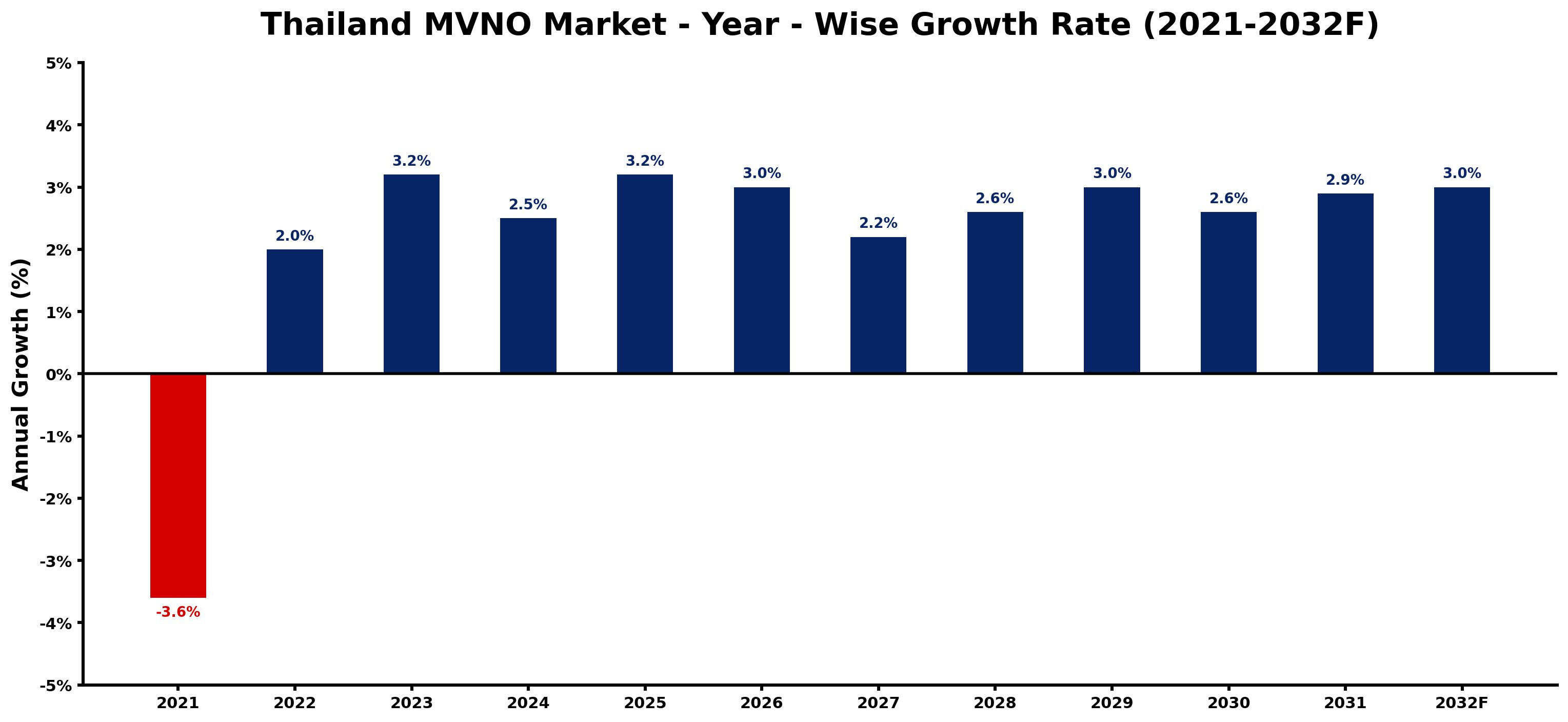
The table below presents the year‑wise growth rates along with the key drivers influencing the market
| Year | Growth Rate | Major Drivers |
| 2021 | -3.6% | Regulatory changes by NBTC limited new MVNO licenses. |
| 2022 | 2.0% | Regulatory support for new MVNO licenses by NBTC |
| 2023 | 3.2% | Increased smartphone penetration among urban Thai youth |
| 2024 | 2.5% | Demand for affordable data plans among budget-conscious users |
| 2025 | 3.2% | Growth of digital services boosting MVNO relevance |
| 2026 | 3.0% | Post-pandemic rebound in mobile service subscriptions |
| 2027 | 2.2% | Emergence of lifestyle apps increasing data consumption |
| 2028 | 2.6% | New MVNO offerings targeting niche demographics |
| 2029 | 3.0% | Strong competition driving innovative pricing strategies |
| 2030 | 2.6% | Ubiquity of 5G technology enhancing mobile service appeal |
| 2031 | 2.9% | Government initiatives promoting digital inclusion through MVNOs |
| 2032 | 3.0% | Rise of remote work boosting mobile data needs |
Note: Market size estimations and growth projections presented in this report are based on 6Wresearch's proprietary forecasting methodology, utilizing the latest available industry data, government publications, and primary research inputs.
Thailand MVNO Market Key Takeaways
Below are some of the specific key takeaways from the market, including:
- MVNOs are gaining traction as consumers seek tailored mobile solutions.
- Intense competition among operators is driving innovation and unique service offerings.
- Regulatory frameworks are adapting to accommodate the growth of MVNOs.
- Consumer demand for flexible pricing models is reshaping the market dynamics.
- The impact of the COVID-19 pandemic has accelerated the adoption of digital services.
Evaluation of Restraints in Thailand MVNO Market
Despite its growth potential, the Thailand MVNO market faces real challenges that could hinder its progress. One significant restraint is the fierce competition among existing players, which often results in price wars that can undermine profitability. Additionally, MVNOs must navigate complex regulatory landscapes that may restrict operational flexibility. Without favorable wholesale agreements with major network providers, smaller MVNOs struggle to carve out a sustainable market presence. These obstacles necessitate strategic partnerships and innovative approaches to succeed in this crowded space.
Thailand MVNO Market Trends
Several trends are currently influencing the Thailand MVNO market. The rise in demand for data-centric services is reshaping product offerings, pushing MVNOs to create plans that cater specifically to heavy data users. on top of that, there’s an increasing shift toward digital platforms for customer acquisition and service delivery, reflecting broader consumer behavior changes. MVNOs are also focusing on niche markets, such as expatriates and specific professional groups, allowing them to tailor services that meet unique needs. These trends are likely to continue driving growth and innovation within the market.
Thailand MVNO Market Opportunities
Growth opportunities abound in the Thailand MVNO market as operators look to innovate and differentiate themselves. The increasing penetration of smartphones and mobile internet opens avenues for MVNOs to introduce data-centric packages and value-added services. Partnerships with technology firms can also help MVNOs enhance their service offerings, particularly in areas like mobile payment solutions and IoT connectivity. on top of that, the ongoing demand for customized experiences positions MVNOs to explore new customer segments, providing tailored services that traditional operators may overlook.
Government Initiatives in the Thailand MVNO Market
Government policy plays a crucial role in shaping the Thailand MVNO market. The Thai government is actively working to create a regulatory environment that fosters competition while ensuring consumer protection. This regulatory posture is particularly relevant as MVNOs aim to expand their presence in a market dominated by a few large operators. Policies that promote transparency and fair access to network infrastructure are essential for the growth and sustainability of MVNOs in Thailand.
- A regulatory framework introduced in 2023 mandates billing transparency for MVNO services.
- Currently underway is a national digital infrastructure upgrade programme aimed at enhancing connectivity.
- A planned public-private initiative expected to expand telecom infrastructure access by 2026 is in the pipeline.
- Recent initiatives have focused on streamlining licensing processes for new MVNO entrants.
Future Insights of the Thailand MVNO Market
Looking forward to 2026-2032, the Thailand MVNO market is expected to experience steady growth. As consumer preferences shift towards more personalized and flexible mobile offerings, MVNOs that successfully adapt their strategies will thrive. The increasing emphasis on digital transformation will likely drive innovation in service delivery, allowing MVNOs to enhance customer engagement and satisfaction. on top of that, with government support for infrastructure development, MVNOs can capitalize on improved network accessibility to reach underserved areas.
Thailand MVNO Market Latest Developments
In the past year, the Thailand MVNO market has seen a flurry of activity as operators adapt to changing consumer demands and technological advancements. As MVNOs refine their service offerings, they are also investing in technology to enhance customer experiences and streamline operations. This trend reflects a broader commitment to remain competitive in a saturated market.
- A major technology vendor announced an ongoing partnership with local MVNOs to enhance digital service capabilities, initiated in Q2 2023.
- In early 2023, a prominent MVNO launched a new service targeting the gig economy, offering flexible plans tailored to freelancers.
- Currently ongoing is a marketing campaign by multiple MVNOs aimed at attracting younger consumers through social media channels.
- A rollout expected to begin in late 2023 will introduce innovative prepaid plans designed for international travelers.
Thailand MVNO Market - Key Attractiveness of the Report
- 10 Years of Market Numbers
- Historical Data Starting from 2022 to 2025
- Base Year: 2025
- Forecast Data until 2032
- Key Performance Indicators Impacting the Market
- Major Upcoming Developments and Projects
Key Highlights of the Report:
- Thailand MVNO Market Outlook
- Market Size of Thailand MVNO Market, 2025
- Forecast of Thailand MVNO Market, 2032
- Historical Data and Forecast of Thailand MVNO Revenues & Volume for the Period 2022-2032F
- Thailand MVNO Market Trend Evolution
- Thailand MVNO Market Drivers and Challenges
- Thailand MVNO Price Trends
- Thailand MVNO Porter's Five Forces
- Thailand MVNO Industry Life Cycle
- Historical Data and Forecast of Thailand MVNO Market Revenues & Volume By Operational Model for the Period 2022-2032F
- Historical Data and Forecast of Thailand MVNO Market Revenues & Volume By Reseller for the Period 2022-2032F
- Historical Data and Forecast of Thailand MVNO Market Revenues & Volume By Service Operator for the Period 2022-2032F
- Historical Data and Forecast of Thailand MVNO Market Revenues & Volume By Full MVNO for the Period 2022-2032F
- Historical Data and Forecast of Thailand MVNO Market Revenues & Volume By Organization Size for the Period 2022-2032F
- Historical Data and Forecast of Thailand MVNO Market Revenues & Volume By SMES for the Period 2022-2032F
- Historical Data and Forecast of Thailand MVNO Market Revenues & Volume By Large Enterprise for the Period 2022-2032F
- Historical Data and Forecast of Thailand MVNO Market Revenues & Volume By Subscriber for the Period 2022-2032F
- Historical Data and Forecast of Thailand MVNO Market Revenues & Volume By Consumer for the Period 2022-2032F
- Historical Data and Forecast of Thailand MVNO Market Revenues & Volume By Enterprise for the Period 2022-2032F
- Thailand MVNO Import Export Trade Statistics
- Market Opportunity Assessment By Operational Model
- Market Opportunity Assessment By Organization Size
- Market Opportunity Assessment By Subscriber
- Thailand MVNO Top Companies Market Share
- Thailand MVNO Competitive Benchmarking By Technical and Operational Parameters
- Thailand MVNO Company Profiles
- Thailand MVNO Key Strategic Recommendations






































