Thailand Natural Fragrance Market Size, Share & Growth Rate
The Thailand Natural Fragrance Market was estimated at USD 145 Million in 2025 and is projected to reach USD 167 Million by 2032, growing at a CAGR of 2.0% from 2026 to 2032. This growth trajectory is primarily driven by a rising consumer preference for natural and eco-friendly fragrance options, which are increasingly viewed as safer alternatives to synthetic scents. The wellness trend, coupled with a heightened awareness of the health benefits associated with natural fragrances, further propels market demand.
Thailand Natural Fragrance Market Year-wise Growth Rate and Key Drivers
This graph highlights how the Thailand Natural Fragrance Market has steadily grown over the years, supported by major growth factors.
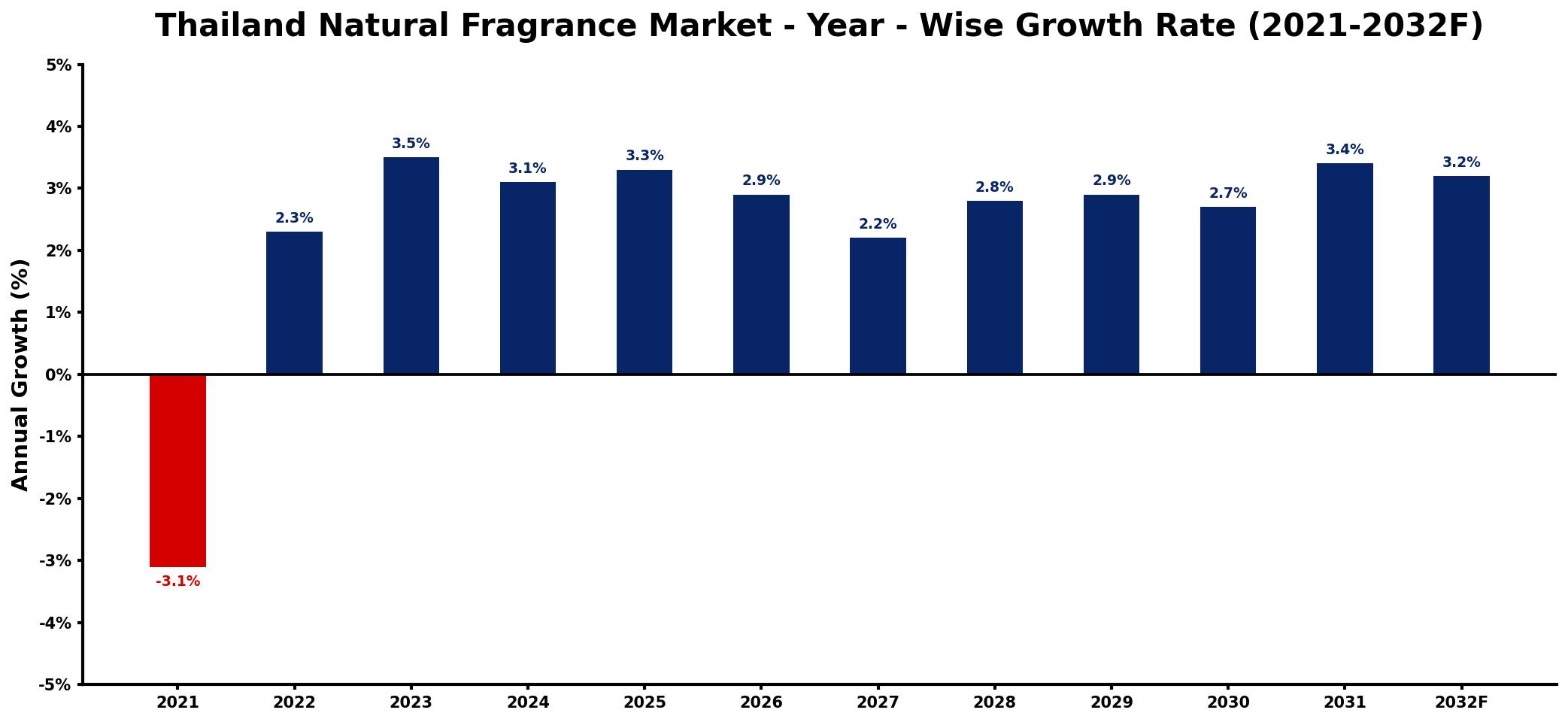
The table below presents the year‑wise growth rates along with the key drivers influencing the market
| Year | Growth Rate | Major Drivers |
| 2021 | -3.1% | decreased consumer spending on luxury |
| 2022 | 2.3% | rise in organic product popularity |
| 2023 | 3.5% | expansion of e-commerce platforms |
| 2024 | 3.1% | increased demand for wellness products |
| 2025 | 3.3% | growing interest in sustainable sourcing |
| 2026 | 2.9% | investment in local production facilities |
| 2027 | 2.2% | emergence of boutique brands |
| 2028 | 2.8% | increased awareness of environmental impact |
| 2029 | 2.9% | growth in export opportunities |
| 2030 | 2.7% | enhanced marketing strategies adopted |
| 2031 | 3.4% | collaboration with lifestyle influencers |
| 2032 | 3.2% | broader distribution channel development |
Note: Market size estimations and growth projections presented in this report are based on 6Wresearch's proprietary forecasting methodology, utilizing the latest available industry data, government publications, and primary research inputs.
Thailand Natural Fragrance Market Synopsis
The Thailand Natural Fragrance Market is undergoing a transformative phase as consumers seek authenticity and sustainability in their fragrance choices. With a rich biodiversity, the nation offers a myriad of natural sources for fragrance production, from essential oils to herbal concoctions.
This market's appeal is particularly evident in personal care and home fragrance sectors, where the integration of natural aromas is not just a trend, but a lifestyle choice. Increased awareness regarding the ecological footprint of synthetic ingredients has fueled demand for more sustainable alternatives, positioning natural fragrances as essential components in modern wellness practices.
Thailand Natural Fragrance Market Key Takeaways
- The market's focus on sustainability aligns with global trends towards eco-friendly consumerism.
- Wellness and aromatherapy have emerged as significant influences on purchasing decisions.
- Transparency in sourcing and production is becoming a crucial factor for consumers.
- Home fragrances and aromatherapy products are witnessing accelerated demand.
- Strong growth is expected as consumers continue to embrace natural lifestyles.
Evaluation of Restraints in Thailand Natural Fragrance Market
Despite its promising outlook, the Thailand Natural Fragrance Market faces significant restraints. A primary concern is the sustainable sourcing of the exotic and often rare botanicals that underpin many natural fragrance products. Overharvesting poses ecological threats, making it challenging to balance consumer demand with environmental stewardship. Furthermore, the market grapples with potential regulatory hurdles as consumer safety and environmental impact come under increased scrutiny.
Thailand Natural Fragrance Market Trends
Current trends indicate a marked shift toward personalization in fragrance choices, with consumers seeking tailored experiences that reflect their individuality. Moreover, the rise of online platforms facilitates greater accessibility to a variety of natural fragrance products, allowing consumers to explore and curate their own scent profiles easily. As the wellness movement continues to gain momentum, the integration of natural fragrances into holistic lifestyle practices is set to grow, further embedding these products into daily routines.
Thailand Natural Fragrance Market Opportunities
The burgeoning interest in natural products presents numerous investment opportunities within the Thailand Natural Fragrance Market. Companies that can innovate in sourcing and processing natural ingredients while adhering to sustainable practices will likely thrive. Additionally, expanding product lines to include multifunctional uses—such as combining fragrances with therapeutic benefits—could attract new customer segments, positioning brands for further growth.
Government Initiatives in the Thailand Natural Fragrance Market
The Thai government has implemented various initiatives aimed at promoting sustainable agriculture and eco-friendly product development, which directly benefit the natural fragrance sector. Public spending in areas focused on environmental conservation and the preservation of local biodiversity encourages responsible sourcing practices. Furthermore, programs supporting local artisans and businesses engaged in producing natural fragrances enhance the market's overall ecosystem.
Future Insights of the Thailand Natural Fragrance Market
Looking ahead to 2026-2032, the Thailand Natural Fragrance Market is poised for steady growth fueled by an expanding consumer base that prioritizes sustainability and wellness. As awareness of the health benefits associated with natural fragrances continues to rise, brands that emphasize quality, transparency, and ethical practices will gain a competitive edge. The potential for innovation, particularly in product formulation and delivery methods, also suggests a dynamic future where natural fragrances become increasingly integral to lifestyle choices.
Thailand Natural Fragrance Market Latest Developments (2025 - 2026)
Recent developments in the Thailand Natural Fragrance Market indicate a shift toward increased online retailing, as brands adapt to changing consumer behaviors post-pandemic. There is also a noticeable emphasis on creating community-driven brands that resonate with local culture, thereby enhancing the emotional connection consumers have with products. Additionally, sustainability practices are at the forefront, with more companies committing to eco-friendly packaging and production processes.
Thailand Natural Fragrance Market - Key Attractiveness of the Report
- 10 Years of Market Numbers
- Historical Data Starting from 2022 to 2025
- Base Year: 2025
- Forecast Data until 2032
- Key Performance Indicators Impacting the Market
- Major Upcoming Developments and Projects
Key Highlights of the Report:
- Thailand Natural Fragrance Market Outlook
- Market Size of Thailand Natural Fragrance Market, 2025
- Forecast of Thailand Natural Fragrance Market, 2032
- Historical Data and Forecast of Thailand Natural Fragrance Revenues & Volume for the Period 2022-2032F
- Thailand Natural Fragrance Market Trend Evolution
- Thailand Natural Fragrance Market Drivers and Challenges
- Thailand Natural Fragrance Price Trends
- Thailand Natural Fragrance Porter's Five Forces
- Thailand Natural Fragrance Industry Life Cycle
- Historical Data and Forecast of Thailand Natural Fragrance Market Revenues & Volume By Ingredient for the Period 2022-2032F
- Historical Data and Forecast of Thailand Natural Fragrance Market Revenues & Volume By Essential Oils for the Period 2022-2032F
- Historical Data and Forecast of Thailand Natural Fragrance Market Revenues & Volume By Natural Extracts for the Period 2022-2032F
- Historical Data and Forecast of Thailand Natural Fragrance Market Revenues & Volume By Type for the Period 2022-2032F
- Historical Data and Forecast of Thailand Natural Fragrance Market Revenues & Volume By Top note for the Period 2022-2032F
- Historical Data and Forecast of Thailand Natural Fragrance Market Revenues & Volume By Middle Note for the Period 2022-2032F
- Historical Data and Forecast of Thailand Natural Fragrance Market Revenues & Volume By Base Note for the Period 2022-2032F
- Historical Data and Forecast of Thailand Natural Fragrance Market Revenues & Volume By Application for the Period 2022-2032F
- Historical Data and Forecast of Thailand Natural Fragrance Market Revenues & Volume By Fine Fragrances for the Period 2022-2032F
- Historical Data and Forecast of Thailand Natural Fragrance Market Revenues & Volume By Personal Care & Cosmetics for the Period 2022-2032F
- Historical Data and Forecast of Thailand Natural Fragrance Market Revenues & Volume By Household Care for the Period 2022-2032F
- Thailand Natural Fragrance Import Export Trade Statistics
- Market Opportunity Assessment By Ingredient
- Market Opportunity Assessment By Type
- Market Opportunity Assessment By Application
- Thailand Natural Fragrance Top Companies Market Share
- Thailand Natural Fragrance Competitive Benchmarking By Technical and Operational Parameters
- Thailand Natural Fragrance Company Profiles
- Thailand Natural Fragrance Key Strategic Recommendations






































