Thailand Office Chair Market: Import Trend Analysis
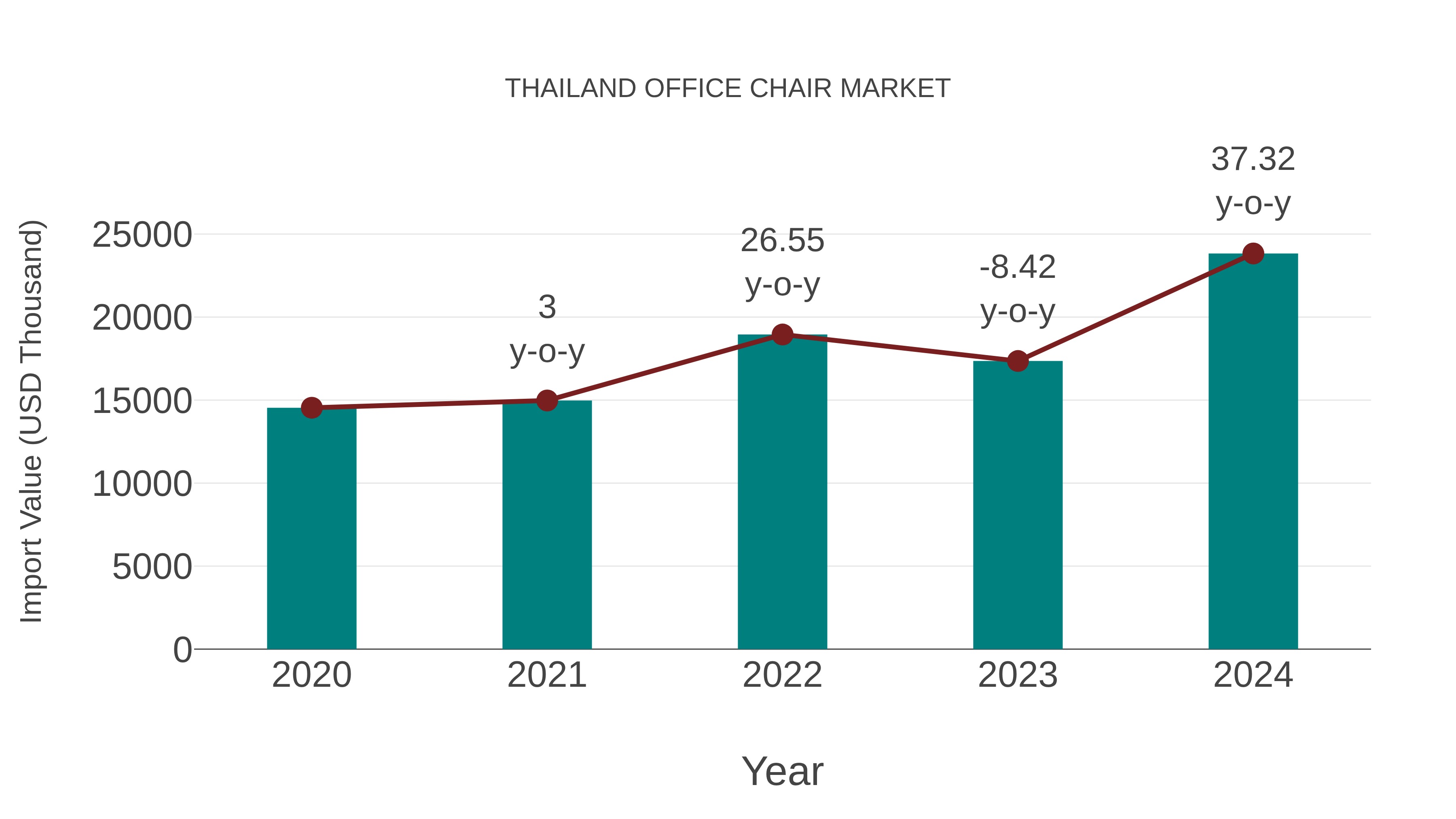
Thailand import trend in the office chair market showed a substantial growth rate of 37.32% from 2023 to 2024, with a compound annual growth rate (CAGR) of 13.15% from 2020 to 2024. This surge in imports can be attributed to a notable shift in demand towards ergonomic and high-quality office furniture, reflecting an increasing focus on workplace comfort and productivity in the region.
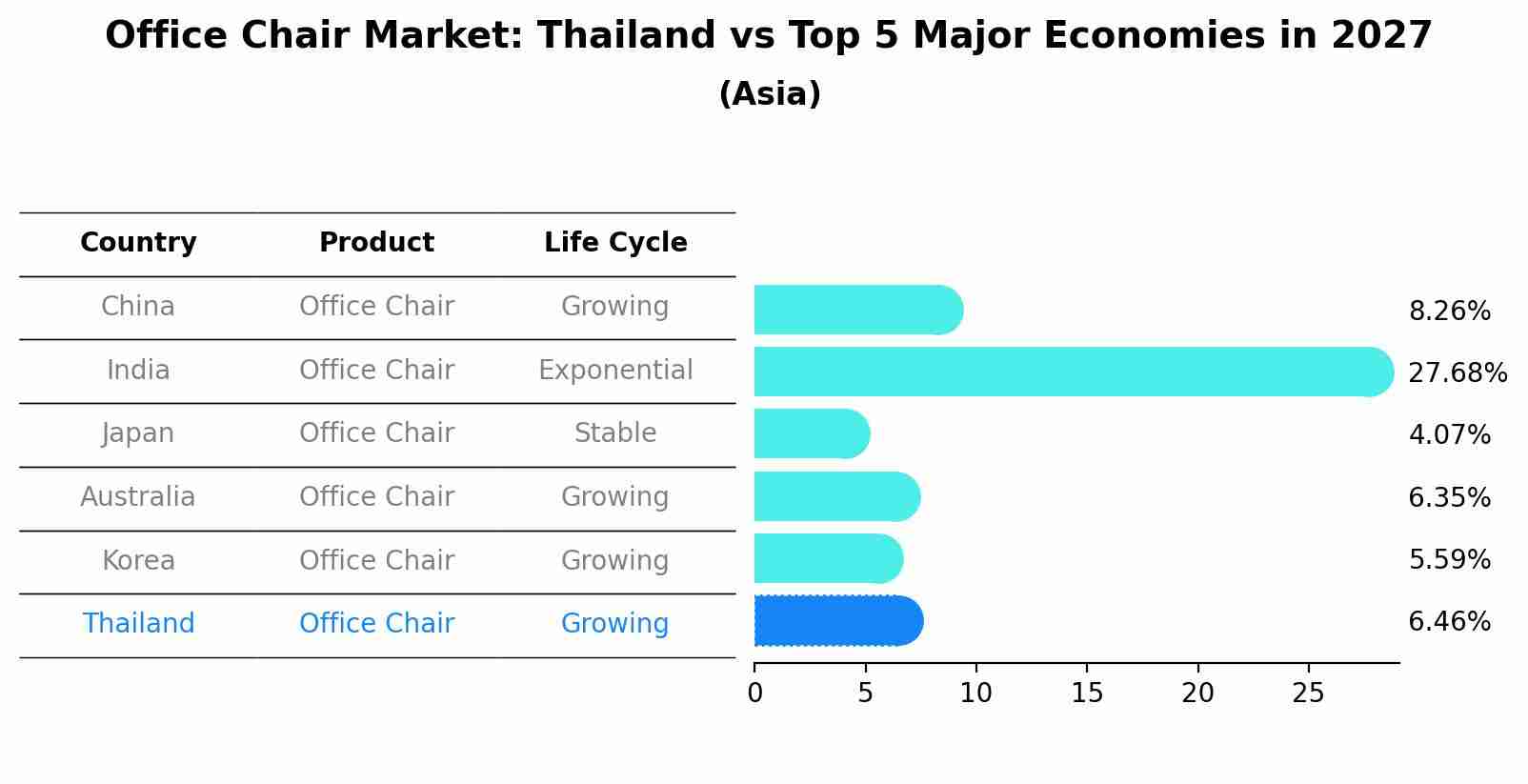
Office Chair Market: Thailand vs Top 5 Major Economies in 2027 (Asia)
By 2027, Thailand's Office Chair market is forecasted to achieve a growing growth rate of 6.46%, with China leading the Asia region, followed by India, Japan, Australia and South Korea.
Thailand Office Chair Market Synopsis
The office chair market in Thailand is closely tied to the growth of the corporate sector. As more companies expand and modernize their offices, the demand for ergonomic and comfortable office chairs has risen. Local and international manufacturers provide a variety of office chair options, including task chairs, executive chairs, and collaborative seating solutions.
Drivers of the Market
The Thailand office chair market is flourishing due to various factors. Firstly, the adoption of flexible and remote working arrangements has created a demand for ergonomic and comfortable office chairs that support long hours of work. Secondly, as awareness of the importance of employee well-being and productivity grows, companies are investing in high-quality office furniture, including chairs. Additionally, the expansion of the corporate sector and the influx of multinational companies into Thailand have increased the demand for office furniture, further driving market growth.
Challenges of the Market
The Thailand office chair market encounters challenges in adapting to changing work trends, such as remote work. As more companies adopt flexible work arrangements, demand for office chairs may decline. Manufacturers need to diversify their product offerings and focus on ergonomic design to cater to the evolving needs of remote workers.
COVID-19 Impact on the Market
The Thailand office chair market faced challenges during the COVID-19 pandemic. With remote work becoming the norm, many offices remained vacant, leading to a decreased demand for office chairs. Businesses reduced their expenditures on office furniture as they adapted to remote work arrangements. However, the market saw a surge in demand for ergonomic home office chairs as employees and employers recognized the importance of comfortable and supportive seating in remote work setups. Manufacturers adjusted their product offerings to cater to home office needs and emphasized online sales channels. The market`s recovery depended on factors such as the return to office-based work and the long-term adoption of flexible work arrangements.
Key Players in the Market
The Thailand office chair market features well-known brands like OfficePro Seating, ErgoComfort Chairs, and ExecutiveDesk Seating as leading players. These companies have established themselves as providers of ergonomic office chairs that prioritize comfort and productivity in professional environments.
Key Highlights of the Report:
- Thailand Office Chair Market Outlook
- Market Size of Thailand Office Chair Market, 2025
- Forecast of Thailand Office Chair Market, 2032
- Historical Data and Forecast of Thailand Office Chair Revenues & Volume for the Period 2022-2032F
- Thailand Office Chair Market Trend Evolution
- Thailand Office Chair Market Drivers and Challenges
- Thailand Office Chair Price Trends
- Thailand Office Chair Porter's Five Forces
- Thailand Office Chair Industry Life Cycle
- Historical Data and Forecast of Thailand Office Chair Market Revenues & Volume By Product Type for the Period 2022-2032F
- Historical Data and Forecast of Thailand Office Chair Market Revenues & Volume By Executive Office for the Period 2022-2032F
- Historical Data and Forecast of Thailand Office Chair Market Revenues & Volume By Ergonomic for the Period 2022-2032F
- Historical Data and Forecast of Thailand Office Chair Market Revenues & Volume By Conference for the Period 2022-2032F
- Historical Data and Forecast of Thailand Office Chair Market Revenues & Volume By Material for the Period 2022-2032F
- Historical Data and Forecast of Thailand Office Chair Market Revenues & Volume By Mesh for the Period 2022-2032F
- Historical Data and Forecast of Thailand Office Chair Market Revenues & Volume By Lather for the Period 2022-2032F
- Historical Data and Forecast of Thailand Office Chair Market Revenues & Volume By Plastic for the Period 2022-2032F
- Historical Data and Forecast of Thailand Office Chair Market Revenues & Volume By Fabric for the Period 2022-2032F
- Historical Data and Forecast of Thailand Office Chair Market Revenues & Volume By Sales Channel for the Period 2022-2032F
- Historical Data and Forecast of Thailand Office Chair Market Revenues & Volume By Offline for the Period 2022-2032F
- Historical Data and Forecast of Thailand Office Chair Market Revenues & Volume By Online for the Period 2022-2032F
- Thailand Office Chair Import Export Trade Statistics
- Market Opportunity Assessment By Product Type
- Market Opportunity Assessment By Material
- Market Opportunity Assessment By Sales Channel
- Thailand Office Chair Top Companies Market Share
- Thailand Office Chair Competitive Benchmarking By Technical and Operational Parameters
- Thailand Office Chair Company Profiles
- Thailand Office Chair Key Strategic Recommendations






































