Thailand Oil and Gas Cloud Applications Market Size & Growth Rate (2026-2032)
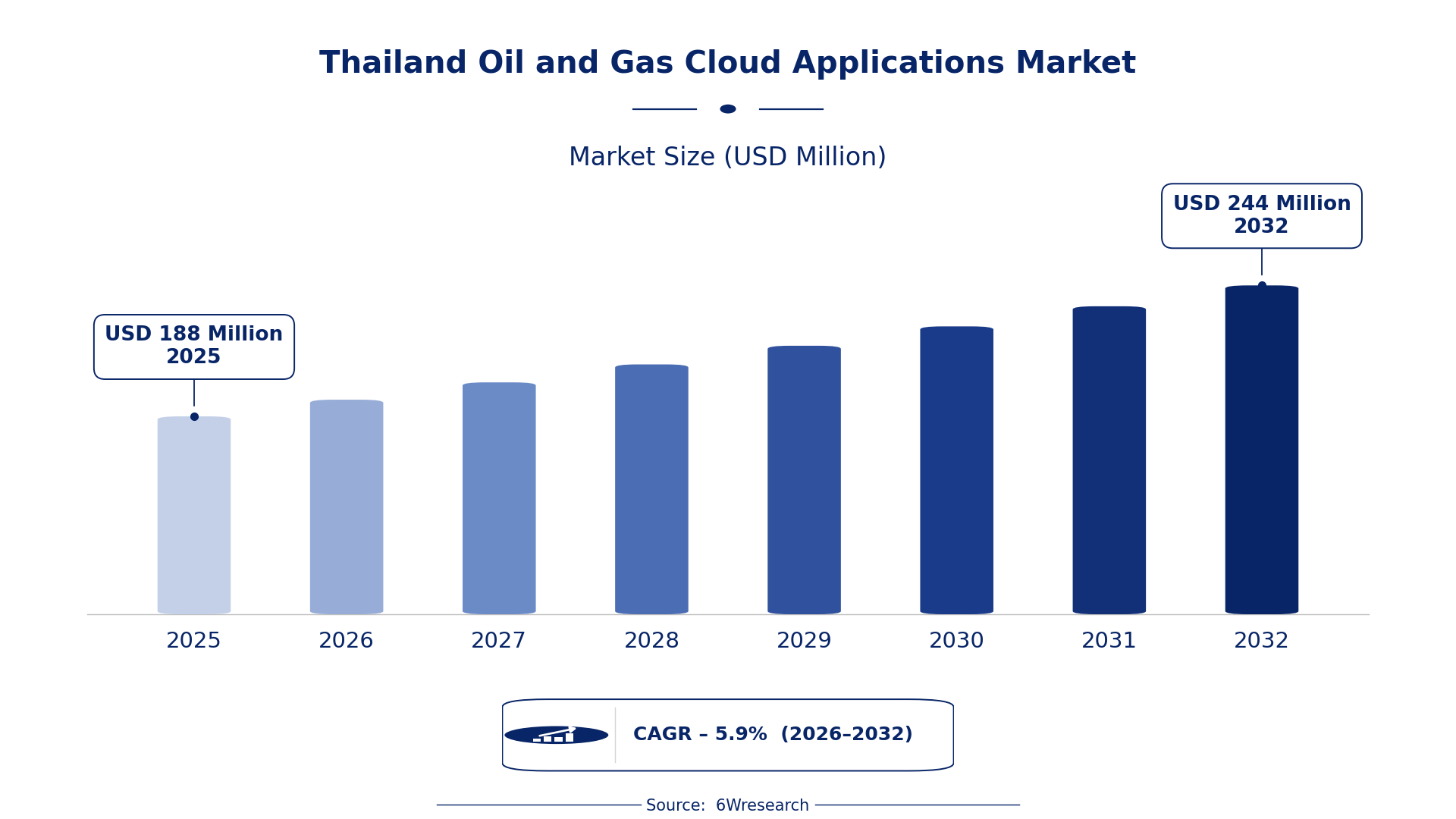
The Thailand Oil and Gas Cloud Applications Market was estimated at USD 188 Million in 2025 and is projected to reach USD 244 Million by 2032, growing at a CAGR of 5.9% from 2026 to 2032.
Thailand Oil and Gas Cloud Applications Market Synopsis
The driving force behind the Thailand Oil and Gas Cloud Applications Market is the urgent need for digital transformation within the sector. As companies strive for operational efficiency and competitive advantage, the adoption of cloud applications is rapidly becoming a core strategy.
Cloud applications are essential for managing vast amounts of data generated by exploration and production activities. They facilitate real-time analytics and enhance collaboration among teams, enabling businesses to adapt swiftly in a challenging market.
Thailand Oil and Gas Cloud Applications Market Year-wise Growth Rate and Key Drivers
This graph illustrates the annual growth rates of the Thailand Oil and Gas Cloud Applications Market from 2021 to 2032, highlighting a steady upward trajectory and projected expansion over the forecast period.
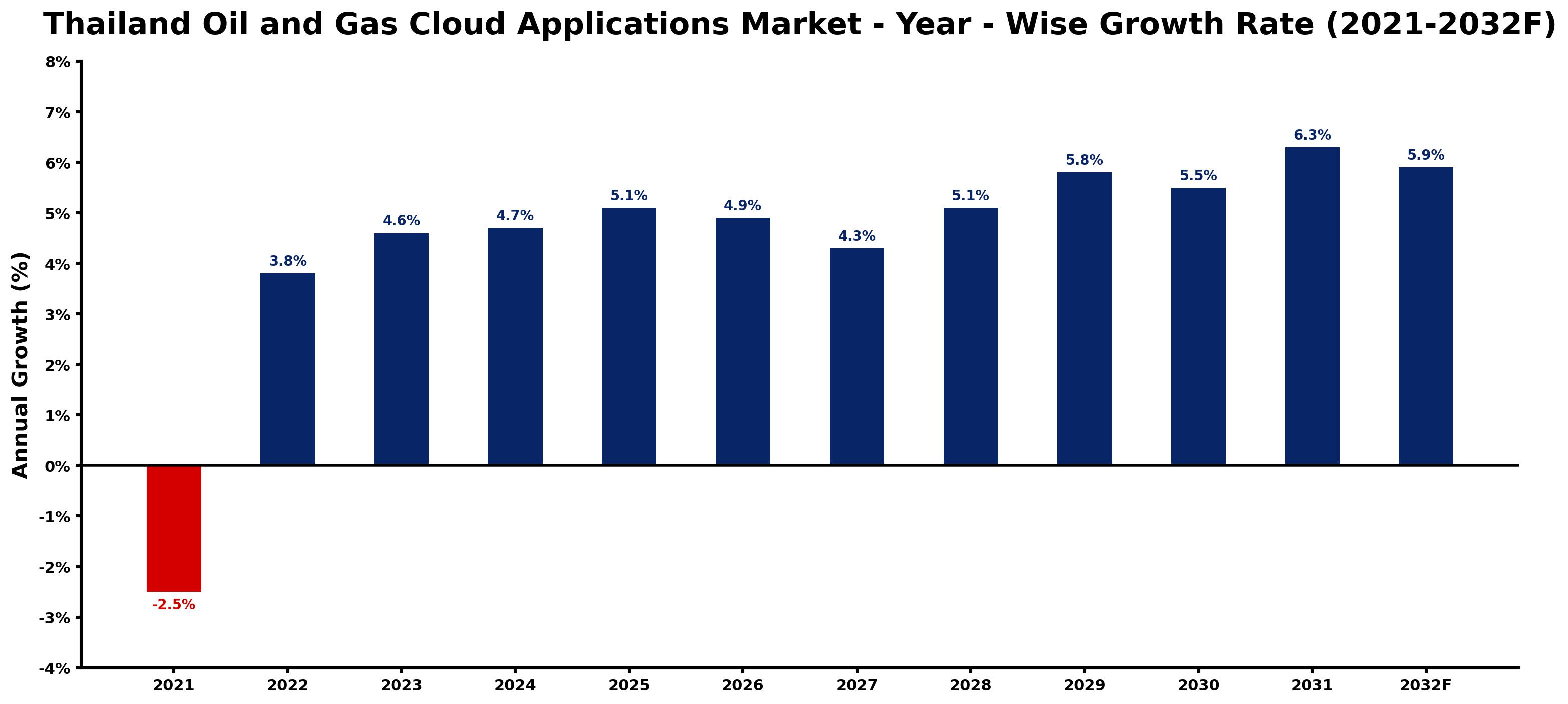
The table below presents the year‑wise growth rates along with the key drivers influencing the market
| Year | Growth Rate | Major Drivers |
| 2021 | -2.5% | Government energy policy slow to adopt cloud solutions. |
| 2022 | 3.8% | Government's digital transformation push for energy sector |
| 2023 | 4.6% | Increased adoption of IoT for oil and gas management |
| 2024 | 4.7% | Oil and Gas Authority incentivizing cloud-based solutions |
| 2025 | 5.1% | Emerging demand for data analytics in resource management |
| 2026 | 4.9% | Enhanced cybersecurity regulations driving cloud adoption |
| 2027 | 4.3% | Shift towards remote monitoring systems in oil fields |
| 2028 | 5.1% | Growing collaboration between tech firms and oil producers |
| 2029 | 5.8% | Rising investments in sustainable gas solutions technologies |
| 2030 | 5.5% | Implementation of national energy efficiency improvement plans |
| 2031 | 6.3% | Surge in data-driven decision-making for process optimization |
| 2032 | 5.9% | Adoption of AI and machine learning in cloud applications |
Note: Market size estimations and growth projections presented in this report are based on 6Wresearch's proprietary forecasting methodology, utilizing the latest available industry data, government publications, and primary research inputs.
Thailand Oil and Gas Cloud Applications Market Key Takeaways
Below are some of the specific key takeaways from the market, including:
- Rapid adoption of cloud applications is driven by the need for data analytics and operational optimization.
- Customized solutions are critical to address industry-specific challenges, including data security and compliance.
- The COVID-19 pandemic has accelerated digital initiatives, emphasizing the need for technology-driven platforms.
- Key players are introducing innovative software solutions to enhance collaboration and resource management.
- Future growth will hinge on the industry's ability to integrate diverse data sources efficiently.
Evaluation of Restraints in Thailand Oil and Gas Cloud Applications Market
The Thailand Oil and Gas Cloud Applications Market faces several restraints, primarily stemming from the industry's unique requirements. Data security remains a critical concern, as the sensitivity of operational data necessitates robust protective measures. Additionally, regulatory compliance poses significant challenges, as firms must navigate a complex framework of local and international standards. Integrating diverse data sources into a cohesive cloud application solution can be technically demanding, requiring tailored approaches that fit the specific needs of the oil and gas sector.
Thailand Oil and Gas Cloud Applications Market Trends
The market is witnessing several trends that are shaping its future. Increased emphasis on real-time data analytics is driving demand for cloud applications that provide actionable insights. There is a growing trend towards collaborative platforms that enhance workforce efficiency and enable remote operations. Companies are also prioritizing sustainability, with cloud solutions supporting environmental compliance and resource management initiatives.
Thailand Oil and Gas Cloud Applications Market Opportunities
Significant growth opportunities lie in the development of customized cloud solutions that cater to the specific demands of the oil and gas sector. There is a clear need for applications that facilitate better asset management and reservoir modeling. on top of that, as companies look to enhance their operational efficiencies, there is potential for investment in technology that supports digital transformation initiatives, especially in areas like predictive maintenance and workforce optimization.
Government Initiatives in the Thailand Oil and Gas Cloud Applications Market
Government policy plays a crucial role in shaping the Thailand Oil and Gas Cloud Applications Market. The Thai government is actively encouraging the adoption of digital technologies to enhance the efficiency of the energy sector. Regulatory frameworks are being developed to promote data security and compliance, which are critical for fostering trust in cloud solutions.
- A regulatory framework introduced in 2025 mandates greater transparency in energy billing, boosting confidence in cloud-based solutions.
- A national digital infrastructure upgrade programme is currently underway, aimed at improving connectivity for oil and gas operators.
- The government has launched a public-private partnership initiative to support the development of innovative cloud applications tailored to the industry.
- Upcoming legislation expected in 2027 will provide incentives for companies investing in technology-driven solutions for operational efficiency.
Future Insights of the Thailand Oil and Gas Cloud Applications Market
Looking ahead to 2026-2032, the Thailand Oil and Gas Cloud Applications Market is set to expand as the industry continues its digital transformation journey. Companies will increasingly adopt cloud solutions to improve data management and operational processes. As competition intensifies, firms that invest in innovative technologies and tailored cloud applications will gain a significant edge. The focus on sustainability will also drive demand for cloud solutions that support environmental goals.
Thailand Oil and Gas Cloud Applications Market Latest Developments
Recent activity in the Thailand Oil and Gas Cloud Applications Market indicates a strong push towards digital innovation. Companies are exploring new technologies to enhance operational efficiencies and improve collaboration. The emphasis on cloud solutions is evident as firms adapt to the changing energy dynamics in the region.
- A major technology vendor launched a new cloud-based asset management solution in early 2025, aimed at enhancing operational efficiency.
- An initiative that began in mid-2025 is currently underway, focused on integrating advanced analytics into cloud applications for better decision-making.
- A partnership between local firms is expected to yield a new collaborative platform, with rollout anticipated in Q3 2026.
- Plans for a comprehensive cloud migration strategy are being developed by a leading regional operator, with implementation expected to commence by late 2026.
Thailand Oil and Gas Cloud Applications Market - Key Attractiveness of the Report
- 10 Years of Market Numbers
- Historical Data Starting from 2022 to 2025
- Base Year: 2025
- Forecast Data until 2032
- Key Performance Indicators Impacting the Market
- Major Upcoming Developments and Projects
Key Highlights of the Report:
- Thailand Oil and Gas Cloud Applications Market Outlook
- Market Size of Thailand Oil and Gas Cloud Applications Market, 2025
- Forecast of Thailand Oil and Gas Cloud Applications Market, 2032
- Historical Data and Forecast of Thailand Oil and Gas Cloud Applications Revenues & Volume for the Period 2022-2032F
- Thailand Oil and Gas Cloud Applications Market Trend Evolution
- Thailand Oil and Gas Cloud Applications Market Drivers and Challenges
- Thailand Oil and Gas Cloud Applications Price Trends
- Thailand Oil and Gas Cloud Applications Porter's Five Forces
- Thailand Oil and Gas Cloud Applications Industry Life Cycle
- Historical Data and Forecast of Thailand Oil and Gas Cloud Applications Market Revenues & Volume By Component for the Period 2022-2032F
- Historical Data and Forecast of Thailand Oil and Gas Cloud Applications Market Revenues & Volume By Solution for the Period 2022-2032F
- Historical Data and Forecast of Thailand Oil and Gas Cloud Applications Market Revenues & Volume By Services for the Period 2022-2032F
- Historical Data and Forecast of Thailand Oil and Gas Cloud Applications Market Revenues & Volume By Deployment Type for the Period 2022-2032F
- Historical Data and Forecast of Thailand Oil and Gas Cloud Applications Market Revenues & Volume By Private for the Period 2022-2032F
- Historical Data and Forecast of Thailand Oil and Gas Cloud Applications Market Revenues & Volume By Public Cloud for the Period 2022-2032F
- Historical Data and Forecast of Thailand Oil and Gas Cloud Applications Market Revenues & Volume By Operation for the Period 2022-2032F
- Historical Data and Forecast of Thailand Oil and Gas Cloud Applications Market Revenues & Volume By Upstream for the Period 2022-2032F
- Historical Data and Forecast of Thailand Oil and Gas Cloud Applications Market Revenues & Volume By Midstream for the Period 2022-2032F
- Historical Data and Forecast of Thailand Oil and Gas Cloud Applications Market Revenues & Volume By Downstream for the Period 2022-2032F
- Thailand Oil and Gas Cloud Applications Import Export Trade Statistics
- Market Opportunity Assessment By Component
- Market Opportunity Assessment By Deployment Type
- Market Opportunity Assessment By Operation
- Thailand Oil and Gas Cloud Applications Top Companies Market Share
- Thailand Oil and Gas Cloud Applications Competitive Benchmarking By Technical and Operational Parameters
- Thailand Oil and Gas Cloud Applications Company Profiles
- Thailand Oil and Gas Cloud Applications Key Strategic Recommendations






































