Thailand Oil and Gas Pipeline Market: Import Trend Analysis
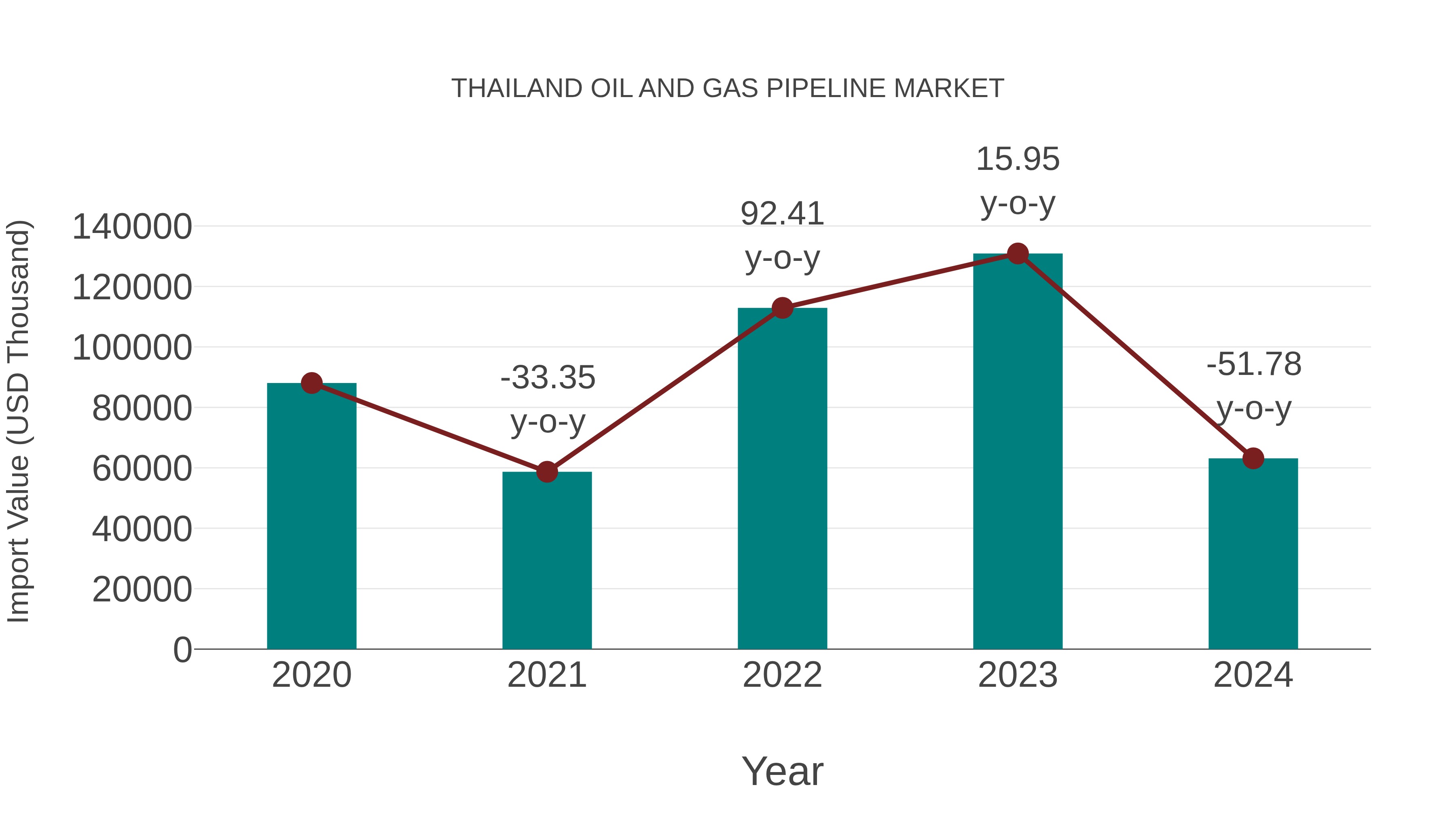
Thailand import trend for the oil and gas pipeline market experienced a notable decline from 2023 to 2024, with a growth rate of -51.78%. The compound annual growth rate (CAGR) for the period of 2020-2024 stood at -7.98%. This significant downturn could be attributed to shifts in demand dynamics or changes in trade policies impacting market stability.
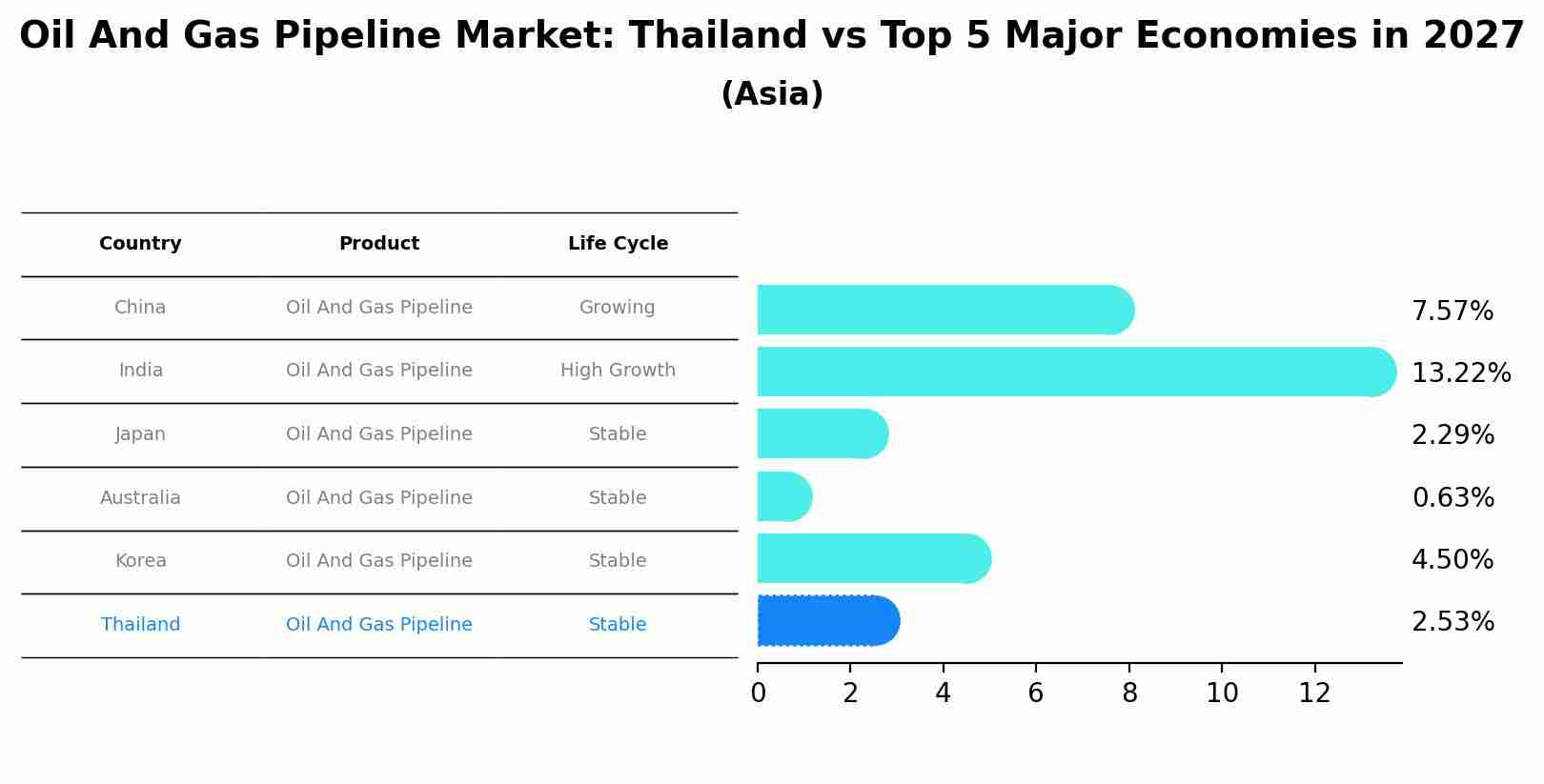
Oil And Gas Pipeline Market: Thailand vs Top 5 Major Economies in 2027 (Asia)
By 2027, Thailand's Oil And Gas Pipeline market is forecasted to achieve a stable growth rate of 2.53%, with China leading the Asia region, followed by India, Japan, Australia and South Korea.
Thailand Oil and Gas Pipeline Market Synopsis
The Thailand oil and gas pipeline market play a crucial role in the country`s energy infrastructure. Pipelines are the primary mode of transportation for crude oil and natural gas from production sites to refineries and distribution centers. The market has witnessed growth in tandem with Thailand expanding energy demands and its efforts to diversify energy sources. Key players in the industry are involved in the construction and maintenance of these pipelines, ensuring safe and efficient transportation of oil and gas resources. Additionally, the government`s initiatives to promote renewable energy sources may impact the market`s dynamics as the energy mix evolves over time.
Drivers of the Market
The Thailand oil and gas pipeline market are influenced by several factors, with energy demand and infrastructure development playing pivotal roles. The continuous growth of the Thai economy and urbanization has led to increased energy consumption, necessitating the expansion of oil and gas transportation infrastructure. The government`s focus on energy security and the promotion of renewable energy sources have also spurred investments in pipeline projects. Moreover, Thailand strategic location as a transportation hub in Southeast Asia has further driven the development of pipeline networks to facilitate the transit of oil and gas resources to neighboring countries. In addition to meeting domestic energy needs, the market is driven by the prospect of becoming a regional energy distribution center, which has attracted significant investments from both domestic and international players.
Challenges of the Market
The Thailand oil and gas pipeline market faces challenges related to safety, environmental concerns, and regulatory compliance. Pipeline operators must invest heavily in maintenance and monitoring to prevent leaks and ensure the integrity of their infrastructure. Additionally, global energy market fluctuations and geopolitical tensions can impact investment decisions and project timelines.
COVID-19 Impact on the Market
The Thailand oil and gas pipeline market faced challenges during the COVID-19 pandemic. The decrease in energy demand, coupled with disruptions in the oil and gas industry, impacted pipeline projects. Construction activities were delayed, and the market experienced a slowdown. As economic activities resumed and energy demand recovered, the market gradually regained momentum.
Key Players in the Market
Prominent companies in the Thailand oil and gas pipeline market include PTT Public Company Limited and SCG Chemicals Co., Ltd. These companies play significant roles in the construction and maintenance of oil and gas pipelines, supporting the energy sector in Thailand.
Key Highlights of the Report:
- Thailand Oil And Gas Pipeline Market Outlook
- Market Size of Thailand Oil And Gas Pipeline Market, 2025
- Forecast of Thailand Oil And Gas Pipeline Market, 2032
- Historical Data and Forecast of Thailand Oil And Gas Pipeline Revenues & Volume for the Period 2022-2032F
- Thailand Oil And Gas Pipeline Market Trend Evolution
- Thailand Oil And Gas Pipeline Market Drivers and Challenges
- Thailand Oil And Gas Pipeline Price Trends
- Thailand Oil And Gas Pipeline Porter's Five Forces
- Thailand Oil And Gas Pipeline Industry Life Cycle
- Historical Data and Forecast of Thailand Oil And Gas Pipeline Market Revenues & Volume By Location of Deployment for the Period 2022-2032F
- Historical Data and Forecast of Thailand Oil And Gas Pipeline Market Revenues & Volume By Onshore for the Period 2022-2032F
- Historical Data and Forecast of Thailand Oil And Gas Pipeline Market Revenues & Volume By Offshore for the Period 2022-2032F
- Historical Data and Forecast of Thailand Oil And Gas Pipeline Market Revenues & Volume By Type for the Period 2022-2032F
- Historical Data and Forecast of Thailand Oil And Gas Pipeline Market Revenues & Volume By Crude Oil Pipeline for the Period 2022-2032F
- Historical Data and Forecast of Thailand Oil And Gas Pipeline Market Revenues & Volume By Gas Pipeline for the Period 2022-2032F
- Thailand Oil And Gas Pipeline Import Export Trade Statistics
- Market Opportunity Assessment By Location of Deployment
- Market Opportunity Assessment By Type
- Thailand Oil And Gas Pipeline Top Companies Market Share
- Thailand Oil And Gas Pipeline Competitive Benchmarking By Technical and Operational Parameters
- Thailand Oil And Gas Pipeline Company Profiles
- Thailand Oil And Gas Pipeline Key Strategic Recommendations






































