Thailand Optical Microscopes Market: Import Trend Analysis
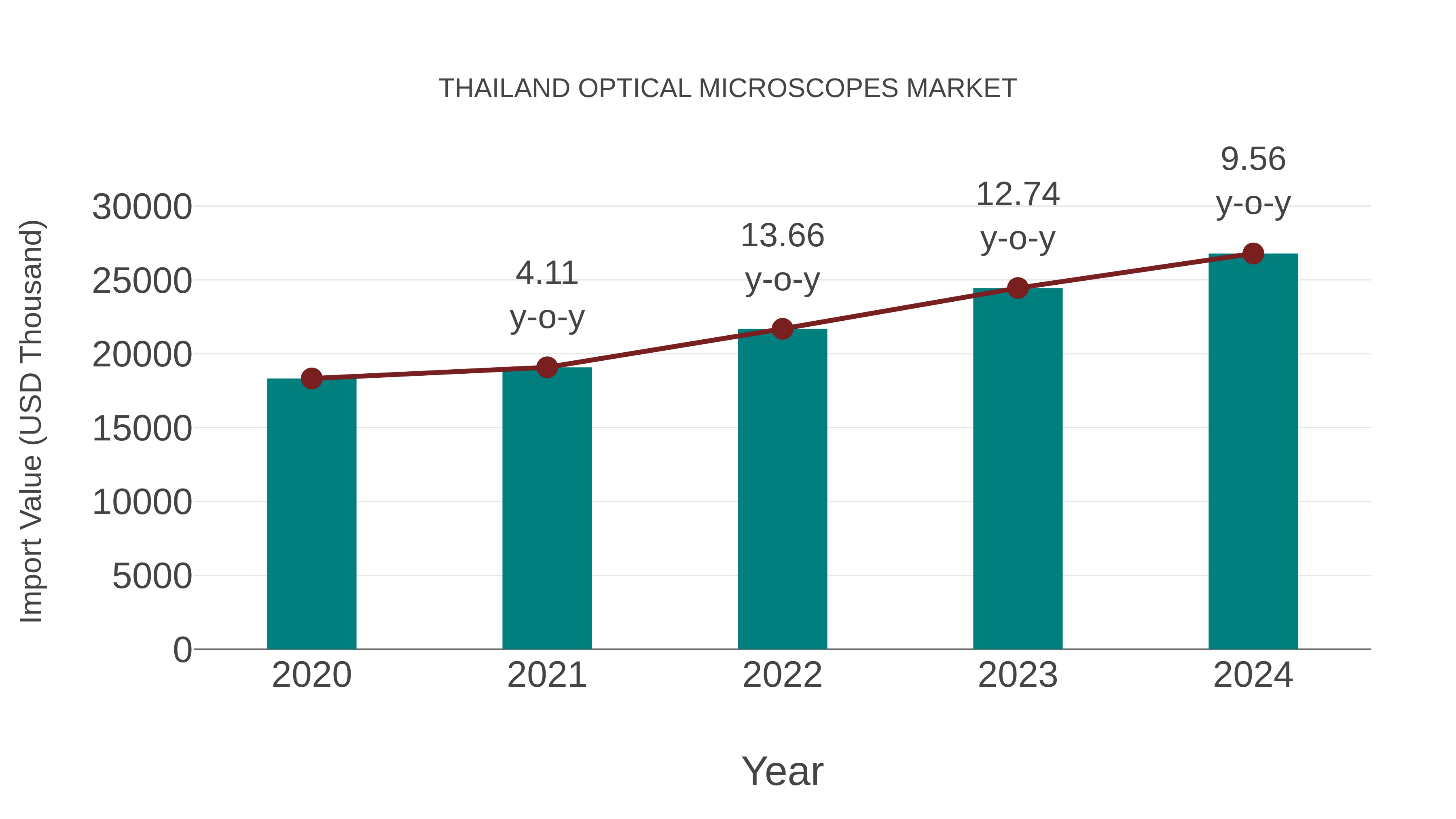
Thailand import trend for the optical microscopes market showed a significant growth rate of 9.56% from 2023 to 2024, with a compound annual growth rate (CAGR) of 9.95% for the period 2020-2024. This uptrend can be attributed to increasing demand for advanced scientific equipment in research institutions and healthcare facilities, indicating a positive market stability and sustained import momentum during the period.
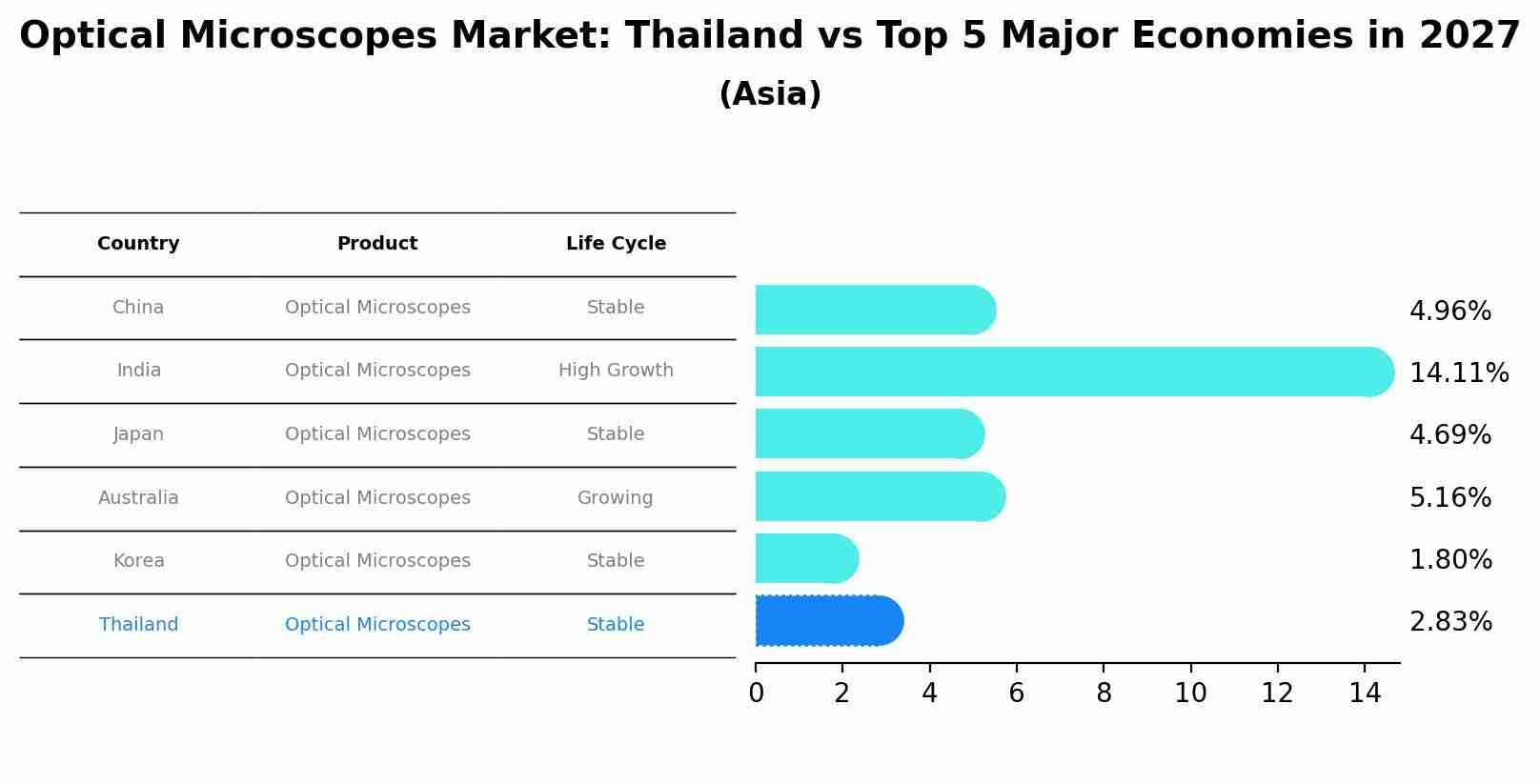
Optical Microscopes Market: Thailand vs Top 5 Major Economies in 2027 (Asia)
In the Asia region, the Optical Microscopes market in Thailand is projected to expand at a stable growth rate of 2.83% by 2027. The largest economy is China, followed by India, Japan, Australia and South Korea.
Thailand Optical Microscopes Market Synopsis
The Thailand Optical Microscopes Market is a key component of the country`s scientific research, education, and industrial sectors. Optical microscopes are essential tools for magnifying and analyzing tiny structures and specimens in fields such as biology, materials science, and electronics. This market encompasses a wide range of optical microscope types, from traditional light microscopes to advanced stereo and digital microscopes. With a growing focus on research and development, education, and quality control in various industries, the demand for optical microscopes in Thailand is increasing. The market includes both local and international manufacturers, offering a diverse range of optical microscopy solutions to cater to the specific needs of academic institutions, research laboratories, and industrial facilities.
Drivers of the Market
The Thailand optical microscopes market is flourishing due to its vital role in scientific research, education, and industrial applications. Academic institutions and research organizations are investing in advanced optical microscopes for various scientific studies. Industries such as healthcare and electronics depend on optical microscopes for quality control and precise inspection. Additionally, the continuous development of microscopy techniques and accessories is expanding the market`s scope. Increased government funding for research and development projects is also driving the adoption of optical microscopes, further propelling market growth.
Challenges of the Market
The optical microscopes market in Thailand confronts various challenges. Limited funding for research and education institutions can restrict the adoption of advanced optical microscopy equipment. Maintenance and servicing of complex microscopes can be expensive, leading to downtime for research facilities. The availability of skilled microscopy technicians and researchers is also crucial but often in short supply. Additionally, competition from alternative microscopy techniques, such as electron microscopy, can affect the demand for optical microscopes. Finally, the market`s growth may be influenced by fluctuations in government funding for scientific research.
COVID-19 Impact on the Market
The Thailand optical microscopes market witnessed a mixed impact from the COVID-19 pandemic. While academic and research institutions faced disruptions due to lockdowns and restrictions, there was an increased need for microscopes in the healthcare sector, particularly for diagnostic and research purposes related to the virus. This resulted in a surge in demand for certain types of optical microscopes. However, the overall market growth was tempered by the economic uncertainties caused by the pandemic.
Key Players in the Market
Thailand optical microscopes market includes significant players such as Nikon Corporation and Olympus Corporation. Nikon Corporation is recognized for its precision optical instruments, including microscopes used in research, healthcare, and industry. Olympus Corporation is known for its wide range of imaging and optical products, including cutting-edge microscopes.
Key Highlights of the Report:
- Thailand Optical Microscopes Market Outlook
- Market Size of Thailand Optical Microscopes Market, 2025
- Forecast of Thailand Optical Microscopes Market, 2032
- Historical Data and Forecast of Thailand Optical Microscopes Revenues & Volume for the Period 2022-2032F
- Thailand Optical Microscopes Market Trend Evolution
- Thailand Optical Microscopes Market Drivers and Challenges
- Thailand Optical Microscopes Price Trends
- Thailand Optical Microscopes Porter's Five Forces
- Thailand Optical Microscopes Industry Life Cycle
- Historical Data and Forecast of Thailand Optical Microscopes Market Revenues & Volume By Product for the Period 2022-2032F
- Historical Data and Forecast of Thailand Optical Microscopes Market Revenues & Volume By Digital Microscopes for the Period 2022-2032F
- Historical Data and Forecast of Thailand Optical Microscopes Market Revenues & Volume By Stereo Microscope for the Period 2022-2032F
- Historical Data and Forecast of Thailand Optical Microscopes Market Revenues & Volume By Inverted Microscopes for the Period 2022-2032F
- Historical Data and Forecast of Thailand Optical Microscopes Market Revenues & Volume By Other Products (Accessories, Software) for the Period 2022-2032F
- Historical Data and Forecast of Thailand Optical Microscopes Market Revenues & Volume By End User for the Period 2022-2032F
- Historical Data and Forecast of Thailand Optical Microscopes Market Revenues & Volume By Hospitals and Clinics for the Period 2022-2032F
- Historical Data and Forecast of Thailand Optical Microscopes Market Revenues & Volume By Academic and Research Institutes for the Period 2022-2032F
- Historical Data and Forecast of Thailand Optical Microscopes Market Revenues & Volume By Diagnostics Laboratories for the Period 2022-2032F
- Historical Data and Forecast of Thailand Optical Microscopes Market Revenues & Volume By Other End Users for the Period 2022-2032F
- Thailand Optical Microscopes Import Export Trade Statistics
- Market Opportunity Assessment By Product
- Market Opportunity Assessment By End User
- Thailand Optical Microscopes Top Companies Market Share
- Thailand Optical Microscopes Competitive Benchmarking By Technical and Operational Parameters
- Thailand Optical Microscopes Company Profiles
- Thailand Optical Microscopes Key Strategic Recommendations






































