Thailand Organic Cotton Market Size, Share & Growth Rate
The Thailand Organic Cotton Market was estimated at USD 250 Million in 2025 and is projected to reach USD 286 Million by 2032, growing at a CAGR of 1.9% from 2026 to 2032. This growth trajectory reflects a substantial shift in consumer preferences towards sustainable and organic textile options, spurred by heightened environmental awareness. As local farmers adopt organic practices, the supply chain is increasingly able to meet the rising demands for eco-friendly textiles, further bolstering market expansion.
Thailand Organic Cotton Market Year-wise Growth Rate and Key Drivers
This graph highlights how the Thailand Organic Cotton Market has steadily grown over the years, supported by major growth factors.
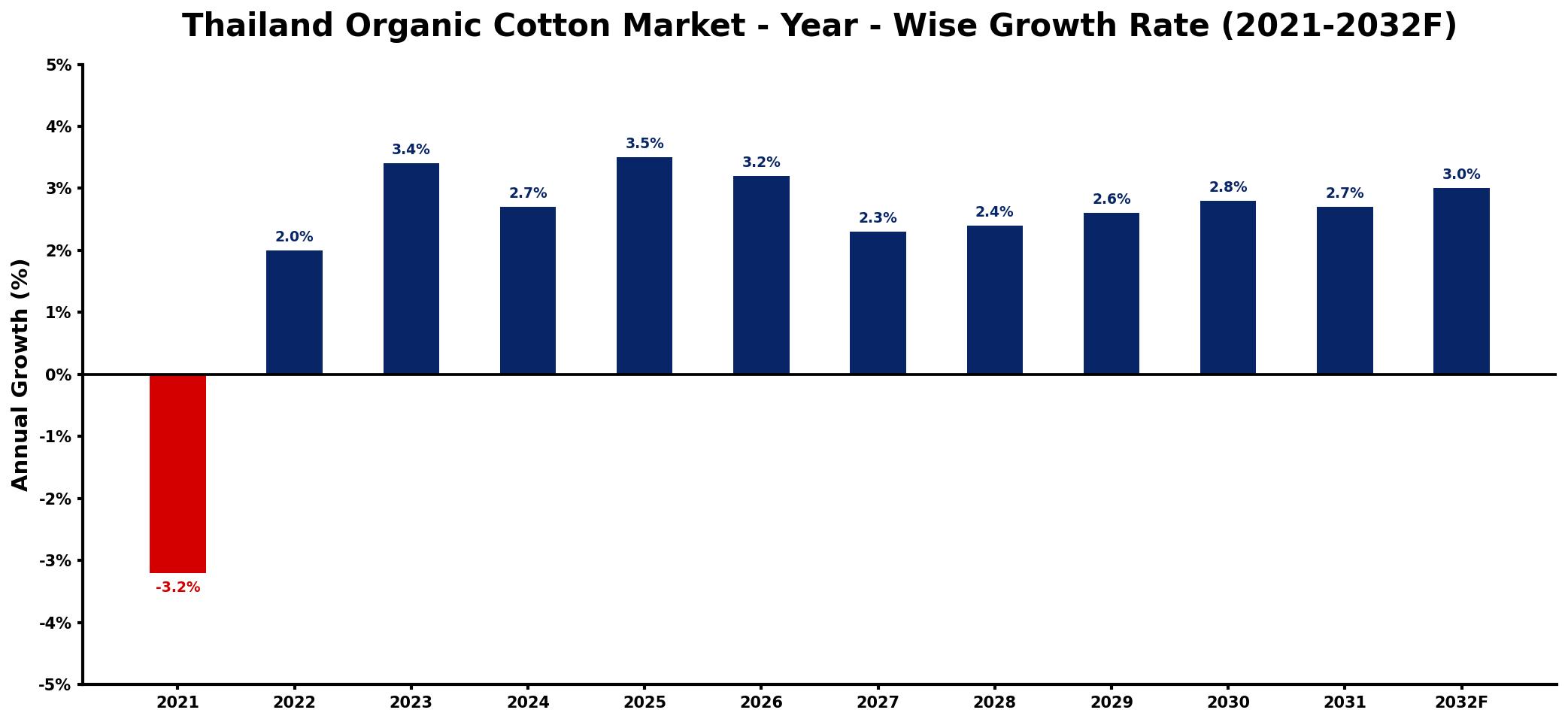
The table below presents the year‑wise growth rates along with the key drivers influencing the market
| Year | Growth Rate | Major Drivers |
| 2021 | -3.2% | Decreased consumer interest in sustainability |
| 2022 | 2.0% | Rise in eco-friendly fashion trends |
| 2023 | 3.4% | Growth in ethical consumerism movement |
| 2024 | 2.7% | Increasing retail support for sustainability |
| 2025 | 3.5% | Expansion of green textile initiatives |
| 2026 | 3.2% | Surge in sustainable agriculture practices |
| 2027 | 2.3% | Improved supply chain transparency efforts |
| 2028 | 2.4% | expanding healthcare application demand |
| 2029 | 2.6% | Increased investment in sustainable farming |
| 2030 | 2.8% | Rising demand for sustainable materials |
| 2031 | 2.7% | Enhanced consumer education on sustainability |
| 2032 | 3.0% | Strengthening global sustainability regulations |
Note: Market size estimations and growth projections presented in this report are based on 6Wresearch's proprietary forecasting methodology, utilizing the latest available industry data, government publications, and primary research inputs.
Thailand Organic Cotton Market Synopsis
The demand for organic cotton in Thailand is being driven by a notable increase in eco-conscious consumer behavior. Consumers are not only seeking sustainable options but are also willing to pay a premium for textiles that align with their values. This shift has prompted local farmers to explore organic farming as a viable alternative, which promises a brighter future for both agriculture and textile production.
Moreover, Thailands commitment to promoting sustainable agriculture enhances the appeal of organic cotton. Government initiatives focusing on environmental preservation and responsible farming practices are creating an enabling environment for the organic cotton sector to thrive.
Thailand Organic Cotton Market Key Takeaways
- Organic cotton is increasingly favored by consumers prioritizing sustainability in their textile choices.
- Thailand is leveraging its agricultural capabilities to enhance the production of organic cotton.
- The rise of eco-friendly practices among local farmers is transforming traditional cotton cultivation.
- Although challenges exist, the market exhibits resilience and potential for growth post-pandemic.
- Government support for sustainable agriculture is a key factor in boosting organic cotton adoption.
Evaluation of Restraints in Thailand Organic Cotton Market
Despite the positive outlook, the Thailand Organic Cotton Market faces significant constraints, primarily related to the scalability of organic farming practices. The labor-intensive nature of organic cotton cultivation presents a challenge, requiring a more substantial commitment of time and resources than conventional farming methods. This increased cost structure can elevate prices for end consumers, potentially limiting market growth. Additionally, maintaining organic certification and adhering to rigorous agricultural standards can create hurdles for small-scale farmers who may lack the necessary resources or knowledge. Addressing these issues is vital for sustaining the growth momentum in this market.
Thailand Organic Cotton Market Trends
The trend toward sustainability is reshaping the textile landscape, with organic cotton gaining traction among environmentally aware consumers. Brands are increasingly transparent about their sourcing practices, fostering a culture of sustainability that resonates with buyers. There is also a growing interest in innovative production techniques that enhance the quality and environmental footprint of organic cotton. Technologies that optimize water usage and minimize waste during cultivation are becoming integral to the sector, further driving demand for organic cotton products.
Thailand Organic Cotton Market Opportunities
There are significant growth and investment opportunities in the Thailand Organic Cotton Market, particularly in expanding production capabilities and supply chain efficiencies. As more consumers lean towards eco-friendly products, collaborations between farmers, manufacturers, and retailers can enhance distribution networks. Investments in marketing organic cotton products can also create awareness and stimulate demand. Additionally, exploring export opportunities to international markets can provide a vital avenue for growth, especially as global trends in sustainable textiles continue to expand.
Government Initiatives in the Thailand Organic Cotton Market
The Thai government has implemented various initiatives to promote sustainable agriculture, including subsidies for organic farming practices. These programs aim to support farmers transitioning to organic methods and enhancing their productivity. Additionally, awareness campaigns that educate consumers about the benefits of organic cotton are also being organized, positioning Thailand as a leader in the eco-friendly textile sector. Such initiatives are crucial for fostering a robust organic cotton market that aligns with national sustainability goals.
Future Insights of the Thailand Organic Cotton Market
Looking ahead to 2026-2032, the Thailand Organic Cotton Market is poised for steady growth driven by continuous consumer demand for sustainable textiles. As public awareness surrounding the environmental impacts of conventional agriculture intensifies, organic cotton is likely to gain further acceptance. The focus on enhancing production capabilities and supporting local farmers will play a pivotal role in this market's evolution. Additionally, collaborations between stakeholders across the value chain can strengthen the ecosystem, fostering innovations that align with consumer expectations.
Thailand Organic Cotton Market Latest Developments (2025 - 2026)
Recent developments within the Thailand Organic Cotton Market indicate a trend towards increasing partnerships between local farmers and textile manufacturers. These collaborations aim to enhance product traceability and ensure that organic cotton adheres to strict sustainability standards. Furthermore, educational workshops focusing on best practices in organic farming are being conducted, which empower farmers and improve yields. Innovations in eco-friendly dyeing processes are also emerging, aligning with the growing demand for sustainable production methods.
Thailand Organic Cotton Market - Key Attractiveness of the Report
- 10 Years of Market Numbers
- Historical Data Starting from 2022 to 2025
- Base Year: 2025
- Forecast Data until 2032
- Key Performance Indicators Impacting the Market
- Major Upcoming Developments and Projects
Key Highlights of the Report:
- Thailand Organic Cotton Market Outlook
- Market Size of Thailand Organic Cotton Market, 2025
- Forecast of Thailand Organic Cotton Market, 2032
- Historical Data and Forecast of Thailand Organic Cotton Revenues & Volume for the Period 2022-2032F
- Thailand Organic Cotton Market Trend Evolution
- Thailand Organic Cotton Market Drivers and Challenges
- Thailand Organic Cotton Price Trends
- Thailand Organic Cotton Porter's Five Forces
- Thailand Organic Cotton Industry Life Cycle
- Historical Data and Forecast of Thailand Organic Cotton Market Revenues & Volume By Type for the Period 2022-2032F
- Historical Data and Forecast of Thailand Organic Cotton Market Revenues & Volume By Long-Staple Cotton for the Period 2022-2032F
- Historical Data and Forecast of Thailand Organic Cotton Market Revenues & Volume By Short-Staple Cotton for the Period 2022-2032F
- Historical Data and Forecast of Thailand Organic Cotton Market Revenues & Volume By Middle Staple Cotton for the Period 2022-2032F
- Historical Data and Forecast of Thailand Organic Cotton Market Revenues & Volume By Extra-long Staple Cotton for the Period 2022-2032F
- Historical Data and Forecast of Thailand Organic Cotton Market Revenues & Volume By Others for the Period 2022-2032F
- Historical Data and Forecast of Thailand Organic Cotton Market Revenues & Volume By Quality Type for the Period 2022-2032F
- Historical Data and Forecast of Thailand Organic Cotton Market Revenues & Volume By Supima/Pima for the Period 2022-2032F
- Historical Data and Forecast of Thailand Organic Cotton Market Revenues & Volume By Upland for the Period 2022-2032F
- Historical Data and Forecast of Thailand Organic Cotton Market Revenues & Volume By Giza for the Period 2022-2032F
- Historical Data and Forecast of Thailand Organic Cotton Market Revenues & Volume By Others for the Period 2022-2032F
- Historical Data and Forecast of Thailand Organic Cotton Market Revenues & Volume By Application for the Period 2022-2032F
- Historical Data and Forecast of Thailand Organic Cotton Market Revenues & Volume By Apparel for the Period 2022-2032F
- Historical Data and Forecast of Thailand Organic Cotton Market Revenues & Volume By Packaging for the Period 2022-2032F
- Historical Data and Forecast of Thailand Organic Cotton Market Revenues & Volume By Others for the Period 2022-2032F
- Thailand Organic Cotton Import Export Trade Statistics
- Market Opportunity Assessment By Type
- Market Opportunity Assessment By Quality Type
- Market Opportunity Assessment By Application
- Thailand Organic Cotton Top Companies Market Share
- Thailand Organic Cotton Competitive Benchmarking By Technical and Operational Parameters
- Thailand Organic Cotton Company Profiles
- Thailand Organic Cotton Key Strategic Recommendations






































