Thailand Organic Fruits and Vegetables Market: Import Trend Analysis
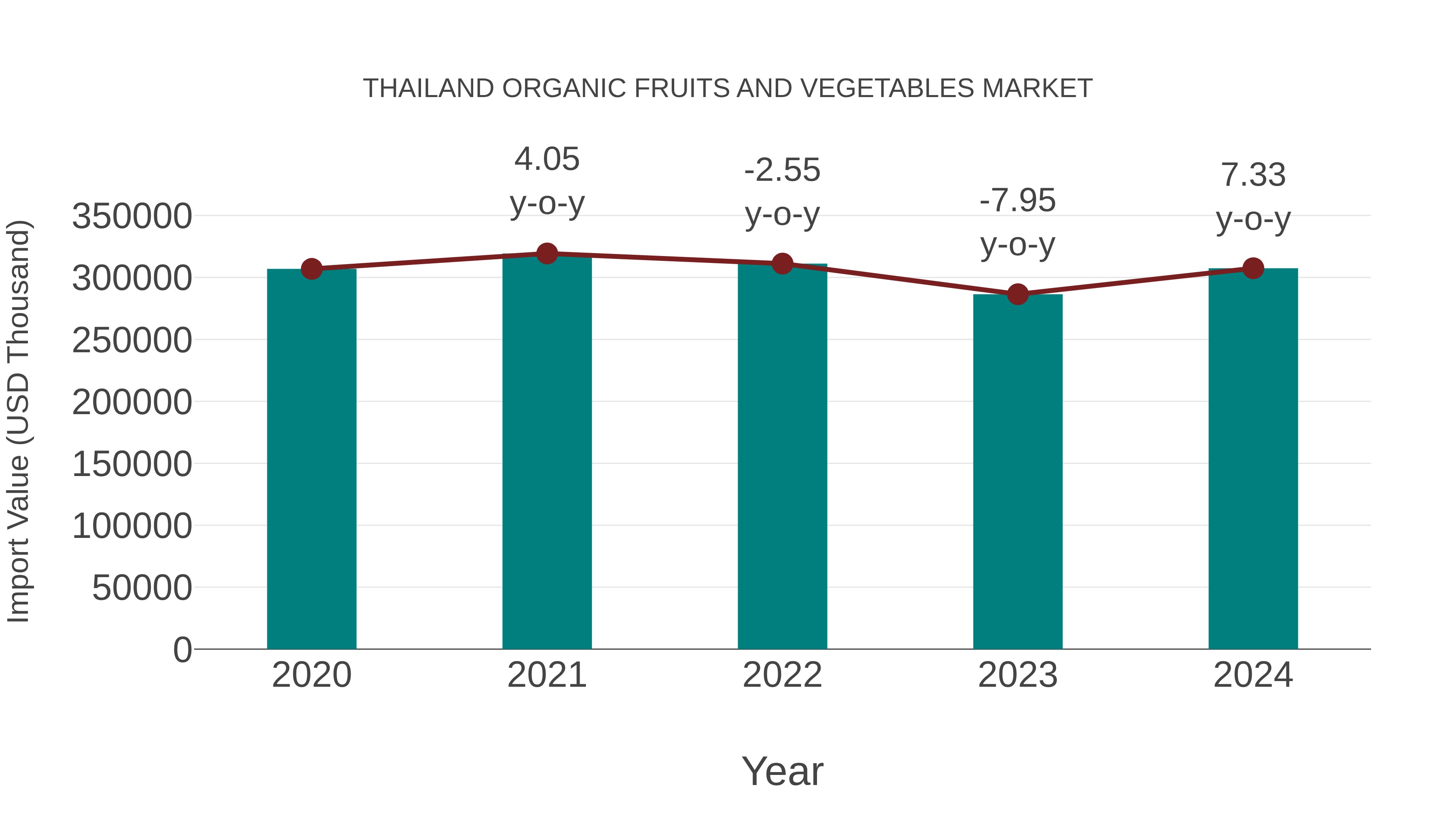
In the Thailand organic fruits and vegetables market, the import trend showed a growth rate of 7.33% from 2023 to 2024, with a compound annual growth rate (CAGR) of 0.04% between 2020 and 2024. This growth can be attributed to a noticeable shift in consumer demand towards healthier and organic food options, driving the import momentum for organic produce in Thailand.
Thailand Organic Fruits and Vegetables Market Synopsis
The Thailand organic fruits and vegetables market has seen substantial growth due to a shift in consumer preferences toward healthier and pesticide-free produce. Organic farming practices have gained popularity among local growers, resulting in an expanded range of organic fruits and vegetables available to consumers. Health-conscious individuals and environmentally aware consumers are driving the demand for organic produce, which is often perceived as a safer and more sustainable choice.
Drivers of the Market
The organic fruits and vegetables market in Thailand is witnessing substantial growth due to increasing consumer awareness of the health benefits associated with organic produce. Organic fruits and vegetables are perceived as free from pesticides and synthetic chemicals, making them a preferred choice among health-conscious consumers. Thailand tropical climate and fertile soil provide favorable conditions for organic farming, further propelling market growth. The demand for organic produce is also driven by the country`s thriving tourism industry, with tourists seeking fresh and healthy options. The government`s support for organic agriculture and certification standards ensures the quality and authenticity of organic fruits and vegetables, contributing to market expansion.
Challenges of the Market
The Thailand organic fruits and vegetables market encounters challenges associated with production scalability and distribution. Organic farming practices often yield lower crop volumes compared to conventional farming, making it difficult to meet growing consumer demand. Organic certifications and compliance with international organic standards can be demanding and costly for farmers. Distribution and logistics challenges, especially for perishable organic produce, also need to be addressed to ensure timely delivery to consumers and minimize food waste. Furthermore, the market faces competition from imported organic products, which can be cheaper due to economies of scale in larger producing countries.
COVID-19 Impact on the Market
The Thailand organic fruits and vegetables market experienced fluctuations during the COVID-19 pandemic. At the outset, panic buying and a focus on health-conscious eating led to a surge in demand for organic produce. However, organic farming faced disruptions in the supply chain, affecting the availability of organic fruits and vegetables in stores. Lockdowns and restrictions on movement also impacted the distribution to export markets. As the situation stabilized, consumers continued to show interest in organic options, especially for their health benefits. Organic farmers and retailers adapted by strengthening online sales channels and home delivery services. The market is expected to recover and continue its growth trajectory as consumer awareness of organic food`s health benefits remains high.
Key Players in the Market
The Thailand organic fruits and vegetables market have seen substantial growth, thanks to the efforts of leading players dedicated to organic farming practices. One notable company in this sector is Siam Organic, recognized for its organic rice and fruit products. Jiraporn Orchid Co., Ltd., is another key player known for its organic fruit production, including durian and mangosteen. Additionally, Siam Organic Fruits Co., Ltd., has a significant presence in the market, offering a variety of organic fruits and vegetables. These leading players have played vital roles in promoting organic agriculture in Thailand.
Key Highlights of the Report:
- Thailand Organic Fruits And Vegetables Market Outlook
- Market Size of Thailand Organic Fruits And Vegetables Market, 2025
- Forecast of Thailand Organic Fruits And Vegetables Market, 2032
- Historical Data and Forecast of Thailand Organic Fruits And Vegetables Revenues & Volume for the Period 2022-2032F
- Thailand Organic Fruits And Vegetables Market Trend Evolution
- Thailand Organic Fruits And Vegetables Market Drivers and Challenges
- Thailand Organic Fruits And Vegetables Price Trends
- Thailand Organic Fruits And Vegetables Porter's Five Forces
- Thailand Organic Fruits And Vegetables Industry Life Cycle
- Historical Data and Forecast of Thailand Organic Fruits And Vegetables Market Revenues & Volume By Product Type for the Period 2022-2032F
- Historical Data and Forecast of Thailand Organic Fruits And Vegetables Market Revenues & Volume By Organic Fruits for the Period 2022-2032F
- Historical Data and Forecast of Thailand Organic Fruits And Vegetables Market Revenues & Volume By Organic Vegetables for the Period 2022-2032F
- Historical Data and Forecast of Thailand Organic Fruits And Vegetables Market Revenues & Volume By Form for the Period 2022-2032F
- Historical Data and Forecast of Thailand Organic Fruits And Vegetables Market Revenues & Volume By Fresh for the Period 2022-2032F
- Historical Data and Forecast of Thailand Organic Fruits And Vegetables Market Revenues & Volume By Frozen for the Period 2022-2032F
- Historical Data and Forecast of Thailand Organic Fruits And Vegetables Market Revenues & Volume By End User for the Period 2022-2032F
- Historical Data and Forecast of Thailand Organic Fruits And Vegetables Market Revenues & Volume By Residential for the Period 2022-2032F
- Historical Data and Forecast of Thailand Organic Fruits And Vegetables Market Revenues & Volume By Commercial for the Period 2022-2032F
- Historical Data and Forecast of Thailand Organic Fruits And Vegetables Market Revenues & Volume By Distribution Channel for the Period 2022-2032F
- Historical Data and Forecast of Thailand Organic Fruits And Vegetables Market Revenues & Volume By Supermarket for the Period 2022-2032F
- Historical Data and Forecast of Thailand Organic Fruits And Vegetables Market Revenues & Volume By Hypermarket for the Period 2022-2032F
- Historical Data and Forecast of Thailand Organic Fruits And Vegetables Market Revenues & Volume By Convenience Store for the Period 2022-2032F
- Historical Data and Forecast of Thailand Organic Fruits And Vegetables Market Revenues & Volume By Online Sale Channel for the Period 2022-2032F
- Historical Data and Forecast of Thailand Organic Fruits And Vegetables Market Revenues & Volume By Others for the Period 2022-2032F
- Thailand Organic Fruits And Vegetables Import Export Trade Statistics
- Market Opportunity Assessment By Product Type
- Market Opportunity Assessment By Form
- Market Opportunity Assessment By End User
- Market Opportunity Assessment By Distribution Channel
- Thailand Organic Fruits And Vegetables Top Companies Market Share
- Thailand Organic Fruits And Vegetables Competitive Benchmarking By Technical and Operational Parameters
- Thailand Organic Fruits And Vegetables Company Profiles
- Thailand Organic Fruits And Vegetables Key Strategic Recommendations






































