Thailand Ornamental Fish Market Size, Share & Growth Rate
The Thailand Ornamental Fish Market was estimated at USD 125 Million in 2025 and is projected to reach USD 143 Million by 2032, growing at a CAGR of 1.9% from 2026 to 2032. This steady growth trajectory can be attributed to the countrys unmatched expertise in breeding and exporting a wide range of ornamental fish species. Additionally, the increasing global interest in home aquariums, alongside supportive government initiatives promoting sustainable practices, positions Thailand as a leader in the international ornamental fish trade.
Thailand Ornamental Fish Market Year-wise Growth Rate and Key Drivers
This graph highlights how the Thailand Ornamental Fish Market has steadily grown over the years, supported by major growth factors.
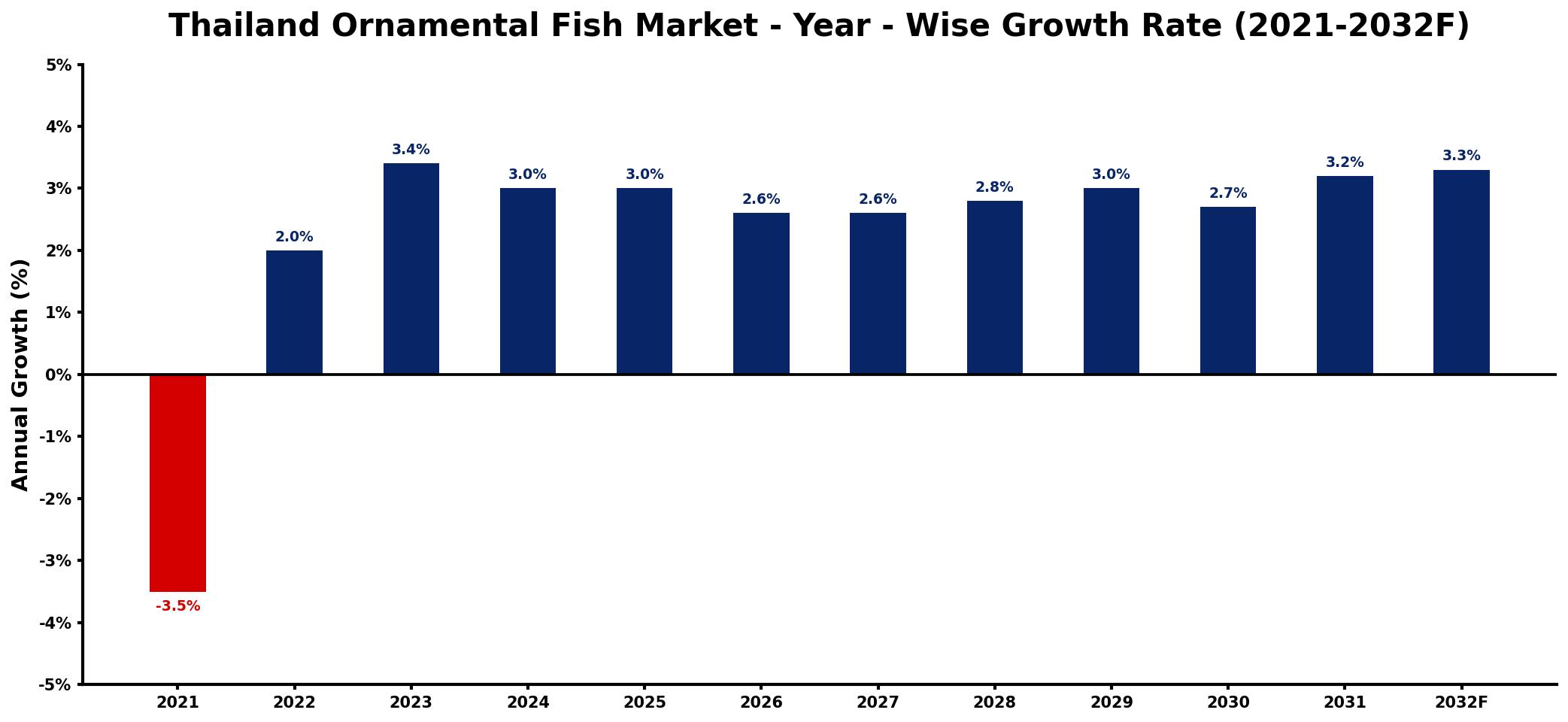
The table below presents the year‑wise growth rates along with the key drivers influencing the market
| Year | Growth Rate | Major Drivers |
| 2021 | -3.5% | decrease in consumer interest |
| 2022 | 2.0% | rise in home aquariums popularity |
| 2023 | 3.4% | increased online sales channels |
| 2024 | 3.0% | growth in pet ownership trends |
| 2025 | 3.0% | expansion of local breeding facilities |
| 2026 | 2.6% | enhanced marketing strategies adopted |
| 2027 | 2.6% | higher disposable income levels |
| 2028 | 2.8% | increased environmental sustainability focus |
| 2029 | 3.0% | growing commercial sector adoption |
| 2030 | 2.7% | rising interest in aquascaping |
| 2031 | 3.2% | improvement in supply chain efficiency |
| 2032 | 3.3% | increased capital investment inflows |
Note: Market size estimations and growth projections presented in this report are based on 6Wresearch's proprietary forecasting methodology, utilizing the latest available industry data, government publications, and primary research inputs.
Thailand Ornamental Fish Market Synopsis
The strongest force shaping the Thailand Ornamental Fish Market is its longstanding reputation for quality and diversity. Thai breeders have honed their skills over decades, ensuring that their fish not only meet but often exceed international standards, making them a preferred choice for aquarium enthusiasts worldwide.
Furthermore, the rise of online sales and e-commerce platforms has significantly expanded the reach of Thai ornamental fish, facilitating easier access to both domestic and international consumers. This dynamic shift in sales channels has opened new avenues for growth while also enhancing consumer engagement.
Thailand Ornamental Fish Market Key Takeaways
- The market is projected to grow steadily due to increasing global demand for ornamental fish.
- Thailand is renowned for its diverse and high-quality fish species, especially the Siamese fighting fish.
- Government initiatives have bolstered industry support through sustainable breeding practices.
- Digital transformation in sales channels is expanding market accessibility.
- Investment in breeding programs is key to maintaining competitive advantage in the market.
Evaluation of Restraints in Thailand Ornamental Fish Market
While the Thailand Ornamental Fish Market shows promising growth, several restraints impede its full potential. Regulatory challenges are significant; strict export regulations regarding certain species can hinder access to lucrative international markets. Additionally, competition from neighboring Southeast Asian countries poses a threat, often impacting market share. The need for strict compliance with international trade standards further complicates market dynamics. Adapting breeding programs to diversify species can help address these challenges and enhance Thailand's competitive position.
Thailand Ornamental Fish Market Trends
Current trends in the Thailand Ornamental Fish Market indicate a shift towards more sustainable practices and eco-friendly breeding methods. Consumers are increasingly seeking ethically sourced fish, prompting breeders to adopt environmentally responsible approaches. Moreover, advancements in technology, such as improved filtration systems and smart aquarium technologies, are enhancing the overall aquarium experience, driving consumer interest and fostering higher sales. The growing trend of aquascaping, where the art of aquarium design is taken to new heights, is also gaining traction, attracting more hobbyists.
Thailand Ornamental Fish Market Opportunities
Significant growth opportunities lie in the potential for product diversification and new species introduction. As international consumer preferences evolve, Thai breeders have the chance to expand their offerings with exotic species that capture market interest. Additionally, tapping into emerging markets, particularly in Asia and Europe, can provide new revenue streams. The increasing popularity of online sales platforms also presents an opportunity for Thai businesses to reach untapped customer bases more effectively, driving overall market growth.
Government Initiatives in the Thailand Ornamental Fish Market
The Thai government actively supports the ornamental fish industry through various initiatives aimed at sustainable growth. Policies promoting environmentally friendly breeding practices have been implemented to ensure the long-term viability of fish populations. Additionally, the government provides training programs for breeders to enhance their skills and knowledge regarding best practices. Export facilitation efforts, including reduced tariffs on ornamental fish shipments, are designed to boost Thailand's competitiveness in the global market.
Future Insights of the Thailand Ornamental Fish Market
Looking ahead to the period from 2026 to 2032, the Thailand Ornamental Fish Market is poised for gradual but robust growth. Enhanced international partnerships and a focus on high-quality breeding will reinforce Thailand's reputation as a market leader. The anticipated recovery from the effects of the COVID-19 pandemic will likely see a resurgence in demand, particularly as global travel resumes and consumer interest in aquarium ownership remains strong. Emphasis on innovative breeding technologies and expanded species varieties will further support sustained growth.
Thailand Ornamental Fish Market Latest Developments (2025 - 2026)
Recently, the ornamental fish sector in Thailand has seen a significant push towards digitalization, with more companies establishing robust online sales platforms to cater to a global audience. Additionally, various breeding farms are collaborating to share best practices and improve sustainability measures. Awareness campaigns promoting the benefits of aquarium ownership have also been launched, aligning with the growing trend of home-based hobbies that gained traction during the pandemic. These developments indicate a dynamic shift that positions the industry for future growth.
Thailand Ornamental Fish Market - Key Attractiveness of the Report
- 10 Years of Market Numbers
- Historical Data Starting from 2022 to 2025
- Base Year: 2025
- Forecast Data until 2032
- Key Performance Indicators Impacting the Market
- Major Upcoming Developments and Projects
Key Highlights of the Report:
- Thailand Ornamental Fish Market Outlook
- Market Size of Thailand Ornamental Fish Market, 2025
- Forecast of Thailand Ornamental Fish Market, 2032
- Historical Data and Forecast of Thailand Ornamental Fish Revenues & Volume for the Period 2022-2032F
- Thailand Ornamental Fish Market Trend Evolution
- Thailand Ornamental Fish Market Drivers and Challenges
- Thailand Ornamental Fish Price Trends
- Thailand Ornamental Fish Porter's Five Forces
- Thailand Ornamental Fish Industry Life Cycle
- Historical Data and Forecast of Thailand Ornamental Fish Market Revenues & Volume By Product for the Period 2022-2032F
- Historical Data and Forecast of Thailand Ornamental Fish Market Revenues & Volume By Tropical Freshwater for the Period 2022-2032F
- Historical Data and Forecast of Thailand Ornamental Fish Market Revenues & Volume By Temperate for the Period 2022-2032F
- Historical Data and Forecast of Thailand Ornamental Fish Market Revenues & Volume By Marine for the Period 2022-2032F
- Historical Data and Forecast of Thailand Ornamental Fish Market Revenues & Volume By Application for the Period 2022-2032F
- Historical Data and Forecast of Thailand Ornamental Fish Market Revenues & Volume By Commercial for the Period 2022-2032F
- Historical Data and Forecast of Thailand Ornamental Fish Market Revenues & Volume By Household for the Period 2022-2032F
- Thailand Ornamental Fish Import Export Trade Statistics
- Market Opportunity Assessment By Product
- Market Opportunity Assessment By Application
- Thailand Ornamental Fish Top Companies Market Share
- Thailand Ornamental Fish Competitive Benchmarking By Technical and Operational Parameters
- Thailand Ornamental Fish Company Profiles
- Thailand Ornamental Fish Key Strategic Recommendations






































