Thailand Passwordless Authentication Market Size & Growth Rate (2026-2032)
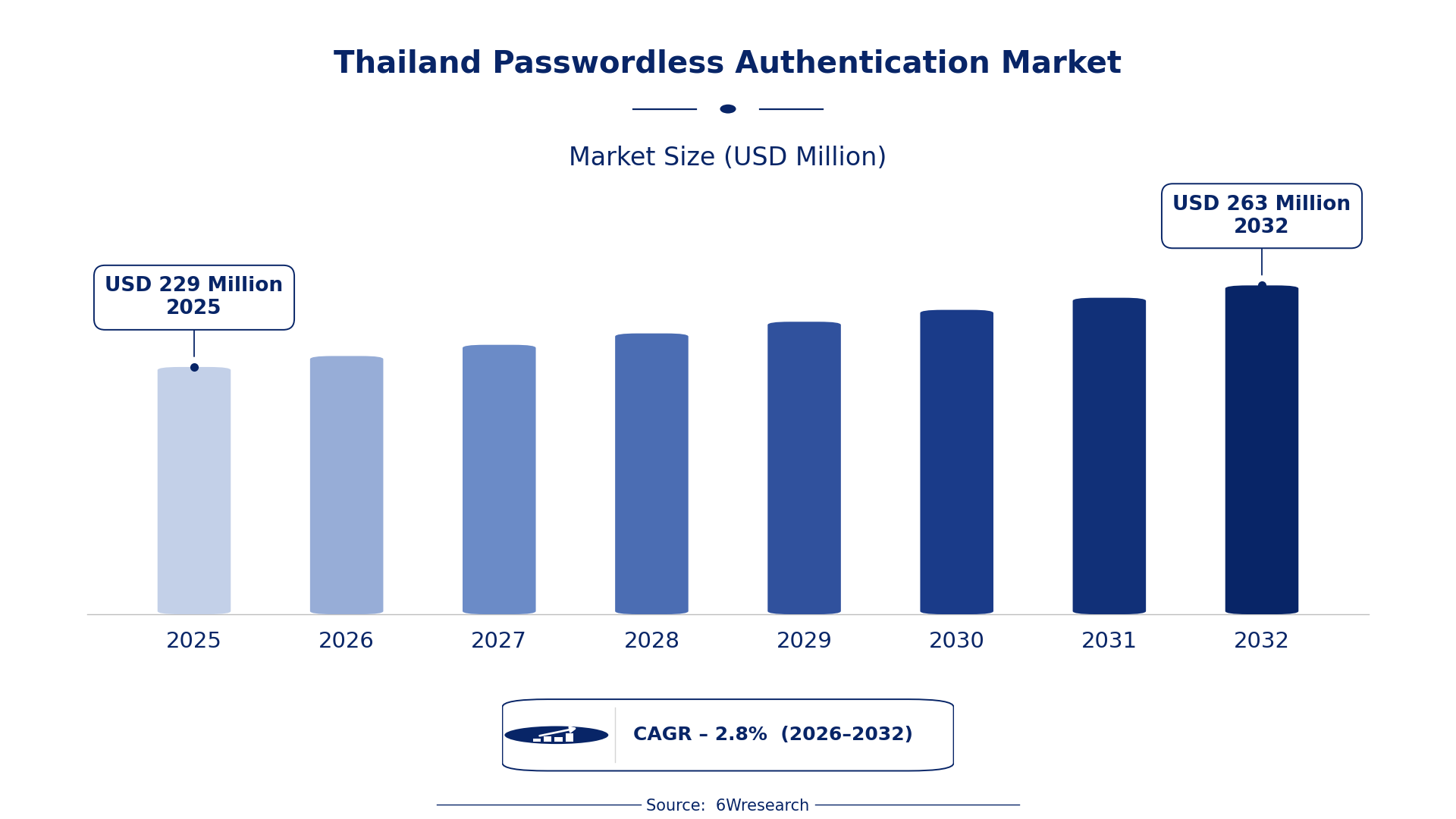
The Thailand Passwordless Authentication Market was estimated at USD 229 Million in 2025 and is projected to reach USD 263 Million by 2032, growing at a CAGR of 2.8% from 2026 to 2032.
Thailand Passwordless Authentication Market Synopsis
The Thailand Passwordless Authentication Market is currently experiencing a surge as businesses become increasingly aware of the security shortcomings associated with traditional password systems. As cyber threats grow in sophistication, organizations are transitioning towards passwordless solutions that promise enhanced security and improved user experiences.
Looking ahead, the demand for innovative authentication methods, such as biometrics and hardware tokens, is expected to accelerate. As organizations prioritize seamless access to digital services, passwordless authentication is set to become a cornerstone of cybersecurity strategies across Thailand.
Thailand Passwordless Authentication Market Year-wise Growth Rate and Key Drivers
This graph illustrates the annual growth rates of the Thailand Passwordless Authentication Market from 2021 to 2032, highlighting a steady upward trajectory and projected expansion over the forecast period.
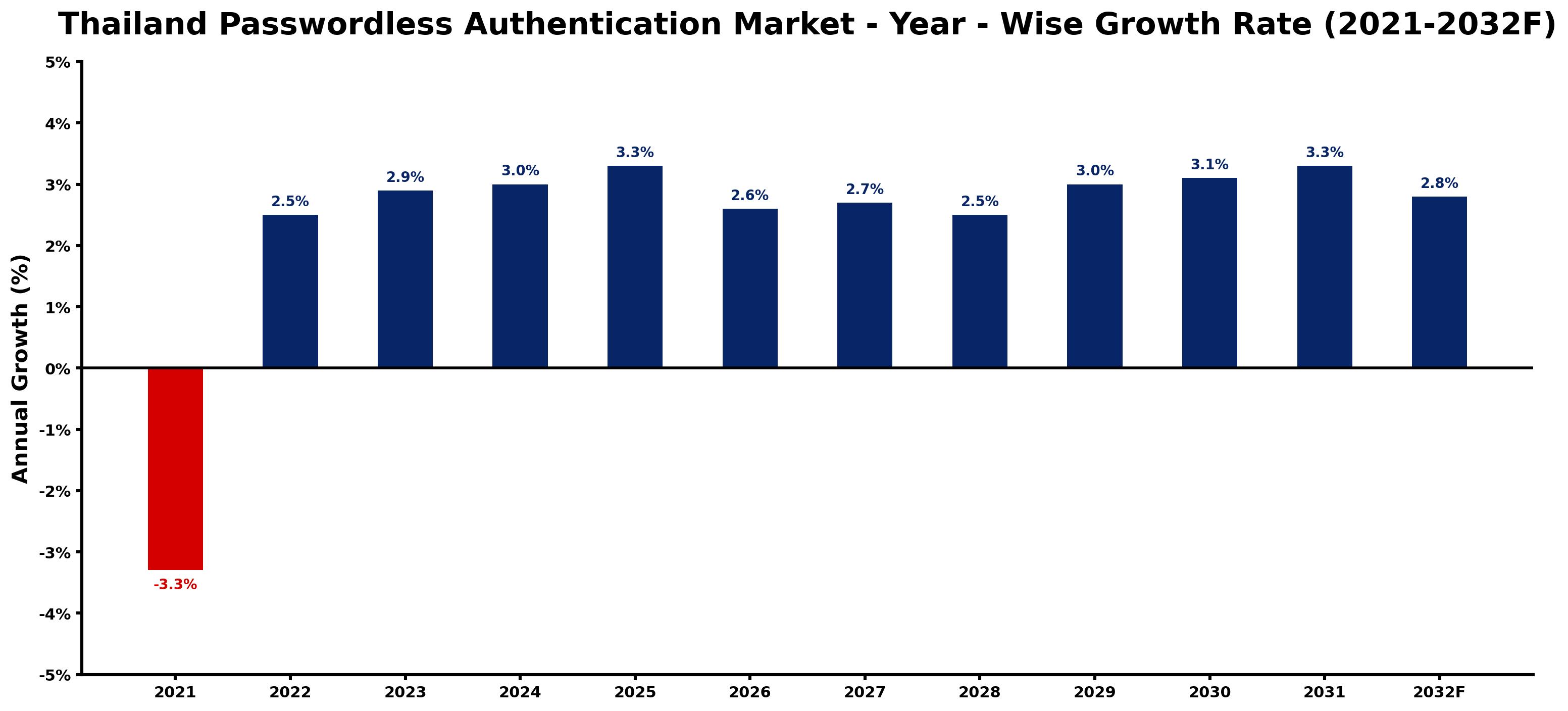
The table below presents the year‑wise growth rates along with the key drivers influencing the market
| Year | Growth Rate | Major Drivers |
| 2021 | -3.3% | Limited adoption due to traditional banking security practices. |
| 2022 | 2.5% | Thai government cybersecurity initiatives boost passwordless adoption. |
| 2023 | 2.9% | Rising e-commerce demands enhanced identity verification solutions. |
| 2024 | 3.0% | Growing concerns over online fraud drive security solutions. |
| 2025 | 3.3% | Increased smartphone penetration accelerates passwordless technology use. |
| 2026 | 2.6% | Financial sector mandates drive adoption of secure authentication. |
| 2027 | 2.7% | Digital transformation initiatives foster demand for seamless access. |
| 2028 | 2.5% | Education sector embraces passwordless solutions for remote learning. |
| 2029 | 3.0% | Regulatory push for stronger consumer data protection enhances market. |
| 2030 | 3.1% | Public sector digital services leverage passwordless technology growth. |
| 2031 | 3.3% | Corporate cybersecurity investments spur passwordless authentication strategies. |
| 2032 | 2.8% | Increased awareness of phishing threats drives market expansion. |
Note: Market size estimations and growth projections presented in this report are based on 6Wresearch's proprietary forecasting methodology, utilizing the latest available industry data, government publications, and primary research inputs.
Thailand Passwordless Authentication Market Key Takeaways
Below are some of the specific key takeaways from the market, including:
- The growing shift towards user-friendly authentication methods is driving market momentum.
- Biometrics and multi-factor authentication are leading the adoption of passwordless solutions.
- Organizational awareness of cybersecurity risks is propelling demand for robust authentication measures.
- Transitioning from traditional systems poses challenges, including user acceptance and interoperability.
- The COVID-19 pandemic highlighted the need for secure and convenient access solutions.
Evaluation of Restraints in Thailand Passwordless Authentication Market
A significant barrier to widespread adoption of passwordless authentication in Thailand remains the inertia associated with traditional password systems. Many organizations face internal resistance to change, as employees are often hesitant to abandon familiar password protocols. Furthermore, ensuring that new passwordless methods are scalable and compatible across various platforms presents a technological challenge. Overcoming these issues will require targeted education campaigns and partnerships between technology providers and end-users.
Thailand Passwordless Authentication Market Trends
Several notable trends are emerging within the Thailand Passwordless Authentication Market. One of the most significant trends is the rising integration of biometrics into authentication systems, such as fingerprint and facial recognition technologies. Additionally, organizations are increasingly adopting multi-factor authentication strategies that combine various passwordless methods, enhancing overall security. A noticeable push towards mobile-based authenticators is also gaining traction as businesses seek to streamline user access while maintaining high security standards.
Thailand Passwordless Authentication Market Opportunities
Opportunities abound for growth within the Thailand Passwordless Authentication Market as businesses seek more effective security measures. The continued expansion of digital services provides a fertile ground for passwordless solutions, especially in sectors like finance, healthcare, and e-commerce. Furthermore, as organizations prioritize user experience alongside security, there is ample room for innovation in authentication technologies, making this a promising area for investment.
Government Initiatives in the Thailand Passwordless Authentication Market
The government of Thailand is actively shaping the direction of the Passwordless Authentication Market through a series of initiatives aimed at enhancing cybersecurity across sectors. Public policy is increasingly focusing on upgrading digital infrastructure and encouraging businesses to adopt secure authentication methods. This proactive approach is essential in combating rising cyber threats and ensuring that Thailand's digital economy remains resilient.
- A recently completed initiative involved the launch of a national cybersecurity framework aimed at improving overall online safety across public and private sectors.
- Current efforts include an ongoing program to provide incentives for businesses that implement passwordless authentication solutions, fostering a shift away from traditional passwords.
- Upcoming initiatives include a planned public-private partnership aimed at developing a national standard for authentication technologies to enhance interoperability across platforms.
- Efforts are underway to educate the public about the benefits of passwordless authentication through government-led workshops and seminars.
- A regulatory body has been established to oversee the implementation of cybersecurity policies, with a focus on passwordless authentication compliance for digital service providers.
Future Insights of the Thailand Passwordless Authentication Market
Looking ahead to 2026-2032, the Thailand Passwordless Authentication Market is set to evolve significantly. As more organizations adopt these secure solutions, we expect to see a convergence of innovative technologies that enhance both security and user experience. With ongoing government support and an increasing focus on cybersecurity, the market is well-positioned for steady growth as businesses and consumers alike recognize the value of passwordless access.
Thailand Passwordless Authentication Market Latest Developments
Recent developments in the Thailand Passwordless Authentication Market indicate a vibrant movement towards adopting cutting-edge authentication solutions. Companies are rapidly enhancing their offerings to meet growing demand and ensure better security against cyber threats.
- A leading technology provider announced the rollout of a new biometric authentication system that began in early 2025 and has been integrated into several banking applications.
- A partnership formed between two major players in the industry is currently underway, focusing on developing multi-factor authentication solutions incorporating biometric and mobile-based systems.
- An initiative that started in late 2025 aims to upgrade government systems with passwordless authentication technologies, enhancing security for citizen services.
- A major regional operator is planning a new service launch in the second half of 2026 that will utilize advanced token-based authentication for enterprise clients.
- Research initiatives are currently ongoing to explore AI-driven passwordless solutions, with early results expected by mid-2026.
Thailand Passwordless Authentication Market - Key Attractiveness of the Report
- 10 Years of Market Numbers
- Historical Data Starting from 2022 to 2025
- Base Year: 2025
- Forecast Data until 2032
- Key Performance Indicators Impacting the Market
- Major Upcoming Developments and Projects
Key Highlights of the Report:
- Thailand Passwordless Authentication Market Outlook
- Market Size of Thailand Passwordless Authentication Market, 2025
- Forecast of Thailand Passwordless Authentication Market, 2032
- Historical Data and Forecast of Thailand Passwordless Authentication Revenues & Volume for the Period 2022-2032F
- Thailand Passwordless Authentication Market Trend Evolution
- Thailand Passwordless Authentication Market Drivers and Challenges
- Thailand Passwordless Authentication Price Trends
- Thailand Passwordless Authentication Porter's Five Forces
- Thailand Passwordless Authentication Industry Life Cycle
- Historical Data and Forecast of Thailand Passwordless Authentication Market Revenues & Volume By Offering for the Period 2022-2032F
- Historical Data and Forecast of Thailand Passwordless Authentication Market Revenues & Volume By Hardware for the Period 2022-2032F
- Historical Data and Forecast of Thailand Passwordless Authentication Market Revenues & Volume By Software for the Period 2022-2032F
- Historical Data and Forecast of Thailand Passwordless Authentication Market Revenues & Volume By Services for the Period 2022-2032F
- Historical Data and Forecast of Thailand Passwordless Authentication Market Revenues & Volume By Motility for the Period 2022-2032F
- Historical Data and Forecast of Thailand Passwordless Authentication Market Revenues & Volume By Fixed/Rack Mounted for the Period 2022-2032F
- Historical Data and Forecast of Thailand Passwordless Authentication Market Revenues & Volume By Mobile/Portable for the Period 2022-2032F
- Historical Data and Forecast of Thailand Passwordless Authentication Market Revenues & Volume By Authentication Type for the Period 2022-2032F
- Historical Data and Forecast of Thailand Passwordless Authentication Market Revenues & Volume By Single-factor for the Period 2022-2032F
- Historical Data and Forecast of Thailand Passwordless Authentication Market Revenues & Volume By Multi-factor for the Period 2022-2032F
- Historical Data and Forecast of Thailand Passwordless Authentication Market Revenues & Volume By End User for the Period 2022-2032F
- Historical Data and Forecast of Thailand Passwordless Authentication Market Revenues & Volume By BFSI for the Period 2022-2032F
- Historical Data and Forecast of Thailand Passwordless Authentication Market Revenues & Volume By IT and ITeS for the Period 2022-2032F
- Historical Data and Forecast of Thailand Passwordless Authentication Market Revenues & Volume By Government and Law Enforcement for the Period 2022-2032F
- Historical Data and Forecast of Thailand Passwordless Authentication Market Revenues & Volume By Healthcare for the Period 2022-2032F
- Historical Data and Forecast of Thailand Passwordless Authentication Market Revenues & Volume By Manufacturing for the Period 2022-2032F
- Historical Data and Forecast of Thailand Passwordless Authentication Market Revenues & Volume By Retail and Consumer Electronics for the Period 2022-2032F
- Historical Data and Forecast of Thailand Passwordless Authentication Market Revenues & Volume By Travel and Hospitality for the Period 2022-2032F
- Historical Data and Forecast of Thailand Passwordless Authentication Market Revenues & Volume By Other Verticals (Education; Energy and Utilities; Aerospace and Defense; Media and Entertainment; Online Gaming; and Transportation and Logistics) for the Period 2022-2032F
- Thailand Passwordless Authentication Import Export Trade Statistics
- Market Opportunity Assessment By Offering
- Market Opportunity Assessment By Motility
- Market Opportunity Assessment By Authentication Type
- Market Opportunity Assessment By End User
- Thailand Passwordless Authentication Top Companies Market Share
- Thailand Passwordless Authentication Competitive Benchmarking By Technical and Operational Parameters
- Thailand Passwordless Authentication Company Profiles
- Thailand Passwordless Authentication Key Strategic Recommendations






































