Thailand Perchloroethylene Market Size, Share & Growth Rate
The Thailand Perchloroethylene Market was estimated at USD 219 Million in 2025 and is projected to reach USD 250 Million by 2032, growing at a CAGR of 1.9% from 2026 to 2032. This growth trajectory is primarily fueled by the increasing demand from the manufacturing sector, particularly automotive and electronics. The dual forces of industrial expansion and the push for compliance with environmental regulations are shaping this market, paving the way for both opportunities and challenges.
Thailand Perchloroethylene Market Year-wise Growth Rate and Key Drivers
This graph highlights how the Thailand Perchloroethylene Market has steadily grown over the years, supported by major growth factors.
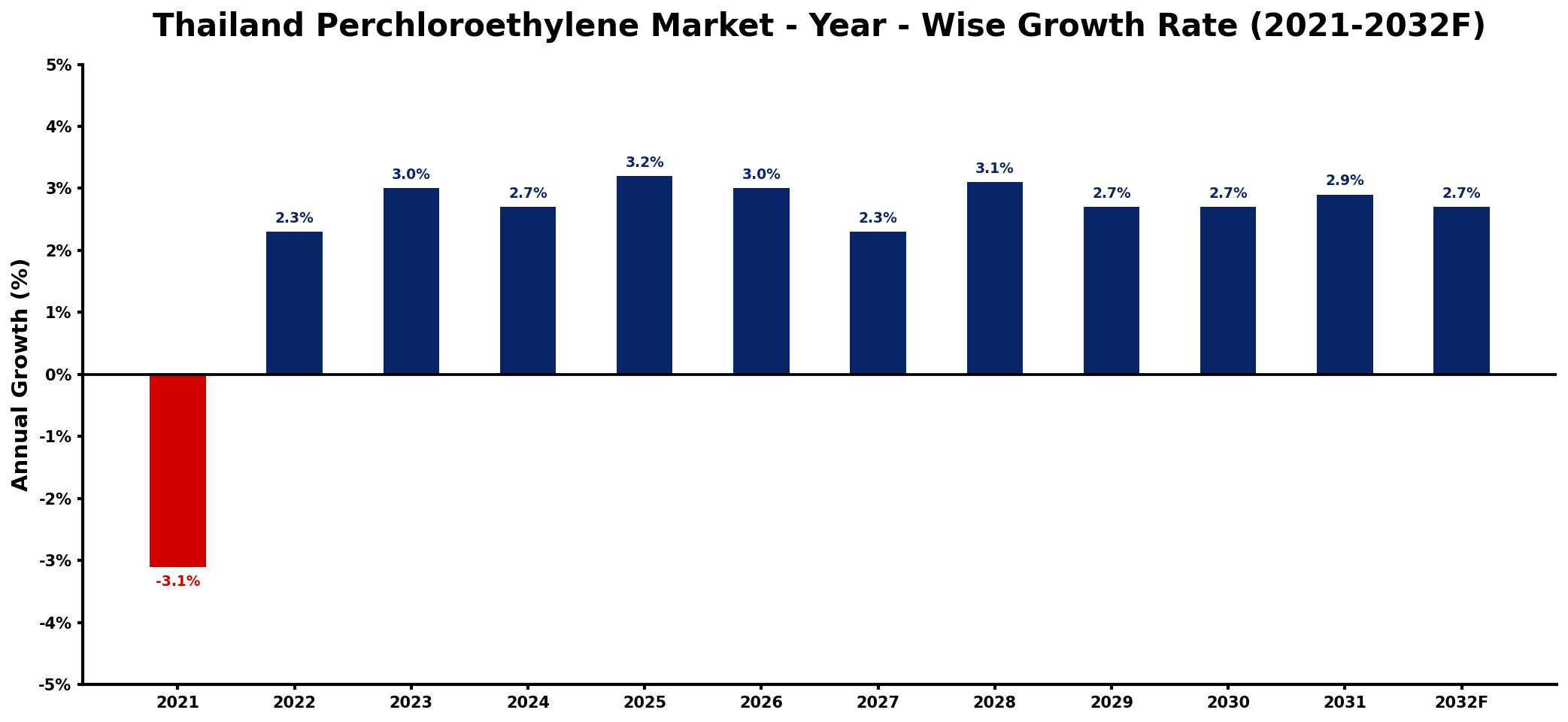
The table below presents the year‑wise growth rates along with the key drivers influencing the market
| Year | Growth Rate | Major Drivers |
| 2021 | -3.1% | Environmental regulations impact demand |
| 2022 | 2.3% | Rising industrial cleaning requirements |
| 2023 | 3.0% | Expansion in textile manufacturing sector |
| 2024 | 2.7% | Growth in automotive maintenance services |
| 2025 | 3.2% | Increased demand from electronics industry |
| 2026 | 3.0% | Surge in dry cleaning services |
| 2027 | 2.3% | Investments in chemical processing plants |
| 2028 | 3.1% | increased overall sector activity |
| 2029 | 2.7% | Rising awareness of solvent alternatives |
| 2030 | 2.7% | rising end-use demand growth |
| 2031 | 2.9% | Increased usage in metal degreasing |
| 2032 | 2.7% | growing automotive sector requirements |
Note: Market size estimations and growth projections presented in this report are based on 6Wresearch's proprietary forecasting methodology, utilizing the latest available industry data, government publications, and primary research inputs.
Thailand Perchloroethylene Market Synopsis
The current landscape of the Thailand perchloroethylene market is heavily influenced by the industrial sectors recovery and growth, especially in manufacturing. As Thailand solidifies its position as a manufacturing hub in Southeast Asia, the demand for perchloroethylene, mainly in dry cleaning and metal degreasing, remains robust, underscoring its critical role in various processes.
Furthermore, environmental regulations are increasingly urging industries to reconsider their reliance on perchloroethylene. This has led to a noticeable shift towards exploring alternative solvents and eco-friendly practices, reflecting a growing awareness of health and environmental impacts.
Thailand Perchloroethylene Market Key Takeaways
- The market is propelled by the thriving manufacturing sector, particularly automotive and electronics.
- Demand from dry cleaning and metal degreasing applications significantly influences market dynamics.
- Strict environmental regulations are driving a search for safer, more sustainable alternatives.
- Market growth remains sensitive to economic fluctuations affecting key user industries.
- Strategic investments in compliance and safety measures are becoming increasingly essential for market players.
Evaluation of Restraints in Thailand Perchloroethylene Market
Several restraints are influencing the Thailand perchloroethylene market, prominently environmental and regulatory pressures. As a volatile organic compound, perchloroethylene faces scrutiny regarding air quality and health risks, prompting stricter regulations. Businesses may find the costs associated with compliance burdensome, impacting their bottom line. Moreover, the market's dependence on sectors like dry cleaning, which can be sensitive to economic downturns, poses a risk to sustained growth. The increased focus on occupational safety also necessitates investment in protective measures, further complicating operational expenditures for companies reliant on perchloroethylene.
Thailand Perchloroethylene Market Trends
Current trends in the Thailand perchloroethylene market include a shift towards sustainable practices and the exploration of alternative solvents. Industries are becoming increasingly aware of the need to minimize environmental impact, prompting research and development for greener cleaning solutions. Additionally, advancements in technology, particularly in the automotive and electronics sectors, are driving innovative applications of perchloroethylene, enabling new efficiencies in cleaning and degreasing processes.
Thailand Perchloroethylene Market Opportunities
With the ongoing evolution of industry standards, there exist genuine opportunities for growth within the Thailand perchloroethylene market. The push for eco-friendly alternatives presents a chance for companies to innovate and differentiate themselves. Furthermore, expanding into sectors such as aerospace and electronics for specialized cleaning applications can broaden the market scope. Investments in greener technologies and practices not only align with regulatory trends but can also enhance brand reputation, potentially attracting a more diverse clientele.
Government Initiatives in the Thailand Perchloroethylene Market
The Thai government has implemented various initiatives aimed at reducing environmental impact and enhancing public health standards. These include stricter emissions regulations for volatile organic compounds and incentives for businesses that adopt cleaner technologies. Public funding for research into eco-friendly solvents has also increased, encouraging industries to transition towards sustainable practices. Such government initiatives are shaping the regulatory environment, influencing operational strategies within the perchloroethylene market.
Future Insights of the Thailand Perchloroethylene Market
Looking ahead to the years 2026-2032, the Thailand perchloroethylene market is likely to evolve significantly under the weight of regulatory changes and shifting consumer preferences. As industries seek to balance operational efficiency with environmental stewardship, the demand for perchloroethylene may stabilize while the exploration of alternatives gains momentum. Companies that proactively adapt to these changes will position themselves favorably in a market that increasingly values sustainability alongside performance.
Thailand Perchloroethylene Market Latest Developments (2025 - 2026)
Recent developments in the Thailand perchloroethylene market indicate a cautious optimism as industries gradually rebound post-pandemic. Innovations in eco-friendly cleaning agents are emerging, reflecting a growing focus on sustainability. Concurrently, theres a marked interest in diversifying applications for perchloroethylene, with increased research directed towards its utilization in high-tech industries. This pivot not only signifies an adaptation to market needs but also a commitment to improved environmental standards.
Thailand Perchloroethylene Market - Key Attractiveness of the Report
- 10 Years of Market Numbers
- Historical Data Starting from 2022 to 2025
- Base Year: 2025
- Forecast Data until 2032
- Key Performance Indicators Impacting the Market
- Major Upcoming Developments and Projects
Key Highlights of the Report:
- Thailand Perchloroethylene Market Outlook
- Market Size of Thailand Perchloroethylene Market, 2025
- Forecast of Thailand Perchloroethylene Market, 2032
- Historical Data and Forecast of Thailand Perchloroethylene Revenues & Volume for the Period 2022-2032F
- Thailand Perchloroethylene Market Trend Evolution
- Thailand Perchloroethylene Market Drivers and Challenges
- Thailand Perchloroethylene Price Trends
- Thailand Perchloroethylene Porter's Five Forces
- Thailand Perchloroethylene Industry Life Cycle
- Historical Data and Forecast of Thailand Perchloroethylene Market Revenues & Volume By Type for the Period 2022-2032F
- Historical Data and Forecast of Thailand Perchloroethylene Market Revenues & Volume By Ethylene Oxychlorination for the Period 2022-2032F
- Historical Data and Forecast of Thailand Perchloroethylene Market Revenues & Volume By Acetylene Method for the Period 2022-2032F
- Historical Data and Forecast of Thailand Perchloroethylene Market Revenues & Volume By Ethylene Direct Chlorination for the Period 2022-2032F
- Historical Data and Forecast of Thailand Perchloroethylene Market Revenues & Volume By End-use for the Period 2022-2032F
- Historical Data and Forecast of Thailand Perchloroethylene Market Revenues & Volume By Dry Cleaning Agent for the Period 2022-2032F
- Historical Data and Forecast of Thailand Perchloroethylene Market Revenues & Volume By Solvent for the Period 2022-2032F
- Historical Data and Forecast of Thailand Perchloroethylene Market Revenues & Volume By Others for the Period 2022-2032F
- Thailand Perchloroethylene Import Export Trade Statistics
- Market Opportunity Assessment By Type
- Market Opportunity Assessment By End-use
- Thailand Perchloroethylene Top Companies Market Share
- Thailand Perchloroethylene Competitive Benchmarking By Technical and Operational Parameters
- Thailand Perchloroethylene Company Profiles
- Thailand Perchloroethylene Key Strategic Recommendations






































