Thailand Personal Computers Market Size, Share & Growth Rate
The Thailand Personal Computers Market was estimated at USD 125 Million in 2025 and is projected to reach USD 143 Million by 2032, growing at a CAGR of 1.9% from 2026 to 2032. This anticipated growth is largely propelled by the increasing adoption of personal computers across various sectors, notably education and business, as organizations and students embrace technology for enhanced productivity and engagement. The urgency created by the pandemic has transformed consumer behavior, solidifying personal computers as essential tools in daily life.
Thailand Personal Computers Market Year-wise Growth Rate and Key Drivers
This graph highlights how the Thailand Personal Computers Market has steadily grown over the years, supported by major growth factors.
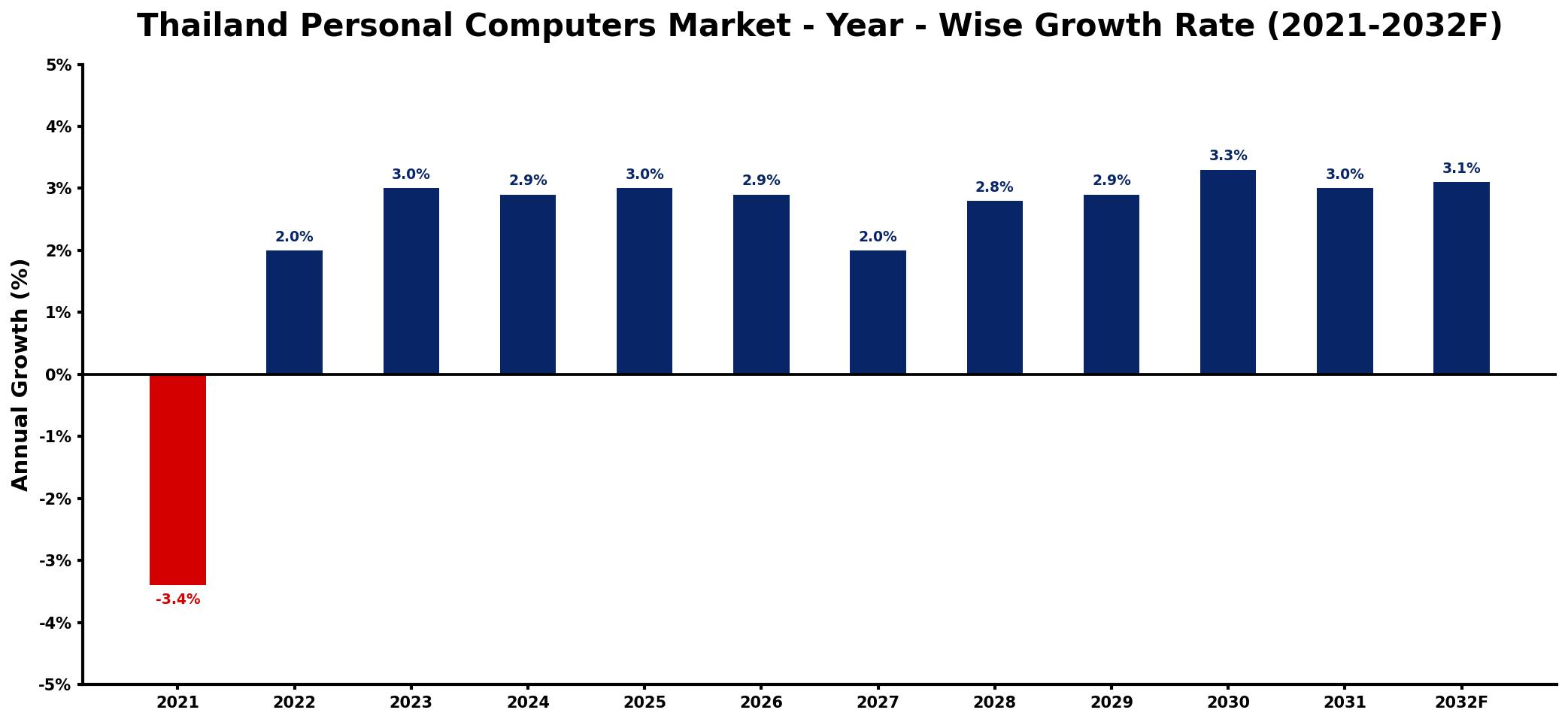
The table below presents the year‑wise growth rates along with the key drivers influencing the market
| Year | Growth Rate | Major Drivers |
| 2021 | -3.4% | decreased consumer technology spending |
| 2022 | 2.0% | rising demand for remote work |
| 2023 | 3.0% | growth in online education platforms |
| 2024 | 2.9% | increased investment in technology infrastructure |
| 2025 | 3.0% | expansion of digital entertainment services |
| 2026 | 2.9% | enhanced focus on cybersecurity solutions |
| 2027 | 2.0% | growing interest in cloud services |
| 2028 | 2.8% | advancements in gaming technologies |
| 2029 | 2.9% | increased adoption of smart devices |
| 2030 | 3.3% | surge in e-commerce activities |
| 2031 | 3.0% | rising end-use demand growth |
| 2032 | 3.1% | increased domestic production output |
Note: Market size estimations and growth projections presented in this report are based on 6Wresearch's proprietary forecasting methodology, utilizing the latest available industry data, government publications, and primary research inputs.
Thailand Personal Computers Market Synopsis
Following a surge in demand due to the COVID-19 pandemic, the Thailand Personal Computers Market now finds itself at a crossroads. While recent momentum has been characterized by heightened sales and innovation, future growth will hinge on adapting to evolving consumer preferences that increasingly lean towards mobile devices.
The market landscape is competitive, with a wide array of products catering to diverse user requirements. As technology continues to evolve, manufacturers must remain agile, offering compelling features and competitive pricing to capture the attention of a tech-savvy consumer base.
Thailand Personal Computers Market Key Takeaways
- Significant growth is expected from the educational sector as institutions increasingly integrate technology into curricula.
- The competitive landscape is fostering innovation, with brands focusing on affordability and performance enhancements.
- Consumer spending is rising due to increasing disposable incomes, driving demand for personal computers.
- Government initiatives aimed at promoting digitalization are creating a favorable environment for PC sales.
- The post-pandemic shift towards hybrid work models is likely to sustain demand for personal computers in the foreseeable future.
Evaluation of Restraints in Thailand Personal Computers Market
Despite the positive growth trajectory, the Thailand Personal Computers Market faces significant restraints. The rapid rise of mobile devices, such as smartphones and tablets, has shifted consumer preferences, making it challenging for traditional PCs to maintain their share. As more individuals opt for portability over performance, manufacturers are compelled to innovate or risk obsolescence. Additionally, fluctuating component prices, particularly for microchips, have the potential to disrupt supply chains and impact pricing strategies.
Thailand Personal Computers Market Trends
Several trends are shaping the Thailand Personal Computers Market. The emphasis on remote work and online education has fostered a demand for lightweight laptops and versatile devices that cater to both professional and educational needs. Furthermore, the integration of AI and cloud computing features is becoming a focal point for new product developments. Enhanced focus on gaming PCs and high-performance laptops reflects the growing interest in gaming as a mainstream form of entertainment, appealing particularly to younger consumers.
Thailand Personal Computers Market Opportunities
The market offers substantial opportunities for growth, particularly in the education sector. With schools and universities increasingly adopting technology-driven learning environments, there is a burgeoning demand for reliable and affordable personal computers tailored for students. Additionally, businesses are investing in upgrading their IT infrastructure, creating a demand for high-performance and customizable PCs. As digital transformation continues to be a priority, there exists a ripe opportunity for manufacturers to develop products that address specific business needs, such as security features and collaboration tools.
Government Initiatives in the Thailand Personal Computers Market
The Thai government has undertaken various initiatives aimed at enhancing digital literacy and technology adoption across the nation. Programs focused on promoting e-learning and tech integration in schools are paving the way for increased personal computer usage among students. Additionally, public spending on technology infrastructure is expected to rise, supporting the growth of the personal computers market. Efforts to encourage small and medium-sized enterprises to adopt digital tools further contribute to a positive outlook for the industry.
Future Insights of the Thailand Personal Computers Market
Looking ahead to 2026-2032, the Thailand Personal Computers Market is poised for stable growth driven by technological advancements and changing consumer behaviors. The integration of advanced features and eco-friendly designs will likely become increasingly important as consumers seek products that align with their values. Additionally, as remote work and hybrid education models become entrenched, the market will need to adapt, emphasizing flexibility and innovation to meet new demands.
Thailand Personal Computers Market Latest Developments (2025 - 2026)
In recent months, the Thailand Personal Computers Market has seen significant movement towards enhancing product offerings, particularly in lightweight and convertible designs. Many manufacturers are investing heavily in R&D to integrate AI-driven features that improve user experience. Initiatives to address component shortages are being prioritized, with some companies forming partnerships to secure stable supply chains. Consumer feedback is driving the evolution of ergonomic designs, while gaming PCs continue to gain traction with younger audiences.
Thailand Personal Computers Market - Key Attractiveness of the Report
- 10 Years of Market Numbers
- Historical Data Starting from 2022 to 2025
- Base Year: 2025
- Forecast Data until 2032
- Key Performance Indicators Impacting the Market
- Major Upcoming Developments and Projects
Key Highlights of the Report:
- Thailand Personal Computers Market Outlook
- Market Size of Thailand Personal Computers Market, 2025
- Forecast of Thailand Personal Computers Market, 2032
- Historical Data and Forecast of Thailand Personal Computers Revenues & Volume for the Period 2022-2032F
- Thailand Personal Computers Market Trend Evolution
- Thailand Personal Computers Market Drivers and Challenges
- Thailand Personal Computers Price Trends
- Thailand Personal Computers Porter's Five Forces
- Thailand Personal Computers Industry Life Cycle
- Historical Data and Forecast of Thailand Personal Computers Market Revenues & Volume By Product Type for the Period 2022-2032F
- Historical Data and Forecast of Thailand Personal Computers Market Revenues & Volume By Desktop for the Period 2022-2032F
- Historical Data and Forecast of Thailand Personal Computers Market Revenues & Volume By Notebook for the Period 2022-2032F
- Historical Data and Forecast of Thailand Personal Computers Market Revenues & Volume By Workstation for the Period 2022-2032F
- Historical Data and Forecast of Thailand Personal Computers Market Revenues & Volume By Others for the Period 2022-2032F
- Historical Data and Forecast of Thailand Personal Computers Market Revenues & Volume By Distribution Channel for the Period 2022-2032F
- Historical Data and Forecast of Thailand Personal Computers Market Revenues & Volume By Business-To-Business (B2B) for the Period 2022-2032F
- Historical Data and Forecast of Thailand Personal Computers Market Revenues & Volume By Business-To-Consumer (B2C) for the Period 2022-2032F
- Historical Data and Forecast of Thailand Personal Computers Market Revenues & Volume By Application for the Period 2022-2032F
- Historical Data and Forecast of Thailand Personal Computers Market Revenues & Volume By Consumer for the Period 2022-2032F
- Historical Data and Forecast of Thailand Personal Computers Market Revenues & Volume By Commercial for the Period 2022-2032F
- Historical Data and Forecast of Thailand Personal Computers Market Revenues & Volume By Industrial for the Period 2022-2032F
- Thailand Personal Computers Import Export Trade Statistics
- Market Opportunity Assessment By Product Type
- Market Opportunity Assessment By Distribution Channel
- Market Opportunity Assessment By Application
- Thailand Personal Computers Top Companies Market Share
- Thailand Personal Computers Competitive Benchmarking By Technical and Operational Parameters
- Thailand Personal Computers Company Profiles
- Thailand Personal Computers Key Strategic Recommendations






































