Thailand Pest Control Products Market Summary
The thailand pest control products market was estimated at USD 133 Million in 2025 and is projected to reach USD 152 Million by 2032, growing at a CAGR of 3.1% from 2026 to 2032.
Thailand Pest Control Products Market Year-wise Growth Rate and Key Drivers
This graph highlights how the Thailand Pest Control Products Market has steadily grown over the past five years, supported by major growth factors.
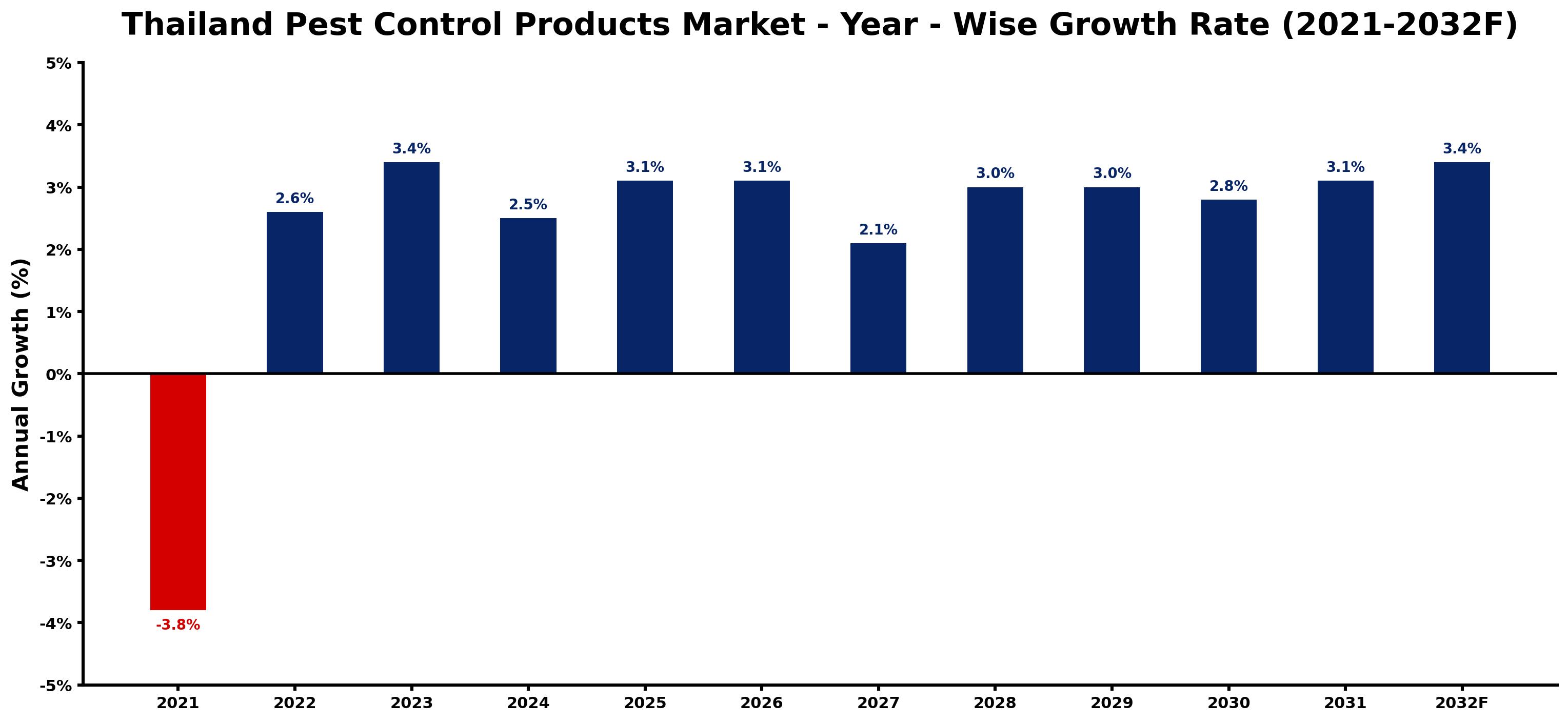
The table below presents the year wise growth rates along with the key drivers influencing the market
| Year | Growth Rate | Major Drivers |
| 2021 | -3.8% | Heightened environmental concerns led to stricter regulations, limiting the use of chemical pest control solutions. |
| 2022 | 2.6% | Urban migration intensified pest issues, driving demand for effective pest control solutions. |
| 2023 | 3.4% | E-commerce platforms emerged, facilitating easier access to pest control products for consumers. |
| 2024 | 2.5% | Local manufacturers began tailoring products to meet specific pest challenges in tropical climates. |
| 2025 | 3.1% | Increased tourism spurred hotel industry investments in pest management and prevention strategies. |
| 2026 | 3.1% | Integrated pest management practices gained traction among agriculture-focused businesses and farms. |
| 2027 | 2.1% | Rising awareness around environmental impact led to a shift towards organic pest control options. |
| 2028 | 3.0% | Smart technology and IoT applications in pest control attracted tech-savvy urban consumers. |
| 2029 | 3.0% | Collaborations between pest control companies and real estate developers enhanced service offerings. |
| 2030 | 2.8% | Emerging health trends emphasized pest-free environments, creating a broader consumer base. |
| 2031 | 3.1% | Regulatory changes encouraged sustainable pest control practices among manufacturers and service providers. |
| 2032 | 3.4% | Continuous innovation in formulations and delivery methods catered to evolving consumer preferences. |
Note - Market size estimations and growth projections presented in this report are based on 6Wresearch's advanced forecasting approach, validated with industry datasets as of June 2026.
Thailand Pest Control Products Market Synopsis
The Thailand Pest Control Products Market is projected to reach 3.1% and witness significant growth during the forecast period (2026-2032). This expansion is fueled by a multitude of factors that underscore the increasing importance of effective pest management strategies among both agricultural producers and urban consumers. Notably, the market is anticipated to grow at a compound annual growth rate (CAGR) of 6.5% during this forecast period, reflecting the ongoing evolution of pest control practices and the escalation of demand across various sectors.
Thailand Pest Control Products Market Growth Drivers
Several key drivers are propelling the growth of the Thailand Pest Control Products Market. First and foremost, heightened investment from the government into the agricultural sector has been pivotal. This investment encompasses various support mechanisms aimed at enhancing agricultural productivity, thereby stimulating demand for pest control solutions. Enhanced public awareness regarding hygiene and pest-related health hazards further complements this growth, as consumers increasingly seek to maintain pest-free environments.
- The rapid urbanization occurring in Thailand leads to increased demand for pest control services as cities expand, creating more opportunities for pest infestations. Urban dwellers are more conscious of pest management due to the close proximity of living spaces and common areas.
- The food and beverage industry, a significant consumer of pest control products, is experiencing robust growth. This sector's stringent regulations concerning pest management directly contribute to an increased reliance on pest control solutions to maintain safety and compliance.
- The adoption of Integrated Pest Management (IPM) techniques is gaining momentum. Farmers are becoming more aware of the detrimental effects of chemical pesticides, leading to the implementation of sustainable practices that include biological controls and natural pest deterrents.
- Increased consumer awareness about the health effects of pests, particularly in residential areas, spurs the demand for pest control products. The desire for improved sanitary conditions further amplifies this demand.
- Rising environmental concerns among consumers are driving the search for eco-friendly pest control solutions, allowing for the growth of products that are perceived as safer for both human health and the environment.
Thailand Pest Control Products Market Challenges and Restraints
Despite its growth trajectory, the Thailand Pest Control Products Market faces several challenges that could impact its potential. A principal issue is the proliferation of counterfeit products, which are often sold at lower prices than their legitimate counterparts. This situation undermines consumer trust and complicates quality assurance for genuine brands.
- Counterfeit products can lead to ineffective pest control solutions, which not only dissuades consumers from investing in legitimate products but also poses risks to health and safety.
- The COVID-19 pandemic has introduced new challenges, disrupting supply chains and impacting the availability of pest control products. Many retailers faced closures, affecting consumer access to essential pest management solutions.
- The economic fallout from the pandemic has resulted in decreased spending power for some consumers, potentially limiting their ability to invest in pest control services and products.
- Regulatory complexities and the need for compliance with local and international standards can complicate market entry for new players and hinder innovation in product development.
- The industry's reliance on traditional chemical methods poses health risks associated with misuse, leading to a gradual shift towards safer, alternative pest management techniques that may not yet be widely adopted.
Thailand Pest Control Products Market Government Investment and Initiatives
The role of the Thai government in supporting the pest control products market cannot be overstated. Government initiatives aimed at promoting agricultural productivity include crop insurance schemes and subsidies for pesticide purchases, which enhance farmers' financial capabilities to engage in pest management practices. Additionally, investments in research and development for sustainable pest control methods are paramount, as they align with global trends toward eco-friendly agricultural practices.
- National policies increasingly emphasize Integrated Pest Management (IPM), encouraging the use of diverse pest control methods that reduce reliance on chemical pesticides.
- Public awareness campaigns funded by the government focus on educating farmers and consumers about pest control risks, further driving the market's growth.
- The government has also established partnerships with international organizations to enhance pest control practices through knowledge transfer and resource sharing.
- Investment in infrastructure aimed at strengthening agricultural practices creates indirect opportunities for pest control products, as improved farming capabilities facilitate the need for effective pest management.
- Efforts to standardize pesticide registration processes are in place, making it easier for legitimate products to enter the market and ensuring safety and efficacy for consumers.
Thailand Pest Control Products Market Latest Developments (May 2025 - June 2026)
Recent developments in the Thailand Pest Control Products Market indicate a shift towards more sustainable practices as industry stakeholders adapt to changing consumer preferences and regulatory requirements. Growing emphasis on environmental sustainability is prompting manufacturers to invest in research and development of eco-friendly pest control solutions.
- New product launches focused on biopesticides and organic pest control solutions are gaining traction as consumers show preference for safer alternatives.
- Companies are increasingly implementing advanced technologies, such as smart pest control devices, to enhance service delivery and efficacy.
- Strategic partnerships between agricultural stakeholders and pest control firms are becoming more common, facilitating the exchange of knowledge and resources that benefit farmers.
- Educational initiatives for farmers regarding IPM practices have been initiated, illustrating a commitment to fostering sustainable pest management protocols.
- The market is witnessing a trend towards integrated solutions that combine pest control with broader agricultural management strategies, enhancing efficiency and effectiveness.
Thailand Pest Control Products Market - Key Attractiveness of the Report
- 10 Years of Market Numbers
- Historical Data Starting from 2022 to 2025
- Base Year: 2025
- Forecast Data until 2032
- Key Performance Indicators Impacting the Market
- Major Upcoming Developments and Projects
Key Highlights of the Report:
- Thailand Pest Control Products Market Outlook
- Market Size of Thailand Pest Control Products Market, 2025
- Forecast of Thailand Pest Control Products Market, 2032
- Historical Data and Forecast of Thailand Pest Control Products Revenues & Volume for the Period 2022-2032F
- Thailand Pest Control Products Market Trend Evolution
- Thailand Pest Control Products Market Drivers and Challenges
- Thailand Pest Control Products Price Trends
- Thailand Pest Control Products Porter's Five Forces
- Thailand Pest Control Products Industry Life Cycle
- Historical Data and Forecast of Thailand Pest Control Products Market Revenues & Volume By Type for the Period 2022-2032F
- Historical Data and Forecast of Thailand Pest Control Products Market Revenues & Volume By Chemical for the Period 2022-2032F
- Historical Data and Forecast of Thailand Pest Control Products Market Revenues & Volume By Mechanical for the Period 2022-2032F
- Historical Data and Forecast of Thailand Pest Control Products Market Revenues & Volume By Biological for the Period 2022-2032F
- Historical Data and Forecast of Thailand Pest Control Products Market Revenues & Volume By Others for the Period 2022-2032F
- Historical Data and Forecast of Thailand Pest Control Products Market Revenues & Volume By Pest type for the Period 2022-2032F
- Historical Data and Forecast of Thailand Pest Control Products Market Revenues & Volume By Insects for the Period 2022-2032F
- Historical Data and Forecast of Thailand Pest Control Products Market Revenues & Volume By Termites for the Period 2022-2032F
- Historical Data and Forecast of Thailand Pest Control Products Market Revenues & Volume By Rodents for the Period 2022-2032F
- Historical Data and Forecast of Thailand Pest Control Products Market Revenues & Volume By Others for the Period 2022-2032F
- Historical Data and Forecast of Thailand Pest Control Products Market Revenues & Volume By Application for the Period 2022-2032F
- Historical Data and Forecast of Thailand Pest Control Products Market Revenues & Volume By Commercial for the Period 2022-2032F
- Historical Data and Forecast of Thailand Pest Control Products Market Revenues & Volume By Residential for the Period 2022-2032F
- Historical Data and Forecast of Thailand Pest Control Products Market Revenues & Volume By Agriculture for the Period 2022-2032F
- Historical Data and Forecast of Thailand Pest Control Products Market Revenues & Volume By Industrial for the Period 2022-2032F
- Historical Data and Forecast of Thailand Pest Control Products Market Revenues & Volume By Others for the Period 2022-2032F
- Thailand Pest Control Products Import Export Trade Statistics
- Market Opportunity Assessment By Type
- Market Opportunity Assessment By Pest type
- Market Opportunity Assessment By Application
- Thailand Pest Control Products Top Companies Market Share
- Thailand Pest Control Products Competitive Benchmarking By Technical and Operational Parameters
- Thailand Pest Control Products Company Profiles
- Thailand Pest Control Products Key Strategic Recommendations






































