Thailand Petroleum Refining Products Market: Import Trend Analysis
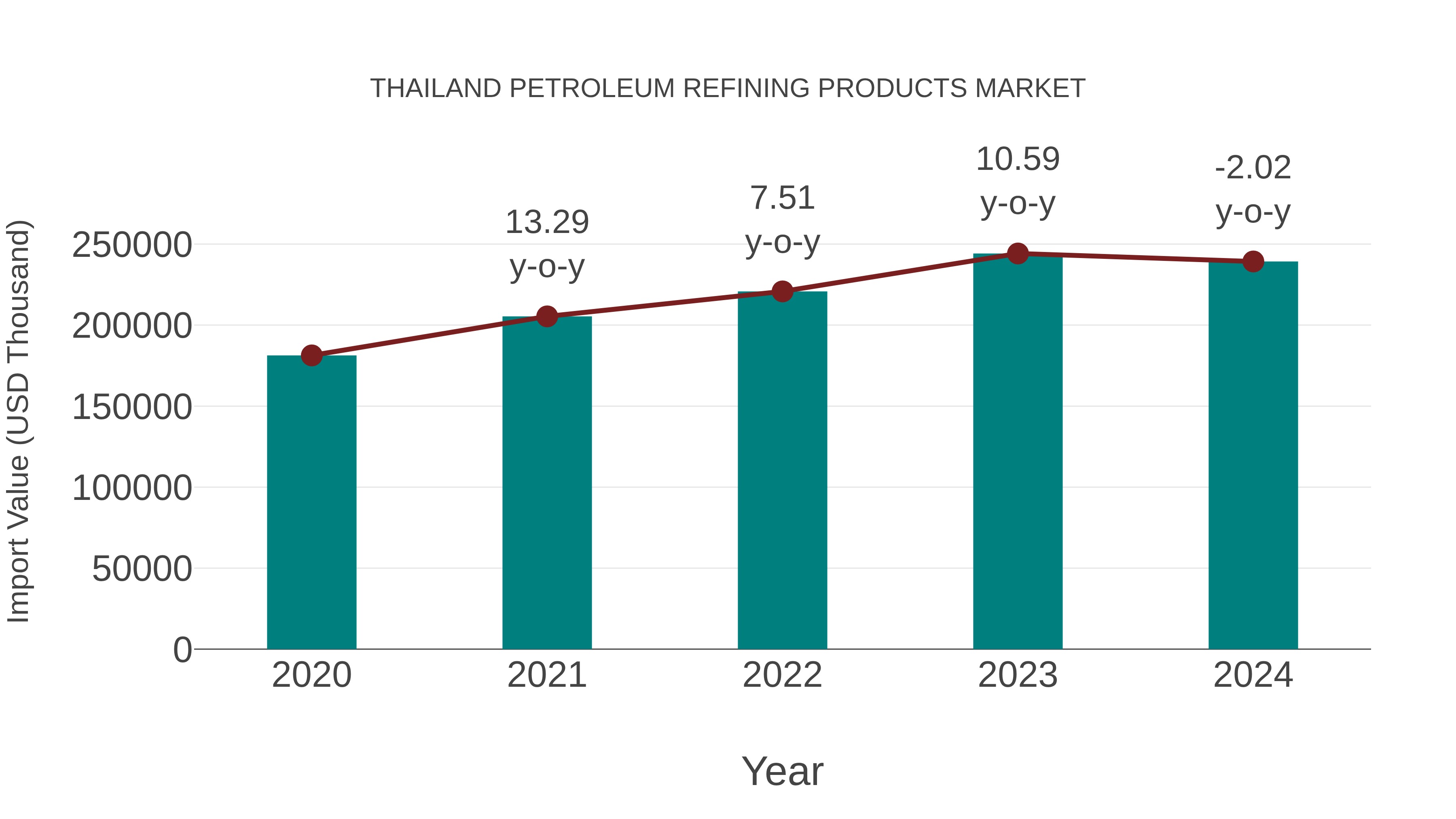
Thailand import trend for petroleum refining products experienced a -2.02% growth rate from 2023 to 2024, with a compound annual growth rate (CAGR) of 7.18% from 2020 to 2024. This decline in growth momentum may be attributed to shifts in global demand patterns or changes in trade policies affecting market stability.
Thailand Petroleum Refining Products Market Synopsis
Thailand is the second largest oil refiner in Southeast Asia and it has a well-developed network of domestic refinery products. The country???s refining sector is dominated by two state-owned firms, namely PTT (Petroleum Authority of Thailand) Public Company Limited and Thailand Oil Public Company Limited. Both the companies have an installed refining capacity of around 8 million barrels per day (bpd). Refining products such as gasoline, naphtha, diesel fuel oil and jet kerosene are widely used in Thailand for various applications like transport and industrial activities.
Market Drivers
The growth of the petroleum refining products market in Thailand can be attributed to the increased demand from end user sectors such as transportation, agriculture, manufacturing industries etc., which have fuelled the need for these products over time. Additionally, rising investments from international players towards expansion & upgradation projects are expected to drive further growth across this market landscape during 2025-2031. Moreover, with rapid urbanization & industrialization coupled with expanding energy needs due to population increase will support higher demand for refined fuels over the forecast period.
Challenges of the Market
The growth of the petroleum refining products market in Thailand can be attributed to the increased demand from end user sectors such as transportation, agriculture, manufacturing industries etc., which have fuelled the need for these products over time. Additionally, rising investments from international players towards expansion & upgradation projects are expected to drive further growth across this market landscape during 2025-2031. Moreover, with rapid urbanization & industrialization coupled with expanding energy needs due to population increase will support higher demand for refined fuels over the forecast period.
Covid-19 Impact on the Market
The outbreak of COVID - 19 pandemic has caused significant disruptions across all major industry verticals including that of Petroleum Refining Products Market in Thailand.Stringent lockdowns imposed by governments along with reduced consumer spending amid economic slowdown has resulted into fierce decline in product sales resulting into significant revenue losses during 2025-2031.However, gradual recovery is being witnessed since mid 2025 owing increasing government initiatives towards reviving business activities alongwith rebound in tourism sector .
Key Players of the Market
Key participants identified across Petroleum Refining Products marketspace include PTT (Petroleum Authority Of Thailand ) Public Company Ltd, Thailand Oil PCL, IRPC Corporation PCL, Bangchak Corporation PCL among others.
Key Highlights of the Report:
- Thailand Petroleum Refining Products Market Outlook
- Market Size of Thailand Petroleum Refining Products Market, 2025
- Forecast of Thailand Petroleum Refining Products Market, 2032
- Historical Data and Forecast of Thailand Petroleum Refining Products Revenues & Volume for the Period 2022-2032F
- Thailand Petroleum Refining Products Market Trend Evolution
- Thailand Petroleum Refining Products Market Drivers and Challenges
- Thailand Petroleum Refining Products Price Trends
- Thailand Petroleum Refining Products Porter's Five Forces
- Thailand Petroleum Refining Products Industry Life Cycle
- Historical Data and Forecast of Thailand Petroleum Refining Products Market Revenues & Volume By Type for the Period 2022-2032F
- Historical Data and Forecast of Thailand Petroleum Refining Products Market Revenues & Volume By Ethane & LPG for the Period 2022-2032F
- Historical Data and Forecast of Thailand Petroleum Refining Products Market Revenues & Volume By Gasoline for the Period 2022-2032F
- Historical Data and Forecast of Thailand Petroleum Refining Products Market Revenues & Volume By Diesel/Gasoil for the Period 2022-2032F
- Historical Data and Forecast of Thailand Petroleum Refining Products Market Revenues & Volume By Jet/Kerosene for the Period 2022-2032F
- Historical Data and Forecast of Thailand Petroleum Refining Products Market Revenues & Volume By Naphtha for the Period 2022-2032F
- Historical Data and Forecast of Thailand Petroleum Refining Products Market Revenues & Volume By Fuel Oil for the Period 2022-2032F
- Historical Data and Forecast of Thailand Petroleum Refining Products Market Revenues & Volume By Others for the Period 2022-2032F
- Historical Data and Forecast of Thailand Petroleum Refining Products Market Revenues & Volume By End-users for the Period 2022-2032F
- Historical Data and Forecast of Thailand Petroleum Refining Products Market Revenues & Volume By Transportation for the Period 2022-2032F
- Historical Data and Forecast of Thailand Petroleum Refining Products Market Revenues & Volume By Others for the Period 2022-2032F
- Thailand Petroleum Refining Products Import Export Trade Statistics
- Market Opportunity Assessment By Type
- Market Opportunity Assessment By End-users
- Thailand Petroleum Refining Products Top Companies Market Share
- Thailand Petroleum Refining Products Competitive Benchmarking By Technical and Operational Parameters
- Thailand Petroleum Refining Products Company Profiles
- Thailand Petroleum Refining Products Key Strategic Recommendations






































