Thailand Piezoelectric Devices Market Size, Share & Growth Rate
The Thailand Piezoelectric Devices Market was estimated at USD 478 Million in 2025 and is projected to reach USD 629 Million by 2032, growing at a CAGR of 4.0% from 2026 to 2032. This growth trajectory is primarily fueled by the escalating demand for advanced consumer electronics, particularly smartphones, which increasingly incorporate piezoelectric components. Additionally, investments in sectors such as defense and healthcare are further propelling the adoption of piezoelectric technology across various industries.
Thailand Piezoelectric Devices Market Year-wise Growth Rate and Key Drivers
This graph highlights how the Thailand Piezoelectric Devices Market has steadily grown over the years, supported by major growth factors.
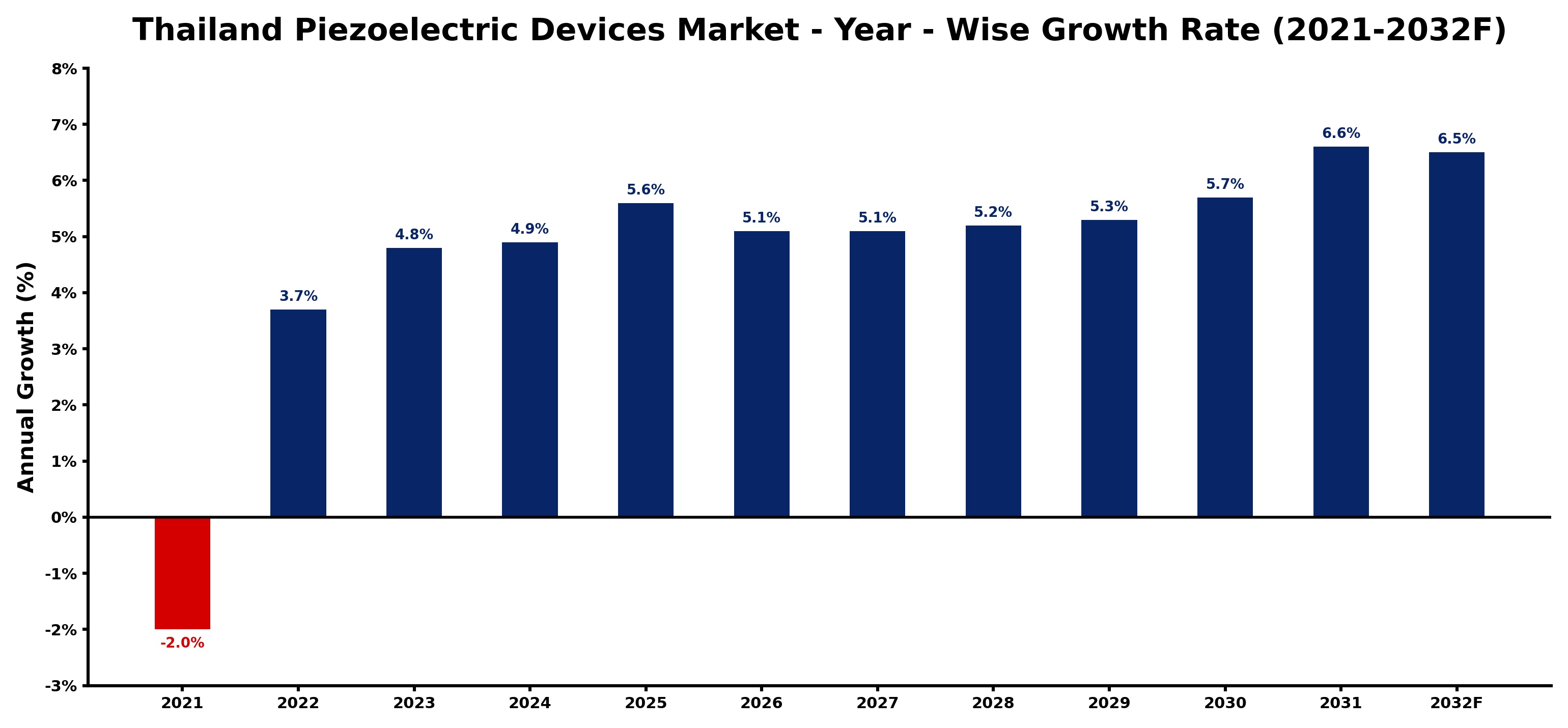
The table below presents the year‑wise growth rates along with the key drivers influencing the market
| Year | Growth Rate | Major Drivers |
| 2021 | -2.0% | Lower export volumes decreased demand for piezoelectric component production |
| 2022 | 3.7% | Reinvestment in renewable energy boosts piezoelectric device manufacturing capacity |
| 2023 | 4.8% | Foreign investment boosts piezoelectric manufacturing capacity in Thailand |
| 2024 | 4.9% | Domestic manufacturers boost piezoelectric device production for export markets |
| 2025 | 5.6% | Improved sensor technology integration boosts piezoelectric device manufacturing efficiency |
| 2026 | 5.1% | Local piezoelectric device manufacturers invest in advanced production technologies |
| 2027 | 5.1% | Domestic demand surge drives piezoelectric device manufacturing capacity expansion |
| 2028 | 5.2% | New manufacturing plants boost piezoelectric component production capabilities |
| 2029 | 5.3% | Export driven electronics demand boosts piezoelectric device production capacity |
| 2030 | 5.7% | Improved semiconductor production capacity drives piezoelectric device demand |
| 2031 | 6.6% | Technology integration enhanced manufacturing efficiency in piezoelectric device production |
| 2032 | 6.5% | Higher domestic piezoelectric manufacturing capacity boosted regional supply stability |
Note - Market size estimations and growth projections presented in this report are based on 6Wresearch’s advanced forecasting approach, validated with industry datasets as of June 2026.
Thailand Piezoelectric Devices Market Synopsis
The piezoelectric devices market in Thailand is experiencing a notable surge, fueled by technological advancements and increasing applications across sectors like automotive, aerospace, and healthcare. The unique ability of piezoelectric materials to convert mechanical energy into electrical energy makes them indispensable in modern electronic devices.
Currently, ceramic materials dominate the market, particularly in the manufacturing of acoustic transducers, which capture a significant share of revenue. As demand for precise sensing and energy-efficient solutions rises, the role of piezoelectric devices in both industrial and consumer applications continues to expand, ensuring a robust market outlook.
Thailand Piezoelectric Devices Market Key Takeaways
- Significant growth driven by the integration of piezoelectric technology in consumer electronics and defense applications.
- Energy harvesting and sensor technologies are emerging as key application areas contributing to market expansion.
- Ceramic materials are the leading choice in piezoelectric device manufacturing.
- Ongoing developments in medical technology are enhancing the market's appeal.
- Strategic collaborations and investments are anticipated to shape the future landscape of the market.
Evaluation of Restraints in Thailand Piezoelectric Devices Market
Despite the favorable growth environment, the Thailand piezoelectric devices market faces significant hurdles. The complexity of scaling production while maintaining consistent quality poses challenges for manufacturers. Moreover, achieving optimal piezoelectric properties remains a technological hurdle, requiring continuous research and development. As firms strive to integrate these devices into diverse applications at competitive costs, the need for innovation and process optimization is paramount to overcoming these restraints.
Thailand Piezoelectric Devices Market Trends
Several key trends are shaping the Thailand piezoelectric devices market landscape. The push for energy-efficient technologies across industries is driving the demand for advanced piezoelectric components. Furthermore, the increasing focus on miniaturization in electronics has led to innovations in the design and functionality of piezoelectric devices. Additionally, the rise of smart technologies, including smart homes and IoT applications, is creating further demand for efficient sensing solutions.
Thailand Piezoelectric Devices Market Opportunities
The Thailand piezoelectric devices market presents numerous opportunities for growth and investment. The increasing emphasis on renewable energy solutions opens avenues for piezoelectric technology in energy harvesting applications. Additionally, advancements in medical devices and wearable technology are likely to create a surge in demand for piezoelectric sensors, which are vital for health monitoring systems. Companies that can innovate and adapt to these emerging needs are poised to capture significant market share.
Government Initiatives in the Thailand Piezoelectric Devices Market
The Thai government is increasingly prioritizing investments in high-tech sectors, including the piezoelectric devices market. Policy initiatives aimed at fostering innovation and technological development are encouraging collaboration between industry players and research institutions. These efforts are complemented by funding programs that support research and development, paving the way for advancements in piezoelectric technology and its applications.
Future Insights of the Thailand Piezoelectric Devices Market
Looking ahead to 2026-2032, the Thailand piezoelectric devices market is expected to evolve significantly, driven by the continued demand for innovative applications in electronics, automotive, and healthcare sectors. As the push for sustainability intensifies, energy harvesting technologies utilizing piezoelectric materials will likely gain traction. Furthermore, advancements in smart technology and the Internet of Things (IoT) will create new avenues for growth, underscoring the essential role of piezoelectric devices in the future landscape of technology.
Thailand Piezoelectric Devices Market Latest Developments (May 2025 - June 2026)
Recent developments in the Thailand piezoelectric devices market have focused on enhancing product performance and integrating advanced technologies. Companies are increasingly exploring partnerships to foster innovation and develop cutting-edge applications. Additionally, there is a growing emphasis on sustainable practices in manufacturing processes, aligning with global trends towards environmental responsibility.
Thailand Piezoelectric Devices Market - Key Attractiveness of the Report
- 10 Years of Market Numbers
- Historical Data Starting from 2022 to 2025
- Base Year: 2025
- Forecast Data until 2032
- Key Performance Indicators Impacting the Market
- Major Upcoming Developments and Projects
Key Highlights of the Report:
- Thailand Piezoelectric Devices Market Outlook
- Market Size of Thailand Piezoelectric Devices Market, 2025
- Forecast of Thailand Piezoelectric Devices Market, 2032
- Historical Data and Forecast of Thailand Piezoelectric Devices Revenues & Volume for the Period 2022-2032F
- Thailand Piezoelectric Devices Market Trend Evolution
- Thailand Piezoelectric Devices Market Drivers and Challenges
- Thailand Piezoelectric Devices Price Trends
- Thailand Piezoelectric Devices Porter's Five Forces
- Thailand Piezoelectric Devices Industry Life Cycle
- Historical Data and Forecast of Thailand Piezoelectric Devices Market Revenues & Volume By Product for the Period 2022-2032F
- Historical Data and Forecast of Thailand Piezoelectric Devices Market Revenues & Volume By Piezoelectric Sensors for the Period 2022-2032F
- Historical Data and Forecast of Thailand Piezoelectric Devices Market Revenues & Volume By Piezoelectric Actuators for the Period 2022-2032F
- Historical Data and Forecast of Thailand Piezoelectric Devices Market Revenues & Volume By Piezoelectric Motors for the Period 2022-2032F
- Historical Data and Forecast of Thailand Piezoelectric Devices Market Revenues & Volume By Piezoelectric Transducers for the Period 2022-2032F
- Historical Data and Forecast of Thailand Piezoelectric Devices Market Revenues & Volume By Piezoelectric Generators for the Period 2022-2032F
- Historical Data and Forecast of Thailand Piezoelectric Devices Market Revenues & Volume By Others for the Period 2022-2032F
- Historical Data and Forecast of Thailand Piezoelectric Devices Market Revenues & Volume By Material for the Period 2022-2032F
- Historical Data and Forecast of Thailand Piezoelectric Devices Market Revenues & Volume By Piezoelectric Crystals for the Period 2022-2032F
- Historical Data and Forecast of Thailand Piezoelectric Devices Market Revenues & Volume By Piezoelectric Ceramics for the Period 2022-2032F
- Historical Data and Forecast of Thailand Piezoelectric Devices Market Revenues & Volume By Piezoelectric Polymers for the Period 2022-2032F
- Historical Data and Forecast of Thailand Piezoelectric Devices Market Revenues & Volume By Piezoelectric Composites for the Period 2022-2032F
- Historical Data and Forecast of Thailand Piezoelectric Devices Market Revenues & Volume By Application for the Period 2022-2032F
- Historical Data and Forecast of Thailand Piezoelectric Devices Market Revenues & Volume By Aerospace & Defense for the Period 2022-2032F
- Historical Data and Forecast of Thailand Piezoelectric Devices Market Revenues & Volume By Industrial & Manufacturing for the Period 2022-2032F
- Historical Data and Forecast of Thailand Piezoelectric Devices Market Revenues & Volume By Automotive for the Period 2022-2032F
- Historical Data and Forecast of Thailand Piezoelectric Devices Market Revenues & Volume By Healthcare for the Period 2022-2032F
- Historical Data and Forecast of Thailand Piezoelectric Devices Market Revenues & Volume By Information & Communication for the Period 2022-2032F
- Historical Data and Forecast of Thailand Piezoelectric Devices Market Revenues & Volume By Consumer Electronics for the Period 2022-2032F
- Historical Data and Forecast of Thailand Piezoelectric Devices Market Revenues & Volume By Others for the Period 2022-2032F
- Thailand Piezoelectric Devices Import Export Trade Statistics
- Market Opportunity Assessment By Product
- Market Opportunity Assessment By Material
- Market Opportunity Assessment By Application
- Thailand Piezoelectric Devices Top Companies Market Share
- Thailand Piezoelectric Devices Competitive Benchmarking By Technical and Operational Parameters
- Thailand Piezoelectric Devices Company Profiles
- Thailand Piezoelectric Devices Key Strategic Recommendations






































