Thailand Piston Rings Market: Import Trend Analysis
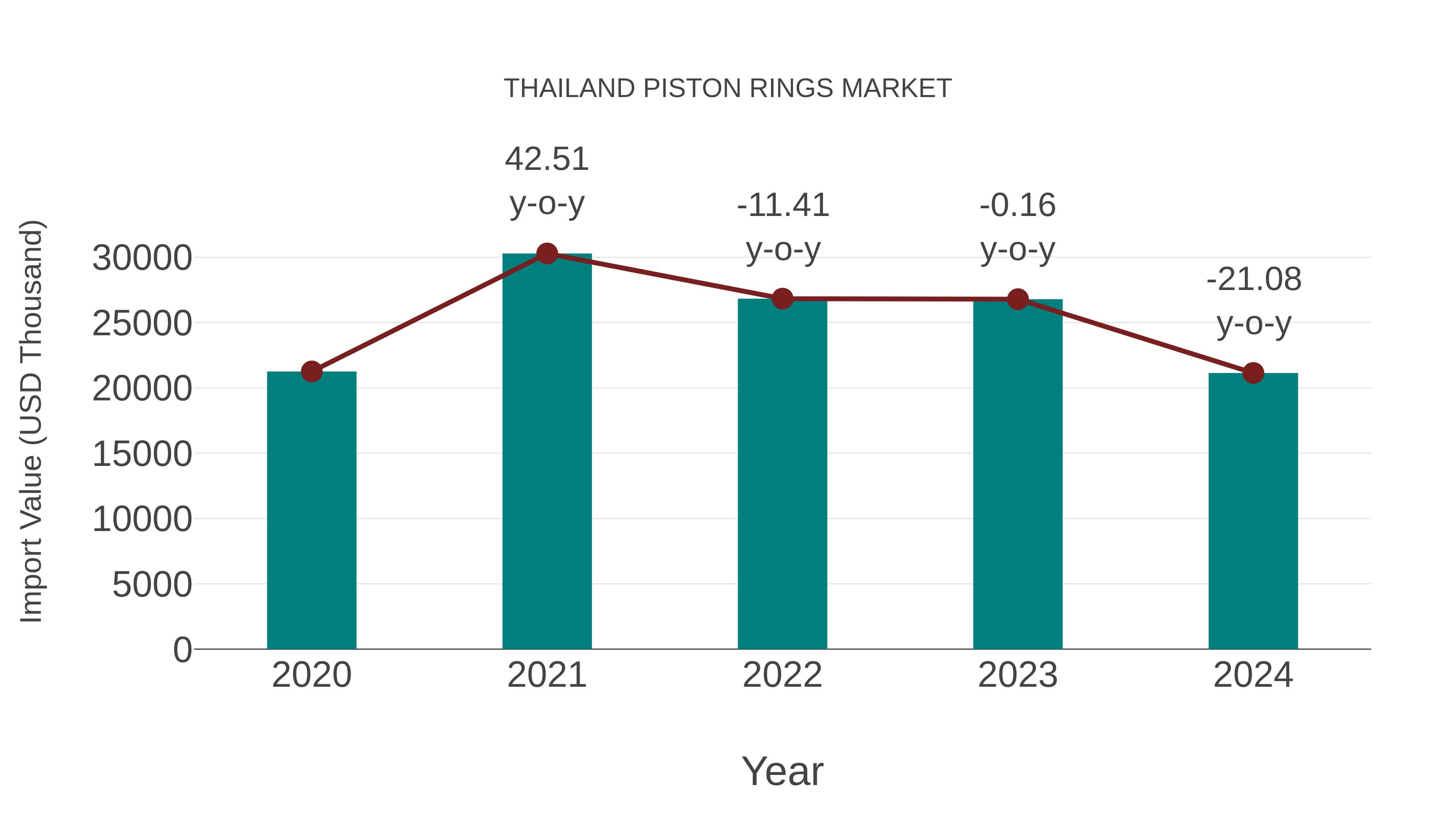
Thailand import trend for the piston rings market experienced a decline, with a growth rate of -21.08% from 2023 to 2024 and a CAGR of -0.13% for 2020-2024. This negative momentum could be attributed to shifting demand dynamics or changes in trade policies impacting market stability.
Thailand Piston Rings Market Synopsis
The Thailand Piston Rings market caters to the automotive and machinery sectors. Piston rings are essential components that maintain proper engine compression and prevent oil leakage in combustion engines. The market`s performance is closely linked to the automotive industry`s trends, with growth driven by factors such as vehicle production and maintenance demand.
Drivers of the Market
The Thailand Piston Rings Market has been driven by several factors. Firstly, the automotive industry in Thailand has experienced significant growth, with the country being a major manufacturing hub in Southeast Asia. Piston rings are critical components in automotive engines, and the increasing production of vehicles has driven demand for these parts. Additionally, advancements in engine technology have led to the development of more efficient and high-performance piston rings, further boosting their adoption. Moreover, the growth of the aftermarket sector, driven by the need for maintenance and replacement parts, has contributed to the market`s expansion. Furthermore, exports of automotive components have played a significant role in the market`s growth, as Thai manufacturers supply piston rings to international markets.
Challenges of the Market
The challenge in the piston rings market lies in delivering high-quality products that can withstand the demands of various industries, including automotive and manufacturing. Ensuring that these products meet international standards is vital for market competitiveness.
COVID-19 Impact on the Market
The Thailand Piston Rings Market faced challenges as the automotive industry, a primary user of piston rings, experienced a sharp decline in sales during the pandemic. Lockdowns and economic uncertainties led to reduced consumer spending on automobiles. Additionally, global supply chain disruptions affected the availability of components. As consumer confidence and automobile production gradually recovered, the market for piston rings began to stabilize.
Key Players in the Market
The Thailand piston rings market is characterized by a competitive landscape with notable players such as PQR Automotive Components, MNO Engine Parts Ltd., and RST Piston Rings Co. Ltd. These companies have established themselves as reliable suppliers of piston rings, offering a wide range of products that cater to the automotive and industrial sectors. Their dedication to delivering top-notch quality and constant innovation sets them apart in this market.
Key Highlights of the Report:
- Thailand Piston Rings Market Outlook
- Market Size of Thailand Piston Rings Market, 2025
- Forecast of Thailand Piston Rings Market, 2032
- Historical Data and Forecast of Thailand Piston Rings Revenues & Volume for the Period 2022-2032F
- Thailand Piston Rings Market Trend Evolution
- Thailand Piston Rings Market Drivers and Challenges
- Thailand Piston Rings Price Trends
- Thailand Piston Rings Porter's Five Forces
- Thailand Piston Rings Industry Life Cycle
- Historical Data and Forecast of Thailand Piston Rings Market Revenues & Volume By Product for the Period 2022-2032F
- Historical Data and Forecast of Thailand Piston Rings Market Revenues & Volume By Gray Cast Iron for the Period 2022-2032F
- Historical Data and Forecast of Thailand Piston Rings Market Revenues & Volume By Ductile Iron for the Period 2022-2032F
- Historical Data and Forecast of Thailand Piston Rings Market Revenues & Volume By SAE 9254 Steel for the Period 2022-2032F
- Historical Data and Forecast of Thailand Piston Rings Market Revenues & Volume By Application for the Period 2022-2032F
- Historical Data and Forecast of Thailand Piston Rings Market Revenues & Volume By Passenger Cars for the Period 2022-2032F
- Historical Data and Forecast of Thailand Piston Rings Market Revenues & Volume By LCV for the Period 2022-2032F
- Historical Data and Forecast of Thailand Piston Rings Market Revenues & Volume By HCV for the Period 2022-2032F
- Historical Data and Forecast of Thailand Piston Rings Market Revenues & Volume By SUVs for the Period 2022-2032F
- Historical Data and Forecast of Thailand Piston Rings Market Revenues & Volume By ports Cars for the Period 2022-2032F
- Historical Data and Forecast of Thailand Piston Rings Market Revenues & Volume By Two Wheelers for the Period 2022-2032F
- Historical Data and Forecast of Thailand Piston Rings Market Revenues & Volume By Cranes/Earth Movers for the Period 2022-2032F
- Thailand Piston Rings Import Export Trade Statistics
- Market Opportunity Assessment By Product
- Market Opportunity Assessment By Application
- Thailand Piston Rings Top Companies Market Share
- Thailand Piston Rings Competitive Benchmarking By Technical and Operational Parameters
- Thailand Piston Rings Company Profiles
- Thailand Piston Rings Key Strategic Recommendations






































