Thailand Planting Equipment Market Size, Share & Growth Rate
The Thailand Planting Equipment Market was estimated at USD 139 Million in 2025 and is projected to reach USD 159 Million by 2032, growing at a CAGR of 1.9% from 2026 to 2032. This growth trajectory is largely fueled by the increasing mechanization of agriculture in Thailand, where farmers are progressively adopting advanced planting technologies to enhance efficiency. Moreover, the ongoing diversification of crop production necessitates specialized equipment tailored to specific agricultural demands.
Thailand Planting Equipment Market Year-wise Growth Rate and Key Drivers
This graph highlights how the Thailand Planting Equipment Market has steadily grown over the years, supported by major growth factors.
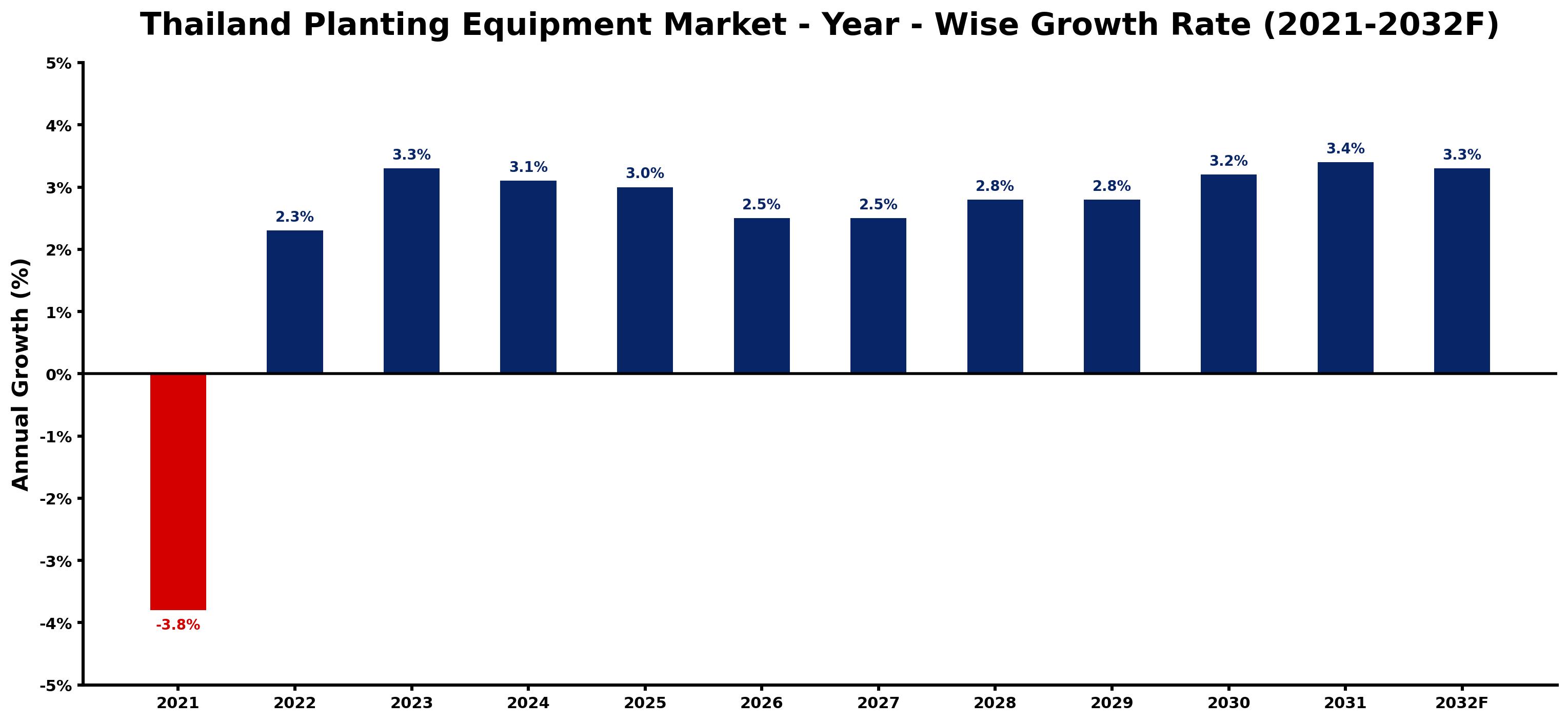
The table below presents the year‑wise growth rates along with the key drivers influencing the market
| Year | Growth Rate | Major Drivers |
| 2021 | -3.8% | Increasing industrial automation investments |
| 2022 | 2.3% | Expansion of manufacturing activities |
| 2023 | 3.3% | Growing renewable energy integration projects |
| 2024 | 3.1% | Expansion of commercial construction activities |
| 2025 | 3.0% | Government infrastructure modernization initiatives |
| 2026 | 2.5% | Growing urbanization and commercial development |
| 2027 | 2.5% | Increasing adoption of advanced technologies |
| 2028 | 2.8% | Expansion of commercial construction activities |
| 2029 | 2.8% | Growing urbanization and commercial development |
| 2030 | 3.2% | Increasing smart city development projects |
| 2031 | 3.4% | Rising electricity demand across industries |
| 2032 | 3.3% | Growing renewable energy integration projects |
Note - Market size estimations and growth projections presented in this report are based on 6Wresearch’s advanced forecasting approach, validated with industry datasets as of June 2026.
Thailand Planting Equipment Market Synopsis
The driving force in the Thailand Planting Equipment Market is the robust growth of the agriculture sector, which remains a cornerstone of the national economy. The push for mechanization and modern farming practices continues to reshape the landscape, enabling farmers to achieve higher productivity and operational efficiency.
As agricultural practices evolve, so does the need for innovative planting equipment capable of supporting diverse crop varieties. This evolution not only enhances planting accuracy but also addresses labor shortages, making it imperative for farmers to invest in modern machinery.
Thailand Planting Equipment Market Key Takeaways
- The Thailand planting equipment market is experiencing a gradual shift towards mechanization, driven by the need for increased efficiency.
- Technological advancements are leading to the development of specialized planting equipment tailored to different crops.
- Financial accessibility remains a challenge for many small-scale farmers, affecting their ability to invest in modern equipment.
- Government initiatives are crucial in providing support and resources to enhance training and access to planting technologies.
- The impact of the Covid-19 pandemic is still being felt, particularly in supply chain disruptions and investment hesitancy.
Evaluation of Restraints in Thailand Planting Equipment Market
While the market holds significant potential, several constraints impede its growth. One of the primary barriers is the high cost of planting equipment, which often discourages small-scale farmers from making necessary investments. Limited access to financial resources or credit facilities further complicates this issue, as many farmers struggle to secure funding for advanced machinery. Additionally, inadequate training and support for utilizing modern planting technologies can inhibit effective usage, particularly in rural areas where resources are scarce.
Thailand Planting Equipment Market Trends
Current trends in the Thailand Planting Equipment Market highlight a growing focus on precision agriculture. Farmers are increasingly integrating GPS and IoT technologies into their planting processes, resulting in enhanced accuracy and reduced waste. Moreover, the rise of sustainable farming practices has prompted the development of environmentally friendly planting equipment that reduces soil disturbance and promotes soil health. The demand for automation in planting processes is also on the rise, reflecting a broader shift toward efficiency and productivity in the agricultural sector.
Thailand Planting Equipment Market Opportunities
The Thailand Planting Equipment Market presents ample opportunities for growth, particularly in the realm of product innovation. With a strong emphasis on crop diversification, manufacturers can explore the creation of specialized planting equipment designed to meet the unique requirements of various crops. Additionally, as farmers increasingly seek to modernize their operations, the market is ripe for investment in new technologies that enhance planting efficiency and effectiveness. Training programs aimed at educating farmers about the latest planting equipment will also create opportunities for service providers.
Government Initiatives in the Thailand Planting Equipment Market
The Thai government plays a pivotal role in supporting the agriculture sector, which extends to the planting equipment market. Various initiatives are aimed at promoting mechanization and efficiency through subsidies, grants, and training programs for farmers. Public spending on rural development projects often includes investments in agricultural machinery, ensuring that farmers gain access to modern tools and technologies. These initiatives are vital for fostering a conducive environment for growth and innovation within the sector.
Future Insights of the Thailand Planting Equipment Market
Looking ahead to 2026-2032, the Thailand Planting Equipment Market is poised for steady growth as the agriculture sector continues to embrace mechanization. The increasing adoption of technology will likely enhance planting accuracy, further driving demand for specialized equipment. As challenges related to labor shortages and environmental sustainability gain prominence, the market will evolve to address these concerns, paving the way for innovative solutions that will ultimately transform planting practices in Thailand.
Thailand Planting Equipment Market Latest Developments (May 2025 - June 2026)
Recent developments in the Thailand Planting Equipment Market indicate a surge in interest towards automation technologies. Innovations in planting machinery that incorporate advanced data analytics and machine learning are gaining traction among farmers looking to optimize their yield. Additionally, collaborative efforts between government bodies and agricultural firms have emerged, aimed at enhancing farmer access to financing for modern equipment. Supply chain improvements have been observed as companies strive to mitigate disruptions experienced during the Covid-19 pandemic, fostering a more resilient market environment.
Thailand Planting Equipment Market - Key Attractiveness of the Report
- 10 Years of Market Numbers
- Historical Data Starting from 2022 to 2025
- Base Year: 2025
- Forecast Data until 2032
- Key Performance Indicators Impacting the Market
- Major Upcoming Developments and Projects
Key Highlights of the Report:
- Thailand Planting Equipment Market Outlook
- Market Size of Thailand Planting Equipment Market, 2025
- Forecast of Thailand Planting Equipment Market, 2032
- Historical Data and Forecast of Thailand Planting Equipment Revenues & Volume for the Period 2022-2032F
- Thailand Planting Equipment Market Trend Evolution
- Thailand Planting Equipment Market Drivers and Challenges
- Thailand Planting Equipment Price Trends
- Thailand Planting Equipment Porter's Five Forces
- Thailand Planting Equipment Industry Life Cycle
- Historical Data and Forecast of Thailand Planting Equipment Market Revenues & Volume By Type for the Period 2022-2032F
- Historical Data and Forecast of Thailand Planting Equipment Market Revenues & Volume By Air seeders for the Period 2022-2032F
- Historical Data and Forecast of Thailand Planting Equipment Market Revenues & Volume By Seed drills for the Period 2022-2032F
- Historical Data and Forecast of Thailand Planting Equipment Market Revenues & Volume By Planters for the Period 2022-2032F
- Historical Data and Forecast of Thailand Planting Equipment Market Revenues & Volume By Others for the Period 2022-2032F
- Historical Data and Forecast of Thailand Planting Equipment Market Revenues & Volume By Design for the Period 2022-2032F
- Historical Data and Forecast of Thailand Planting Equipment Market Revenues & Volume By Mechanical for the Period 2022-2032F
- Historical Data and Forecast of Thailand Planting Equipment Market Revenues & Volume By Automatic for the Period 2022-2032F
- Historical Data and Forecast of Thailand Planting Equipment Market Revenues & Volume By Crop Type for the Period 2022-2032F
- Historical Data and Forecast of Thailand Planting Equipment Market Revenues & Volume By Cereals & grains for the Period 2022-2032F
- Historical Data and Forecast of Thailand Planting Equipment Market Revenues & Volume By Oilseeds & pulses for the Period 2022-2032F
- Historical Data and Forecast of Thailand Planting Equipment Market Revenues & Volume By Fruits & vegetables for the Period 2022-2032F
- Historical Data and Forecast of Thailand Planting Equipment Market Revenues & Volume By Others for the Period 2022-2032F
- Thailand Planting Equipment Import Export Trade Statistics
- Market Opportunity Assessment By Type
- Market Opportunity Assessment By Design
- Market Opportunity Assessment By Crop Type
- Thailand Planting Equipment Top Companies Market Share
- Thailand Planting Equipment Competitive Benchmarking By Technical and Operational Parameters
- Thailand Planting Equipment Company Profiles
- Thailand Planting Equipment Key Strategic Recommendations






































