Thailand Platform as a Service (PaaS) Market Size & Growth Rate (2026-2032)
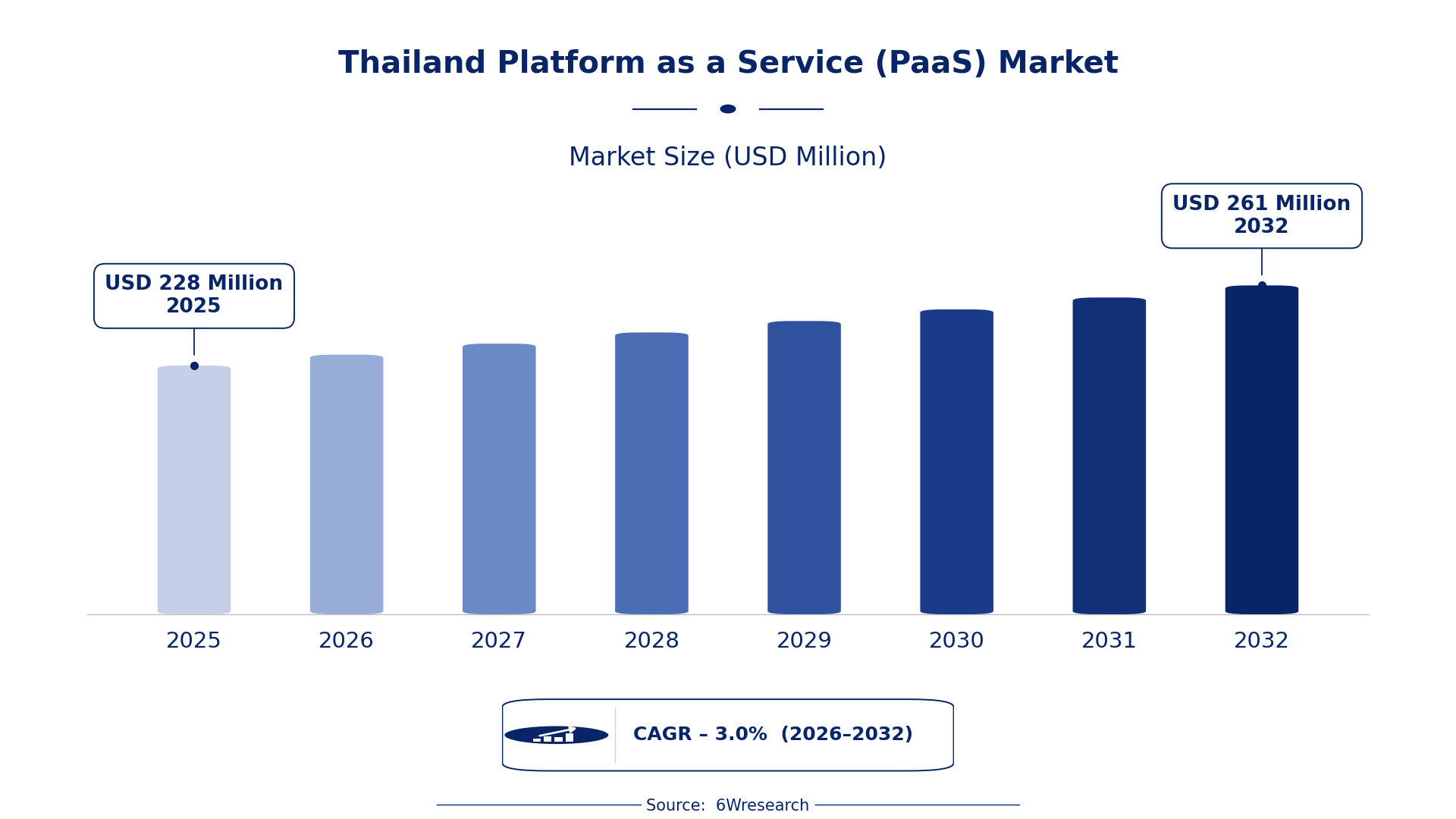
The Thailand Platform as a Service (PaaS) Market was estimated at USD 228 Million in 2025 and is projected to reach USD 261 Million by 2032, growing at a CAGR of 3.0% from 2026 to 2032.
Thailand Platform as a Service (PaaS) Market Synopsis
The Thailand Platform as a Service (PaaS) market is currently experiencing a notable shift as businesses increasingly adopt cloud technologies. This trend reflects a broader movement towards more efficient application development and deployment processes that can significantly reduce time-to-market.
With organizations prioritizing rapid application development, the demand for PaaS solutions is surging. Companies are looking for platforms that not only simplify the development cycle but also support scalability and innovation in a competitive landscape.
Thailand Platform as a Service (PaaS) Market Year-wise Growth Rate and Key Drivers
This graph illustrates the annual growth rates of the Thailand Platform as a Service (PaaS) Market from 2021 to 2032, highlighting a steady upward trajectory and projected expansion over the forecast period.
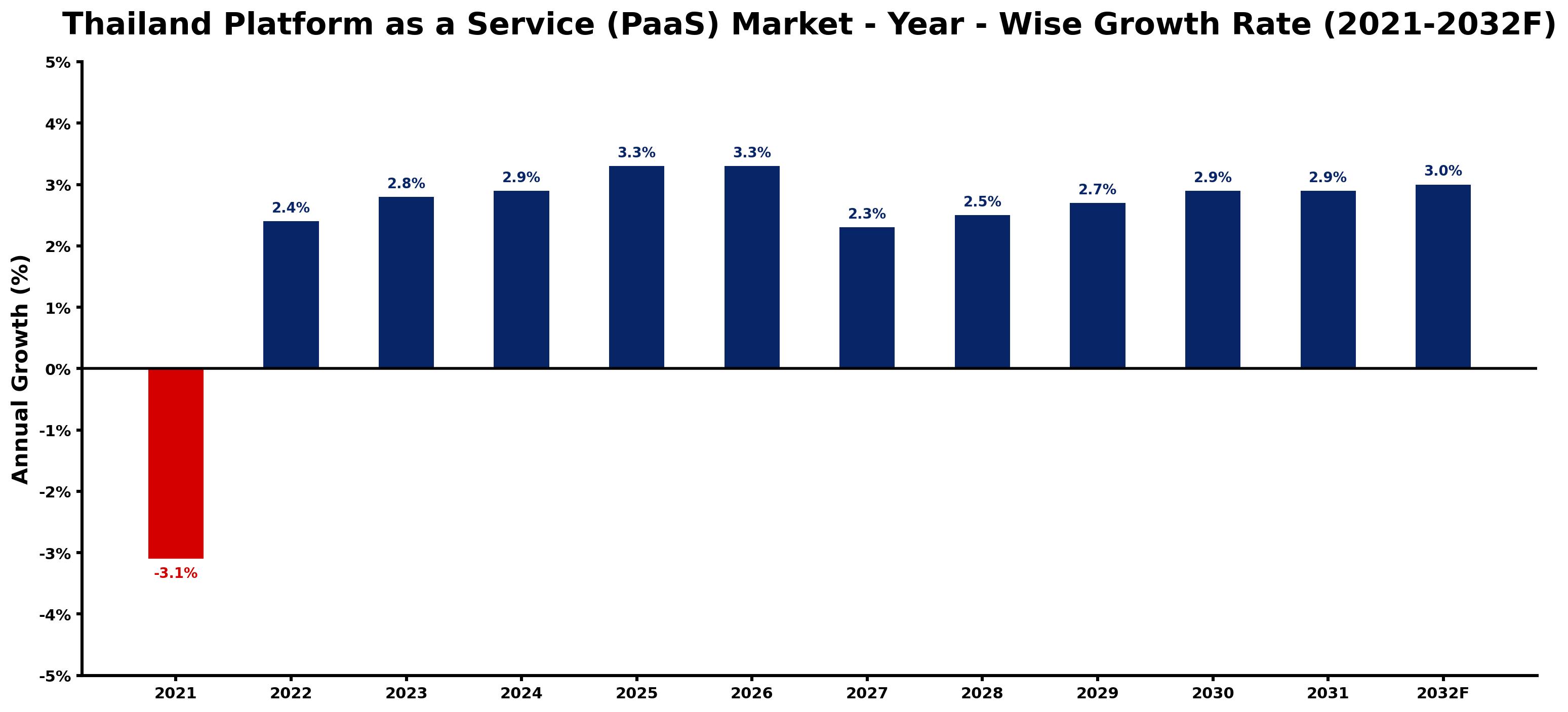
The table below presents the year‑wise growth rates along with the key drivers influencing the market
| Year | Growth Rate | Major Drivers |
| 2021 | -3.1% | Tough competition from local providers like Builk.com |
| 2022 | 2.4% | Thailand's digital economy plan boosts cloud adoption. |
| 2023 | 2.8% | Increased investments in fintech drive PaaS usage. |
| 2024 | 2.9% | Government initiatives support smart city technology integration. |
| 2025 | 3.3% | Growing local startup ecosystem demands scalable solutions. |
| 2026 | 3.3% | Digital transformation strategies enhance enterprise cloud platforms. |
| 2027 | 2.3% | Emerging AI technologies influence application development. |
| 2028 | 2.5% | e-Government initiatives propel platform integration across sectors. |
| 2029 | 2.7% | Rising cybersecurity regulations encourage secure PaaS environments. |
| 2030 | 2.9% | 5G rollout encourages innovative cloud-based applications. |
| 2031 | 2.9% | Economic recovery post-pandemic boosts technology investments. |
| 2032 | 3.0% | PaaS solutions enhance operational efficiency in Thai businesses. |
Note: Market size estimations and growth projections presented in this report are based on 6Wresearch's proprietary forecasting methodology, utilizing the latest available industry data, government publications, and primary research inputs.
Thailand Platform as a Service (PaaS) Market Key Takeaways
Below are some of the specific key takeaways from the market, including:
- The market is driven by the shift towards cloud-native applications and agile development practices.
- PaaS solutions help mitigate the complexities of infrastructure management, appealing to developers and businesses.
- Customization demands are challenging providers to balance flexibility with standardization.
- COVID-19 has accelerated the adoption of cloud-based development solutions in Thailand.
- Major players are enhancing their offerings to meet the evolving needs of Thai businesses.
Evaluation of Restraints in Thailand Platform as a Service (PaaS) Market
The Thailand PaaS market faces several constraints that could limit growth. One of the prominent issues is the diverse customization needs of businesses, which complicates the standardization of development environments. Companies often require tailored solutions that address specific operational challenges. This necessity for customization can lead to increased costs and longer deployment times, making it difficult for providers to offer a one-size-fits-all solution. Balancing flexibility with the need for standardized offerings is crucial for market players to satisfy a broader range of customer demands.
Thailand Platform as a Service (PaaS) Market Trends
The market is witnessing several trends that are shaping demand and technology. The rise of low-code and no-code platforms is making it easier for non-technical users to develop applications, thereby broadening the user base. This democratization of application development is fostering innovation across various sectors.
Another trend is the increasing importance of cloud-native architectures. Companies are migrating legacy applications to cloud platforms, which enhances agility and operational efficiency. As organizations prioritize digital transformation, the need for PaaS solutions will continue to grow.
Thailand Platform as a Service (PaaS) Market Opportunities
The PaaS market in Thailand presents numerous growth opportunities. Industries such as finance, healthcare, and retail are increasingly looking for robust solutions to enhance their digital capabilities. The demand for integrated tools that support application development, testing, and deployment is rising.
on top of that, as businesses focus on innovation and efficiency, the introduction of AI-driven development tools within PaaS solutions is likely to attract significant interest. Providers that can offer enhanced analytics and machine learning capabilities will be well-positioned to capture market share.
Government Initiatives in the Thailand Platform as a Service (PaaS) Market
Government policy is increasingly influencing the Thailand PaaS market, as public initiatives aim to foster a conducive environment for digital transformation. The Thai government is prioritizing technological advancements, which directly impacts the cloud computing sector. Supportive regulations and investments in digital infrastructure are essential to encourage PaaS adoption among businesses.
- A national digital infrastructure upgrade programme, recently launched, aims to enhance cloud connectivity across Thailand.
- A regulatory framework introduced in 2025 is expected to improve billing transparency for cloud services, enhancing trust among businesses.
- Currently, an initiative is underway to promote digital literacy and cloud adoption within SMEs, focusing on training and resource allocation.
- A planned public-private partnership aims to expand telecom infrastructure access by 2028, facilitating better cloud service delivery.
Future Insights of the Thailand Platform as a Service (PaaS) Market
Looking ahead to 2026-2032, the Thailand PaaS market is set to evolve significantly. The shift toward more sophisticated cloud solutions will likely drive continued growth, particularly as businesses seek to enhance operational efficiencies and innovate rapidly. The interplay between advanced technologies, such as AI and machine learning, within PaaS offerings will be a focal point for both developers and users. As organizations increasingly embrace digital transformation, the demand for adaptive and powerful PaaS solutions will remain strong.
Thailand Platform as a Service (PaaS) Market Latest Developments
Recent developments in the Thailand PaaS market indicate a vibrant and dynamic industry. Over the past year, various companies have intensified their efforts to innovate and expand their offerings. This period has seen a heightened focus on cloud-based solutions as businesses adapt to changing operational requirements.
- A leading technology vendor launched a new low-code development platform in early 2025, aimed at accelerating application development for businesses.
- An initiative that began in mid-2025 is currently underway, focusing on integrating AI capabilities into existing PaaS solutions.
- A rollout expected to begin in Q3 2025 will introduce enhanced security features across PaaS platforms, addressing growing concerns over data protection.
- A strategic partnership between cloud service providers was announced in late 2025, aimed at streamlining access to PaaS solutions for SMEs.
Thailand Platform as a Service (PaaS) Market - Key Attractiveness of the Report
- 10 Years of Market Numbers
- Historical Data Starting from 2022 to 2025
- Base Year: 2025
- Forecast Data until 2032
- Key Performance Indicators Impacting the Market
- Major Upcoming Developments and Projects
Key Highlights of the Report:
- Thailand Platform as a Service (PaaS) Market Outlook
- Market Size of Thailand Platform as a Service (PaaS) Market, 2025
- Forecast of Thailand Platform as a Service (PaaS) Market, 2032
- Historical Data and Forecast of Thailand Platform as a Service (PaaS) Revenues & Volume for the Period 2022-2032F
- Thailand Platform as a Service (PaaS) Market Trend Evolution
- Thailand Platform as a Service (PaaS) Market Drivers and Challenges
- Thailand Platform as a Service (PaaS) Price Trends
- Thailand Platform as a Service (PaaS) Porter's Five Forces
- Thailand Platform as a Service (PaaS) Industry Life Cycle
- Historical Data and Forecast of Thailand Platform as a Service (PaaS) Market Revenues & Volume By Type for the Period 2022-2032F
- Historical Data and Forecast of Thailand Platform as a Service (PaaS) Market Revenues & Volume By Application PaaS (aPaaS) for the Period 2022-2032F
- Historical Data and Forecast of Thailand Platform as a Service (PaaS) Market Revenues & Volume By Integration PaaS (iPaaS) for the Period 2022-2032F
- Historical Data and Forecast of Thailand Platform as a Service (PaaS) Market Revenues & Volume By Database PaaS (dbPaaS) for the Period 2022-2032F
- Historical Data and Forecast of Thailand Platform as a Service (PaaS) Market Revenues & Volume By Others for the Period 2022-2032F
- Historical Data and Forecast of Thailand Platform as a Service (PaaS) Market Revenues & Volume By Deployment for the Period 2022-2032F
- Historical Data and Forecast of Thailand Platform as a Service (PaaS) Market Revenues & Volume By Public for the Period 2022-2032F
- Historical Data and Forecast of Thailand Platform as a Service (PaaS) Market Revenues & Volume By Private for the Period 2022-2032F
- Historical Data and Forecast of Thailand Platform as a Service (PaaS) Market Revenues & Volume By Market Type for the Period 2022-2032F
- Historical Data and Forecast of Thailand Platform as a Service (PaaS) Market Revenues & Volume By APaaS for the Period 2022-2032F
- Historical Data and Forecast of Thailand Platform as a Service (PaaS) Market Revenues & Volume By IPaaS for the Period 2022-2032F
- Historical Data and Forecast of Thailand Platform as a Service (PaaS) Market Revenues & Volume By DBPaaS for the Period 2022-2032F
- Historical Data and Forecast of Thailand Platform as a Service (PaaS) Market Revenues & Volume By Organization Size for the Period 2022-2032F
- Historical Data and Forecast of Thailand Platform as a Service (PaaS) Market Revenues & Volume By Large Enterprises for the Period 2022-2032F
- Historical Data and Forecast of Thailand Platform as a Service (PaaS) Market Revenues & Volume By SMEs for the Period 2022-2032F
- Historical Data and Forecast of Thailand Platform as a Service (PaaS) Market Revenues & Volume By Vertical for the Period 2022-2032F
- Historical Data and Forecast of Thailand Platform as a Service (PaaS) Market Revenues & Volume By BFSI for the Period 2022-2032F
- Historical Data and Forecast of Thailand Platform as a Service (PaaS) Market Revenues & Volume By Consumer goods and retail for the Period 2022-2032F
- Historical Data and Forecast of Thailand Platform as a Service (PaaS) Market Revenues & Volume By Telecommunication for the Period 2022-2032F
- Historical Data and Forecast of Thailand Platform as a Service (PaaS) Market Revenues & Volume By IT and ITeS for the Period 2022-2032F
- Historical Data and Forecast of Thailand Platform as a Service (PaaS) Market Revenues & Volume By Manufacturing for the Period 2022-2032F
- Historical Data and Forecast of Thailand Platform as a Service (PaaS) Market Revenues & Volume By Healthcare and life sciences for the Period 2022-2032F
- Historical Data and Forecast of Thailand Platform as a Service (PaaS) Market Revenues & Volume By Energy and utility for the Period 2022-2032F
- Historical Data and Forecast of Thailand Platform as a Service (PaaS) Market Revenues & Volume By Others for the Period 2022-2032F
- Thailand Platform as a Service (PaaS) Import Export Trade Statistics
- Market Opportunity Assessment By Type
- Market Opportunity Assessment By Deployment
- Market Opportunity Assessment By Market Type
- Market Opportunity Assessment By Organization Size
- Market Opportunity Assessment By Vertical
- Thailand Platform as a Service (PaaS) Top Companies Market Share
- Thailand Platform as a Service (PaaS) Competitive Benchmarking By Technical and Operational Parameters
- Thailand Platform as a Service (PaaS) Company Profiles
- Thailand Platform as a Service (PaaS) Key Strategic Recommendations






































